The Lightning Catcher

Alfie has noticed a few things since his family moved to Folding Ford. He really misses life in the city. He and his sister don’t exactly fit in here. But the most interesting one is that the weather is BONKERS. One frost-covered branch on one tree in the middle of June? A tiny whirlwind in a bucket in the garden? Only in Folding Ford.

Armed with his bike, a notepad and his new best mate Sam, Alfie is going to investigate. His best clue is Nathaniel Clemm … the only thing in town weirder than the weather. When Alfie ‘investigates’ Mr Clemm’s garden, only SLIGHTLY illegally, he finds a strange box that freezes his trainers and makes his teeth tingle. And when he opens it, only SLIGHTLY deliberately, SOMETHING gets out. Something fast, fizzing and sparking with electricity and very, very much alive. But the creature from the box brings trouble of its own, and as barometers and tempers go haywire in Folding Ford, Alfie finds himself at the centre of a perfect storm.
Skellig meets Stranger Things in this funny, heartfelt adventure story perfect for fans of Ross Welford, Christopher Edge and Frank Cottrell Boyce.

Bloomsbury
Cover illustration by Paddy Donnelly

I loved THE LIGHNTING CATCHER! An absolutely brilliant debut, really imaginative sci-fi for MG+ with brilliant characters and some unexpected turns. I asked Clare Weze some questions and her answers are wonderfully insightful, so I’m not going to say anything else (except that: if you have the opportunity to invite an author in to do a creative writing session, I love her idea and want to come along)!

What gave you the idea of creating living weather (basically) for a story?

This is such a lovely question, because from an early age I’ve loved weather, so I was probably waiting for an opportunity to use inspiration arising from our own increasingly bizarre weather. But the idea came to me in stages rather than all at once. The isolation of the setting (based on aspects of the house I live in now) encouraged wild and unpredictable weather, but it wasn’t until I had the character that things started to gel. Because he was a curious, intrepid and somewhat contrary character, he went trespassing. The plot couldn’t have unfolded in my mind without that event, because it set off a unique chain. When he opened that box and let something loose, it gave me the perfect opportunity to have a creature that created its own weather systems. So rather than reverse-engineer a situation that would suit a creature like that, everything grew organically from playing around with a character in a setting.

Did you always intend to write for a middle grade audience, or did Alfie and the plot evolve that way?

The middle grade age has always been my favourite, not only to write for but to engage with in all ways. I particularly enjoyed being with my own children at that age. Pre-teens have such clever and original ideas, and their language use is funny and inspiring. And of all the ages I’ve been myself, that age felt the most magical in terms of the possibilities of the world, and even the universe. You get glimpses of what certain aspects of the natural world and the world of people might mean, but you don’t always get the full facts, so your mind joins the dots and comes up with something new and fun (even if it’s sometimes completely wrong!). That’s why that age felt, to me, like really living your best life. Perhaps when we’re that age, we carry that sense of ‘living in the moment’ into the worlds we inhabit when we read a book, and that’s why middle grade books feel so real and plausible to their readers.  

I find middle grade writing very freeing in terms of what can be explored. As long as you clarify things and don’t let the plot hang around, the sky’s the limit. Ordinary things can be explored afresh, and when they’re put next to extraordinary things, something new and exciting arrives.

Which is your favourite of Clemm’s menagerie?

I need two favourites, please! Lysander the hornbill is curious and cheeky, and he taps into Lily’s mood so perfectly, but I also have a big soft spot for Julia, the accidentally hairless cat. I also love the fact that Clemm has sacrificed almost everything for his conservation cause. His farm is falling down around his ears because instead of working hard to build up his finances, he’s been abroad looking for animals in distress.

Towards the end it takes quite a dark turn, with Alfie having been mistrusted by the “locals” in the small village the family have moved to, without overtly telling the reader that he was stereotyped because of his race. What led you to not be explicit about tension being caused by racism?

A lot of racism these days is covert and consists of gaslighting, so I thinks it’s fitting for the suspicions circling Alfie to follow this zeitgeist. I didn’t want to centre this particular book around race explicitly – to give it top billing – because Alfie’s exciting adventure is the main event.

It’s always nice to leave a few gaps between the lines so readers can insert their own meaning, their own interpretations, as that can be a richer experience. So with Mr Lombard in particular, his motivations can be however you choose to interpret them, because in real life, we only get to see what people show us.

The book set ups many questions about Mr Lombard’s motives. I suspect he wouldn’t view himself as racist. He might even be one of those people who thinks racism’s gone extinct, and he’s going after Alfie purely because of his audacity and rule-breaking. He’s certainly a busybody. Race might be a convenient peg for him to hang his prejudices on, but there’s always the alternative viewpoint. He could have mistrusted any incomer who’d been trespassing. The book might have worked with a white character who acted in the way Alfie did, but would Lombard have made it into such a vendetta with any other child? It’s interesting to go back and forth in this way. There’s quite a philosophical conundrum there. When someone from an ethnic minority does something slightly wrong, are they targeted because they stand out more, or is there less leeway given?

As for the other people in the village, the rumour mill is fascinating, and it doesn’t take much to get it going in small places. Racism is so complex, and it’s only getting more so as time goes on. I doubt even the most dyed-in-the-wool racist really has a firm grasp on why they’re acting that way.

I was interested in Alfie’s learning curve regarding all this, because coming from the particular area of the city he used to live in, he’d never really experienced being quite so conspicuous before. His detective cover is ruined; basically, he has no cover! His attempts at covert surveillance are therefore quite funny and touching.

Alfie and his family have moved because of his sister’s eating disorder, triggered by bullying at her old school, almost a whole storyline in itself and the main reason his parents are distracted. Did you find it harder to write these realistic scenes or the fantastical adventure side?

Both had their tricky aspects. The fantastical side probably wins the hardest label, because although it made sense in my head, there’s always the worry that it won’t transfer. I was dedicated while writing Lily, though, because I don’t think that particular kind of eating disorder gets much attention. You’re upset and traumatised, so your appetite disappears – without an appetite, there isn’t enough saliva being made, and you’re trying to chew dry food. It’s fairly common after a trauma. I thought it would be interesting to look at the consequences of bullying, the ‘next chapter’ of the part of Lily’s story that began in their former home.

In a perfect world, what kind of events would you like to do with young readers to get them interested in science and literature?

I would like to do an event where I give young readers some of my notes for The Lightning Catcher, which contain additional details for the science, and get them to formulate their own questions about everything involved. I’d also be interested in talking about where Alfie goes from here and whether he pursues science or detective work in his later teenage years. There are always more notes and ideas than a book has room for, so it would be nice to talk over some of the aspects that didn’t find space, which would be an interesting combination of science and literature for the event.

What are you reading at the moment and who would you recommend it to?

I’ve just started Voyage of the Sparrowhawk by Natasha Farrant. It appealed to me because the opening promised quirky characters and a fast-paced adventure, and the writing style is lovely and lyrical. There are orphans, and people helping each other, and others chasing them, and lots of animals, which sounds like my perfect read!

Have you plans for any more children’s books?

Yes, I’m writing my second children’s book for Bloomsbury right now! It’s about a London girl sent to live with her grandparents by the sea after her family are evicted from their home. She’s traumatised by the separation from her parents and school friends, but sees a boy in the sea who is never seen on land. An adventure begins, and the way she feels about home starts to change.

After that, I have outlines and notes for five more children’s books.

Thank you so much, Teen Librarian! These have been lovely, thought-provoking questions.

Thank you, Clare, for your brilliant, thoughtful answers! THE LIGHNTING CATCHER is out now in the UK and I’m really looking forward to what comes next! Huge thanks to Bloomsbury for sending a review copy and to Beatrice Cross for facilitating this interview.

15 Years of TeenLibrarian

The release of the latest issue of the TeenLibrarian Newsletter marks the 15th anniversary of both newsletter and blog.

You can read the newsletter here: https://mailchi.mp/b0566afe1947/teenlibrarian-newsletter-may-2021

I launched this blog 15 years ago (I feel old) to try and provide the library workers in the UK that had a focus on working with teens in libraries a dedicated site to share information, experience and ideas. It turned into a personal blog where I shared ideas, resources, reviews and other things I was working on as well as posts and articles from friends and colleagues I coaxed into writing up things that they had designed, created or worked on with regard to teens in libraries.

I would like to thank everyone that has read the newsletter, browsed through the blog, made use of the resources and provided feedback on improving them THANK YOU!

Also a massive thank you goes out to my co-editor (UK) Caroline Fielding for helping keep the good ship TeenLibrarian afloat over the years; as well as my other friends, colleagues, authors and illustrators who have contributed articles, interviews and ideas. In no particular order they are:

anonymous
Steve Gravener
Paul Fisher
Gail Wright
E.E. Richardson
Lisa Clark
Garth Nix
Emma Vieceli
Sonia Leong
Janet Atkinson
Jerry Hurst
Tabitha Suzuma
Sue Prior
Eileen Brock
Sherry Ashworth
Lucy Kitchener
Peter Hautman
Cathy Hopkins
Ferelith Hordon
Cathy Myers
Elaine Simpson
Mary Byrne
Donna Taylor
Jane McCarthy
Joe Craig
Gabrielle Koenig
Sarah McNicol
J.M. Warwick
Clare Argar
Anthony McGowan
Emma Sherriff
Angela Robinson
John Vincent
Cherry Whytock
Nancy Lockett
Matthew Bernstein
Tim Lott
Liz Rose
Jen Trevisan
Derek Lawrence
Mel Gibson
Amanda Lees
Gemma Malley
Maria Snyder
Jon Hayward
Greg Neri
Cathy Forde
Jonathan Zemsky
Rachel Wright
Phil Bradley
Amanda Deaville
Karen Wenbourn
Celia Rees
Margot Lanagan
Susie Cornfield
Archie Black
Carl Cross
Emily Barwell
James Swallow
Alina Pete
Julie Musslewhite
Craig Simpson
Nicola Cameron
Dawn Stanley Donaghy
Pamela McKee
Sam Enthoven
Pauline Fisk
Gemma Panayi
Graham Marks
Jen Bakewell
Lili Wilkinson
Judy Ottaway
M.G. Harris
Clover Anyon
Rachel Ward
Liz de Jager
N.M. Browne
Ana Grilo
Thea James
Tim Bowler
Josh Lacey
Damian Kelleher
Luisa Plaja
Becca Fitzpatrick
Judith Way
Emily Milroy
Mary Naylus
Bev Humphrey
Marcus Chown
Tamsyn Murray
Darren Hartwell
Alyxandra Harvey
Clare Thompson
Keris Stainton
Jill Keeling
Jim Carrington
Angela Shoosmith
Fiona Hukins
Liz Rose
Jandy Nelson
Nina Simon
Emily Dezurick Badran
P.C. Cast
Nicola Cameron
Rebecca Lee
Jon Mayhew
Paul Stringer
Shaun Kennedy
Karen Horsfield
Colette Townend
Caroline Fielding
Miriam Halahmy
Mal Peet
Sara Grant
Nicky Adkins
Jane Prowse
Savita Kalhan
Paula Rawsthorne
Dave Cousins
Bryony Pearce
Keren David
Katie Dale
Matt Whyman
Zac Harding
Barry Hutchison
Anne Harding
S.A. Partridge
James Kearney
Chris Ould
Dr Matthew Finch
Jeff Norton
Lesley Hurworth
Anna James
Edyth Bulbring
Joanne Macgregor
Ian Johnstone
Andy Robb
Sophie Castle
Sandra Greaves
Andrew Givan
Gill Ward
Marcus Alexander
Helen Robinson
Lucy Powrie
Natasha Desborough
Tracey Hager
Non Pratt
Jenny Hawke
Melanie Chadwick
Amy McKay
Neena Shukla
Valerie Dewhurst
A.J. Steiger
Jaime Dowling
Peter Kalu
Anne Booth
Sam Usher
Lucas Maxwell
Dr Dominic Walliman
Ben Newman
Paul Register
Helen Swinyard
Sarah Alexander
Laura Bennett
Barbara Band

The Jhalak Children’s & YA Prize 2021 Shortlist

The Jhalak Prize for Book of the Year by a Writer of Colour is an annual literary prize awarded to British or British-resident BAME writers. £1,000 is awarded to the sole winner. The Jhalak Prize launched in 2016 and was created by writers Sunny Singh, Nikesh Shukla, and Media Diversified.

The Children’s & YA Prize was founded in 2020, and, like it’s sister award it celebrates books by British/British resident BAME writers. The inaugural shortlist was announced today. The authors on the list are:

The Block by Ben Oliver

Luka is in prison again – but this time it’s worse.

He’s in the Block, a place where reality and simulation start to blur. But an audacious breakout reunites Luka and his friends at last. Hiding out in the heart of the destroyed city, Luka realises the scale of their mission to defeat all-powerful AI, Happy. How can they stay hidden, let alone win the war? Old friends and new – including annoyingly cheerful companion drone, Apple-Moth – hold the key to their slim chance of victory …

The sequel to acclaimed debut The Loop: Prison Break meets 1984 in this cutting-edge sci-fi thriller series.

Chicken House Books

I finished reading a proof of The Loop on a train on the way to the last live Chicken House Breakfast event in Jan2020 and excitedly got Ben Oliver to sign it at the event – it is one of the best sci-fi (dare I say, dystopian) YA novels I’ve read for years – so I was really excited to be offered a spot on the blog tour for the equally thrilling sequel: The Block. Ben has written a bit about the inspiration for the series:

INSPIRATION BEHIND THE LOOP SERIES

The Loop was the fifth full-length novel I had written, and straight away it felt different. It felt as though I was writing the book I really wanted to write. I had learned from my mistakes in previous books, I had developed as a writer and now I had the tools to write the kind of book I wanted to read. The inspiration to write this series came from the desire to write the type of book I would love to have read when I was fourteen, and I felt like that’s what I’m doing when I’m writing – I’m trying to write for myself when I was fourteen (don’t get me wrong, I still love these books as a 35 year old, but books meant the world to me when I was in high school).

As for the concept of the book (kids breaking out of a futuristic death-row prison), that idea came from … well, nowhere, really. I know that’s a bit of a disappointing answer, but it’s the truth. I wasn’t researching the prison system at the time, I wasn’t watching a documentary about death row – the idea just popped into my head one day, and that’s where it stayed for about a year, slowly developing into a plot, characters appearing, twists and turns materialising. And one day I sat down and started writing, and – like I said – straight away it felt different from what I had written before, and that sense of excitement, that sense that I was writing something really good was as much an inspiration to keep going as anything else.

I think Neil Gaiman put it best when he was asked about where he gets his inspiration and ideas from – I’m probably misquoting, but he said something like, ‘Ideas comes from a lot of different places, but mainly from daydreaming. I suspect it’s something that every human being does, but writers train themselves to notice when they’ve had an idea.’

The writing of The Loop happened very quickly – once the idea was ready to go, I was getting somewhere between two and four thousand words a day (looking back, I have no idea how as I was working full time and studying to get my teaching qualification). Writing the sequel to The Loop; The Block was a different experience. I’d never written a sequel before and I learned very quickly that it’s a whole new skill! I’m so grateful that I had my agent and editor there to keep me on track and to proof-read and make suggestions. It took a lot longer, but The Block is even better than The Loop in my opinion.

THE LOOP and THE BLOCK by Ben Oliver are out now, each priced £7.99. Read chapter 1 of THE LOOP here

Thanks to Chicken House for a review copy!

Take Three Girls

Mean stuff spreads so fast. One click. Post. Send. Share. Online bullying = sometimes suicides, so all the private schools have strategies for dealing with it. At St Hilda’s, it’s Wellness classes. We greeted the idea with genuine enthusiasm. Why not? Everyone loves the chance to slack off.

Elevator pitch: If you enjoyed Moxie by Jennifer Mathieu then this book will be right up your bookshelf! Wait you have not read Moxie? Dang… ok wait a moment don’t leave this elevator yet Read Moxie and also Take Three Girls – it does not matter which one you read first as they are both brilliant! Take Three Girls is a wonderful portrayal of female friendship, strength and a fierce critique of anonymous, online shame culture

Three girls, one popular, one sporty and one smart, one day student and the other two are boarders (it is a private boarding school with day students), each student written by a different author, this works wonderfully! Each character is wonderfully realized and they each come to life on the page.

Take Three Girls is one of the first Australian YA books I have read in years, it may be your first one too so please do pick it up! Cath Crowley, Simmone Howell and Fiona Wood are superb writers! This book can be used to show that girls and young women all over the world face the same issues and struggles and that by working together they can begin to overcome the misogyny ingrained in many (lets be honest it is most, if not all) of our institutions!

You can get your hands on a copy today!

Take Three Girls is published in the US by Sterling Teen and is available from today!

House of Hollow

The Hollow sisters – Vivi, Grey and Iris – are as seductively glamorous as they are mysterious.

They have black eyes and hair as white as milk. They share the same birthday, spaced exactly two years apart. The Hollow sisters don’t have friends – they don’t need them. They move through the corridors like sharks, the other little fish parting around them, whispering behind their backs.And everyone knows who the Hollow sisters are. Because one day the three Hollow sisters simply disappeared. And when they came back, one month later, with no memory of where they had been, it was as if nothing had changed.

Almost nothing, apart from, for example, the little scar that had appeared in the hollow of their throats … and a whispering sense that something is not quite right about them, despite (or maybe because of) the terrible passion to be with them that they can exert on anybody at will…

A thrilling, twisting, novel that is as seductive and glamorous as the Hollow sisters themselves….

Hot Key Books

I don’t really know how to describe this book…it is mysterious, creepy, glamorous, gross, fantastical and modern…Haunting & unsettling but totally gripping. I was so taken in I could nearly smell Grey’s perfume. I was thinking about it for a long time after finishing reading, and just had to ask the author some questions:

House of Hollow is an…unsettling novel, did you have any routines when writing to get yourself into the right mood?

I listened to the Annihilation soundtrack over and over and over again to keep me in an eerie headspace. I find music and movement to be particularly good gateways into a story. If I used to do this thing when I was a kid called “imagination time” where I would just walk around in the back yard for hours or jump on the trampoline and imagine my way through stories. It was my favourite hobby! Now I walk or drive or (in the Before Times) catch public transport while listening to music to get my imagination flowing.

What first idea sparked the story?

It’s a scrapbook of different ideas that eventually merged together. The first spark came to me when I was out hiking with my sister and I thought, “What if I turned around right now and she was just gone?” If there was no sound, no struggle, no one else around – it was such a horrifying thought.

The story really started to percolate after I visited Anuradhapura in Sri Lanka and saw “ghost doors” scattered around the forest – ruins where every part of a structure had fallen away except the doorframe. They felt at once inviting and dangerous, like fairy circles. I wanted to walk through one, but found myself afraid that if I did I might end up somewhere… else. Those two elements really drew me in and I started to build the story and characters and world around them.

Liminal spaces are such an interesting concept, did you read lots about them before writing the book?

I actually started an Honours thesis on liminal spaces while I was writing House of Hollow, so not only was I creating my own liminal space, I was researching other liminal spaces in literature at the same time.

Liminality feels particularly relevant to young adult stories. To borrow an idea from the Chemical Hearts movie, the teenage years really are like of limbo between childhood and adulthood. It’s very much an in-between time; you feel stuck halfway between no longer and not yet. I wanted to explore that in House of Hollow, albeit in a more overt way. 

Who is your favourite of the sisters?

Ugh! I love them all, don’t make me choose! I suppose I’m most like Iris, who’s quiet and studious and keeps her head down. Vivi and Grey were a lot more fun to write though. They’re dream girls, you know? They’re the women I wanted to be when I was growing up. Vivi is rough and wild and heavily tattooed. Honestly, is borderline feral, a ball of walking chaos. Grey is the opposite: The height of glamour and the embodiment of control. I think Grey is the most morally grey (and appropriately named) character in the book, so I’ll say she’s my favourite.

Was there anything your editors asked you to tone down?

Surprisingly, no. I’m always a little shocked by what I’m allowed to do! The director of Chemical Hearts was an early reader of House of Hollow and his feedback was something along the lines of, “How the hell did you get away with this?!” So far the reaction to the book has been hugely positive, but I was worried for a little while that I might have pushed things too far!

In an ideal world, what kind of events would you like to be doing with your readers?

In an alternate universe in which COVID didn’t exist, I’d love to host a House of Hollow fashion show. Everyone would get dressed up in their most eccentric, lavish, Alexander McQueen-esque outfit and we could all hang out looking glamourous and creepy. Sigh.

What are you reading at the moment and who would you recommend it to?

I’m reading The Electric Kingdom by David Arnold, who’s probably most well-known for Mosquitoland. It’s pitched as “Station Eleven meets The 5th Wave” which might not be everyone’s cup of tea at this particular moment in time, but I’ve found it full of hope.

What are you working on at the moment?

I’m currently working on the first draft of my fourth YA book which, like House of Hollow, is set in a version of London that brushes up against the supernatural. In a world where only women can use magic and the men who know about it seek to eradicate them, three lonely teenage girls – one cursed, one hunted, one out for revenge – team up to track down and take out a brutal killer. It’s a lot of fun!

Huge thanks to Krystal for her great answers and to Hot Key Books for giving me a review copy and facilitating this interview!

House of Hollow by Krystal Sutherland is out now

(Hot Key Books, £7.99)

Mermaid Life: The Joy of Making Waves by Christine De Carvalho

Ah, salty breezes, beach hair, the feeling of bare feet (or fins) in warm sand. And dreams of that mer-mazing world under the sea. An ode to the joys of making waves, this sweet celebration is filled with mermaids, merman, purrmaids, and other underwater lovelies- complete with quotes, folklore, and mantras.

Mermaid Life is a celebration of all things aquatic as tied to Merfolk. The illustration style is reminiscent of old-style sailor tattoos but modern and somehow timeless.

This little book has a ton of aquatic facts, definitions, inspirational quotes (that are dying to be turned into posters) as well as some really hilarious puns and and will no doubt inspire readers to go and get themselves inked (if they have not already done so!)

Inspirational Quotes
Puns!

This book is pretty and fun to read or flip through at random and has a page of really shiny stickers at the back!

Highly recommended for fans of Merfolk, beautiful art and puns!

Mermaid Life: The Joy of Making Waves by Christine De Carvalho is published by Workman Publishing and will be available on April 6th

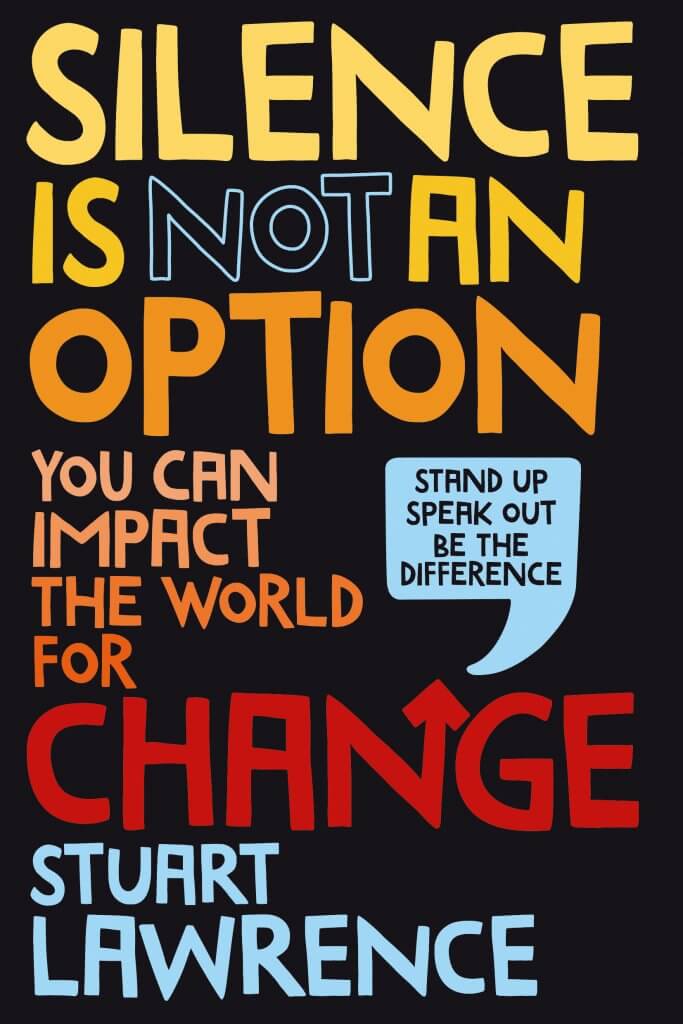
Silence is Not an Option

Silence is Not an Option is the first book by Stuart Lawrence – the younger brother of Stephen Lawrence who tragically died in an unprovoked attack on 22 April 1993. The book is interspersed with reflections on his brother Stephen’s life and murder as well as the tools that have helped him live positively and kept him moving forwards when times have been tough. An inspiring read directed at younger readers (aged 10 +) Stuart’s aim is to use his
own experience to help young people – to help all people – find their own voice, stand up for change, and contribute towards creating a more positive society.
Stuart is determined to ensure that children today understand the impact of their actions against others and the importance of inclusion through teaching tolerance and celebrating difference. He has a background in education – working as a teacher for over 15 years – and is now a motivational speaker and youth engagement specialist. Stuart is also a mentor for several young people in the South London area.
Since his brother’s death, Stuart and his family have had a huge impact on the change of attitude towards racism within British society. Their story is still as impactful and important today.

Scholastic

This is a great book to read slowly. It gives the reader practical activities in each chapter, to really think about themselves and how they can impact those around them, before moving onto the next chapter. It is for independent reading and reflection, but could also prompt some brilliant discussions between young people if shared with a group. Chapters range from the influence of role models (Stuart discusses meeting Nelson Mandela) to championing yourself and others. Stuart is incredibly busy, but I just asked him to quickly recommend some books for teenagers to help them understand their place in the world and how to contribute positively:

– Black and British by David Olusoga (I’ve read the abridged “short history” version for younger readers and it is brilliantly fascinating)

– This Book is Anti-Racist by Tiffany  Jewell (another full of practical advice)

– Everyone Versus Racism by Patrick Hutchinson

– No Win Race: A Story of Belonging, Britishness and Sport by Derek A Bardowell

Scholastic also allowed me to share this excerpt from chapter 3: YOU ARE IN CONTROL:

SELF-CONTROL

After losing my brother Stephen, I really had to learn self-control. Suddenly, my family and I were in the newspapers and on the TV. A lot of the time, the public were being misinformed about our story. I was so angry that my brother was being portrayed as a gang member and a drug dealer, when he was an A-level student aspiring to become an architect.

However, I had to control myself, because lashing out would only affect my family and my brother’s case negatively. It didn’t mean I didn’t speak out, but I had to exercise self-control in the way I handled the situation. I had to be calm and composed, even though I didn’t feel like it.

What is Self-control? Having self-control means being able to manage your decisions, emotions and behaviours so that you can achieve your goals. This skill is what separates humans from the rest of the animal kingdom!

Self-control is rooted in the front part of our brains, in an area called the prefrontal cortex. This is the planning, problem-solving and decision-making centre of the brain. Did you know that this part of the brain is much larger in humans than it is in other mammals? This area of our brain acts differently at different stages of our lives. For example, teenagers are more likely to act on impulse or to misunderstand their emotions than older people. As much as you might not want to believe us adults and feel like you are an exception to the rule, these are scientific facts!

You can only control yourself. For example, let’s say you are trying out to become the captain of the school netball team and, unfortunately, you aren’t picked for the role. Instead of sulking, getting angry or upset, you show good sportsmanship and shake the hand of your competitor. In doing this, you use your self-control. You are unable to control the situation but you are able to control your reaction and that is what is important. Don’t forget, it’s always useful to get feedback so that you can improve and win next time.

About the author: Stuart Lawrence is the younger brother of Stephen Lawrence, the young man who, on 22 April 1993, at the age of just 18, was murdered in an unprovoked racist attack. Stuart is an educator and motivational speaker, dedicated to helping to transform the life chances of young people.

Stephen Lawrence Day is held on 22 April each year to commemorate Stephen’s life.
Follow the journey: #SilenceIsNotAnOption Insta @hon_stuartlawrence Twitter @sal2nd

SILENCE IS NOT AN OPTION is published today by Scholastic.

With thanks for sending me a review copy

Sisyphus had it Easy: the Soul-destroying thing about being a Public Library Campaigner

The soul-destroying thing about being a Public Library campaigner is that you have to fight the same battle every few years and usually on multiple fronts against a multitude foes.

Each time you get a new Libraries Minister in the UK you have to fight to get them to abide by the terms of the Public Libraries Act. Full details here basically the Libraries Minister (and the DCMS) is responsible for making sure that local governments are fulfilling their obligations by providing a full, statutory Public Library service, and if they are not the Minister has a duty to intervene (a duty they always seem eager to avoid)

Each time after local government elections if you get a new local council (and even if you still have the one you had before) there is a constant battle to get them to not try and hand off libraries to volunteer organizations, mutuals (a public service mutual (PSM is “an organisation which was in the public sector, continues to deliver public services, and has a significant degree of employee control.”) or other social enterprises.

Each time you come up against non-statutory groups (see above) claiming they are running a public library and doing it better than the professionals (librarians who needs them) we have to fight to educate local communities about their statutory rights, they are so often being denied a fully-funded library service that they have already paid for through taxes.

Each time local groups stuff a phone box/decorated boxes and so on with books and call them community libraries. The danger with these is that people get upset when library campaigners are seen to criticize ‘nice’ things and people trying to ‘help’ their communities.

The latest “scandal” about adult books being left in a Hampshire Telephone Box Library show that when it comes to Public Libraries staff are a necessity!

Each time a local council tries to run age restricted staffless Libraries, this not only puts patrons at risk but library users under a a certain age would be unable to access the service!

Every year there are fewer and fewer campaigners, we lose so many due to retirement, libraries being closed, burnout and there are an ever increasing amount of confrontations that pop up with tiresome regularity.

Sisyphus had it easy! He had one boulder and a hill! We have boulders of different shapes & weights and often there are people pushing them down as we struggle to push them up.

But the thing about Public Library campaigners is that we believe in what we are doing and will keep fighting to preserve public libraries for as long as we are able!

Donations and Books in Libraries

There has been a big go-round on library twitter over the past little while about a tweet about book donations and patrons getting upset at the thought of library workers selling or recycling donated items rather than putting them in to the library collection.

I know that as library workers we are usually inured to the thought that books have a finite lifespan before they are moved on to being sold or sent off to be pulped, but I think a majority of the library-going public are not as hardened to these realities as we are. It is so easy to write our library users off as being precious or over-sensitive about the fate of beloved books that they wish to donate to us, they have loved the stories and wish to share them with others.

The belief that books are precious and need to be looked after is one that is instilled in people from a very young age – usually beginning at library story-times, I can remember my librarian who showed us how to look after books, not tear pages, turn the page from the top right-hand corner and be respectful of library books, as others need the chance to read them too. This is passed down from adult to child in families that have been brought up using libraries and often they may have had the same librarian showing them how to be look after books.

These kinds of interactions are often the most that a lot of people have with library staff, they grow up believing that library workers love books and want library users to look after them and treat them gently (and we do want that – we know how many times books have to be loaned to recoup their expense). When they come up against the harsh reality that often we are unable to use donations except as fund-raising items for book sales they can get upset because their idealized image of library workers seldom matches up with the harsh reality of what we do.

We do not need to be harsh when confronted with library donations, most times people’s hearts are in the right place when they bring in things that they think we can use, it may be that they have heard that library budgets are constantly under thread and donating books is the only thing that they can do (if it helps them clear space in their homes then it is a double bonus).

It is so easy to poke fun of people on social media, especially those whom we can be judgey about (like people who get upset when they find out that their donations are not wanted) at the moment most people support libraries and library workers but if they see more and more of us act like entitled a-holes online that may change.

We work in libraries to serve our users and educate them, and that includes education on how libraries work and how we maintain our loan materials and everything else!

No, physical books are not eternal items of wonder and magic, but to most people (myself included) some can be, and we would do well to remember that.