Monthly Archives: May 2026

You are browsing the site archives by month.

20 Years of Teen Librarian

20 years ago today (May 15, 2006) the first issue of the Teen Librarian Monthly newsletter was sent out to around a dozen subscribers who I had met at a training day on working with Teens in Libraries that was offered by CILIP. During an break in the training we had all got to chatting and I suggested that when we got back to our libraries we keep in contact and share ideas, resources and support as then ,as now, there is a hole in library services when it comes to comprehensive teen library services.

The original newsletter was a two page word document that I mailed out, I later had the idea to convert it to .pdf. Nowadays of course, most word processing programs offer save to pdf as a matter of course, but back in 2006 I had to sign up for an Adobe account to get a limited number of free pdf conversions, and each month I would patiently upload a word version of the newsletter and then download a pdf copy to send out. I had to create a large number of emails as I kept having to sign up for Adobe accounts as, if memory serves, I only had six free conversions before I had to pay for more.

Behold the original issue of Teen Librarian Monthly

I created the logo in MS Paint:

and, basic as it is, I still have a lot of love for it. For years I wanted to jazz it up but my (at the time) limited digital graphic design skills could never match what I could see in my head so the 2006 graphic remained at the masthead for years. My original idea was to create a newsletter with content and ideas submitted by colleagues across the country, so that Teen Librarians would not constantly need to reinvent the wheel, but sadly too many of my colleagues were so busy doing the work that they did not have time to write and share what they were doing. Many were able to share successful programming ideas but for the most part I put together a newsletter of news, ideas and resources that I either found while looking for things to aid me in my job, created or worked on with friends.

A full archive of my pdf newsletters is available to download and read here: https://teenlibrarianmonthly.wordpress.com/

In 202o the newsletter transitioned to MailChimp and this iteration of the newsletter ran until 2024 when my job changed and I mostly stopped working with teens in libraries altogether (not through choice but due to the changing nature of my life in libraries).

The MailChimp era newsletters are all available here: TeenLibrarian Newsletter

These days the TeenLibrarian site is run by me in the US and my friend Caroline in the UK, mostly book reviews as well as posts and articles about Libraries in the US & UK, the struggles they face and resources for Library Workers who bear the brunt of attacks on books, burnout and more.

To everyone who has written for, subscribed to or otherwise shared the work we have done here – THANK YOU! Over the years, whenever I was at a low ebb I received emails and other messages saying thing to the effect of “Thank you – I no longer feel so alone in Libraries!” and honestly, those emails kept me going.

Honestly, I do not know how much longer the site will be around, the newsletter is pretty much done, but if anyone has any ideas on what we can still do here, please do not be afraid to let me know, my contact details are here: https://teenlibrarian.co.uk/contact/

A Martin Amis Moment for Mac Barnett

For those who are not familiar, Martin Amis, an award-winning writer of serious books for serious people (adults) said during an interview:

People ask me if I ever thought of writing a children’s book. I say, ‘If I had a serious brain injury, I might well write a children’s book’, but otherwise the idea of being conscious of who you’re directing the story to is anathema to me, because, in my view, fiction is freedom and any restraints on that are intolerable. [source: https://www.theguardian.com/books/2011/feb/11/martin-amis-brain-injury-write-children]

When I first heard about Mac’s 94.7 % quote my mind immediately went to Amis’ interview, due to the tone-deafness of the words and the opprobrium that resulted. Imagine my surprise then, that, while reading Make Believe I saw that he referred to the Amis incident in a wonderful footnote in chapter one – A Grand Unifying Theory of Children’s Literature. I love footnotes in books; they bring me a lot of joy (and additional information and sometimes humor too).

I am a fan of his books and have been for years, Make Believe, his first book for adult readers is thought-provoking, funny and contains truths and observations that closely resemble ones that I have held for years.

Read in context, Barnett’s Addendum to Sturgeon’s Law makes more sense than the words shorn of the preceding and following chapters. This is not to say I agree with him on this. I personally would never refer to any book as ‘crud’, as a Librarian and long-time lurker in libraries I have learned that not every book is for every reader. This goes for children’s books as well, because we are all individuals and have differing tastes, and kids learn early what types of stories and formats of books they enjoy.

The more I read Make Believe, the madder I got. Not because it is a bad book, but because Mac wrote it with his heart on his sleeve, he is a well-known and beloved author who has worked with some phenomenal illustrators. He makes great points about celebrating children’s literature; as well as the less great books that adults may not always understand but kids love. The thing that made me mad is the fact that his addendum will poison people’s perception of the book and make many less inclined to pick I tup and read it.

I have seen several people online trying to push back against what they perceive as dogpiling on Mac Barnett and others who have read the book without knowing who he is or why so many of us are upset.

If anyone is interested why there has been such a huge pushback, it is because there is a problem affecting books for young readers – and it is not the books, rather there is a movement dedicated to making sure books by and about certain communities or individuals are kept out of libraries (both school & public), ostensibly to ‘protect’ children but the overarching goal is to control who gets to be reflected in our modern literary canon as one prong of an assault trying to push vulnerable minorities out of public view.

Having the current National Ambassador for Young People’s Literature and best-selling author for young readers stand up and say that he fears that 94.7% of kids books are crud gives culture warriors that already have libraries and children’s books in their crosshairs a huge stick to continue to beat us with. It is a massive unforced error, and not only that, but it is also dismissive of most authors who write books for younger readers.

I 100% believe that Mac’s intention was not to denigrate children’s books or those what write them, but in life when harm is done, it is not good enough to say he had good intentions but instead to acknowledge that harm has been done and work on remedying it.

The School Library Journal has a decent article about his response to the uproar that you can read here: Mac Barnett Responds Amid Continued Backlash

In closing I will say that Make Believe is a good (but flawed) book that is worth reading despite the negative publicity around it but I fully understand and support those that choose not to.

Other Articles about Mac Barnett:

Sunday Reflections: If the kids books are crud, what does that make the kids that like those books?

Literaticat on Mac Barnett

Children’s Book Community Responds in Outrage to Mac Barnett Comments

Mac Believes…

… that 94.7 percent of kids’ books are crud.

Mac being Mac Barnett, the current National Ambassador for Young People’s Literature and best-selling author for young readers.

In his new book Make Believe: on Telling Stories to Children he has written “I have a nagging fear that children’s literature suffers from a slightly higher crud percentage than literature as a whole…maybe more like 94.7 percent of kids’ books are crud.“

A hyperbolic statement? Almost certainly, but also utterly tone deaf and incredibly dismissive of the tens of thousands of authors across the world who write books for children and young readers. Who gets to chose which books are worthy and which ones are, not to put too fine a point on it… crud?

Mac is not alone in believing that this, there are people and organizations around, like Moms for Liberty and their fellow travelers, who believe that many kids books are crud, full of themes, ideas and people that they do not want their children exposed to. Mac’s belief gives cover and credence to these people and their hateful views.

Who knows, Mac’s book may be a paean to children’s literature, extolling its virtues, but sadly the nagging fear that he shares may be all that many people take away from it. This negative publicity may in fact deter people who may benefit from reading it from picking it up. I have ordered a copy and will read (and review) it as I have long been a fan of his work, but honestly he (or his editor) should have thought about that sentence before the book was published.

If this is something he truly believes then he should resign the position of ambassador and let someone who truly sees the value young people’s literature assume the position!

Runaway Road

Three life-changing minutes. Two siblings on the run. One choice that changes everything.

Ezra is sixteen. He’s no stranger to crossing the line, but this time it’s serious – and someone might be dead. To escape justice, he’ll have to cross another line: the Northern Irish border. But that means leaving behind the only thing that really matters. His little sister, Evie.

Evie is nine and sees it differently. When she was three, Ezra took her into care, into safety – and to the bookshop that became her lifeline. Ezra understands her. Why shouldn’t she go on the run with him now?

Ezra and Evie are used to feeling invisible. Now they have to become invisible for real.

Set in Derry~Londonderry and Donegal along the Wild Atlantic Way in 2023, Runaway Road is my third novel. My books are all available in independent bookshops, major book chains and online. Please shop local if you can!

Sue Divin

A gorgeous YA, set in contemporary Northern Ireland, covering all sorts of “issues” with a deft touch. It is heartbreakingly sad in parts, but also thoughtful, warm, and a gripping read. Sue Divin has produced a wonderful trailer:

and also wrote a piece for us, which I’m sharing just in time for publication on 7th May:

Three life-changing minutes. Two siblings on the run. One choice that changes everything…

In the north-west of Ireland, along the Wild Atlantic Way, there is a sign that says, ‘Welcome to Amazing Grace country.’ That sign sparked some of the thinking behind Runaway Road. Giving Grace, AKA second chances, or ‘cutting people some slack,’ as protagonist Evie puts it, is one of the themes at the heart of the book.

I’m often inspired by the stunning landscapes in the north-west of Ireland, and the ‘Wild Atlantic Way,’ so, when pondering ideas for my third novel, I wanted to set it in Derry and Donegal. This location allowed me to explore the issues facing Northern Ireland (and these islands) about borders and identity. Walking local beaches, I discovered the connection with John Newton – his near-death experience in a storm off the coast, conversion to Christianity and transformation from slave-trader to abolitionist. Being given a second chance allowed him to make a huge, positive difference. Do we give people today that space, that grace, to change? What if a teenager messes up badly? Are they categorised for life? What if, like protagonist Ezra, they didn’t have much of a chance in the first place?

As a writer, I thrive on big themes and emotions blended with hope, humour and a story that keeps readers turning the pages. Whilst my writing inspiration often comes from a sense of place; contemporary issues; and character voice, I’m also seeking something universal that teens (and adults) across the UK and Ireland can connect with. In Runaway Road, that’s about belonging, family and friendship. Ezra (16) and Evie (9) have struggled all their lives to fit. Raised in care, they are used to feeling invisible, but when Ezra commits a crime and goes on the run with Evie, the siblings have to become invisible for real. There are over 4000 children in the care system in Northern Ireland, and one in every 17 school-age children here, like Evie, has an autism (ASD) diagnosis.

Runaway Road is also about inclusion and diversity. Northern Ireland is a place of increasing diversity, and the legacy of Brexit has thrown up big questions. Ezra and Evie are broadly from the British identity in Northern Ireland – something rarely, or stereotypically, represented in British and Irish literature. Alannah’s mixed-race character also poses the question of how we define Irish, Northern Irish or British today. How inclusive are we? I’ve done many author workshops and Q&As with teen readers. In Northern Ireland the response is often that, for the first time in a book, readers ‘feel seen’. Wider afield in Great Britain or the Republic of Ireland the novels provoke connection and empathy around identity as well as a questioning of why Northern Ireland, like Ezra and Evie, is almost invisible. How much does contemporary Northern Ireland feature in your library?

I find many teens are curious to learn more. Whilst textbooks teach the head, novels reach the heart. I’m impressed to see how many teen readers make connections between post-conflict Northern Ireland and all sorts of complex identity, diversity, justice and reconciliation issues in their own lives and communities.

What also makes my heart sing is how teen readers relate to the humour and voices of my characters. (And yes, I’m often asked about ‘Derry Girls’.) The plot, the pace, the twists and turns, the dry wit and self-depreciating humour – it’s kind of part of the culture here and I love ‘putting it on the page’ as Evie would say. I’m into writing the big rollercoaster emotions – and with all the hormones, teens love reading them. Like my previous novels, Guard Your Heart and Truth Be Told, I hope Runaway Road makes readers think, smile, cry and laugh out loud.

Northern Irish YA writing is currently going through a golden phase. Jenny Ireland’s novels, The First Move, The Boy Next Door are popular fiction, highly inclusive of disability. Sheena Wilkinson writes from boarding schools to historic battles for women’s emancipation. Shirley McMillan writes contemporary issues and diversity. Her most recent novel, Grapefruit Moon, is reminiscent of Dead Poets Society. Kelly McCaughrain’s Just Another Dead Boy poses the question if you knew when you would die, would it change how you live? Stephen Daly’s début The Last Death Poet is an urban fantasy set in post-conflict Belfast, and Siobhán Murphy’s Hedge Witch is a queer dystopian fantasy in a world when all the magic used to be locked safely behind a hedge. If you thought that Northern Irish YA was only Joan Lingard’s 1970s Beyond The Barricades, please think again!

For more on books by Northern Irish writers and/or illustrators, check out the 2026 Northern Lights guide published by Children’s Books Ireland and endorsed by the British and Irish Children’s Laureates.

Sue Divin

Runaway Road Publishes 7th May, First Ink

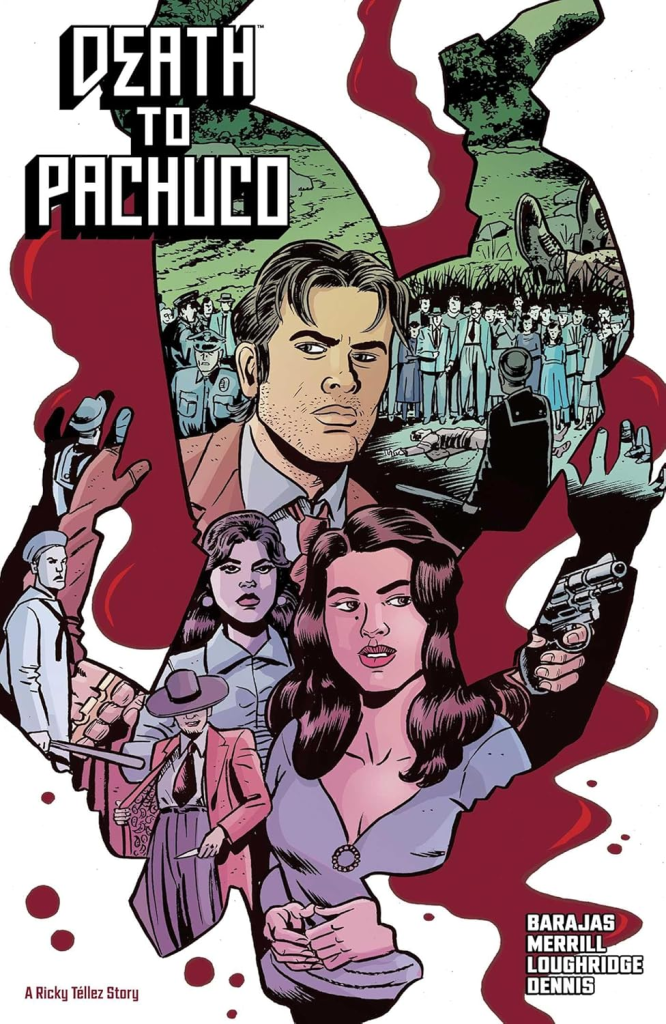
Death to Pachuco Interview with Henry Barajas

Hello, and thank you for taking the time to answer a few questions about Death to Pachuco. Before we begin, could you please introduce yourself to those reading this who may not be aware of who you are? I’m Henry Barajas. My roots are in Tucson but I live in Los Angeles. My passion is making comic books. My most notable work is La Voz De MAYO Tata Rambo art by J. Gonzo, letter art by Bernardo Brice, and edited by Claire Napier.

Are you able to give an elevator pitch to convince a potential reader to pick up a copy of Death to Pachuco? Death to Pachuco is a chicano noir taking place during 1940s war-time Los Angeles centered around racist events: the Sleepy Lagoon Murder Trial and Zoot Suit Riots.

How did you and Rachel come to collaborate on Death to Pachuco A mutual friend shared Rachel’s “Adult Romance” comic online. I was looking for an artist to work with on DTP and her sensibilities and inking style drew me to her work. I respect that she has her own style when there tends to be a homogenized artistic standard. She’s not trying to draw like anyone else, but good at extracting her influences. 

How did you and Rachel come to work together? Was there a strict separation between writing and art or was it a more back-and-forth collaborative approach? Thankfully, she started working on Gil Thorp with me. This was our chance to fine tune the band and get us ready for something larger than what we’re used to doing. I write full scripts. She would do some breakdowns; ultimately, we went straight to inks for DPT because she had an idea of what I was looking for. She is good at taking notes but also shows the professional attitude to learn and apply it to her craft. I also letter the comic, so I was able to make adjustments to my script to fit the structure of the page. The editor, Will Dennis, was key to bridging a lot of communication and having a third person to have a more objective voice to what worked and what didn’t.

Originally, this was going to be black and white. But the comic book gods blessed us with Lee Loughridge. He was able to fit us in his busy schedule and made the whole book sing.

What is the background to the story of Death to Pachuco? The background for me is the uncomfortable truths and history this country would much rather forget than learn from. Immigration and Customs Enforcement (ICE) has been supercharged for the purpose of terrorizing and maintaining white supremacy. This was what happened during the 1943 Zoot Suit Riots. The sailors took justice upon their own hands and tried to beat, strip, and burn Mexican counterculture appropriated by Black jazz musicians. I tried to make that clear without spelling it out for people.

How much research went in to creating this story? La Voz de MAYO was a four-and-half year long journey of research. I learned from that. Story supersedes research. You can have all the answers, but if your story sucks, no one will care. Thankfully, that wasn’t the case with La Voz. But I could’ve done one more project in those five years. I give myself a year of pre-production that usually takes place while I’m working on something else. But I’m getting older and slower, so I am starting from scratch again with my current project.

For people who may be interested in L.A. in the 1940’s and the Zoot Suit Riots what works can you recommend? I would say Manuel Ramos’ The Skull of Pancho Villa and Other Stories. He’s the godfather of Chicano noir. The obvious is Raymond Chandler’s Phillip Marlowe series, and The Good Asian by Pornsak Pichetshote, Alexandre Tefenkgi, and Loughridge. DTP is the first comic I have woven film as a major reference in my work. I would say the 1952 classic No abras nunca esa puerta by Carlos Hugo Christensen is a gem I watched thanks to the Noir City Film Festival.

For those readers who after finishing DtP may want to read more of your works, what can you recommend? (either in print or online) My work with the Civics For All group that educates the NYC public students. I wrote two comics for hispanic history, one on Dolores Huerta and migrant farmworkers and Sal Castro. Free to read and download.

What are you reading at the moment? I am inspired by Jazmine Ulloa’s El Paso nonfiction book on the incredible relationship the US has with El Paso specifically. It’s truly the Ellis Island of the Southwest. 

Thank you for giving up your time to answer these questions! Thank you for reading and supporting our work!

You can find links to Henry’s work, interests and socials here: https://linktr.ee/henrybarajas