Monthly Archives: April 2026

You are browsing the site archives by month.

What is a “DEI Book”

A rational person (such as myself and quite probably you dear reader) may assume that a DEI Book is a non-fiction tome such as DEI Deconstructed: Your No-nonsense Guide to Doing the Work and Doing It Right by Lily Zheng, or Reconstructing Inclusion: Making DEI Accessible, Actionable, and Sustainable by Amri B. Johnson.

One author whose books I would not automatically have put in the “DEI Books” list (not that I have such a list, but it appears others do) is best-selling young readers author Alan Gratz. I do not know Alan at all but have been aware of his books for years. His works are perennially popular, and his stories mix historical fact with high adventure and derring-do and have been described as emotionally charged, complex subject matter told in a way children can understand, …incorporating informative, real-world scenarios and events with relatable characters and narratives.

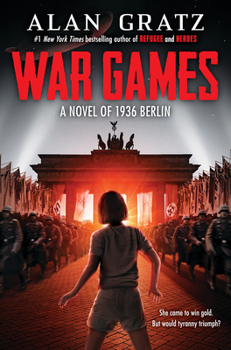
However, according to the famously balanced & impartial Heartlander News (archived link here) War Games by Alan Gratz is apparently a “diversity, equity and inclusion (DEI) graduate seminar inside a story about the theft of gold from the German National Bank during the Olympics.“

I have bumped up against Heartlander before as detailed here, and they have targeted libraries in the Kansas City metro a number of times over the years but I am astounded by how scant the evidence is that they are using to back up their assertions. I took the time to look up War Games on Common Sense Media, and their coverage of this book showed no reason for even the most concerned of parents to be worried.

This is the description of Diverse Representation in War Games from CSM:

Karl Hühnerbein is German and gay and Ursula Diop is biracial (her father is from Senegal and her mother is White and German), which means she’s considered “physically and morally degenerate” by the Nazis. Solomon Monday is White and British and Heinz Fischer’s mother is Jewish. Hitler believed the Olympics would showcase the superiority of White athletes, something that was shattered when Black American Olympian Jesse Owens won four gold medals. While only 18 athletes on the US team were Black (16 men and 2 women), they would win 14 medals, eight of then gold.

It appears that merely the presence of Black, Gay and Jewish characters in a book is enough to get it branded as “DEI”. I have requested a copy of War Games and will read and review it here next week.

I have also reached out to Alan Gratz through his agent and if he has any comment I will post it here if I hear back.

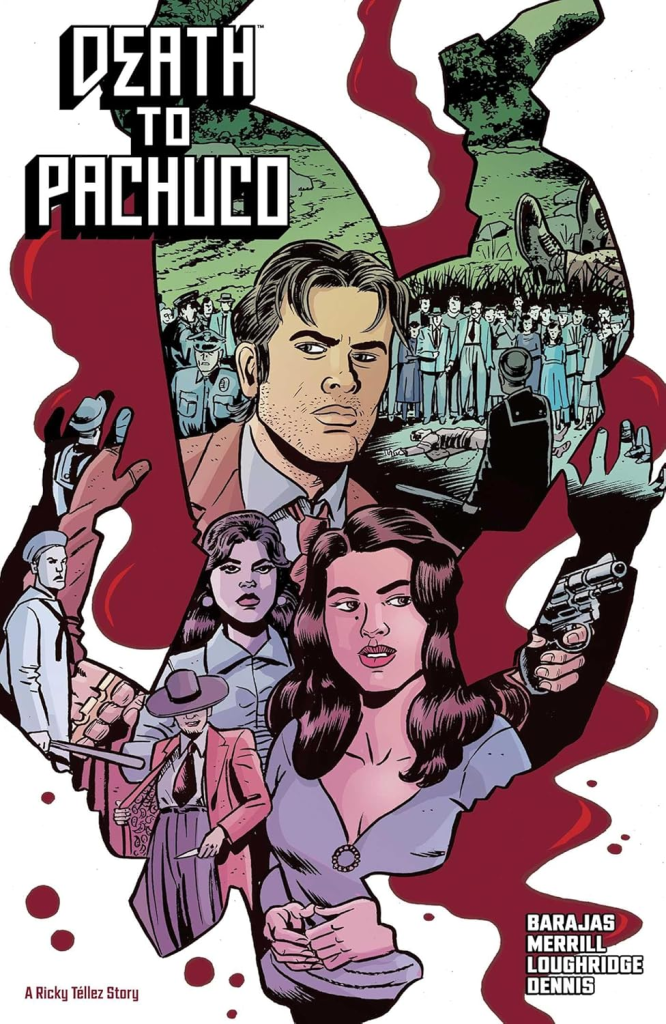
Death to Pachuco by Henry Barajas & Rachel Merrill

During the summer of 1943, Los Angeles became a hotbed of tension and conflict as a series of fierce clashes erupted between U.S. Navy members and Mexican American youth stemming from the murder of Carlos Urbano. Private eye Ricardo “Ricky” Tellez needs to find the Sleep Lagoon Killer before the racist mob kills him in the Zoot Suit Riots.

The clock is ticking—and it’s a bad time to be a Mexican.

TL;DR Review: A bloody brilliant example of Chicano Noir that belongs in any (& every) collection! Henry and Rachel’s writing and art complement each other in this grim and engrossing historical mystery! Buy it and read it – you will not regret it! Trust me I am a Librarian!

—

Just in case you were wondering: Pachuco: (slang) a young Mexican-American having a taste for flashy clothes and a special jargon and usually belonging to a neighborhood gang
Thanks to Merriam-Webster

I got pulled into appreciating noir early in life, thanks in part to being exposed to Chinatown and The Maltese Falcon as a child. In recent years comic noir has held my interest due to the works of Ed Brubaker, Frank Miller, Jason Aaron and Greg Rucka to name but a few! To my personal canon of favorite graphic novel noir yarns I have now added Death to Pachuco by Henry Barajas and Rachel Merrill. A dark detective yarn that took me down the gritty streets of the 1940’s City of Angels, serving up action, mystery, morally ambiguous characters and shining a light on the historical plight and experiences of Mexican-Americans in California. All in all a phenomenal introduction to the Chicano Noir subgenre that has left me wanting more! Fortunately this is only the first of what I hope will be many stories about Ricky Tellez.

One of the things I love about reading is, that almost without exception I learn something new no matter what I am reading. Death to Pachuco introduced me to so many things I had no idea existed or only had a passing knowledge about, from the Zoot Suit Riots and the Sleepy Lagoon Murder to the Tongva people, the history of Los Angeles (Calle Olvera, Rancho Rodeo de las Aguas and other places – I have bookmarked a number of sites to read at my leisure and indulge my joy of learning about history).

I have been a fan of Henry’s work for a few years now, thanks to an interview with him I heard on All Things Considered where he discussed Helm Greycastle and discussed  La Voz De M.A.Y.O.: Tata Rambo based on the oral history of Ramon Jaurigue, an orphan and WWII veteran who co-founded the Mexican, American, Yaqui, and Others (M.A.Y.O.) organization. I also highly recommend those two works, they are phenomenal and would make worthy additions to personal and library collections!

In Ricky Tellez, Henry Barajas has created a quintessential noir protagonist, damaged, flawed and haunted by his past but still driven to do the right thing. Rachel Merrill’s art style is perfect for noir storytelling!

Death to Pachuco was created by Henry Barajas and Rachel Merrill. It is published by Image Comics and will be available wherever comics can be purchased on April 14.

You can also find Henry and Rachel collaborating on long-running sports comic strip Gil Thorp.