There’s a ghost in Richard’s wardrobe. Every day he carries out a series of rituals that he believes will keep the ghost trapped inside. He tries to tell his friends and family, but they dismiss his worries and concerns as being part of his OCD. But then one day, the wardrobe door is opened… And that’s when the hauntings begin.
Scholastic

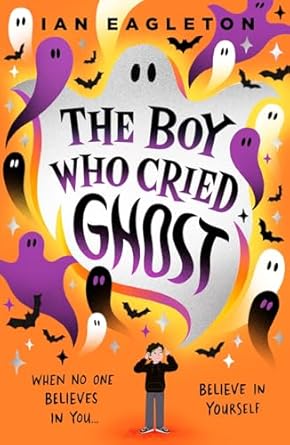
I loved everything about this book: the main character, his friends, and the supportive adults. Adored the book recommendations, bad jokes, and actually-quite-scary bits…so I was very pleased to be able to ask the author, Ian Eagleton, some questions!
What can you tell us about your new book, The Boy Who Cried Ghost?
The Boy Who Cried Ghost is a spooky, thrilling, heartwarming and funny story, full of twists
and turns. It was inspired by my love of horror movies, Hocus Pocus, the Goonies, Buffy,
Casper, and a friend who used to tell the most terrifying ghost stories when we went away
camping.
Richard is just starting Year 6 when he has to move with his mum into his grandma’s old
house. He is angry and resentful and filled with worry about making new friends at a new
school. He is also consumed by obsessive behaviours, low self-esteem and grief. I always
think the best ghost stories are nothing to do with the ghost, but instead explore what it’s like
to be haunted by trauma. Over the course of his journey, Richard has to learn to accept
himself and understand how to start dealing with his OCD.
You’ve said that you have OCD and hope that it means you’ve portrayed it well, but
did that personal connection also mean that it was difficult to write?
So difficult! I really wanted the story to feel authentic, raw and challenging, as well as being
fun and gripping too. I had to dig deep and go back in time to explore my own experiences of
living with OCD. Throughout the story, we get to read Richard’s flashbacks and memories as
he comes to terms with how his brain works. These were all based on my own memories, so
it was often very emotional and draining to write. I remember being absolutely terrified as a
child and teenager by these strange, intrusive thoughts and all-encompassing rituals I
carried out. However, I do really feel that books for children and young adults are the MOST
important of all books and that my readers therefore deserve the absolute best of me. this
means putting everything I have into my writing, no matter how painful it might be at the
time. By the end of the process, I often feel a sense of relief and acceptance. Writing can
definitely be cathartic!
There is a growing selection of titles for children that feature mental health issues and
disability in a positive way, but are there any other books you’ve read that you think
represent OCD well?
There are three books which stand out for me. They are:
The Goldfish Boy by Lisa Thompson
When I See Blue by Lily Bailey
A Flash of Fireflies by Aisha Bushy
Have you any suggestions for how those that work with a child/teen with OCD might
best support them?
As an adult, I read Because We Are Bad by Lily Bailey, which was life-changing and really
helped me understand what I had experienced myself as a child and teenager with OCD. I
would also recommend the following books to people who work with children and teenagers
with OCD:
The Man Who Couldn’t Stop by David Adam
Pure by Rose Bretécher
Brain Lock by Jeffrey M. Schwartz
I think these books portray the terror and uncertainty of OCD particularly well and would
really help people understand the complexity of this mental health disorder.
I would also remind people that saying things like ‘Oh, I’m SO OCD’ just because you like
things to be neat or tidy can be quite harmful and offensive to people who suffer with OCD.
I love the diversity of your characters, in all your books. Are they ever based on
friends or colleagues?
Hmmmm. Sometimes they are. A good friend of mine told me a story once about how she’d
whacked a nasty boy at school around the face with a bouquet of stinging nettles. I was so
shocked and amused by this story – don’t try it at home – that I asked her if I could include it
in my first middle-grade book, which was Glitter Boy. She kindly agreed! In The Boy Who
Cried Ghost, one of the adults in Richard’s life is called Mr Levick, who is based on someone
I know. He often wears gender-defying clothes and is openly gay and I felt like this sort of
positive role model should be celebrated in the story.
Sometimes, however, my characters are based on what I like to call ‘wish-fulfilment’. In
Glitter Boy, James has an amazing teacher called Mr. Hamilton who is marrying his
boyfriend, Sam, and spends a lot of time talking to the class about LGBTQ+ history and
rights. This would have been transformative for me as a queer teenager, but it wasn’t
something that ever actually happened. I just wish I’d had a teacher like Mr. Hamilton who
could’ve supported and guided me.
I know a lot of the jokes were suggested by your dad while you were writing the book,
but do you have a favourite?
There’s a scene in the story where Richard’s stepdad, Tony, and his new school friend,
Quinn, are trading jokes and quips and I LOVE it! Here’s an extract from it, which you might
enjoy!
But Tony and Quinn were already walking off, chatting happily and loudly.
“I’ve been telling everyone at school about the benefits of eating dried grapes today,” Quinn
was saying animatedly. “I’ve been raisin awareness…”
Tony burst out laughing and slapped Quinn good-naturedly on their back.
“That’s nothing!” Tony began. “I asked someone at work today to bring me a newspaper.
They told me that newspapers are ‘old school’ and handed me their iPad instead. Well, that
fly didn’t stand a chance!”
“Oh … my…!” Quinn guffawed. “That was HILARIOUS! Tell me more!”
I think Tony’s joke about evolution and Darwin has to be my favourite though – I hope you
enjoy it too!
What are you reading at the moment and who would you recommend it to?
I’m currently reading A Ship in the Dark by Yarrow Townsend. It’s about a young girl called
Anna, whose father is arrested for smuggling. She sets out to prove his innocence and soon
discovers that the truth may lie on a mysterious, missing ship called the Albatross. Yarrow
Townsend’s A Map of Leaves was one of my standout books of 2022 and I am thoroughly
enjoying their new story. The writing is fresh. gripping and immediate, whilst also being
beautiful and lyrical, and the story is a rip-roaring adventure full of twists and turns. I would
recommend A Ship in the Dark to readers who have enjoyed The Girl of Ink & Stars and The
Lost Whale.


