Monthly Archives: May 2025

You are browsing the site archives by month.

First Amendment cannot be used to challenge book removals in Public Libraries (according to the Fifth Circuit Court of Appeals)

The Fifth Circuit Federal Appeals Court ruled en banc that the First Amendment cannot be used to challenge book removals in Public Libraries as a library’s collection decisions are government speech and
therefore not subject to Free Speech challenge.

ACLU Attorney Josh Block has a comprehensive thread on Bluesky that covers this breaking news:

En banc Fifth Circuit overrules decades of precedent and holds that there is no First Amendment right to receive information in a public library.

— Josh Block (@joshablock.bsky.social) 2025-05-23T14:35:16.501Z

You can read their ruling here:

The ruling is summarized as: Plaintiffs have a First Amendment right to read books. They don’t
have a First Amendment right to force a public library to provide them. So I
agree that we should reverse, and accordingly concur.

The ruling was not unanimous as three judges dissented, the dissent is also included above and is worth reading in full. The dissent begins with: Because the majority forsakes core First Amendment principles and
controlling Supreme Court law, I dissent.

and ends with: Because I would not have our court “join the book burners,” I dissent.

The Fifth Circuit Court is widely considered to be the most conservative court in the US. It remains to be seen if this ruling will be overturned on appeal, but it is concerning that the activist judges on the court are trying to remove the First Amendment from the arsenal of people fighting to prevent book bans ad censorship in libraries.

You can find out more about the court case Little vs Llano county here: https://www.aclu.org/cases/little-v-llano-county

Links to More Information

5th Circuit rules Texas library patrons have no First Amendment right to information – Austin-American Statesman

My Name is Samim

‘There were twenty-eight of us in the tiny dinghy, packed in like dates in a crate…’

My name is Samim.

I’m thirteen years and three months old, I love chess — and I’m a refugee.

I was happy in Afghanistan, until the day bombs ripped my life apart. I escaped with my best friend Zayn, hoping to find safety in the UK. But the journey was dangerous and we lost so much along the way…

Now I’m here, trying to make new friends and a new home, but will the authorities let me stay?

First, I must tell my story. Are you ready to hear it?

Kelpies

At the 2024 CILIP YLG National conference in Glasgow I met the publisher and publicist of this middle grade (& older) novel and they thrust a proof in my hands with promises that it would be a book that stayed with me. I actually read it on the way home, in one sitting, and then sat thinking about it until the end of the journey (luckily Glasgow to London takes some time)! I sent a few questions to the author, debut Fidan Meikle:

The first line is a tremendous hook. Did you always intend to start the story with Samim already in a UK detention centre, looking back at his journey, or did it evolve that way?

It took me some time to figure out the best way to tell Samim’s story. I debated for a long time whether to start with the moment his home was destroyed by a bomb or dive straight into the dramatic scene in the English Channel. But Samim’s story is really two stories in one: his journey to the UK and his journey within the UK. I needed a point where both narratives could unfold together. Having him recount his experiences during an asylum interview felt like the right choice – on one hand, he’s telling us about his past, and on the other, he’s stepping into his future, entering foster care and starting school. In the end, both journeys align as he searches for a place to belong.

What kind of research did you do before and during writing?

I have a background in Asian and Middle Eastern Studies, specialising in Afghanistan, so I already had an understanding of its history, languages, literature, religion, and geography. I’d spent years studying the country, but I knew that to tell Samim’s story properly, I needed to go beyond textbooks and research real experiences.

I read memoirs and personal accounts from refugees, collected stories from Afghan asylum-seekers, and studied reports from charities working directly with migrants. I also looked into immigration policies, especially those affecting unaccompanied minors, to make sure I got the legal side right. Watching documentaries and following investigative journalism helped me understand the constantly changing situation better.

One of the most valuable parts of my research was working with an Afghan photojournalist Through his friends and acquaintances who fled Afghanistan, I gained invaluable insights that also helped to shape the book.

How did you balance the true horror of many refugee experiences with a hopeful but realistic story?

With great difficulty at times! This isn’t an easy topic to soften – it’s a harsh reality for millions of children around the world. I wanted to do justice to their experiences, but I also wanted the book to be accessible for primary school children, something that could spark meaningful discussions rather than overwhelm young readers. To keep that balance, I made sure there was always a sense of hope, even in the darkest moments. Zayn’s lively personality helped a lot – his humour and resilience bring light to the story, reminding us that even in hardship, joy and friendship can exist.

Are there other books on the theme of refugees that you recommend?

I highly recommend The Lightless Sky by Gulwali Passarlay, a powerful memoir about a young boy’s journey as a refugee. I also love Hinterland by Caroline Brothers, which follows two Afghan brothers navigating Europe alone.

What are you reading at the moment, and who would you recommend it to?

I’m currently reading Tali Girls by Siamak Herawi, an adult novel that delves into the lives of Afghan women under the Taliban’s draconian rule. It’s a deeply moving and eye-opening read, a story about women who are often silenced but never powerless.

Do you have any more stories planned?

I have several works in progress, all in different genres, too. But the book I’m dedicating most of my time to right now is a Young Adult fantasy novel. I’m really excited about this project and can’t wait to hopefully publish it someday.

Fidan Meikle is an Azerbaijani-British writer, linguist and translator. She writes poetry and prose for children and adults. When she isn’t writing, Fidan can be found teaching languages, indulging her love of Azerbaijani cuisine, or exploring the Scottish Highlands with her husband and children. Her debut middle-grade novel, My Name is Samim, is inspired by the true stories of young refugees who undertake courageous journeys in the hope of finding a safe home. She lives in West Lothian, Scotland.

The Wycherleys

For the Kingdom. For the magic. And for love . . .

Seventeen-year-old Aurelia Wycherley is entering her debutante season as a witch. Aurelia should be excited about finding the perfect match to tether her magic to. But her magic is cursed – dark, dangerous, and not the kind that her peers want to match with – and, without a tether, she faces losing her magic completely.

But when Aurelia learns that enigmatic, aloof Jules, a member of arch enemy family the Nightlys, is searching for a way that a witch can keep their magic without tethering, she realises he may be her only hope. A forbidden alliance is formed . . . but as they navigate the Magical Season with its glamoured balls and perilous trials, they uncover dark forces that threaten their families and the magical world they live in.

Expect family secrets, generational curses, forbidden romance, gorgeous ballgowns, bribery, extortion, trespass, magic and kissing . . . lots of kissing.

Simon & Schuster

Treating you to a guest post from ex-Librarian Annaliese Avery about her fantastical new UKYA!

Wycherley Worldbuilding

Discovering the worlds of the stories that I am writing is one of my favourite aspects of writing. I write in quite an open and free way, I think of it as exploring, I set off into the story armed with very little details; sometimes I don’t even know the destination, but I will know a few things and I will follow those like trails in the wildness and see where the story leads. As I am navigating these tracks and pathways, I will start to discover the story around me either through the writing of the story itself or through the thinking that I do about the story – usually when I am not at my desk.

For The Wycherleys I knew quite a bit as I set off to write; I knew the basis for the magic system, and I knew the time period that I wanted to set the story in. Importantly I also had my main character Aurelia Wycherley and her brother Vaughn. I find it best to explore a story with a guide and my characters are always that for me – as I write about them they show me the world that they live in and I learn about it as the story progresses and grows.

About a year before I started writing The Wycherleys I had written a proposal for a middle grade story that had a pair of witches who could only perform magic when in close proximity to one another, although nothing came of that proposal, I thought the idea was a good one and it grew into the basis for the magic system in The Wycherleys.

By the time I sat down to start work on writing I knew that in this story world magic was in decline and unstable, and that when a witch received their magic they had a handful of years before it would fade away to nothing, unless they could find someone to tether their magic too, this would keep it in place but that tethering bond would last a lifetime. Finding a tether was paramount, finding the right tether was also important.

The alternate Regency time period for the story was there early on too. I knew I wanted to write a magical fantasy story with a romance to it, and one of my favourite romances is that of Darcy and Elizabeth in Pride and Prejudice, and of course I had been watching Bridgerton and something about the debutante season and the season of the witch clicked together. I thought, what if when the debutante season finished the Season of the Witch began, with the debutantes of magic taking over London and making their way through the Sabbats of the wiccan wheel of the year as they attended balls and magical soirées all will exploring their power and the possible magical matches available to them.

I do remember at one point in the drafting stage I wrote “In this third age of magic …” and stopped as I realised if my characters were living in the third age of magic then there had been another two ages before them. I then had a lot of fun looking at key historical events and seeing how they would have played out in this alternate magical timeline. I discovered the rise and fall of the witch clans and their queens and how this gave way to the burning times and the persecution of the magically gifted. The civil war where malevolent magic rose and the witches of the day stood beside the non-magical folk to fight it in a magical war that caused a shift in magic, a shift that meant that witches now needed to tether.

Editing is a key phase in my writing process, if I am exploring my way through the writing of the story then editing is where I get out the notes and musings that I’ve made on my journey and put it all into a guide book, my book bible, then I use that to edit the story so that when I share it with the reader they won’t get lost or stray from the path. It’s at this phase in the process that I might do some deeper thinking if needed or sometimes realise that things link up in a way that I didn’t notice when I was writing. It’s a little like journeying to the top of a mountain and then being able to look back at the land you have covered, seeing it all and how it relates to each other.

The Wycherleys was such a fun world to discover, I adored spending time there and I hope that you will have a magical time there too.

The Wycherleys is out now!

New Platform Launches in Response to Class Crisis in UK Writing Industries

Actor and philanthropist Michael Sheen has supported the founding of a new literary magazine and platform for working-class writers, The Bee. 

The magazine, launching on May Day, Monday May 5, is edited by Richard Benson, the former editor of iconic 80s and 90s magazine The Face, and supported by the British publishing house Faber, home to Sally Rooney, Simon Armitage, and Kazuo Ishiguro.  

The Bee has been created to fight the increasing marginalisation of working-class writers, and of working-class people in publishing. In 2014, 43 per cent of people in publishing came from middle-class backgrounds, with 12 per cent being of working-class origin. Since 2019, the former figure has risen to sixty per cent, and as recent news stories about access to the arts have shown, the barriers for the less well-off are increasing. 

Benson said: “Justice and fairness demands that people from the less well-off sections of society have the chance to tell their stories, and to get them heard. But it’s also about common sense. Much of the important writing being done today, and so many of the best-loved stories come from ordinary working people. So often, it’s stories from the working classes that express what’s really happening in the world.”  

The Bee’s channels include a website, literary magazine, podcast, and a large-scale outreach programme to seek out, and support the professional development of, new writers from working class backgrounds. It will publish fiction and non-fiction.  

The initiative was born out of A Writing Chance, a UK-wide programme for working-class writers co-founded with the actor and philanthropist Michael Sheen, Joseph Rowntree Foundation, and Northumbria University, and produced by the writing development charity, New Writing North. A Writing Chance alumni have already gone on to become published authors, including Tom Newlands whose novel Only Here, Only Now was published in 2024 to critical acclaim.  

Claire Malcolm, CEO of New Writing North, the writing development charity producing The Bee, said: “Our research shows that despite incredible success stories from these initiatives the class crisis continues to grow. There’s never been so much debate about class in the creative industries but nothing has changed and things are actually getting worse and inequality more entrenched, hence the need to make our own reality.  

“Talent is classless. Opportunity, however, is class-bound. The Bee is an urgent response to that.”  

Richard Benson grew up on a small farm in Yorkshire and began his writing career as a reporter for the Beverley Guardian. After editing The Face magazine in the 1990s, he went on to be shortlisted for the Guardian first-book award for his bestselling 2005 memoir, The Farm. In 2016 his memoir The Valley, about a Yorkshire mining family, won the James Tait Black prize for biography, and the Portico prize.  

He said: “Class has always been hard to define precisely, and it can mean different things to different people. But what is clear is that in 2025, your background can still affect your life chances and career prospects.  

“It’s not just about your income or job, it’s also about family, upbringing, education, opportunity and lived experience. As society changes, we need a grown-up, nuanced debate about class, which will be an important subject for us.  
 
“Readers want this. In our survey of working-class readers, 63 per cent said it was important to them to see people of their background represented in books – and not just represented, but represented accurately. There is a market for this, but to meet that demand we need more people from working-class backgrounds working in publishing and making key decisions.”  

Claire Malcolm pointed out that just 10% of authors and writers are from working-class backgrounds, whilst 47% are from the most privileged social starting points* and 44% of newspaper columnists attended independent school (only 7% of the population attend independent schools). **  

She added: “Working-class means a multitude of things depending on who you are and who you ask, but what we do know is that in 2025 your background can still affect your life chances and career prospects. We see very few working-class voice and stories visible in mainstream publishing. Representation matters. Real change often happens from outside of the mainstream, and we hope to build a new community of writers and readers around The Bee to support real change, and to highlight the talent that is out there.”  

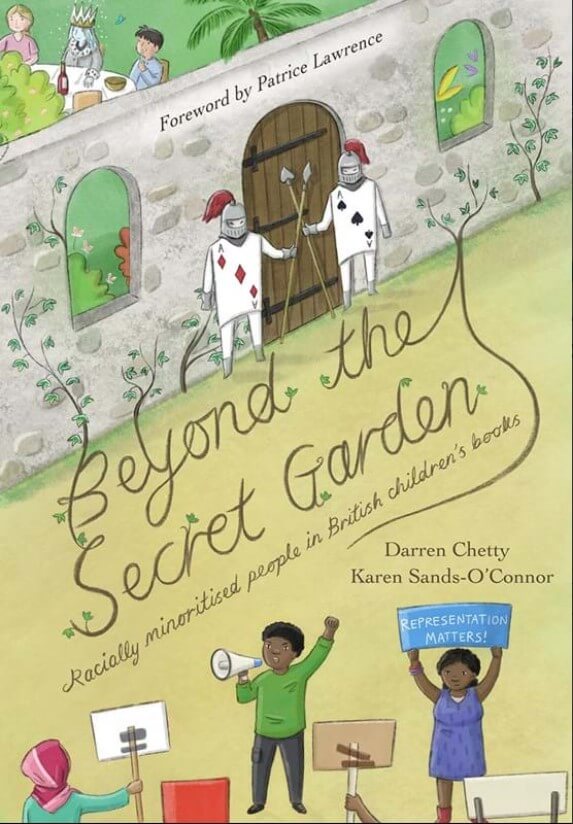
Beyond the Secret Garden

Drawing on and expanding their long-running column for Books for Keeps, Dr Darren Chetty and Professor Karen Sands O’Connor trace how Black and racially minoritised characters have been represented in ‘the secret garden’ of British children’s literature from its earliest stages. Examining how children’s literature has both been shaped by, and shaped, prevailing attitudes towards people of colour, they take a thematic approach that offers teachers and parents contextual knowledge that will enrich how books are discussed with children. 

English Media Centre
Cover illustration by Lucy Farfort

Beyond the Secret Garden has long been my favourite article in the (entirely brilliant) Books for Keeps virtual magazine, exploring the representation of Black and racially minoritised characters in British children’s literature, so when Darren and Karen were supported to expand that into a book by the English Media Centre I was thrilled. It is essential reading for anyone involved in children’s books in any capacity. I’ve heard Darren speak a number of times about the importance not only of representation, but of *positive* representation, in the books children consume. The duo have written us a piece about how teens specifically are engaged.

Teen Readers and YA Books Beyond the Secret Garden

When we conceived of our column, Beyond the Secret Garden, we were mostly thinking about British children’s books and the way that they created a safe haven—adventure without risk, and with a nice hot something waiting to eat or drink at the end of it—but only for certain readers and certain characters.  White British characters in books like Frances Hodgson Burnett’s The Secret Garden (1911) or C. S. Lewis in the Narnia chronicles get to have the adventure, while Mary Lennox’s servants are ‘not people’ and the Pevensie children fight the dark-skinned Calormenes in The Last Battle (1956).  But children’s books traditionally follow a home-away-home pattern, so their main characters are always going to have the keys to the secret garden, and people who are not like them are barred out.  Teenagers, on the other hand, more typically are on a quest away from home, away from safety.  They are, in some sense, leaving the secret gardens behind to find new continents and new worlds, or new ways to be themselves.  So, does that make YA literature inherently beyond the secret garden already?

Historically, the answer is no.  Before YA literature had a label, books for teen boys and teen girls published in Britain had very separate functions.  Books for teen boys, written by the likes of G.A. Henty or Captain Marryat for example, were about conquering and maintaining the Empire, which often involved recreating Britain in far off locations such as India and an often generic version of Africa.  Books for teen girls, such as Julia Horatio Ewing’s Six to Sixteen, were about becoming good future wives and mothers when the adventuring boys returned home. But Henty’s heroes, like the Pevensie children, had ‘savages’ to tame and Margery in Six to Sixteen (1872) exchanges an Ayah’s education for the freedom of the Yorkshire countryside—much as Mary Lennox would do a few decades later. Black and Brown ‘savages’ and servants alike disappear from the narratives the closer the teenaged British character comes to achieving their proper adult role.

Many modern British YA novels begin with the secret garden of childhood already destroyed. Clare Furniss’s The Things We Leave Behind (2024) opens with a picture of the main character, Clem’s, last perfect day, a birthday picnic with nostalgic childhood food and best friends she’d known most of her life.  Yet despite the perfection, cracks are already appearing—Britain (minus Scotland which has seceded) is run by an authoritarian leader who wants to expel or imprison all foreigners and refugees.  This includes Clem’s stepmother, Claudia, who is Jamaican by birth and who is forcibly removed from their home and detained.  Following a mass protest in London, Clem and her younger half-sister Billie (Claudia’s and Clem’s father’s daughter) are separated from their father, and ultimately must escape from London to Edinburgh in order to survive. Clem’s thoughts are constantly on her stepsister, but Billie remains carefree throughout.  The ending of the book contains a reunion, but it is a broken reunion, and the perfection of the picnic birthday is gone forever, as is any semblance of childhood innocence. 

Like Clem, Patrice Lawrence’s character Charlene in Needle (2022) is concerned for her younger half-sister Candy.  However, unlike Clem, Charlene is Black British, living in present-day Britain rather than a dystopia, and the concern she has for Candy is portrayed differently from the concern Clem has for Billie.  Clem’s sense of responsibility for her sister leads to a mental breakdown, which is treated by the adults around her with kindness and compassion.  Charlene, on the other hand, is constantly under surveillance and is always presumed to be leading her sister astray rather than looking out for her.  Charlene does not become mentally ill over her concern for her sister, she becomes angry, and this anger leads to her eventual arrest and a journey through the juvenile justice system.  She, unlike Clem, is not granted a reunion, even a broken one, because she remains angry at those who would separate her from her half-sister, including a foster brother who, despite inciting Charlene’s anger, is free to carry on at university without punishment.  While both books examine teenage experiences outside of the secret garden of childhood, only Clem is allowed to keep sacrosanct the idea of innocent childhood that the secret garden protects, at least in her memories.  Black youths like Charlene, and even Billie, do not get to remain safe in Britain’s secret garden; instead, their well-being is viewed by society as less important than that of the white youths who retain innocence – this is seen starkly in real-life cases of ‘adultification’ where Black children are treated as adults by authority figures..  While all young adult characters may be outside the secret garden, their access to it was never equal to begin with.

Professor Karen Sands O’Connor is Visiting Professor at the University of Sheffield and a former British Academy Global Professor specialising in the history of Black, Asian and Minority Ethnic children’s literature and publishing, and the author of three books on children’s literature. Dr Darren Chetty taught in primary schools for over twenty years. His essay in the best-selling The Good Immigrant has been used in schools, and universities and shared widely in children’s and young adult publishing. In addition to their Books for Keeps column, Darren and Karen advise on CLPE’s Reflecting Realities research and contributed to the CILIP Carnegie Awards Diversity Review.

A Flash of Neon

Laurie loves stories. She loves reading them in her mums’ bookshop in their small Scottish town. She loves sharing them with new readers. She also loves telling stories about people she’s not yet met and places she’s not yet been. But when one of these people comes crashing into Laurie’s world, it turns her whole life upside down.

Neon is the boy Laurie’s been dreaming of for the last six months, and he’s exactly as she had created him – down to his ability to play any instrument he picks up. And when he steps off the train and into Laurie’s world, he teaches her what it means to be real…

Sophie Cameron

This is such a great idea for a story, I had no idea how it would manage to have a satisfying ending and was gripped all the way through. I asked Sophie a few questions!

In your books you introduce something fantastical (or maybe sci-fi) into a contemporary setting as a way of exploring “issues” (grief, loneliness, bullying, self esteem…) without it ever feeling like an “issue” book. In A Flash of Neon, which element was the seed of the story?
The idea for the book actually came from the TV show Catfish, which helps people in online relationships meet their partners, many of whom turn out to be very different from the person they’ve described! I find it fascinating how people can trick themselves into believing what they want to believe – sometimes it seems the person lying has even convinced themself that their stories are actually true, too. I had this idea about a character who makes up an online friend, becomes completely absorbed in the story she’s created, then is stunned when the character appears in real life. Originally I thought it could be a thriller, but it ended up being a light, fun fantasy that explores the boundaries between fiction and reality.
Laurie’s situation with her friends was very believable, what would you say to any child reading this book that feels in a similar position?
Laurie has two best friends who are very nice when she spends time with either of them one-on-one, but have a tendency to gang up on her when they’re in a trio. At first she takes it very personally, but she comes to realise that their behaviour only reflects badly on them, not on her. I think this is a really common situation – I’ve experienced it, too! – and it is really hurtful, but I hope anyone going through it would realise, like Laurie eventually does, that they deserve friends who lift them up and make them feel good about themselves.
There is loads of LGBTQ+ positive representation, and I loved Laurie’s thoughts about whether she actually wants to kiss anyone at all, why do you think it was important to include that indecision?
When I was Laurie’s age a lot of my friends had already had several boyfriends or girlfriends, some even quite long-term. I felt a lot of pressure to catch up, even though at that stage I wasn’t really interested in dating at all. I’m sure some young people nowadays feel the same way, no doubt even more so due to the influence of social media. I wanted to write about a character who feels that pressure but is still questioning who she is and what she wants, and highlight that there’s really no rush for her to decide – Laurie can take her time to work out if dating is something she wants, and if she ultimately realises it’s not for her then that’s totally fine.
As you’re no longer based in the UK, do you get much opportunity to speak to your young readers and get feedback?
Not as much as I’d like! I try to go back to the UK a few times a year to visit friends and family, so occasionally I’m able to squeeze in school visits or other events while I’m there. I also run an English-language book group at my local library in Spain, and it’s been really interesting speaking to young people and finding out about what they enjoy reading at the moment.
What are you reading at the moment and who would you recommend it to?
I recently read The Doughnut Club, a middle grade novel by Kristina Rahim about a donor-conceived girl who finds out she has sixteen half siblings, and really enjoyed it. I’m also reading the shortlist for the 2025 Women’s Prize for Fiction, and my favourite so far has been The Safekeep by Yael van der Wouden.
Anything you can tell us about your next project?
I’m currently working on another teen fantasy novel. It’s still in the early stages so I can’t say much about it, but it’s my first book set outside Scotland – it takes place in a Spanish holiday resort that is nearly deserted due to some mysterious goings-on that have scared all the tourists away.