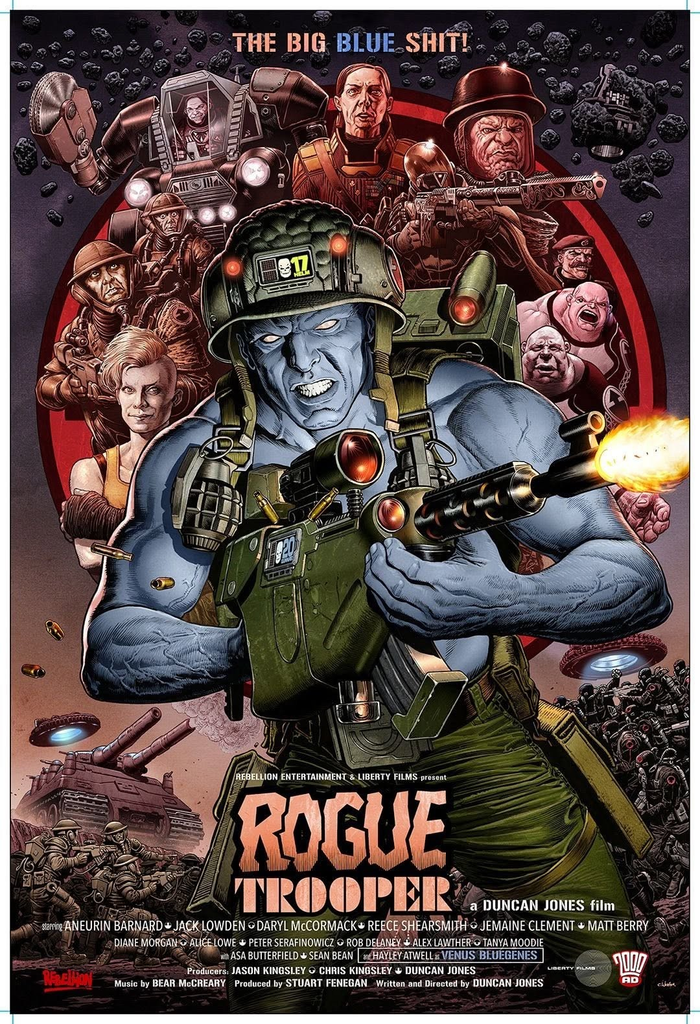
Earlier this month, I attended the London Film Festival for one of the three screenings of Duncan Jones’s new film, Rogue Trooper. I have been eagerly awaiting this opportunity since July 2018, when Jones (best known for Moon and Source Code) first announced his plans to adapt the classic 2000 AD comic.
Animated entirely in Unreal Engine, the movie is a fast, funny, and bold sci-fi adventure. It follows “19” (voiced perfectly by Aneurin Barnard), a blue-skinned, genetically engineered super-soldier and his companions fighting a never-ending war. The stellar voice cast truly elevates the material, featuring Hayley Atwell alongside brilliant comedic performances from Jemaine Clement and Matt Berry as a pair of amoral scavengers. Rather than trying to be a high-brow drama, it is an action-packed, old-school war movie that knows exactly what it wants to be and nails it.
I attended the screening with long-time friend James Swallow, author of the tie-in novel Blood Relative. We both agreed that Jones handled the difficult jump from page to screen with deep respect, fully embracing the bizarre, gritty nature of Nu-Earth without trying to modernise or water down its weird origins. By choosing 3D animation, Jones was able to affordably build a toxic, war-torn world while retaining the dark humour and harsh aesthetic that made the comic a cult favourite. It is clearly a labour of love that captures the wild spirit of the source material while still feeling entirely fresh.
As a bonus for librarians managing young adult collections, this film should directly to today’s teenagers. Its visual style, reminiscent of high-quality video game cutscenes, perfectly bridges the gap between console gaming and the graphic novels sitting on library shelves. It offers young people a highly accessible way to explore mature themes like bioengineering, cloning ethics, and the mental toll of war. As a lifelong fan, I know I am biased, but in a time where comic book films often devolve into indistinguishable slop, Rogue Trooper goes against the grain. It is a refreshing homage to its roots that feels destined for a passionate cult following, if only in the UK.
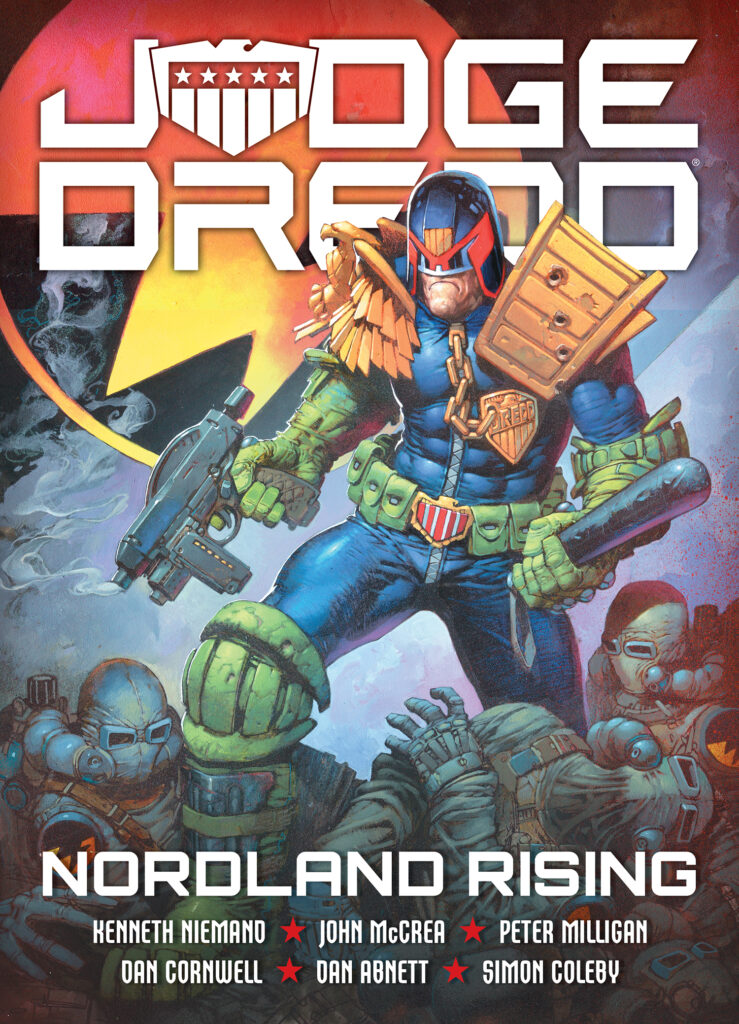
Thanks to advances in Nort technology, War Marshal Josef Jaegir has used the black hole around which Nu Earth orbits as a means of invading other universes.
Reaching out to Sov War Marshal Kazan, he’s joined forces with East-Meg One to subjugate Mega-City One, and in other realities the Norts have allied themselves with the alien Krool, the Geeks, the Volgans and the Nazis. It’s a war on all fronts, with Jaegir demanding nothing less than total victory.
Meanwhile, Venus Bluegenes has used a d-jump device to hop between the universes and recruit fighters from the various affected realities – Bad Company, the V.C.s, Captain Constanta and his Fiends, Major Eazy – and brought them back to MC-1. Now, Dredd, Anderson, Rogue Trooper and Atalia Jaegir – rebelling against her father – have assembled strike-teams to go after the enemy…
I am not always a fan of cross-overs, too often they can feel pandering to fans and do nothing to change the status quo of comic book world. Fortunately 2000 AD as a publisher has never been afraid of shaking up the ant farm and giving some of the ants more advanced weaponry just to see what happens.
Nordland Rising feels as if it was written just for me! They gave me some characters that I had been missing (Atalia Jaegir, Bad Company and Major Eazy), added in some of my regular favourites Dredd, Anderson the Rogue Trooper and a bunch of other fantastic characters, then gave the keys to amazing authors and artists and voila! A story that gives a deeper understanding of the 2000 AD multiverse as it is, and leaves enough story strands trailing for a revisit down the line, but complete enough to be enjoyed if they decide not to revisit it.
Obviously, as with any comic that has been going for almost half a century there is a ton of character lore and quirks that have developed over the decades that long-time fans will get more out of this work than new readers. But it provides a decent jumping on point for new or casual readers.
Nordland Rising, as with many 2000 AD titles takes a jaundiced eye to those who view war and destruction as viable methods of getting their point across, mixing in fun, bloody violence and a take no prisoners approach to saving the Multiverse (I hope that Marvel will take some notes on how to handle a great Multiversal story).
Nordland Rising is out now from 2000AD, buy it AND/or order it form your local library – they need some new comic books!
On the planet Deadworld, the insane Judge Death and his lieutenants Fear, Fire and Mortis have deemed that as only the living could break the law, life itself should be a crime, and living person is due their judgement. As the Dark Judges set out to bring extinction to their world, a small group of rebels led by Judge Fairfax launch a desperate effort to halt their city’s conversion into a Necropolis.
In the midst of all this chaos, the neighbouring Soviet forces launch an attack on their American enemies in a bid to stop the devastation.
You don’t need to know anything about Judge Dredd or the Dark Judges to pick up and read The Fall of Deadworld (but it helps give a deeper appreciation of the story). Being a near lifelong 2000AD reader I have read much of the backstory already, Judge Dredd stories that feature megadeath are pretty much par for the course in a post nuclear war world; who does not love reading about a fascist lawman defending his city and citizens from ever worse threats from beyond the city walls?
If you want to read the first stories of how Dredd and Judges Fear, Fire, Mortis and Death first met go to your local library and learn how inter-library loan works (if you have not already discovered it), you will decades of works to read through. Or you could buy them from the 2000AD shop or even your local comic store!
Enjoying this story is another issue, it is not a fun comic, this story is so bleak, but remains eminently readable and utterly compelling! I have read most of it already in weekly instalments but having the story so far it in one collection it hits harder with no waiting to give you a break from the bleakness and blooms of hope that the characters still have. I found myself poring over the pages, soaking in the art of Dave Kendall and the storytelling skills of Kek-W! These two are perfectly matched for this world! I read it, knowing what the destination is going to be, but knowing where does not tell us how, and in The Fall of Deadworld we are starting to get the answers that have been brewing for years!
For decades now, John Wagner has been my favourite Dredd writer, but lately his place at the top has been threatened by Rob Williams(seriously his run on Judge Dredd has been out of this world!), and more recently by Kek-W mostly thanks to this stunning story.
The Fall of Deadworld is a worthy addition to the Dark Judges mythos, and one that I hope presages stories (and maybe even another Mega-epic) yet to come of their attempts to fulfil the punishment of a world that has been found guilty of the crime of life!
Buy it or borrow it but read it you must! You won’t regret it – trust me, I am a Librarian!
Hello, and thank you for taking the time to answer a few questions about Death to Pachuco. Before we begin, could you please introduce yourself to those reading this who may not be aware of who you are? I’m Henry Barajas. My roots are in Tucson but I live in Los Angeles. My passion is making comic books. My most notable work is La Voz De MAYO Tata Rambo art by J. Gonzo, letter art by Bernardo Brice, and edited by Claire Napier.
Are you able to give an elevator pitch to convince a potential reader to pick up a copy of Death to Pachuco?Death to Pachuco is a chicano noir taking place during 1940s war-time Los Angeles centered around racist events: the Sleepy Lagoon Murder Trial and Zoot Suit Riots.
How did you and Rachel come to collaborate on Death to Pachuco A mutual friend shared Rachel’s “Adult Romance” comic online. I was looking for an artist to work with on DTP and her sensibilities and inking style drew me to her work. I respect that she has her own style when there tends to be a homogenized artistic standard. She’s not trying to draw like anyone else, but good at extracting her influences.
How did you and Rachel come to work together? Was there a strict separation between writing and art or was it a more back-and-forth collaborative approach? Thankfully, she started working on Gil Thorp with me. This was our chance to fine tune the band and get us ready for something larger than what we’re used to doing. I write full scripts. She would do some breakdowns; ultimately, we went straight to inks for DPT because she had an idea of what I was looking for. She is good at taking notes but also shows the professional attitude to learn and apply it to her craft. I also letter the comic, so I was able to make adjustments to my script to fit the structure of the page. The editor, Will Dennis, was key to bridging a lot of communication and having a third person to have a more objective voice to what worked and what didn’t.
Originally, this was going to be black and white. But the comic book gods blessed us with Lee Loughridge. He was able to fit us in his busy schedule and made the whole book sing.
What is the background to the story of Death to Pachuco? The background for me is the uncomfortable truths and history this country would much rather forget than learn from. Immigration and Customs Enforcement (ICE) has been supercharged for the purpose of terrorizing and maintaining white supremacy. This was what happened during the 1943 Zoot Suit Riots. The sailors took justice upon their own hands and tried to beat, strip, and burn Mexican counterculture appropriated by Black jazz musicians. I tried to make that clear without spelling it out for people.
How much research went in to creating this story?La Voz de MAYO was a four-and-half year long journey of research. I learned from that. Story supersedes research. You can have all the answers, but if your story sucks, no one will care. Thankfully, that wasn’t the case with La Voz. But I could’ve done one more project in those five years. I give myself a year of pre-production that usually takes place while I’m working on something else. But I’m getting older and slower, so I am starting from scratch again with my current project.
For people who may be interested in L.A. in the 1940’s and the Zoot Suit Riots what works can you recommend? I would say Manuel Ramos’The Skull of Pancho Villa and Other Stories. He’s the godfather of Chicano noir. The obvious is Raymond Chandler’s Phillip Marlowe series, and The Good Asian by Pornsak Pichetshote, Alexandre Tefenkgi, and Loughridge. DTP is the first comic I have woven film as a major reference in my work. I would say the 1952 classic No abras nunca esa puerta by Carlos Hugo Christensen is a gem I watched thanks to the Noir City Film Festival.
For those readers who after finishing DtP may want to read more of your works, what can you recommend? (either in print or online) My work with the Civics For All group that educates the NYC public students. I wrote two comics for hispanic history, one on Dolores Huerta and migrant farmworkers and Sal Castro. Free to read and download.
What are you reading at the moment? I am inspired by Jazmine Ulloa’s El Paso nonfiction book on the incredible relationship the US has with El Paso specifically. It’s truly the Ellis Island of the Southwest.
Thank you for giving up your time to answer these questions! Thank you for reading and supporting our work!
During the summer of 1943, Los Angeles became a hotbed of tension and conflict as a series of fierce clashes erupted between U.S. Navy members and Mexican American youth stemming from the murder of Carlos Urbano. Private eye Ricardo “Ricky” Tellez needs to find the Sleep Lagoon Killer before the racist mob kills him in the Zoot Suit Riots.
The clock is ticking—and it’s a bad time to be a Mexican.
TL;DR Review: A bloody brilliant example of Chicano Noir that belongs in any (& every) collection! Henry and Rachel’s writing and art complement each other in this grim and engrossing historical mystery! Buy it and read it – you will not regret it! Trust me I am a Librarian!
—
Just in case you were wondering: Pachuco: (slang) a young Mexican-American having a taste for flashy clothes and a special jargon and usually belonging to a neighborhood gang Thanks to Merriam-Webster
I got pulled into appreciating noir early in life, thanks in part to being exposed to Chinatown and The Maltese Falcon as a child. In recent years comic noir has held my interest due to the works of Ed Brubaker, Frank Miller, Jason Aaron and Greg Rucka to name but a few! To my personal canon of favorite graphic novel noir yarns I have now added Death to Pachuco by Henry Barajas and Rachel Merrill. A dark detective yarn that took me down the gritty streets of the 1940’s City of Angels, serving up action, mystery, morally ambiguous characters and shining a light on the historical plight and experiences of Mexican-Americans in California. All in all a phenomenal introduction to the Chicano Noir subgenre that has left me wanting more! Fortunately this is only the first of what I hope will be many stories about Ricky Tellez.
One of the things I love about reading is, that almost without exception I learn something new no matter what I am reading. Death to Pachuco introduced me to so many things I had no idea existed or only had a passing knowledge about, from the Zoot Suit Riots and the Sleepy Lagoon Murder to the Tongva people, the history of Los Angeles (Calle Olvera, Rancho Rodeo de las Aguas and other places – I have bookmarked a number of sites to read at my leisure and indulge my joy of learning about history).
I have been a fan of Henry’s work for a few years now, thanks to an interview with him I heard on All Things Considered where he discussed Helm Greycastle and discussed La Voz De M.A.Y.O.: Tata Rambo based on the oral history of Ramon Jaurigue, an orphan and WWII veteran who co-founded the Mexican, American, Yaqui, and Others (M.A.Y.O.) organization. I also highly recommend those two works, they are phenomenal and would make worthy additions to personal and library collections!
In Ricky Tellez, Henry Barajas has created a quintessential noir protagonist, damaged, flawed and haunted by his past but still driven to do the right thing. Rachel Merrill’s art style is perfect for noir storytelling!
Death to Pachuco was created by Henry Barajas and Rachel Merrill. It is published by Image Comics and will be available wherever comics can be purchased on April 14.
You can also find Henry and Rachel collaborating on long-running sports comic strip Gil Thorp.
Hi Alex, welcome to TeenLibrarian and thank you for taking the time to answer some questions about your amazing Full Tilt Boogie!
Alex de Campi: Hi Matt! It’s great to be here, thank you for having me!
First question – when developing FTB, what came first, the title or the story?
de Campi: They sort of both happened at the same time. I used to do a lot of sailing when I lived in Hong Kong, racing dayboats called Etchells, and some of the boats had just fantastic names. I mostly raced on a boat called Bellwether, there was an Aussie boat called Lunchcutter, and then another boat called Full Tilt Boogie. I thought, what a great name that would be for a spaceship!
The FTB story came about through me having grown up on the US dubs of Gatchaman and Space Battle Cruiser Yamato, and wanting to take the things I loved about classic Japanese space opera anime and maybe deconstruct them a little, while also keeping both the emotional arcs and the funny moments.
I’d spent a lot of time before and during FTB working on books that were more grounded and needed more research, or at least were nominally set in the real world—Bad Girls, Dracula, Motherf**ker!, Parasocial, Bad Karma. So FTB was its own special treat where I could just let my imagination run wild and make things up as I went along—and a whole galaxy to play in!
How did you first get to work with 2000 AD, the galaxy’s greatest comic?
de Campi: I lived in the UK for a long time, and had a lot of friends who wrote and/or drew for the Prog. Tharg’s door was always open to me, I just never… walked through it, until noted Dredd writer Art Wyatt (Judge Dredd: A Better World and more) kind of strongarmed me through it. He just told me we were writing a Dredd miniseries together.
2000 AD is really refreshing to write for as a woman writer, because they just don’t care. I’m so used to the big US comic companies only wanting women to write niche or female-led books, but Tharg was immediately like “yeah here’s Dredd, you can kill him if you want” (it was a Dredd movieverse series).
I can’t tell you how unlikely it would be for DC to call me up and go “yeah here’s Batman, go for it” and Marvel—well, it’s the year of our lord 2025 and Iron Man has still never had a woman writer. But for Tharg, to paraphrase Neko Case, I wasn’t a woman in comics—I was a writer in comics. And that made all the difference.
If you had to give an elevator pitch to a reader that was not sure about picking up a copy of FTB how would you describe it to them?
de Campi: Broke teenager and her cat jobbing in the galactic gig economy as a bounty hunter accidentally restarts thousand year old galactic war. There’s also a teen super sentai team but some clubs turn out to be a real bummer after you join.
FTB is a glorious love-letter to space opera – what were your inspirations in writing this story?
de Campi: Heavens, so much—from Lois McMaster Bujold’s Vorkosigan books to classic Japanese space anime (and even more modern ones like Witch from Mercury).
Full Tilt Boogie made its first appearance in an issue of 2000 AD Regened – a special aimed at attracting younger readers. Apart from FTB can you recommend any of the other Regened stories to readers new to 2000AD?
de Campi: My absolute fave from Regened is Roger Langridge and Brett Parson’s Pandora Perfect—what if teenaged Mary Poppins was a cat burglar? Honestly anytime you see Roger Langridge’s name on a book you should pick it up, he’s one of our greatest writers.
Do you have a favourite 2000 AD character and are there any that you have a hankering to write for?
de Campi: I’ve been doing a few Judge Anderson (Psi Division) scripts recently and I find I have a lot more Anderson stories in me than Dredd ones—which is good, because Art Wyatt and Rob Williams are just turning out epic Dredd story after epic Dredd story, the SMALL HOUSE > CONTROL -> A BETTER WORLD run is one for the ages.
I like digging into the weird side of Mega-City One. I like Judge Giant, I know he just went to space in ENCELADUS but I want to do an Expanse-style story with him.
I would like to ask one question about Rogue Trooper (if I may) – he, Helm, Gunnar and Bagman are some of my all-time favourite characters in 2000 AD, did you feel any pressure about being given the keys to Nu Earth ahead of Duncan Jones’ movie? (I am also a fan of your collaboration Madi that came out a few years ago)
de Campi: I was PETRIFIED. I felt so much pressure, but it was all self imposed. The brief was to create something that would fill in new readers on classic Rogue Trooper, but not be a retread, or a full reimagining. Sometimes you spend ages circling a story and trying to figure out a way in, but then when you do it all falls together with a certain inevitable elegance. That was GHOST PATROL, the long Rogue Trooper story Neil Edwards (who is KILLING it on art) and I have starting in September in the Prog. I hope readers like it. The 2000 AD audience has been very kind and supportive of my work so far, so fingers crossed.
And we just reissued MADIin a revised, refreshed, expanded edition with Image Comics, which means we finally have a digital edition available on Hoopla/Libby!
Where can readers find you online if they want to find out more about you and your works?
de Campi: I’m really only on Bluesky now: @alexdecampi.bsky.social. I also have a free newsletter, buttondown.com/themagpie, which is kind of monthly and filled with strange gain and interesting links.
Full Tilt Boogie is written by Alex de Campi, drawn by Eduardo Ocaña and will be published by 2000AD on October 21. It will be available wherever great comics are sold! You should order yourself a copy or request that your local library purchase a copy, you will not de disappointed! Trust me I am a Librarian!
School girl. Skater boy. What if neither label fits? A poignant LGBTQ+ graphic novel about self-discovery, skateboarding and finding your true community of friends, perfect for fans of Heartstopper.
At school, Elliot gets bullied for being ‘different to other girls’ whereas at the skate park, everyone welcomes Elliot – presuming they’re male – but neither label feels right.
As Eliot’s love of skateboarding and friendships grow, their worlds collide at a sports expo where the school netball team and skate crew are competing. Can Elliot find the courage to share what they’ve learned about non-binary identity? Will best friend Jess or the skateboarding crew accept Elliot for who they are? And what about Ryan, the skater who Elliot has been feeling increasingly close to?
The first volume of a new graphic novel series that will steal your heart!
As I said on Bluesky earlier today, I don’t want to just say you should read KickFlip because it is an important book at this point in time, coz it undoubtedly is…I mainly want you all to read it because it is a heartwarming, funny, thoughtful story of friends & family & finding yourself. I loved everything about it, but especially how supportive Elliot’s mum is (and L.D.’s response below about what teen readers want is really interesting regarding parents in stories).
I loved Jamie by L.D. Lapinski, a middle grade story of a non-binary child faced with choosing between the boys and girls secondary schools in their town. Jamie was quite certain about their identity, but it doesn’t come so easily to everyone, and I think a comic style was such a wonderful choice of medium for KickFlip, to convey the thoughts of a questioning teen really succinctly and powerfully.
L.D. and Logan have both given some great recs below for other reading, but I’d like to quickly shout out HomeBody (which has just won the shadowers’ choice award for the 2025 Carnegie medal for illustration) and the teen novel ‘Jay’s Guide to Crushing It’ by Ruby Clyde.
I had a few questions for LD and Logan:
LD: did you want to write a graphic novel & come up with a story, or did you think of Elliot and decide a graphic novel was the best way to tell their story?
Kickflip was born during a teaching session, when I was working with young adults to improve their own diverse stories as part of a scheme with Pop Up Projects. We were discussing what they as readers in their teens wanted to see in a queer story, and what they were sick of seeing. They wanted a coming-out story, they wanted the main character to have a hobby that they loved, they wanted to see relatable struggle and a plotline that didn’t shy away from bullies but did have supportive friends or family. The discussion got filed away, but the idea of a trans character discovering themselves through a hobby kept nagging at me. At that time, I was not very sporting, but I knew I wanted the character to do something physical, to learn to be comfortable within their body, as they learned to use it in other ways. Skateboarding seemed like a natural choice, given that it’s typically very masculine, split-gender when it comes to competitions, and something that you could stumble across in the park.
Elliot arrived in my head more or less fully-formed… With JAMIE about to be published at that time, I didn’t feel that a prose book was the way to go; it felt too repetitive. I’d never written a graphic novel script before, but I had written teleplays at uni, so decided to write Elliot’s story that way, in the hopes I would be paired up with an artist, like a picture book writer, if it sold to a publisher.
LD: Having written the script and worked with an artist, what is the main difference between this and writing full text novels? Do you have a preference?
I can’t speak for other comic script writers, but for me this was very much a filmic experience – I could see Elliot and their friends in my head, but the actual interpretation of them was down to Logan, with support from designers Sam and Caitlin. In that way, they were the casting directors and film-makers, and I was the script writer who’s just excited to see their story come to life! When it comes to writing prose novels, you have to describe a lot, and in this script there was very little description – only what was important to me to include.
Logan: How did you get involved in the project?
I met my art director, Samuel Perret, a few years ago at a conference called New Designers. My illustrations were on display and I got asked to sample for a skateboarding comic about a non-binary character about a year later (Kick Flip, but I didn’t know that yet!!) This was my dream commission so I was really excited. After creating a few different examples of characters and skateboarding spreads, I was asked to illustrate LD’s story!
Logan: Who was your favourite character to draw?
My favourite character to draw was Elliot – I spent a lot of time imagining what their days looked like and how they would react to things. Every time I draw them it feels like drawing someone I know really well. I also have a soft spot for Alex – he’s such a goof and I kept trying to make myself laugh by making his expressions weirder and weirder in different scenes!!
Have you any advice for adults working with teens in libraries about how to be obviously but professionally inclusive and supportive?
LD – We’ve come a long way since the days of Section 28, but the recent government attitudes in the UK will be making some teens and young adults wary about who is a safe adult to be themselves around. Having a well-stocked and diverse library is always a good way to be supportive, and simple initiatives like a Pride display say a lot without using words.
Logan – Having a diverse selection of books on display, and being open to any questions from readers. Understanding pronouns and LGBTQ+ identities – theres a lot of charities like Mermaids UK, The Trevor Project and Stonewall that have educational resources on their websites. All the incredible librarians throughout my life have always opened the door to learning and encouraged questions and new ideas. Helping students feel safe enough to talk and learn about themselves is a huge step – and fostering a safe space where they can be who they are.
Are there any other books that you wish you could have read as a teen?
LD – I think comics like HEARTSTOPPER, BLOOM, THE GIRL FROM THE SEA and WELCOME TO ST HELL would have made a world of difference to me as a teenager! Queer books were banned in schools until I got to university in 2003, and I remember borrowing Judith Butler’s GENDER TROUBLE from the uni library so often that I got a warning about it…!
Logan – I wish I could have read Tillie Walden’s comics as a teen. I love the way she draws, talks and thinks about comics. I grew up with a lot of traditional super hero comics and didn’t really relate to the characters – even though I loved the stories and the drawings. Seeing diverse casts of characters who are openly LGBTQ+ in comics is really exciting. I didn’t see a lot of comics about everyday life when I was a kid – it’s great to see more artists like Alice Osman, Maia Kobabe and Tillie exploring that today.
What are you reading at the moment and who would you recommend it to?
LD – I’m reading Greenwild: The Forest in the Sky by Pari Thomson. Definitely a great read for fans of The Strangeworlds Travel Agency, Pages and Co., and Nevermoor.
Logan – I’ve just started a manga called ‘The Summer Hikaru Died’ by Mokumokuren. It has queer characters/themes with a supernatural twist – my favorite!! I’d recommend it to anyone who loves comics and manga who is looking for more LGBTQ+ representation.
L.D. Lapinski (photo credit: Karen Thorburn) and Logan Hanning
Thank you so much to Orion books for an early reading copy, LD & Logan for thoughtful answers, and to everyone involved in creating the book. It is out in the UK now!
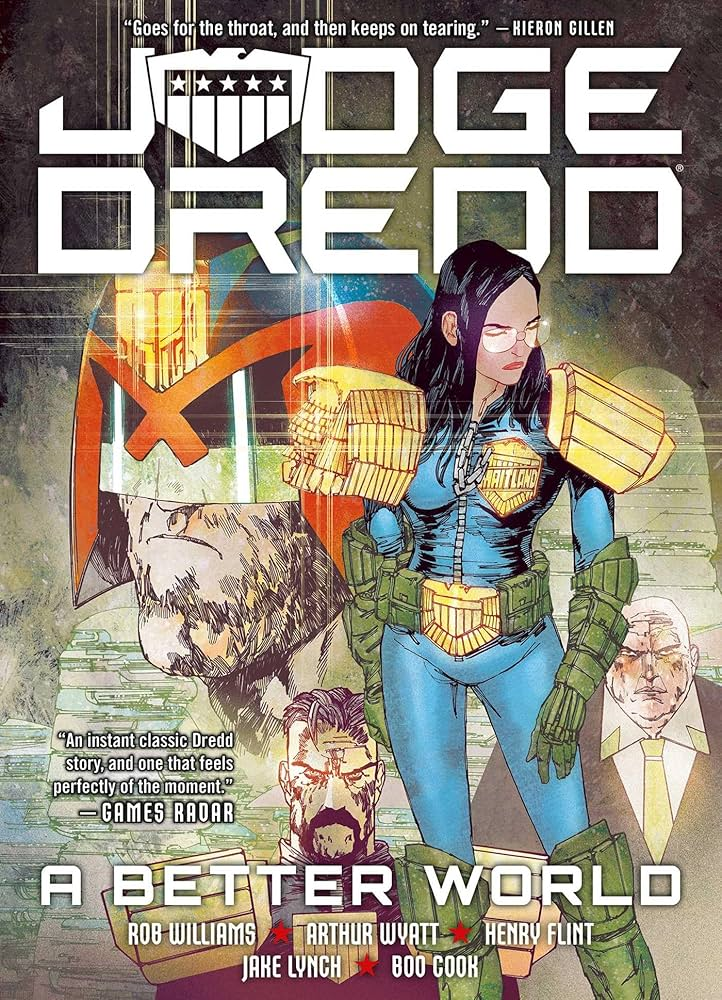
Judge Maitland has a plan to lower the crime rate of Mega City One: divesting funds from Justice Department into education and services that would benefit the average citizen. She is given one year to improve one sector of Mega-City One; one year to succeed, and create a better world.
But when her plan begins to work, and Justice Department decides to roll it out over ten more sectors, citizens like vid-news mogul Robert Glenn and Judge Hernandez – who have a vested interest in keeping the status quo – step in to spoil the experiment using whatever means are at their disposal.
Judge Dredd started out as a satire of British and American culture, with a focus on authoritarianism and police brutality. As I have grown older and slightly more jaded I have looked at the ramping up of militarized policing around the world and begun to wonder if some people have looked at these comics and thought “Hey this is a good idea!” instead of “Gosh this is a bit much – maybe we should not go down this road!”
Dredd has never been the good guy, in his words he is The Law. Judgement and punishment doled out without fear or favor to the deserving and often to those who commit crimes like eating sugar, or taking their teacher a fresh apple. It was ever a warning, given with a nudge and a wink but the joke has never been funny (except for the stories that were written to elicit a laugh).
A Better World is a Judge Dredd story that is as near to perfect as you will read, Rob Williams has become one of my favorite Dredd writers and, though it may be heresy to say, his take on the lawman of the future often builds upon and surpasses the works of John Wagner. This story is a timely take on the defund the police movement that has been rolling around the United States in recent years, except in this case, that call comes from within the Justice Department. Judge Maitland is a young Judge that earned the trust of Judge Dredd in one of his earlier cases and provides insights and thoughts that Dredd himself, due to his nature cannot envision or express.
Mega City One has been through a lot over the decades and the Judges and what citizens are left after Apocalypse Wars, Zombies, Dark Judges and more eventually something will have to give. So when Maitland approaches Dredd after her research shows that ploughing money, education and services into deprived areas will change the lives of the citizens of MC1 and make them less liable to become perps she has to take it before the ruling council (of five) of the City.
Hope is dangerous, if you are not careful it will get you killed!
I have been a fan of 2000AD for most of my life, and loved the Dredd stories in particular, but living i a country where firearms are fetishized to the nth degree and the police are lauded as incorruptible paragons of virtue while given billions in funding at the expense of other services it taints my enjoyment somewhat as the line between satire and reality is so indistinct as to be invisible! Oh I love this story, I want to push it into the hands of everyone (and particularly those who hold financial control over towns and cities).
A Better World *is* possible, not just in the pages of Judge Dredd but in our world too. I would like to thank Rob and Arthur for creating a story that elicited a bone-deep feeling of despair and hope within me that I feel every time I read this work.
Get yourself a copy! In its pages you may just find your favorite graphic story of the year.
OCT 2024 – Rebellion Publishing is celebrating the launch of The Monster Fun Collection with special “tear-away” posters across the UK.
Four “tear-away” posters can be found across London, Birmingham, Glasgow, and Manchester. These offer kids and parents the chance to tear off and keep a giant A3 comic page from The Monster Fun Collection’s Steel Commando: No Time To Lose and The Leopard From Lime Street: Birthright stories. The posters are on display now until 20th October, and can be found at:
London – opposite Lewisham Station, in archways
Birmingham – Highgate Road, by Woodfield Road
Glasgow – Skypark, Pointhouse Road
Manchester – Trinity Way
“We wanted to do something exciting to celebrate our new line of Children’s graphic novels, and it’s not often you can go on a hunt for a giant comic page with your kids,” said Rebellion CEO, Jason Kinglsey CBE, “It’s so important to find new, fun ways to get children excited about reading, and we’re proud of what we have already achieved with our Monster Fun series. Now, our latest comic The Monster Fun Collection offers children a fun reading experience, focused on some of their favourite characters.”
The Monster Fun Collection gathers two adventure stories from the monthly Monster Fun children’s comic, which launched in April 2022 with a changing roster of characters inside.
“With The Monster Fun Collection we want to show children that reading can be fun and exciting, and these installations do exactly that!” said PR and Marketing Manager, Jamie Elby, “I’m thrilled we could showcase The Monster Fun Collection with giant comic page to take home, and parents and young readers can know The Monster Fun Collection is here and ready to add some epic thrills to reading time!”
Steel Commando: No Time To Lose sees World War II robot hero Steel Commando travel across past, present, and future to defeat the forces of evil on an epic time-travel adventure. Meanwhile, The Leopard From Lime Street: Birthright sees young Billy Farmer unlock his powers after being bitten by a radioactive leopard (these things happen, right?), uncover family secrets, and just maybe save his home town from destruction from dastardly super villains.
Both Steel Commando: No Time To Lose and The Leopard From Lime Street: Birthright can be purchased now on Amazon or in the Monster Fun webstore, with an RRP of £9.99. More entries in The Monster Fun Collection will be coming in 2025
JULY 2024 – “Everyone’s gearing up for big superhero moments in the cinema, but Deadpool and Wolverine isn’t for all comic book fans – but our graphic novels are! With super cool heroes that can rival those big screen characters.” says Monster Fun Editor Keith Richardson, as Monster Fun launches it’s first two graphic novels in The Monster Fun Collection this summer. This new range of graphic novels for children aged 7-12 collects up exciting stories from the epic Monster Fun comic, giving children a whole new range of books to love!
In fact, our new graphic novels will keep kids entertained throughout the summer holidays. Keith continues, The movie’s age rating prevents so many young comic book fans from experiencing it. But The Monster Fun Collection won’t be doing that. We have brilliant books with stories suitable for all ages, and definitely a great alternative for those who won’t be allowed in to see the movie!
The Monster Fun Collection aims to undoubtedly be the highlight of this year’s school summer holidays. After all, it’s not every day that a brand new line of children’s graphic novels launches!
The Children’s Book market shows children are devouring graphic novels like never before, with 425% volume growth in the category since 2019 (Source: The Bookseller), providing a more fun reading experience over traditional novels. The heroes of our graphic novels may have graced just the pages of the Monster Fun comic rather than the silver screen, but will provide the same amount of joy and entertainment to those who read them – as well as the main hero of each book having been around years longer than Marvel’s big screen characters!
The Leopard From Lime Street is the UK’s answer to Spider-man, and was published for over a decade before Marvel’s merc with the mouth even graced a comic book page. Meanwhile, whilst Wolverine made his first appearance in 1974, our very own metal-plated soldier Steel Commando has been kicking around since 1970! Whilst the versions found in The Monster Fun Collection are rebooted for a new generation of readers, the admirable qualities and fun stories that made these characters endure the test of time are present in the new graphic novels.
So what are the new books all about? Steel Commando: No Time To Lose sees World War II robot hero Steel Commando travel across past, present, and future to defeat the forces of evil on an epic time-travel adventure, whilst The Leopard From Lime Street: Birthright sees young Billy Farmer unlock his powers after being bitten by a radioactive leopard (these things happen, right?), uncover family secrets, and just maybe save his home town from destruction from dastardly super villains.
The brand new Monster Fun Collection graphic novels, Steel Commando: No Time To Lose and The Leopard From Lime Street: Birthright can be purchased now on Amazon or in the Monster Fun webstore; where individual issues, international orders, and subscriptions to the monthly Monster Fun comic can also be purchased.