
Hello, and thank you for taking the time to answer a few questions about Death to Pachuco. Before we begin, could you please introduce yourself to those reading this who may not be aware of who you are? I’m Henry Barajas. My roots are in Tucson but I live in Los Angeles. My passion is making comic books. My most notable work is La Voz De MAYO Tata Rambo art by J. Gonzo, letter art by Bernardo Brice, and edited by Claire Napier.
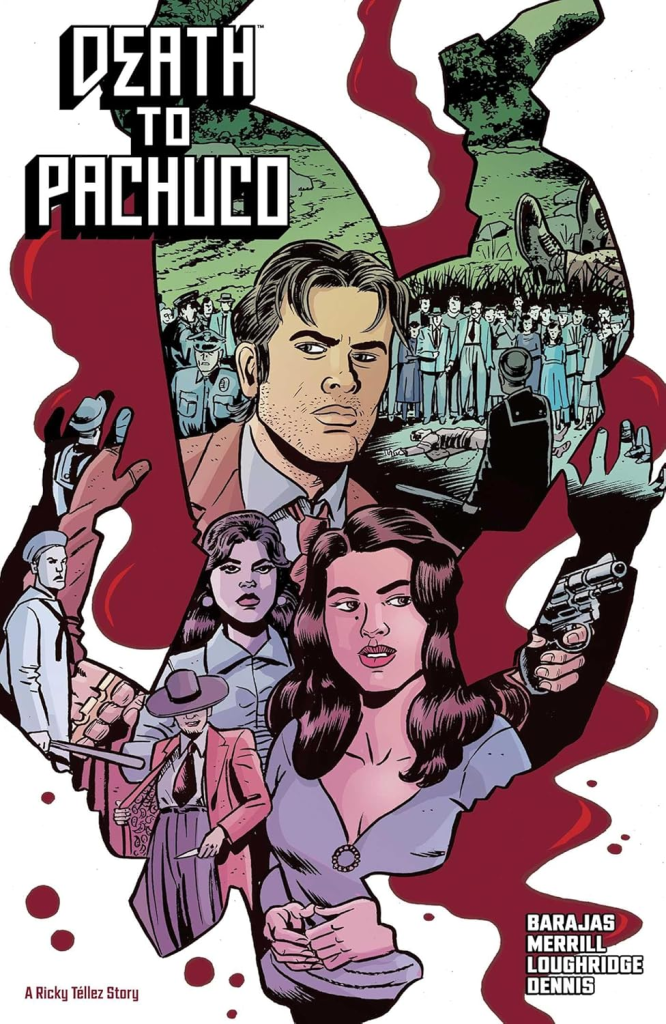
Are you able to give an elevator pitch to convince a potential reader to pick up a copy of Death to Pachuco? Death to Pachuco is a chicano noir taking place during 1940s war-time Los Angeles centered around racist events: the Sleepy Lagoon Murder Trial and Zoot Suit Riots.
How did you and Rachel come to collaborate on Death to Pachuco A mutual friend shared Rachel’s “Adult Romance” comic online. I was looking for an artist to work with on DTP and her sensibilities and inking style drew me to her work. I respect that she has her own style when there tends to be a homogenized artistic standard. She’s not trying to draw like anyone else, but good at extracting her influences.
How did you and Rachel come to work together? Was there a strict separation between writing and art or was it a more back-and-forth collaborative approach? Thankfully, she started working on Gil Thorp with me. This was our chance to fine tune the band and get us ready for something larger than what we’re used to doing. I write full scripts. She would do some breakdowns; ultimately, we went straight to inks for DPT because she had an idea of what I was looking for. She is good at taking notes but also shows the professional attitude to learn and apply it to her craft. I also letter the comic, so I was able to make adjustments to my script to fit the structure of the page. The editor, Will Dennis, was key to bridging a lot of communication and having a third person to have a more objective voice to what worked and what didn’t.
Originally, this was going to be black and white. But the comic book gods blessed us with Lee Loughridge. He was able to fit us in his busy schedule and made the whole book sing.
What is the background to the story of Death to Pachuco? The background for me is the uncomfortable truths and history this country would much rather forget than learn from. Immigration and Customs Enforcement (ICE) has been supercharged for the purpose of terrorizing and maintaining white supremacy. This was what happened during the 1943 Zoot Suit Riots. The sailors took justice upon their own hands and tried to beat, strip, and burn Mexican counterculture appropriated by Black jazz musicians. I tried to make that clear without spelling it out for people.
How much research went in to creating this story? La Voz de MAYO was a four-and-half year long journey of research. I learned from that. Story supersedes research. You can have all the answers, but if your story sucks, no one will care. Thankfully, that wasn’t the case with La Voz. But I could’ve done one more project in those five years. I give myself a year of pre-production that usually takes place while I’m working on something else. But I’m getting older and slower, so I am starting from scratch again with my current project.
For people who may be interested in L.A. in the 1940’s and the Zoot Suit Riots what works can you recommend? I would say Manuel Ramos’ The Skull of Pancho Villa and Other Stories. He’s the godfather of Chicano noir. The obvious is Raymond Chandler’s Phillip Marlowe series, and The Good Asian by Pornsak Pichetshote, Alexandre Tefenkgi, and Loughridge. DTP is the first comic I have woven film as a major reference in my work. I would say the 1952 classic No abras nunca esa puerta by Carlos Hugo Christensen is a gem I watched thanks to the Noir City Film Festival.
For those readers who after finishing DtP may want to read more of your works, what can you recommend? (either in print or online) My work with the Civics For All group that educates the NYC public students. I wrote two comics for hispanic history, one on Dolores Huerta and migrant farmworkers and Sal Castro. Free to read and download.
What are you reading at the moment? I am inspired by Jazmine Ulloa’s El Paso nonfiction book on the incredible relationship the US has with El Paso specifically. It’s truly the Ellis Island of the Southwest.
Thank you for giving up your time to answer these questions! Thank you for reading and supporting our work!
You can find links to Henry’s work, interests and socials here: https://linktr.ee/henrybarajas