Monthly Archives: January 2025

You are browsing the site archives by month.

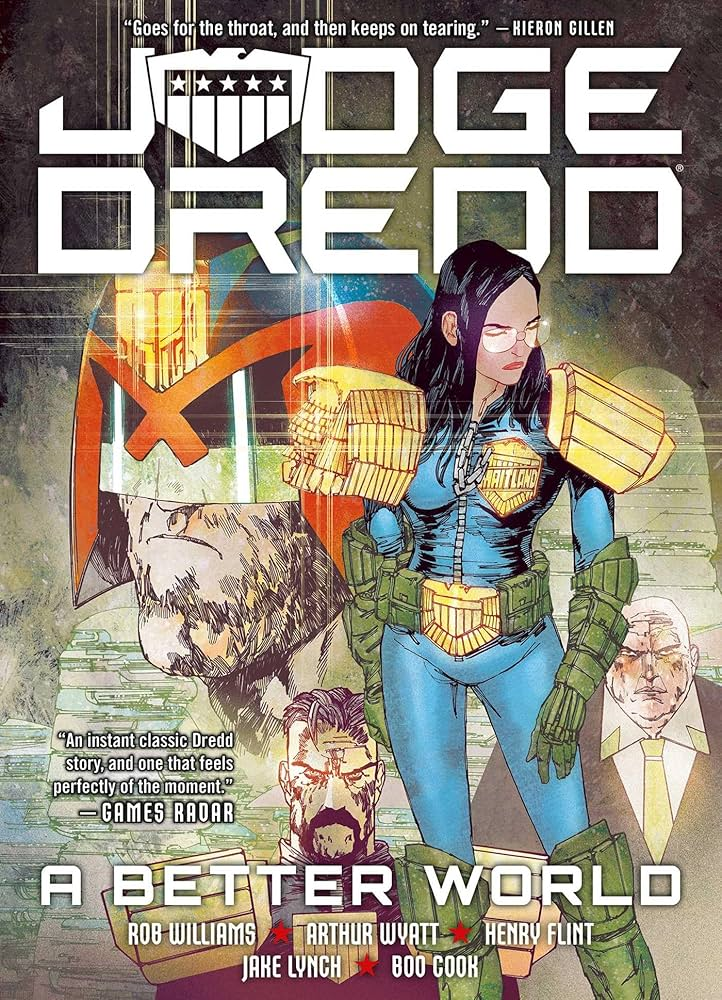
Judge Dredd: a Better World

Judge Maitland has a plan to lower the crime rate of Mega City One: divesting funds from Justice Department into education and services that would benefit the average citizen. She is given one year to improve one sector of Mega-City One; one year to succeed, and create a better world.

But when her plan begins to work, and Justice Department decides to roll it out over ten more sectors, citizens like vid-news mogul Robert Glenn and Judge Hernandez – who have a vested interest in keeping the status quo – step in to spoil the experiment using whatever means are at their disposal.

Judge Dredd started out as a satire of British and American culture, with a focus on authoritarianism and police brutality. As I have grown older and slightly more jaded I have looked at the ramping up of militarized policing around the world and begun to wonder if some people have looked at these comics and thought “Hey this is a good idea!” instead of “Gosh this is a bit much – maybe we should not go down this road!”

Dredd has never been the good guy, in his words he is The Law. Judgement and punishment doled out without fear or favor to the deserving and often to those who commit crimes like eating sugar, or taking their teacher a fresh apple. It was ever a warning, given with a nudge and a wink but the joke has never been funny (except for the stories that were written to elicit a laugh).

A Better World is a Judge Dredd story that is as near to perfect as you will read, Rob Williams has become one of my favorite Dredd writers and, though it may be heresy to say, his take on the lawman of the future often builds upon and surpasses the works of John Wagner. This story is a timely take on the defund the police movement that has been rolling around the United States in recent years, except in this case, that call comes from within the Justice Department. Judge Maitland is a young Judge that earned the trust of Judge Dredd in one of his earlier cases and provides insights and thoughts that Dredd himself, due to his nature cannot envision or express.

Mega City One has been through a lot over the decades and the Judges and what citizens are left after Apocalypse Wars, Zombies, Dark Judges and more eventually something will have to give. So when Maitland approaches Dredd after her research shows that ploughing money, education and services into deprived areas will change the lives of the citizens of MC1 and make them less liable to become perps she has to take it before the ruling council (of five) of the City.

Hope is dangerous, if you are not careful it will get you killed!

I have been a fan of 2000AD for most of my life, and loved the Dredd stories in particular, but living i a country where firearms are fetishized to the nth degree and the police are lauded as incorruptible paragons of virtue while given billions in funding at the expense of other services it taints my enjoyment somewhat as the line between satire and reality is so indistinct as to be invisible! Oh I love this story, I want to push it into the hands of everyone (and particularly those who hold financial control over towns and cities).

A Better World *is* possible, not just in the pages of Judge Dredd but in our world too. I would like to thank Rob and Arthur for creating a story that elicited a bone-deep feeling of despair and hope within me that I feel every time I read this work.

Get yourself a copy! In its pages you may just find your favorite graphic story of the year.

Judge Dredd: a Better World is published by 2000AD and is available wherever fine comics can be found!

Artificial Intelligence some questions and answers from a Librarian’s perspective

What is Artificial Intelligence (AI)?

Broadly speaking, AI is intelligence shown by machines, particularly computer programs. It is a field of research in computer science dedicated to developing and studying software and methods that allow machines to perceive their environment and use their intelligence, bolstered by learning to take actions that will allow them to increase its chances of achieving defined goals.

Are any machines or computer programs actually intelligent?

To put it bluntly no, currently all publicly available “AI” programs are basically a type of machine learning programs known as “large language models” (LLMs) that have been trained on massive amounts of text and images, and with set parameters can generate text and images. True machine intelligence has been hypothesized in science fiction but until the AI singularity occurs true Artificial Intelligence will remain in the realm of science fiction.

What is the AI Singularity?

This is the hypothetical point at which AI systems will achieve the ability to surpass human ingenuity and be able to improve itself and soon after this achieve true intelligence and then (possibly) attempt to destroy humanity.

So how are ‘Large Language Models” trained?

The people programming them load vast quantities of text and images into the program to allow the program to analyze these and learn how to write similar works.

Where did they get these vast quantities of text?

They scraped the entirety of the world wide web and downloaded everything they could find to feed the digital beasts they were creating.

And did they pay for all the works not in the public domain that they downloaded?

They did not!

Why not?

To legally acquire all the material still under copyright would have bankrupted them all! To quote (Generative AI) company Anthropic: today’s general-purpose AI tools simply could not exist if AI companies had to pay licences for the material

Why did they not just use materials that are in the public domain?

To quote a spokesman from OpenAI (creator of the LLM program ChatGPT): “copyright today covers virtually every sort of human expression – including blog posts, photographs, forum posts, scraps of software code, and government documents – it would be impossible to train today’s leading AI models without using copyrighted materials. Limiting training data to public domain books and drawings created more than a century ago might yield an interesting experiment, but would not provide AI systems that meet the needs of today’s citizens.”

So they didn’t want to pay to access all copyrighted material to train their programs because it would have been too expensive?

Basically yes!

Is that even legal?

Writers, musicians, artists, other creators and a bunch of publishers and more claim that it isn’t! There is a statement that has been released that has amassed over 40 thousand signatures protesting the use of copyright materials in LLM training: The unlicensed use of creative works for training generative AI is a major, unjust threat to the livelihoods of the people behind those works, and must not be permitted.

The creators of LLM AI programs claim that it is fair use to use copyrighted materials to train their programs: we believe that legally copyright law does not forbid training.

So a legal grey area that will have to be fought out in the courts?

mmmmm

OK but is it ethical?

Is it ethical to use a program that has been created using pirated materials in libraries? To quote article 4 of the American Library Association’s Code of Ethics: We respect intellectual property rights and advocate balance between the interests of information users and rights holders. I think as Library Workers we should not be using tools that have been created using methods that may be considered legally, ethically or morally suspect. Most, if not all of us are aware that a majority of authors, musicians and artists struggle to survive on the money they make from what they have created, so to give tacit approval to companies owned by billionaires stealing what they have labored over for years by using Generative AI products so we can push a button to create a generic library lesson plan or library poster that may have one too many fingers or other weird digital glitch is not worth it.

What if I really want to use Generative AI programs at work?

Well I can’t stop you, but I will encourage you to read up on the ethics of using such programs as well as the impact they have on the environment and author incomes. I will put some links to articles below if you would like to start here.

Links:

OpenAI warns copyright crackdown could doom ChatGPT – archived Telegraph article

Explained: Generative AI’s environmental impact – MIT news

Generative AI requires massive amounts of power and water, and the aging U.S. grid can’t handle the load – CNBC

Does the Use of Copyrighted Works to Train AI Qualify as a Fair Use? – Copyright Alliance

Meta Secretly Trained Its AI on a Notorious Piracy Database, Newly Unredacted Court Docs Reveal – Wired article

Authors file a lawsuit against OpenAI for unlawfully ‘ingesting’ their books – The Guardian

UC student explores AI art ethics – University of Cincinnati News

Training Generative AI Models on Copyrighted Works Is Fair Use – Association of Research Librarians

Fair Use Defenses in Disruptive Technology Cases – UCLA Law Review

le chat GPT

This Feast of a Life

From the author of If You Still Recognise Me comes a delicious story of two people brought together by a shared love of food as they figure out themselves and each other.

Auden is finding different ways to be themself. The first – using their new chosen name, which feels most authentically them. The second – starting a food blog where they can share their passion for food, through family recipes and the stories behind them. And when the blog brings them Valerie, they discover more than they’d ever expected.

It’s been over a year since Valerie lost her mum – her beautiful, vibrant mum who loved cooking. Since her mum’s death, Valerie and her dad have drifted further and further apart, the kitchen left cold and empty, until Valerie finds Auden’s blog. The blog (and its writer) spark something in Valerie. Could she have found a recipe for happiness?

I interviewed Cynthia when their first novel IF YOU STILL RECOGNISE ME came out, so was very keen to read their next offering and pleased to see that the premise was completely different while still focusing on young people reflecting on their identities and exploring relationships (friendships, romances, and family). I asked a few new questions:

The parents played a significant role in this story. I really appreciated that they weren’t perfect but also weren’t awful, they felt very real. Did you consider making Auden’s parents more or less supportive?

I did think about making them less supportive, but I know that there’s a desire for something a bit more upbeat when it comes to narratives around trans/nonbinary characters. And I didn’t want dealing with unsupportive parents to be a big focus of the book – and if the parents were less supportive, I felt like that would have to take up too much space within the narrative. That wasn’t the story I was trying to tell.

So I did also consider making them more supportive, but I personally don’t find it very satisfying or easy to write about parents who are wholly supportive – maybe because I don’t actually know anyone whose parents are like that. (If your parents are, then I’m thrilled for you!)

That’s why they ended up more in the middle, and I’m glad they seem real!

I *love* all the food references in THIS FEAST OF A LIFE, do you cook yourself?

Yes, I do! Although I don’t think of myself as a great cook, I can follow a recipe well enough and I cooked for myself for years. My wife Olivia now does the majority of the cooking in our household (she’s incredible at it) but I still cook regularly.

When I asked you about the reaction from teens to IF YOU STILL RECOGNISE ME you hadn’t really had any as it was still brand new…what response from readers has the last couple of years brought you?

Readers who have messaged me about how the book helped them through a tough time, how it felt like a warm hug or made them feel less alone – these are the responses I treasure the most. One teen reader I met in a signing queue said they found me inspirational as a person from a different background discovering their identity, which is something I wrote down word for word in my diary because it moved me so much! I’m really glad my books can be there for queer teens who don’t always feel seen.

Have you started working on a fantasy novel yet or can we expect more beautiful contemporary characters?

Yes, I have started working on a fantasy novel – very slowly! It’s a contemporary fantasy though and I’m especially interested in trying to balance a contemporary narrative that includes my usual elements of queer romance and identity – understanding yourself  and figuring out who you want to be in the world – with the fantastical aspects.

Cynthia So (credit Caitlin Wilder)

Cynthia So was born in Hong Kong and lives in London. Their work has been published in speculative fiction magazines such as Uncanny, Strange Horizons and Anathema. They are also one of the new voices in PROUD, an anthology of LGBTQ+ YA stories, poems and art by LGBTQ+ creators, published by Little Tiger in March 2019. When they’re not writing, they can often be found at the theatre, entranced by a play or a musical. They’re also extremely enthusiastic about board games and tabletop role-playing. If You Still Recognise Me – shortlisted for the Waterstones Prize, the YA Prize and the Diverse Book Awards – was their first novel.

THIS FEAST OF A LIFE is out now in the UK, published by Little Tiger. Thanks to Jade for sending me a review copy and co-ordinating interview questions.