Illustrated Classics: The Wonderful Wizard of Oz

Discover the magical world of Oz as we accompany Dorothy on her journey to the enchanted Emerald City. Packed with stunning illustrations and exclusive interactive features, MinaLima™ reimagines an essential tome of American pop culture.

MinaLima

MinaLima are very clever people. I wanted to know a bit more of the background to their beautiful Illustrated Classics series, so was pleased to be given the opportunity to ask a few questions!

What prompted you to start creating these beautiful reimaginings of classics?

Miraphora: During our 20-year journey of creating graphic designs for the Wizarding World, we had the opportunity to create many books as props for the films but also behind-the-scenes  film “tie-in” books for the “real” world. In this way we developed a good relationship with our publisher Harper Design. Together we had the idea of redesigning the classics – we knew that these were stories loved by readers across the world but also that these were tales set in fantastical worlds, which we love.

Do you do everything collaboratively or do you each have particular roles when working together?

Miraphora: The whole process starts with Eduardo reading through the book and creating a book map of all the interesting, quirky and intriguing occurrences in the book that we feel should be marked as illustrations or interactive elements. Then, we begin developing an overall creative direction, creating rough sketches of the characters and locations.

Eduardo: Mira usually starts these early sketches. We have a fantastic team, who then picks these up and starts drawing the illustrations in more detail. They also begin crafting all the paper engineered interactive elements, cutting and pasting different sections to see if they work. We believe that the sum of the parts are always greater than any individual illustrator or designer and we bring this collaborative approach to everything we do.

How have you chosen the titles you’ve done so far? Do you have a favourite?

Eduardo: We have chosen the titles we all know and love; these are fairytales we have all grown up reading. My favourite book is definitely Pinocchio –  I have loved this story since I was a child and I knew from the beginning that this had to be in our MinaLima Classics collection!

Miraphora: My favourite is The Wonderful Wizard of Oz, which is our latest title – so Eduardo got to reimagine his favourite first!

If you could reimagine any book, without having to worry about permissions, what would it be?

Eduardo: I love the Agatha Christie books but the descriptions are so beautifully detailed that I am not sure if they leave much room for reimagination!

What are you tackling next?

Miraphora: This year is a very special year for us: we are celebrating 20 years of working together. So we are crafting a very special book:The Magic of MinaLima, which will be published by Harper Collins in 2022. 

Eduardo: This book charts our experience of creating the graphic universe of the Wizarding World, from films in which you can escape to books you can delve into, from products you can hold to experiences in which you can immerse yourself.

MinaLima is an award-winning graphic design studio founded by Miraphora Mina and Eduardo Lima, renowned for establishing the visual graphic style of the Harry Potter and Fantastic Beasts film series. Based in London, the MinaLima studio is renowned internationally for telling stories through design and has created its own MinaLima Classics series, reimagining a growing collection of much-loved tales including Peter Pan, The Secret Garden, and Pinocchio.

Mina Lima, Portraits


Instagram: minalimadesign | Twitter: @minalima | Web: www.minalima.com

Thankyou to Harper360 for sending me a review copy of their latest title, The Wonderful Wizard of Oz

The Royal Rebel

Born in 1876, Princess Sophia Duleep Singh was the daughter of the last Sikh ruler of the Punjab, and goddaughter of Queen Victoria. After her father lost control of his empire and was exiled to England, Sophia had a privileged but troubled upbringing that left her unsure about where she belonged – in India or England. Sensitive to injustice, she became an suffragette and fought hard to win the vote for women. This is the extraordinary story of her life.

Barrington Stoke
artwork by Rachael Dean

Bali Rai has such a range when it comes to writing, he really has done something for just about every reader, but I have a soft spot for his Barrington Stoke titles, I reviewed his previous one, STAY A LITTLE LONGER, here. Barrington Stoke titles are a little bit special because there is not a word wasted, they’re written to engage and not patronise children and young people. This particular book, THE ROYAL REBEL, is based on the real life story of Princess Sophia Duleep Singh, who led an extraordinary life. I was filled with sadness reading it, about how affected her life was by British colonialism and politics, but she was a fascinating character and Bali Rai’s writing from her perspective has really brought her to life.

I asked Bali Rai a few questions!

What prompted you to write about Princess Sophia Duleep Singh?

My family is Sikh, so I had known the story of Sophia’s grandfather, Maharajah Ranjit Singh, and of her father, Duleep Singh, since childhood. However, I had never been told of the role Sophia played. So, when I discovered who she was and her role within the Suffragette movement, I was determined to bring her story to younger readers. I am passionate about representing unheard voices in British literature and always have been.

Has your research led you to any other figures in history that you would like to write about?

Yes, I learned of the roles played by the Royal Indian Army Service Corps at Dunkirk, and Mohinder Singh Pujji (RAF) during World War 2. I have written about both. The next figure I want to write about is an Indian revolutionary called Udham Singh, whose story is much darker, but just as important. There are many unheard voices throughout British history, and I hope to write about many more.

You’ve written in a wide range of genres, is writing a historical novel a very different process to that of writing about contemporary characters? Do you favour one over the other?

My main genre is reality based fiction, so the research involved in writing historical fiction is very different. I actually enjoy the historical research more than the contemporary stuff. I’ve always loved history and like nothing more than getting stuck into research. It’s often time-consuming but always worthwhile. We can learn a great deal about where we are now, based on what came before us.

You’ve written a number of books for Barrington Stoke, as well as longer novels, for middle grade and YA audiences. How do you choose which of your ideas to use for the shorter novellas and for what target age?

I generally think of an idea, and work on that with my agent and the editors at Barrington Stoke. That’s most true of the more contemporary stories I’ve written for them. The Royal Rebel was only possible because of that partnership (I reworked the idea several times) and it’s a collective effort that I value highly. The age range doesn’t really enter into my head. I have a voice that I want to write, and a theme to explore – and the target age and reading level are determined by the amazing people at Barrington Stoke. Since my first books for them, Dream On, it’s been a team effort, and it’s a process I love to be part of. Barrington Stoke are wonderful publishers, doing something vitally important.

Which of your books are your favourite to do events for?

My younger historical fiction books are now firm favourites for events. The response to them has been amazing. And much as I adore working with older teens, there’s something even more wonderful about introducing diverse British history to KS2 and KS3 pupils. The levels of enthusiasm for the events just add to that pleasure.

What are you reading at the moment and who would you recommend it to?

I’m currently reading lots of non-fiction about the British Empire, for a new young adult series I’d like to write. The last children’s book I read was How I Saved The World In A Week by Polly Ho-Yen. I’d recommend that to anyone who loves imaginative and thrilling adventure stories. It’s brilliant and Polly is a superb writer!

What can we expect from you next?

I have a junior series for Reading Planet out soon, called Green Patrol, and a short novel called Wolf Girl. I’m currently researching and working on a new young adult idea, and also a new World War 2 story with British Indian characters. Oh, and I’m reworking an older adventure series idea, in the hope of showing that to an editor at Penguin.

THE ROYAL REBEL is out now from Barrington Stoke, thank you to them for a review copy and to Bali Rai for answering my questions, I’m really excited to see more about your next ventures!

Michael Rosen’s Sticky McStickstick

After being admitted to hospital in 2020 with coronavirus, Michael Rosen had to learn to walk again. With the support of doctors and nurses and a walking stick he names “Sticky McStickstick”, he manages to embark on the slow steps to recovery. This moving picture book from the former Children’s Laureate, with illustrations from Tony Ross, tells a story of perseverance and hope, and is a testament to the importance of overcoming fear and learning to accept help.

Walker Books
Sticky McStickstick is illustrated by Tony Ross

Michael Rosen is a National Treasure and so many people were very worried about him when he was hospitalised with Covid-19 in 2020. It took him a long time to recover, and while he did he had the support of his walking stick (as well as family and NHS staff, obviously). Many Different Kinds of Love, a collection of Rosen’s poems and the coronavirus diaries of his nurses, was published by Ebury in March 2021 for grownups to read, but this is for everyone…and I mean everyone. When I was asked if I’d like to send a few questions for him, of course I said yes!

‘Many Different Kinds of Love’ has already been published, on adult lists, did you write the two books at the same time?

No. I wrote MDKOL first but I noticed that I had mentioned Sticky McStickstick. People asked me about the stick and I started telling them things about where it is or what happened when I tried to walk with it and so on. A voice in my head told me that I could personify the stick and it then became fun to write it all out as a story. 

This complements your Sad Book beautifully. Why do you think having books about such emotive subjects is important for children?

Books for children can be about anything that the adults who care for children think are OK things to talk about. Society has taboos around children and childhood and writers have to respect these. Subjects like death and serious illness are on the edge of the taboos. Some people won’t take their children to funerals, for example. Or they might not tell their children about a terminal illness. That’s their choice. My two books go into an area where some have those taboos but others think that it’s helpful to talk about experiences such as these which are as much about life as eating or sleeping. All books open up trains of thought and conversations. I’d be very glad if both those books do just that with children being looked after or brought up by people who think it’s a good idea to talk about such things. 

Do you have thoughts about how ‘Sticky McStickstick’ might best be used in schools?

I would start with a class talking in pairs to each other their illnesses and accidents, swapping stories, perhaps writing about them or drawing pictures of them. Then reading my book. Or it could be the other way round. Reading my book first, perhaps. There are open-ended trigger questions that are helpful too e.g. Is there anything in this book that makes you think of anything that has happened to you or to anyone you know? Is there anything in this book that makes you think of anything you’ve ever read before, or heard in a song, or on the TV or in a film? If you could ask anyone in the book a question, what would you ask? Can you answer that question? If you could ask the author a question, what would it be? Can you answer that question? Are you affected by any part of the book? Which part? How?  Why? 

Tony Ross has illustrated a number of your books. Do you let him get on with it or do you make suggestions about what the illustrations might look like?

I most certainly do let him get on with it. I write the words. The illustrator, designer and editor make the book.

Sticky McStickstick was published on 4 November 2021 by Walker Books

(9781529502404, £12.99, Hardback)

Libraries, the new front-line in the Culture Wars

The election of reactionary individuals to the board of the Niles-Maine Public Library in May gave me chills, back in 2020 I had been thinking about how the fragmented nature of the US Library system made it vulnerable to subversion by groups with specific views, but 2020 being 2020 gave a lot more to focus on than hypothetical threats to the public library system and I shelved that thought. The thoughts about the relative fragility of the US library system germinated in an article I wrote for the UK Library magazine The Youth Library Review in 2019 comparing the UK and US Public Library systems.

2021 has not been much better for libraries with wholescale challenges to many books for young readers about gender and sexuality and more that may faintly resemble what many on the right perceive to be Critical Race Theory (CRT).

Challenging Times

The Niles-Maine takeover provides a way forward for other reactionary groups that want to control their local libraries and the recent mega challenges to entire slates of reading materials provides an enhanced template for those who wish to stifle the free flow of information to young readers (and others).

This will happen with Library Boards if we do not take notice: “Anti-CRT” school board candidates are winning

Resources to push back against challenges and how to defend your libraries

Richard Price is Associate Professor of Political Science at Weber State University created the Adventures in Censorship website that tracks challenges to books in school and public libraries: https://adventuresincensorship.com/

Angie Manfredi’s article on the freedom to read and what you can do to support your local libraries from encroaching censorship:  https://www.harpersbazaar.com/culture/features/a38161583/how-to-fight-for-the-freedom-to-read/

How to Fight Book Bans and Challenges: an Anti-Censorship Tool Kit https://bookriot.com/how-to-fight-book-bans-and-challenges/

Become a Library Trustee: http://www.ilovelibraries.org/get-involved/become-library-trustee

Why you should sit on your library board: https://bookriot.com/why-you-should-sit-on-your-library-board/

Local library advocacy group celebrates rejection of harmful library policy proposals. https://www.facebook.com/CDCCLJonesboro/posts/116312794168897

CRT Toolkit https://crttoolkit.com/

The Hideaway by Pam Smy

The Hideaway tells the story of a boy, Billy McKenna, who runs away from a difficult situation at home and takes refuge in an overgrown graveyard. While hiding there he meets an elderly man who is tending the graves in preparation for a day in November when something magical is set to happen.

The book is written in two alternating narratives, both different aspects of the same story. One thread tells of Billy’s experience of hiding away in the graveyard, his mixed-up feelings and emotions, and the supernatural events he eventually witnesses. The other tells of his mother’s situation at home and the police search for Billy. Covering themes of family, childhood, separation and reunion, domestic violence and doing the right thing, this is an important and beautiful book for middle grade readers right up to adults.

Billy’s story is illustrated throughout with tonal and textured black and white drawings, until the event on All Souls’ Eve, when the text gives way to a series of double page images of the supernatural happening.

The Hideaway is a compelling, exciting and emotional story that will stay with you long after you finish the last page.

Pavilion Books

Pam Smy is such an interesting illustrator, Thornhill is a wonderfully unique book (shortlisted for the Carnegie Award), so I was very excited to be sent a review copy of her 2nd novel The Hideaway…which is haunting and sad and uplifting and will really stay with you…and then even more excited to ask her a few questions! And of course, the most appropriate book to highlight for Halloween!

Which aspect of The Hideaway came to you first?

The scene-setting of The Hideaway came to me first. The graveyard where it is set is a real place here in Cambridge, and it has the chapel in the middle, the row of yew trees, the poem carved into the back wall, and most importantly, the World War 2 pillbox. The combination of the meaning of the poem All Souls’ Night by Frances Cornford and the idea that someone could use the pillbox to hide away sparked the idea for the book.

Thornhill was alternate chapters, a wholly illustrated contemporary voice and a historical diary, while The Hideaway is an illustrated story. Did you draw and write at the same time or had you mainly got the words down before choosing which sections to illustrate?

With Thornhill I wrote the text and made the rough drawings for the story in turn, so both elements of the story evolved at the same time. With The Hideaway I wrote the manuscript first, and then illustrated it – but I knew that I wanted there to be a wordless sequence in it from the outset and I knew what I wanted the feeling of the graveyard to look like in the illustrations.

Do you lay out the pages alone or with a designer?

For The Hideaway I worked directly into an InDesign document so that I could move the text around the illustrations I was making, and the very patient designer, Ness Wood, tidied it all up at the end.

They’re both a bit spooky with extremely atmospheric illustrations, very suitable for Halloween season, is the supernatural your favourite genre to read?

I read a variety of books. I love books about people and relationships, and stories that are set in the past or in rural environments. I also love crime novels. I read a lot of picture books and illustrated books of all kinds for all ages. I wouldn’t say that I especially read supernatural books, although they are certainly on my bookshelf.

I think I am drawn to write and illustrate spooky books because I love making atmospheric artwork, and building a world that is based on the everyday, but is different from what we may typically see – but without tipping into fantasy or sci-fi.

You’ve also published a picture book, Merrylegs! Three very different books, which was most enjoyable to work on?

I enjoyed making the artwork to The Hideaway the best. I was trying to work without using much linework – so it was a new challenge for me.

The Mermaid in the Millpond, written by Lucy Strange and illustrated by you, is being published in January by Barrington Stoke. Do you find it easier or harder when the words aren’t your own?

Both easier and harder. If I am illustrating my own ideas the vision of those illustrations is already in my head, and the excitement and the challenge is to get that across on paper. When I am illustrating someone else’s writing it is a joy to be able to bring to life the words, and to add atmosphere or understanding to what is being described. I love illustrating other people’s texts, especially if the art direction and design layout isn’t too prescriptive and I have a little bit of a free reign.

What are you reading at the moment and who would you recommend it to?

I am reading and re-reading Captain Rosalie by Timothee de Fombelle, illustrated by Isabelle Arsenault. I am recommending it to everyone I know, and buying copies of it to send to my friends. I think everyone who is 6 and over should read it. It is a beautiful piece of writing and Arsenault’s illustrations are absolutely stunning. Also by my bedside is While You’re Sleeping by Mick Jackson and John Broadley, and All Among the Barley by Melissa Harrison.

What might we see from you next?

I am working on developing a few collaborations at the moment which I am VERY excited about, but can’t say anything about yet.

The Hideaway by Pam Smy is published by Pavilion Books, out now, 14.99 hardback.

HOW DO YOU LIVE? by Genzaburo Yoshino

First published in 1937, Genzaburō Yoshino’s How Do You Live? has long been acknowledged in Japan as a crossover classic for young readers. Academy Award–winning animator Hayao Miyazaki has called it his favorite childhood book and announced plans to emerge from retirement to make it the basis of a final film. 
 
How Do You Live? is narrated in two voices. The first belongs to Copper, fifteen, who after the death of his father must confront inevitable and enormous change, including his own betrayal of his best friend. In between episodes of Copper’s emerging story, his uncle writes to him in a journal, sharing knowledge and offering advice on life’s big questions as Copper begins to encounter them. Over the course of the story, Copper, like his namesake Copernicus, looks to the stars, and uses his discoveries about the heavens, earth, and human nature to answer the question of how he will live.

There are a lot of books that get given the title ‘classic’, not all of them deserve that, but for How Do You Live? that title is richly deserved! Re-edited and published in Japan many times over 80 years

For people who can only read books in English this is a rare treat! As more and more books from outside the English canon are translated we see more into the cultural milieu of other nations. The story questions militarism and the rise of martial society, which in the time it was originally written and published is really quite amazing!

Read this work before Miyazaki’s movie is released (it will give you instant street cred in the eyes of all the fans of Studio Ghibli’s works)

Power Born of Dreams: My Story is Palestine

What does freedom look like from inside an Israeli prison?

A bird perches on the cell window and offers a deal: “You bring the pencil, and I will bring the stories,” stories of family, of community, of Gaza, of the West Bank, of Jerusalem, of Palestine. The two collect threads of memory and intergenerational trauma from ongoing settler-colonialism. Helping us to see that the prison is much larger than a building, far wider than a cell; it stretches through towns and villages, past military check points and borders. But hope and solidarity can stretch farther, deeper, once strength is drawn of stories and power is born of dreams. Translating headlines into authentic lived experiences, these stories come to life in the striking linocut artwork of Mohammad Sabaaneh, helping us to see Palestinians not as political symbols, but as people.

How can something so beautiful be so heart-breaking?

I ask myself that each time I pick up Power Born of Dreams… three time snow I have read this book each time I have spent ages poring over the pages admiring the stark beauty emanating from the pages of this work of art that Mohammad Sabaahneh has created. I learned the art of linocut when I was in school, but Mohammad has elevated the simple act of slicing shapes out of linoleum he cut into the history of his time as a political prisoner and the stories of Palestinians, living their lives under a brutal occupation, fenced in with electronic eyes watching them every day and night. These are stories of heartache and loss and of hope. These are some of the stories of Palestine.

It may be the fact that I grew up in South Africa during apartheid that makes me sympathetic to the plight of the Palestinian people. Having heard the stories from my friends and fellow South Africans of colour of what they experienced the dehumanising and degrading treatment at the hands of the white minority government has made me resolute in my opposition to oppression wherever it may occur.

In time I can see Mohammad Sabaahneh joining Joe Sacco, Art Spiegelman and other cartoonists in the lists of those who have used their art to open the eyes of the world to the iniquities suffered by so many.

Power Born of Dreams: My Story is Palestine was created by Mohammad Sabaahneh and will be published in November by Street Noise Books.

Yusuf Azeem Is Not A Hero

Yusuf Azeem has spent all his life in the small town of Frey, Texas—and nearly that long waiting for the chance to participate in the regional robotics competition, which he just knows he can win. Only, this year is going to be more difficult than he thought. Because this year is the twentieth anniversary of the 9/11 terrorist attacks—an anniversary that has everyone in his family on edge. After reading his uncle’s journal from that time, Yusuf feels like he almost understands what that nationwide fear and anger felt like. But when certain people in town start to say hateful things to Yusuf and his community, he realizes that the anger hasn’t gone away. And soon he will have to find the courage to stand up to the bullies, with understanding, justice, and love.

Saadia Faruqi

I really enjoyed Saadia Faruqi’s previous middle grade book, A Thousand Questions, so was very happy to host an interview with her for the blog tour for her new title, Yusuf Azeem Is Not a Hero.

Why did you decide to write about the attacks of September 11, 2001, knowing that your readers may
not care about an event that happened so long before their births?

The events of 9/11 and everything that happened afterwards – the wars in Iraq and Afghanistan, the
changes to regulations of airport security, the suspicion of anyone who was “different” – were so
monumental that they literally changed the world. It was worrying to me that an entire generation of
readers were not too concerned about this event even though their lives too were affected by it in a
myriad of ways. Although generally young readers find it hard to connect with historical events, 9/11
was different for two reasons: it was very much alive in the mind of readers’ parents and grandparents;
and it affected how many of the readers and their families were treated in their communities. That’s
why I decided to write a book about the last twenty years and showcase history in a very contemporary
context for children.

Are any of the characters in Yusuf Azeem Is Not A Hero inspired by real people?

Every author puts pieces of themselves or people they know in the books they write. None of the
characters in this book is based on a single person, but there are some parts of me and my family and
friends in them. Even the main villain Trevor Grant is based on a pretty horrible person I once met! Yusuf
himself is a little like my son at that age – sweet and nerdy and just trying to go through life without
attracting any attention. He was also treated unfairly and unkindly by his classmates and teachers when
he was younger, and it’s very much affected his behavior in small ways. So I definitely had that in mind
as I was writing Yusuf’s scenes… just that feeling of uncertainty and discomfort. I love putting the nicest
characters into situations that test them, which is what happens to Yusuf and his friends.

This book is mostly contemporary, based in current times with mention of the pandemic and white
supremacist groups and so much more. Yet there’s also twenty-year-old journal entries. How did you
manage that balance of time periods?

I decided to set the main story in current times because I know young readers identify better with
contemporary settings. They want to know why they should read a story, what’s the pull for them? I also
didn’t want to write a historical novel because in my mind 9/11 isn’t really a historical event, even
though it’s twenty years old. It’s current because there are millions of people feeling it’s repercussions
all over the world even today, whether it’s because a family member is in the army in Afghanistan, or
they’re a Muslim boy who gets teased in school, or they’re randomly selected for additional screening
every time they enter an airport. So I knew I wanted to base this story very firmly in the present, to
showcase the rise of intolerance, of white nationalism, and all the horrible ways outsiders are treated
every single day. The journal entries are written every three chapters, as a window into the world
twenty years ago, and in very strategic ways they draw parallels to the action in the contemporary part
of the story.

Many readers are not aware of how Muslims were treated after the attacks of September 11. As a
Muslim, did you experience any of the prejudices described in this book?

I was in college when the attacks happened, and immediately after I escaped notice because I didn’t
look visibly Muslim. I didn’t wear the hijab, which was a huge red flag for people in those days – and still
is. But in the years after the attacks, as I grew more confident about my religious and cultural identity,
including wearing the hijab, I certainly faced prejudice from my coworkers, neighbors, parents of my
kids’ friends… the list is endless and exhausting. I also saw many of my family go through these things,
and it was obvious that anybody who was “other” was being targeted. It only made me more firm in my
belief that we needed to talk about these issues, describe what was happening, so that we could make
changes.

This is a book with emotionally heavy topics. How did you ensure that it was appropriate and
understandable for younger readers?

Yusuf Azeem definitely has emotionally charged scenes. A lot of pretty awful things happen to Yusuf and
his friends and family in the book. I didn’t want to shy away from that trauma because I wanted to show
reality, and I know readers are brave enough and curious enough to want to know the truth. I also want
readers who go through bullying to know that they’re not alone. However, overall this book isn’t a sad
book. There are jokes and laughter, funny characters who bring comedic relief. There is an intense
robotics competition and a robot called Miss Trashy. Overall, there is a hopeful ending as Yusuf’s
community rallies together and helps him, and showcases ways that one can be an ally to others.

What do you want readers to do after reading Yusuf Azeem?

I’d like readers to learn more about 9/11 from a variety of perspectives. I’d also like them to discuss this
topic from the adults in their lives – parents, teachers, family friends – to understand what it was like in
those days. Also ask adults if they know about the discrimination faced by the Muslim community. They
will be surprised to know that many adults are also unaware of the far-reaching repercussions of 9/11.
Talking about these repercussions is the first step to healing and making changes.

You’ve written books for children of all ages, specifically the popular Yasmin series. Which category do
you like to write best?

I love writing for all ages. Each of my books has a slightly different aim and purpose. The Yasmin books
are about a little girl from an immigrant family, doing everyday things at school and in her
neighborhood. These stories help give young readers the confidence they need, while also teaching
about tolerance and welcoming communities. Yasmin is based on my own daughter, so that may be one
of my favorite characters ever! On the other hand, my middle grade novels like Yusuf Azeem Is Not A
Hero focus on real-world challenges that children face when they look different, or when their families
and culture are seen as “other”. These books are about allyship, and as such they have a special place in
my heart as well.

Overlooking Problematic Content is a Feature, not a Bug

Kate Clanchy’s memoir Some Kids I Taught and What They Taught Me is an award-winning book that has received rave reviews, New Statesman called it refreshing, The Guardian thought that people like Clanchy are needed to keep liberal ideals alive, The Times called it inspiring and uplifting, The Sunday Times deemed it inspiring, moving and funny.

Philip Pullman said that it is: The best book on teachers and children and writing that I’ve ever read. No-one has said better so much of what so badly needs saying. I want to see this book become a bestseller, I want to see it in every staffroom, I want to see it read by every student teacher. This is a wonderful achievement.

In 2020 Some Kids I Taught and What They Taught Me won the 2020 Orwell Prize for Political Writing

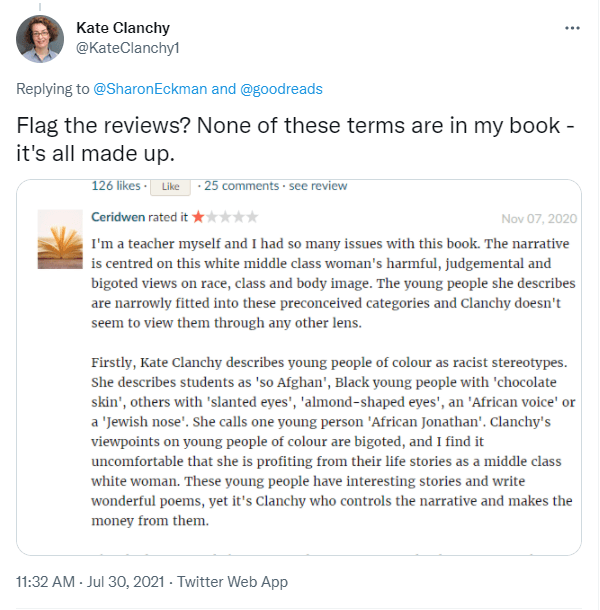
Then in 2021 on twitter Kate Clanchy alleged that Goodreads reviewer Ceridwen had made-up quotes from her book in their review.

Things went downhill rapidly from there!

Unfortunately, whenever people have received near universal acclaim & praise for their work they can react poorly when they encounter someone who says “whoa there is a problem here” and this is exactly what happened!

Instead of giving a blow by blow account what occurred, I will recommend that you read Beth Bhargava’s comprehensive write-up of what happened over at Bad Form Review here. I will just say that I was bitterly disappointed by a number of authors whose work I have previously enjoyed.

Like Public Libraries, Publishing is a majority white profession, both of which can be difficult to break in to, as many opening positions are notoriously low-paid. I could not help but compare what is happening with Kate Clanchy’s book with what happened with the CILIP Carnegie & Kate Greenaway Medals in 2017 where it took people of colour to start asking why no-one who was not white had won either of the awards in over 80 years and a big push from them and allies to start the process to effect change.

Kate Clanchy issued a statement on August 6th which caused more consternation and upset. Picador, KC’s publisher released three statements on the 6th, 9th and 11th, The Orwell Foundation issued a brief statement denying responsibility of what their external judges did, and Philip Pullman released an ‘apology’ on the 10th.

No mention was made by anyone at the centre about the vile language and threats directed against Professor Sunny Singh, Chimene Suleyman & Monisha Rajesh three of the highest profile people that stepped up to offer honest critiques of Clanchy’s work and challenge the racist rhetoric that was springing up in the discussion.

The end result of the storm of protest is that Kate Clanchy will rewrite portions of her work to remove the racist and ableist stereotypes contained in the original.

Systemic racism does not require that those working within the system to be racist; in publishing like libraries, is made up mostly of good, well-intentioned (white) people who do their best but miss many signs that what they are working on may be harmful to minority groups. Unfortunately, most white people lack the insights and cultural knowledge to identify problematic work and content. Even after an outcry those who ‘have learned’ from the criticism are often rewarded, while still excluding those that were harmed.

It should not fall to People of Colour to fight for systemic change on their own, no matter where it happens – in libraries, in publishing, or elsewhere if someone says that something is harming them and their community we need to stand with them and fight to make a meaningful change.

We (white people) have benefitted from systemic racism for hundreds of years, we are complicit even when we fight against it, and we should fight against it – we lose nothing if those that are disadvantaged gain the privileges that we currently enjoy.

It is often said that When you’re accustomed to privilege, equality feels like oppression, but this is something we need to stamp out of our psyches and instead embrace the need for true equality.

The Sound of Everything

Winner of the Everything with Words’ YA Competition 2019 judged by Patrice Lawrence, The Sound of Everything is a heart-felt coming of age story for all those who struggle to feel like they deserve love.

Betrayal, rejection, violence Kadie has known it all. She’s tough and prepared for everything. Everything except love.

Kadie has has just arrived in yet another foster home. She trusts no one and lives by the rules: don’t count on anyone, always act, be prepared to lose everything. She’s lost everything more times than she can count but then she meets Lips and learns that some things are even more important than survival. But she has secrets of which she must let go if she is to make a stab at friendship and love.

Everything With Words

I was immediately interested in reading this book when I saw that Patrice Lawrence had helped to choose it as the winner of the Everything With Words’ YA competition 2019, because she has good taste in stories and I wasn’t disappointed, I was gripped from start to finish by the events of Kadie’s life. I was also pleased to read a book by a fellow school librarian, although Rebecca hasn’t been in the role for very long, hopefully it will give her some ideas for a future story! After sending these questions through the publisher, I found out about Rebecca’s musical background, which really helps to explain how much music features in the book (though she is more classically trained on the violin), and that she’s been working on this story since she was the age of her main characters.

Did you decide to write about a girl in foster care and that turned into Kadie, or was it her character that started you writing this story? I believe I decided to write about foster care first, out of which came Kadie – but it’s been so long since I had the initial idea that I can’t really recall what the process was. Kadie herself took a long time to develop into the complex character that she is, but foster care was definitely always a large part of the story, I think because there was so much to explore within it, beginning with the daunting prospect of being dropped into a new environment in the middle of GCSE years. I think what really touched me when I was learning about the realities of foster care was the amount of pain that a lot of young people go through as they are shafted by the system. I quickly learned that it’s not as simple as just being put with a family and staying there.

Did you have to do much research before/while writing?
Yes! I did a lot of research. I knew next to nothing about foster care, so I researched and researched some more. I read real life stories, newspaper articles, blog posts; I watched videos, looked at film renditions, and found what I could in the library. I love the research side of things. I find it particularly important, once you think you have exhausted all your sources, to go back some time later and dig around for new stuff. There’s always a wealth of information out there.

Do you think there should be a trigger/content warning on the book for the self harm element? I think just to err on the side of caution I would add a trigger warning just in case, if it was up to me. I don’t think I was particularly explicit about the self-harm, but I always want readers to be prepared for sensitive topics the same way I would want to be prepared if I was reading a book that covered serious issues.

Who was your favourite character to write? Was there anything or anyone (without spoilers) that you found difficult to get onto paper?
That’s really hard. Really hard! In first place has to be Beverly. She’s just so huggable. She’s partially inspired by siblings (“I’m stuck. In boredom.” – one of my favourite lines.) Very, very close second would be Lips best, particularly when it came to fleshing out his character right down to the nitty gritty bits like his likes and dislikes, his fashion choices, his little quirks – I thoroughly enjoyed that. Lips is almost like one of those big mascots at sports events – big and clumsy, though perhaps not cuddly, although he might chase you for a hug.

In terms of getting things written down, I didn’t find any bits of the book hard to write, but quite a few of the scenes did undergo some serious overhauls that took a little brainstorming before I got them right. That said, I think Shadavia was a hard character to write and I’m actually a little bit not 100% happy with her. I’m not sure whether she’s a friend or an enemy, which is off-putting because I think I wanted her to be either or.

You won the Everything with Words 2019 YA competition, has the story changed much between your submission and the published book?
A lot has changed since the manuscript that I entered into the competition, but at the same time not much has. The bits that have changed are fundamental to the plot but not in a way that changes the direction of the story. Previously I had focused on Kadie’s issues and the things she was trying to hide, without expounding on the reasons for things, the complex background to why she thinks the way she does.

Also, a lot of my secondary characters were very flat in the original. I had a lot of great fun making them into real people. Readers will never know most of the details about Eisha or Josh or even Kelly, but I know them, and that’s the important thing, because it really makes a difference when the background characters have a full personality.

As you work in a school library, did you make the most of your access to teenagers and get them to read early drafts for feedback, or did you keep it to yourself? It may surprise you that I actually didn’t work in a secondary school at the time I wrote The Sound of Everything. I am just a word nerd, obsessed with London slang. I started studying it for a story some time back and became interested in the way it evolves and spreads out to the rest of the country (kids in Swindon often talk with what could be considered London slang, only with a Swindonish edge to it). I learned to imitate the language by listening to interviews and watching vlogs to see how young people talk in their comfort zones. I really, really enjoy the dialogue side of things, which you can probably tell.

Nobody really read early drafts before the competition. I don’t know that I would have had the confidence to convince a student to read the manuscript before it was published!

What are you reading at the moment and who would you recommend it to? I am currently reading Ballet Shoes by Noel Streatford and Harriet the Spy by Liz Fitzhugh. Ballet Shoes is a classic story about sisters and the struggle for money, and I think would appeal to little girls who like to read challenging. However, it would also still appeal to teenage girls too, if they like historical fiction.

Any plans for a 2nd novel?
Ooh . . . not at the moment. I have a lot going on, including scraps of other ideas, but nothing that could be called a plan for a second novel.  

THE SOUND OF EVERYTHING is out now! Huge thanks to Mikka at Everything With Words for sending me a review copy and organising the interview.