Category Archives: Reviews

Death to Pachuco by Henry Barajas & Rachel Merrill

During the summer of 1943, Los Angeles became a hotbed of tension and conflict as a series of fierce clashes erupted between U.S. Navy members and Mexican American youth stemming from the murder of Carlos Urbano. Private eye Ricardo “Ricky” Tellez needs to find the Sleep Lagoon Killer before the racist mob kills him in the Zoot Suit Riots.

The clock is ticking—and it’s a bad time to be a Mexican.

TL;DR Review: A bloody brilliant example of Chicano Noir that belongs in any (& every) collection! Henry and Rachel’s writing and art complement each other in this grim and engrossing historical mystery! Buy it and read it – you will not regret it! Trust me I am a Librarian!

—

Just in case you were wondering: Pachuco: (slang) a young Mexican-American having a taste for flashy clothes and a special jargon and usually belonging to a neighborhood gang
Thanks to Merriam-Webster

I got pulled into appreciating noir early in life, thanks in part to being exposed to Chinatown and The Maltese Falcon as a child. In recent years comic noir has held my interest due to the works of Ed Brubaker, Frank Miller, Jason Aaron and Greg Rucka to name but a few! To my personal canon of favorite graphic novel noir yarns I have now added Death to Pachuco by Henry Barajas and Rachel Merrill. A dark detective yarn that took me down the gritty streets of the 1940’s City of Angels, serving up action, mystery, morally ambiguous characters and shining a light on the historical plight and experiences of Mexican-Americans in California. All in all a phenomenal introduction to the Chicano Noir subgenre that has left me wanting more! Fortunately this is only the first of what I hope will be many stories about Ricky Tellez.

One of the things I love about reading is, that almost without exception I learn something new no matter what I am reading. Death to Pachuco introduced me to so many things I had no idea existed or only had a passing knowledge about, from the Zoot Suit Riots and the Sleepy Lagoon Murder to the Tongva people, the history of Los Angeles (Calle Olvera, Rancho Rodeo de las Aguas and other places – I have bookmarked a number of sites to read at my leisure and indulge my joy of learning about history).

I have been a fan of Henry’s work for a few years now, thanks to an interview with him I heard on All Things Considered where he discussed Helm Greycastle and discussed  La Voz De M.A.Y.O.: Tata Rambo based on the oral history of Ramon Jaurigue, an orphan and WWII veteran who co-founded the Mexican, American, Yaqui, and Others (M.A.Y.O.) organization. I also highly recommend those two works, they are phenomenal and would make worthy additions to personal and library collections!

In Ricky Tellez, Henry Barajas has created a quintessential noir protagonist, damaged, flawed and haunted by his past but still driven to do the right thing. Rachel Merrill’s art style is perfect for noir storytelling!

Death to Pachuco was created by Henry Barajas and Rachel Merrill. It is published by Image Comics and will be available wherever comics can be purchased on April 14.

You can also find Henry and Rachel collaborating on long-running sports comic strip Gil Thorp.

Wild Song by Candy Gourlay

Wild Song by Candy Gourlay was my book of the year for 2023. This is a heart-wrenchingly beautiful book told in a first-person narrative by Luki, one of the protagonists of Candy’s previous book Bone Talk.

You can find out more about Bone Talk in this 2018 interview with Candy in which I discovered that the foundations of Wind Song had already been laid.

If you have not already read Bone Talk I urge you to do so, as it will give you context for Wild Song; as Candy says in the interview: I actually wanted to write another book, set in a World Fair in 1904 where American exhibited Filipinos in a human zoo. But it would have been a disservice to the tribal people AND to Americans not to show the context of that story. So I decided to begin at the beginning, when the United States invaded the Philippines in 1899 and annexed it as “unincorporated territory”. We became a republic in 1945 but Puerto Rico, which was annexed by the US on the same year, continues to be unincorporated territory. It’s odd how so much of the world has no idea of this. I realise that the Philippines is a small state that doesn’t do much to influence the world, but the United States is a major world power.

Wild Song uncovers a piece of forgotten history of the world – a tale that takes us from from the mountains of Bontoc in the Philippines, to the city of St Louis, Missouri, the site of the 1904 World’s Fair, that played host to the largest human zoo in history.

It is the story of Luki, running away from her village to find her place in the world, Samkad who follows her, her frenemy Tilin and her little sister Sidong, as well as people from the other mountain tribes of northern Luzon in the Philippines, known collectively as the Cordilleran peoples. It is about discovering the wider world and one’s place in it and it is about the end of innocence and discovery that people who wield power do not always do so well or justly. It is also an indictment of white saviorism and the commodification of the culture and bodies of Black & Indigenous People of Color by white people, an ongoing practice that is still hotly debated!

Until I read Bone Talk and Wild Song I had no idea that the Philippines had been a territory of the United States, or that the people of the Philippines had been subjected to a war of conquest and subjugation after Spain had sold it to the US at th econclusion of the Spanish-American War. Seriously I learned more about US imperialism in the late 1800s and early 1900s thanks to Candy than I had ever done so before.

Candy wove historical figures and organizations into this story and provided short biographies about them at the end of Wild Song including Lieutenant Walter Loving and the Philippine Constabulary Band, the most present was Truman K. Hunt, a former lieutenant governor of Bontoc Province who befriended the Igorot and persuaded many to accompany him to St. Louis to participate in the World’s Fair, he gained and lost a fortune off the backs of the peoples he displayed there, and in other parts of the US. He was (no major spoilers here) an utter scumbag, whose mistreatment of the Igorot was so scandalous that he was eventually pursued and arrested by the Pinkerton Detective Agency.

Wild Song is a beautifully told, by turns uplifting, sad and hopeful! Keep an eye out for it on awards lists and make sure that you purchase a copy or request it from your local library in March!

It was originally published by David Fickling Books in the UK and is now published by Lerner Books in the US.

You can find out more about the exhibition of the Cordilleran people with this video clip from the PBS series Asian Americans:

1.1-1904-Worlds-Fair-Exhibition-of-the-Igorot-Filipino-People from Asian American Education Project on Vimeo.

Slaying in Sedgefield by Sally Partridge

After the unsettling events of The Witches of Hogsback, Zelda Scott is very much grounded.

But when her best friend, Song, reconnects with a childhood friend turned social media star, Song manages to convince Zelda’s mom to let her tag along on a holiday to a secluded island in Sedgefield. Zelda soon finds herself the outsider in a group of glamorous teens with an unsettling dynamic. With no adults around, they indulge in endless partying—until the fun takes a deadly turn.

Cut off from the mainland by a raging wildfire and with their communication sabotaged, Zelda must confront a chilling reality: someone on the island is a killer. As people start to vanish and bodies begin to pile up, Zelda races against time to unmask the murderer. But in a group where everyone harbours dark secrets, can she trust anyone?

Slaying in Sedgefield is a direct sequel to the thrilling The Witches of Hogsback. In the opening pages we find our heroine Zelda still suffering the aftereffects of her experiences in unmasking a killer and finding a sort-of boyfriend during her trip to the Hogsback.

I picked up my copy of Slaying… during my trip back home to Cape Town in September last year but I held off on reading it for months because I was missing home and wanted to delay my pleasure in reading this book.

While reading the conversations between Zelda and her friend Song as well as with the other characters in this book hearing their Cape Town accents coming through the text brought me so much joy, for a few moments it was like I had never left home! As mentioned in other reviews, Sally writes in such a way that I could see their surroundings, Sedgefield was a family favourite holiday destination when I was a child, although we had a caravan rather than a fancy holiday home on an island.

Much like the first book in the Zelda Scott mysteres, Slaying in Sedgefield begins as a slow burn, Zelda is distracted by her long-distance situationship with Marius and concerned about her growing friendship with Song and wanting to keep her safe. Even though she only has a small role I empathise with Zelda’s parents wanting to keep her safe but also wanting her to spend time with a friend and meet new people.

My sense of unease crept in once Zelda and Song had connected with Song’s friend and her hangers-on and it only got worse from there! Memories of being an outsider at raucous teen parties with no adult supervision surfaced in my brain and I began to get seriously stressed.

Sally has woven another gripping mystery that kept my guessing throughout, isolation, outside threats and a group of highly dysfunctional young people with murky motives kept me engaged throughout!

Slaying in Sedgefield was written by Sally Partridge and published in may 2025 by LAPA Publishers and is available in print in South Africa and ebook format in other parts of the world.

Read these books to get a taste of great South African YA fiction! You won’t regret it – trust me I am a librarian!

Thirst

Nobody talks about the strange happenings in Maimsbury. No one speaks of the hooded figures glimpsed in the woods, nor the children’s game that went so horribly wrong. But most of all, nobody dares whisper their doubts about the river they have worshipped for centuries.

Like everyone in Maimsbury, Gorse is used to the sacrifices made every spring to the River Yeelde. The life of a farm animal – in return for a year of plenty – seems a fair trade. That is, until a tragedy leads Gorse to a blood-curdling discovery.

Because this year is a Brim Year, and after giving so much, the river needs more than an animal’s life to sate its thirst…

Pushkin Press
Cover illustration by Natalie Smilie

This was actually the first book by Darren Simpson I’ve read, though I’m not sure why because I’ve seen lots of praise on social media from teachers and librarians for him on social media. I think he might be one of those authors I avoided because where others rave I’m often ‘meh’…but I was certainly biting my nose off to spite my face because, when I sat down to read this, I was hooked from the first page and had to finish it the same day. It raises some big thoughts about whether it can be justifiable to do a bad thing, how decisions affect more than just your own loved ones, and having the courage to say no. All wrapped up in a wonderfully gruesome folklore-ish tale set in the vividly imagined world of a small village.

I asked Darren a few questions:

You write dark but hopeful stories. Do you start with a theme or the world or a character…or something else?

Each book seems to have started with a different thing. Scavengers was inspired by the sight of cats scrapping over a sandwich at a recycling centre, which got me thinking about animals and humans living on landfill. The Memory Thieves was driven by the desire – prompted by the time I crashed my car and went through a rough patch – to encourage emotional openness in young people. In contrast, Furthermoor evolved from the conundrum of how to use a vivid, fantastical setting in an urban, realist story. And my latest book, Thirst, came from an itch to write horror (leaning into that darkness, I guess), and from a growing appreciation of folklore and the part it still plays in our lives today.

As you can see, I have worryingly little control over where my inspiration comes from. But one thing I do have is the instinct to spot it, grab it and see where it takes me.

Without spoilers, are there any bits that you thought might be too scary or that editors asked you to tone down?

There are a couple of scenes I thought I’d have to tone down or take out altogether. But it turned out I didn’t have to do any of that.

As much as Thirst has its grisly moments, they’re never excessive or gratuitous. There’s one scene in particular I thought I’d never get away with in young fiction. But my editor, Sarah Odedina of Pushkin Press, didn’t bat an eyelid. When I quizzed her over this, she said the scene plays a powerful part in saying a lot about a certain antagonist. And as much as the scene is heartbreaking, its events are implied rather than described.

So again, I don’t feel Thirst is gratuitous. Any nastiness in it serves a purpose, not only in saying something, propelling the story or stirring readers’ emotions, but also in delivering within the horror genre. I love horror stories, and would feel let down if I read one that didn’t at some point leave me a little shaken or disturbed. That’s all part of the thrill, isn’t it? That’s why we watch horror movies, ride rollercoasters and tell spooky stories around the campfire.

What kind of author event do you enjoy doing most?

As much as I love giving author presentations, it’s usually creative workshops that give me the biggest buzz. It’s always a joy to watch students warm to a creative task and come up with such brilliant, original, funny things. My workshops focus more on teamwork, imagination and invention than on producing written work, and the freedom of expression that this allows pupils tends to nurture a relaxed, open, even gleeful atmosphere. Encouraging young people to see how much fun inventing and writing can be is the most rewarding thing, and their engagement always leaves me feeling inspired – even though the inspiring is supposed to be my job!

What are you reading and who would you recommend it to?

I’m currently reading Hyperion by Dan Simmons. It’s epic, ultra-ambitious sci-fi and it’s blowing my mind. A perfect mix of literary goodness and downright entertainment. I’d recommend it to anyone who likes their sci-fi lofty, eclectic and original. It’s very adult in places, though. In terms of books for younger readers that I’ve recently enjoyed, The Twelve by Liz Hyder, Greta by Manon Steffan Ros and The Worlds We Leave Behind by A.F. Harrold and Levi Pinfold all come to mind. I’d recommend each of them heartily.

What will we see from you next?

I’m working on something quite special – and very different – with illustrator Keith Robinson. We’ve been chipping away at this project for a couple of years now, and it’s going to be so exciting to finally see it become a reality next year, thanks to Puskin Press. I can’t say too much just yet, but it’s going to be eerie, poignant, and more than a little bold. I can’t wait for folk to see it.

Thirst is published this week by Pushkin Press. Thank you to Vicki Berwick for organising a review copy and the Q&A.

The Little Book of Trees

What is a tree and how does it actually grow? How does a tree change over the course of the seasons and what phases does it go through during its entire life? What happens in its crown, trunk or roots if we look closely? Which animals live there and which forests have developed in the different regions of the world where many trees grow close together? The Little Book on Trees takes children into the world of these fascinating plants.

This stunning book for younger readers is a wonderful introduction to trees around the world.

No matter how much you think you may know about trees, you will almost definitely find something new to add to your store of knowledge! Aimed at younger readers and learners, this book is the perfect starting place for budding arboriculturists as well as those with just a passing interest in trees.

Illustrated by Caroline Attia with text by Claire Philip this is an book should be an essential addition for elementary collections in classrooms and libraries.

The World of Sharks

Did you know that sharks are among the oldest creatures on earth? They swam through the primordial oceans long before there were dinosaurs. Many legends surround these animals with their fearsome sharp teeth. But how dangerous are sharks really? In this book, you will not only find out how sharks were able to survive so many other animals and how many different species we know today, but also a lot about their very special teeth, their peculiar lateral line organ and excellent sense of smell. However, many sharks have hardly been researched to this day – their habitats are too deep in the sea for us humans to reach. This book is the starting point for so much more to explore about sharks.

Little Gestalten publishes beautiful, tactile books that are a pleasure to read and share with younger readers.

The World of Sharks is no exception!

When I was a younger reader (around 40 years ago now) I fell in love with a shark book at my local library. It contained stories and information about sharks from around the world, from the Wobbegong (or Carpet Shark) in Australia, to the Great White Shark from South Africa where I grew up, it became one of the books I checked out every few weeks as I had become a shark fan (this happens to many children around the world when they learn about sharks, also common when they discover dinosaurs).

Anyway I digress, The World of Sharks has reawakened that love frenzy I felt for sharks when I was a child, and it did the same for my daughter who is about the age I was when I picked up that book.

Containing a ton of information broken down into bite-size chunks, The World of Sharks is lavishly illustrated with matte pages and a slightly rough cover that is a delight to hold and peruse from cover to cover or just opening to random pages. Honestly if you (or a small person in your life) is a lover of sharks or the ocean then this book is a must-have, or at least a must-borrow if you have a local library that you can request it from!

The World of Sharks is written by Darcy Dobell and illustrated by Becky Thorns and is published by Little Gestalten. It is available now wherever good books are sold!

Before the Hunt by Barry Lyga

STOP! I implore you, before you pick up this glorious collection of short stories and novellas about Jasper Dent, his best friend, girlfriend, murderous dad and mysterious mom you need to read I Hunt Killers (review here), Game and Blood Of My Blood.

Back when I read the trilogy for the first time I was in my 30’s and the story blew my mind! I love murder mysteries and I used to be heavily into YA books (I still am but not as much any more) and I Hunt Killers was the perfect meld of YA and serial killer mystery shenanigans to grip my and hold my attention.

Do yo u want to know something? When I reread the books they held up 13 years later and were just as good, honestly it was a relief as sometimes when you pick up a book that you have fond memories of reading, sometimes it does not live up to the original read. Barry Lyga is a phenomenal writer!

You are seventeen years old and your father is a serial killer.

These are the stories that made you.

Set in the years before the groundbreaking, bestselling I Hunt Killers trilogy, Before the Hunt collects the prequels that build on the mythology of the series. From the story of how Jasper Dent came to be known as “Jazz” to the day Billy was arrested and beyond, this anthology is a must-have for any I Hunt Killers fan!

You are going to have to trust me on this (if nothing else) – read the trilogy first and then pick up Before the Hunt, because if you love those books then you will love this one too! You will still love them if you read Before the Hunt first, but probably not as much. It will be like watching the prequel trilogy to Star Wars before the originals, yes you can, but why would you want to? Unless you like spoilers and reading things in date, if not publication order.

Honestly who am I to tell you how to enjoy books? Yes, they are good stories but without knowing the actual story first you will miss the emotional punches they provide and also as I said before there are some massive spoilers contained herein.

You have been warned!

I can honestly say I loved Before The Hunt! I have read it three times already (and not only because I accidentally sat on, and broke my e-reader.

Get your hands on all the books! Check them out of your local library if you have to!

Trust me – I am a Librarian!

This Song is About Us

When stardom calls, can love survive?

Everyone wants a piece of the Drew Schafer, the talented and troubled lead singer of up-and-coming band The Kerbs. Only his girlfriend Ruby knows the real Drew – the gentle, vulnerable boy beneath the stardust. But no one else even knows that Ruby exists…

Told over three music festivals, this searing new novel from bestselling prize winner Sara Barnard charts the highs and heartbreaks of what it means for a dream to come true.

Walker

I’m clearly not the target audience for This Song is About Us, being well out of my youth, but Sarah Barnard is one of my favourite writers, in any genre for any age group, and this is one of her best. This might seem a strange statement from me if you know that I tend to balk at the idea of “escapist romance”, as this was pitched, but she is just absolutely brilliant at writing the most real characters that the reader ends up rooting for whether they feel they can relate to them or not. I was . It also has that most precious and elusive of things: a satisfying and believable ending (no spoilers)!

The basic idea of idolising musicians isn’t new, I had brilliant festival experiences as a teen and had posters of my favourite bands (though mine came from Kerrang magazine instead of Smash Hits), but I never quite got into a fandom…Sara has written a piece for TeenLibrarian about how her love of pop as a youth inspired This Song is About Us, and how much some things never change…

On your experience with fandom and music as a teen and what that means to you, and how it
inspired This Song is About Us

What did you love as a teenager? I mean, really love. Love in the way that it became a part of you. Love you made a personality out of. Love that made you understand yourself, and explain yourself to the world.

Me, I loved music. I loved books as well; reading and writing and everything in between. But music – specifically, pop music – was something else, because loving pop music, loving a band, means you become something very special: a fan.

The late ’90s and early noughties were a great time to be a fan of pop music, because it was everywhere. It was Radio 1 and Party in the Park. It was the majority of the charts. Most of the 99p singles on sale at Woolworths or ASDA. This was the era of magazines like Smash Hits and TOTP, which were full of posters and interviews, facts and lyrics. Saturday morning kids’ and music TV shows like CD:UK, with performances and comedy skits. The earliest days of official websites, with community spaces like message boards where you could talk to other fans – people who understood.

As a fan, you had access to your idols on what was, at the time, an unprecedented scale. You could go online and watch videos whenever you wanted. Email in questions to be answered on an online Q&A. That seems like a strange thing to say now, in 2025, when social media is ubiquitous and stars post TikToks from their living rooms and livestream their make-up routines. What once felt like precious glimpses into the possible lives of little more than fictional characters is now ordinary, even expected. It’s content.

What hasn’t changed in this new world is the very thing that eluded me as a teenage fan: these popstars aren’t fictional characters. They’re real people, living a real life, just one that is being packaged and sold. This was always true, and it’s the kind of thing that seems obvious as an adult, but in those long-ago days, when I was a teenager breathlessly flicking through Smash Hits for what I honestly believed was a real insight into someone I idolised, I wouldn’t have believed it. I was being sold a product; I was the consumer. Everything about those popstars was carefully curated especially for girls like me.
It’s easy to forget now how much this is still the case, even if the packaging has changed so drastically. The curation may be more about TikTok FYPs and Instagram feeds than Smash Hits interviews and Sunday paper exclusives, but it’s still curation. We are conditioned to believe that the glimpses we see of famous people – celebrities, if we want to use the word – amount to their whole lives, their whole selves, when of course they don’t. They can’t, and they shouldn’t. There’s a big gap between the version we’re sold and the real life they’re living.

It’s this gap that has fascinated me in adulthood, as I continue to love pop music – and other music, too! – and the people who make it. There’s so much that happens in that gap that we never see, and barely even think about. But what does it do to a person, psychologically, to live in it? In a music industry so consistently obsessed with youth, what happens to young stars who never have the chance to develop a sense of self before they’re told who they are by managers and critics, and even their own fans? And when all of this is packaged as a dream, what right do they have to complain? How can they learn to balance giving enough of themselves so it feels authentic to the fans they really do love, appreciate and value, but not so much that they lose themselves along the way?

These are the kinds of questions that make my brain spark, and they’re the reason I wrote This Song Is About Us, which is the story of Drew – talented, troubled and tantalisingly close to fame – and his long-term girlfriend, Ruby, when Drew’s band, The Kerbs, achieves the dream of fame, fortune and success. Ruby and Drew decide to keep their relationship a secret to protect it from the fans, the press and the savage world of social media, because so long as they know what’s true, nothing else matters.

But what does ‘true’ mean in the world of the famous when the headlines and TikToks and Discord posts and blinds are where everyone else looks for answers?

Drew and Ruby are about to find out.

Sara Barnard is a bestselling author of seven novels for young adults. Her debut, Beautiful Broken Things, was a Zoella Book Club Pick, and she went on to win the YA Book Prize with her third novel, Goodbye, Perfect. This Song Is About Us is her second novel with Walker Books. Sara believes that sad books are good for the soul, and happy books lift the heart. She hopes to write lots of books that do both.

Huge thanks to Walker Books for a review copy, This Song Is About Us is out now!

Coyote Run by Lilith Saintcrow

THE RUNNER

Just behind the front lines of a war they call ‘civil’, the shifter called Coyote is tough, fast, ugly-and known for taking jobs nobody else will.

THE JOB

Marge’s sister is locked in a prison camp civilians shouldn’t know about, deep in enemy territory. Rescuing her will take a plan made of weapons-grade insanity.

THE TRICK

To get in, all Coyote has to do is get caught.

THE PAYOFF

None, unless the satisfaction of killing an old enemy counts. And maybe a few small bounties from murdering fascist clones…

RUN, COYOTE. RUN.

Bloody and brutal while being utterly engrossing, I found Coyote Run to be exactly what I needed when Horned Lark sent me a review copy juuuuuust before the election last year. I finished reading it on November 4 and was quietly confident that the fascist future we feared would not happen just yet.

Well I was wrong!

I picked up Coyote Run on November 6 and reread it again, filled with bile and fury that so many people had listened to the hate spewed on the election trail and thought “Yup, that’s the guy for us!” Coyote Run did not bring me peace on the second reread, but I achieved a visceral satisfaction at the bloody violence and retribution meted out on the fascist lackeys that got in Coyote’s way during her mission.

War is, as they say, Hell, but in this future dystopia our guide through the Inferno that the Disunited States has become is not Virgil, but rather a genetically modified shapeshifter named Coyote. She will get you to where you need to go and possibly save some lives on the way!

Coyote Run is stripped down storytelling, just muscle, bone and connective tissue, everything extraneous feels like it has been surgically removed! The sights, sounds and ambience is masterfully described in a text so spare, but you can still feel the dirt under your feet, the heat of the sun and the burn of alcohol that is (barely) a step up from engine degreaser. You also feel the hurt and anger that Coyote carries, as well as the burning need for revenge. This is not just a roaring rampage story, there is also empathy and heart to balance out the fury. It is so damn good!

Lilith Saintcrow is an artist; be warned though, Coyote Run is more Guernica than Sistine Chapel but it will still hold your attention and rip your breath away!

If you are looking for something to remind you that fascists can not only be fought, they can be beaten and left hanging in a town square then coyote Run is the book for you. It is also great if all you want is a two-fisted tale of war and retribution, and maybe even a glimmer of hope for the future!

Coyote Run is written by Lilith Saintcrow and published by Horned Lark Press antifascist and in your face – check them out and see what else they have available!

Buy this book (available wherever good books are sold), or request that your local library purchase copies – they generally listen to their patrons when it comes to adding books to their collection, that way you can recommend it to everyone you know and maybe get together with them and talk about it afterwards! Honestly building, and sustaining communities is one of the ways we will get through the next few years!

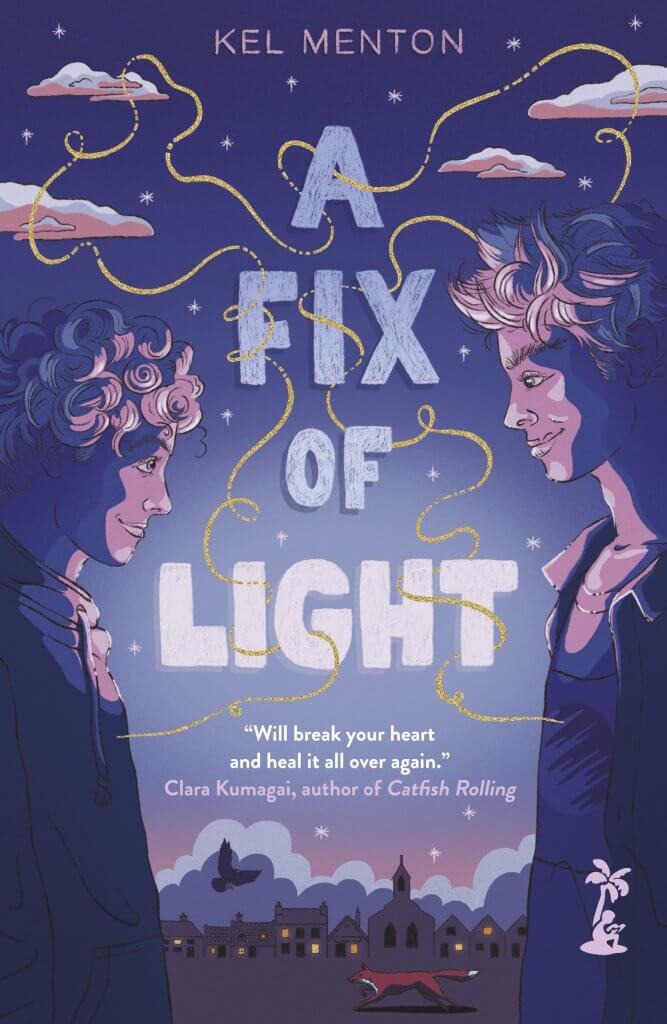
A Fix of Light

Hanan is supposed to be dead.

The forest outside Skenashogue sent him home alive – but changed. A strange new magic makes every emotion a physical force he can’t control.

Bright and gentle, fox-like Pax is everything Hanan is not. And when he touches Hana he mutes his secret power, quiets the curse.

To survive their own darkness they’ll need to open up to each other. But Hanan isn’t sure Pax will like what he finds out …Can their love help them find their way back to the light?

Little Island

Be Careful. The dark is listening.

The cover blurb on the proof states “The latest YA debut from Little Island is a trans love story with a dark magical twist from an astonishing new voice in Irish writing”…and it doesn’t lie about it being dark! It is definitely not one for a precocious younger reader. The content note is stark:

A Fix of Light contains references to suicide and self-harm, depression, anxiety and episodes of psychosis, as well as other symptoms associated with borderline personality disorder. It also contains graphic depictions of homophobic and transphobic hate speech and physical violence, and references to past sexual assault, Reader discretion is advised.

The prologue sets the tone, as a boy walks into the forest intending to die. To be honest, I found those first few pages extremely difficult to read and wasn’t sure I wanted to continue, but I did, and was quickly drawn into the story of Hanan and Pax. I keep typing sentences and deleting them because they feel a bit too spoilery, but the magical fantasy aspects are woven neatly into a contemporary story of two traumatised teenagers. Dual POV, their worlds very quickly revolve around one another, for better and for worse, with a classic ‘things get worse before they get better’ storyline. The reader is drawn in by their hopeful, tentative connections and the heartbreaking events that test them, it is hard going at times but also a very satisfying read.

Kel wrote a thoughtful piece for TeenLibrarian about writing through the conflicting memories of childhood wonder and teenage angst:

When I was a child, I spent one week every summer with my mom’s side of the family – grandparents, aunts, uncles, cousins and all – in Dingle. It was my favourite week of the year.

We wrote messages to mermaids in the sand, sipped hot chocolate from flasks, shared halved apples, and searched for faeries among the fuschia. I remember staring out across the sea at the Sleeping Giant, hoping to see his chest rise and fall, or standing on top of cliffs and staring down at the shifting water, seeking flashes of mermaid’s tails. I was an explorer, an adventurer, just like the protagonists of my favourite books, and the air was thick with potential and magic.

When I started writing A Fix of Light, I was about 16 years old, and I was becoming increasingly unhappy that with each passing year I grew further from childhood and closer to adulthood. Adults, in my opinion, were disenchanted and miserable creatures. I raged against my descent into such banality. What better way to fight disenchantment than to write?

I knew I wanted A Fix of Light to have magic. I knew I wanted it to be set in Ireland, somewhere by the sea. Looking back, I think I was trying to preserve some of that childhood wonder. Every time I sat down to write a little more, I could steep in those memories, try to conjure up the feelings again and translate them onto a page. The act of writing the book, as well as the finished product, could keep those memories pressed like flowers.

The story, though, and the characters, were born of my teenage self. If you are or have ever been a teenager, you know that self-actualisation is a pretty uncomfortable process. Lots of growing pains. I was figuring out How To Write A Novel and Who I Am at the same time, against the backdrop of idyllic childhood memories. How do I make these contrasting flavours complement each other? How do I make this novel coherent, when it feels like I am trying to cram a thousand of my selves into it?

Phillip Pullman, the author of His Dark Materials and other fantastic works, wrote that “…if we are going to do any good in the world, we have to leave childhood behind” (Introduction to Oxford UP’s World’s Classics ed. of Paradise Lost, 2005). I will never be a child again, and that used to make me sad. It felt like someone had locked the door to my favourite room, and hidden the key on Mars. I wanted to go back, and I never could. That is sad, I suppose. But spending the rest of my life staring at a locked door would be much worse.

Trading your childhood for adulthood is exactly that: a trade. You are not left empty-handed, but exchange your innocence for experience and wisdom. Here’s another great Pullman quote: “Innocence is not wise; wisdom cannot be innocent.” (“The Writing of Stories”, May 2002). I have gained wisdom – and will hopefully continue to collect it forever – which has opened a thousand new doors.

As I got older, I realised that adults are not necessarily miserable and disenchanted creatures. In fact, one of the brilliant things about being an adult is that you become responsible for creating the magic. I can make it with my mind, with my hands, with speech, with writing. I did not have to surrender my wonder or enchantment; I just had to start making my own. That’s how I made my childhood wonder and teenage angst become friends.

That’s how I made A Fix of Light.

Kel Menton (they/them) is a non-binary, neurodivergent writer from Cork in Ireland. Kel works in youth theatre as a facilitator and playwright mentor. They were selected as a Young Writer Delegate for the 2021 Dublin Book Festival. They hold a master’s in medieval English literature from University College Cork.

Thankyou to Little Island for sending me a proof copy to review and to Antonia Wilkinson for organising the guest post.

A FIX OF LIGHT publishes on the 6th February 2025.