Hanan is supposed to be dead.
The forest outside Skenashogue sent him home alive – but changed. A strange new magic makes every emotion a physical force he can’t control.
Bright and gentle, fox-like Pax is everything Hanan is not. And when he touches Hana he mutes his secret power, quiets the curse.
To survive their own darkness they’ll need to open up to each other. But Hanan isn’t sure Pax will like what he finds out …Can their love help them find their way back to the light?
Little Island

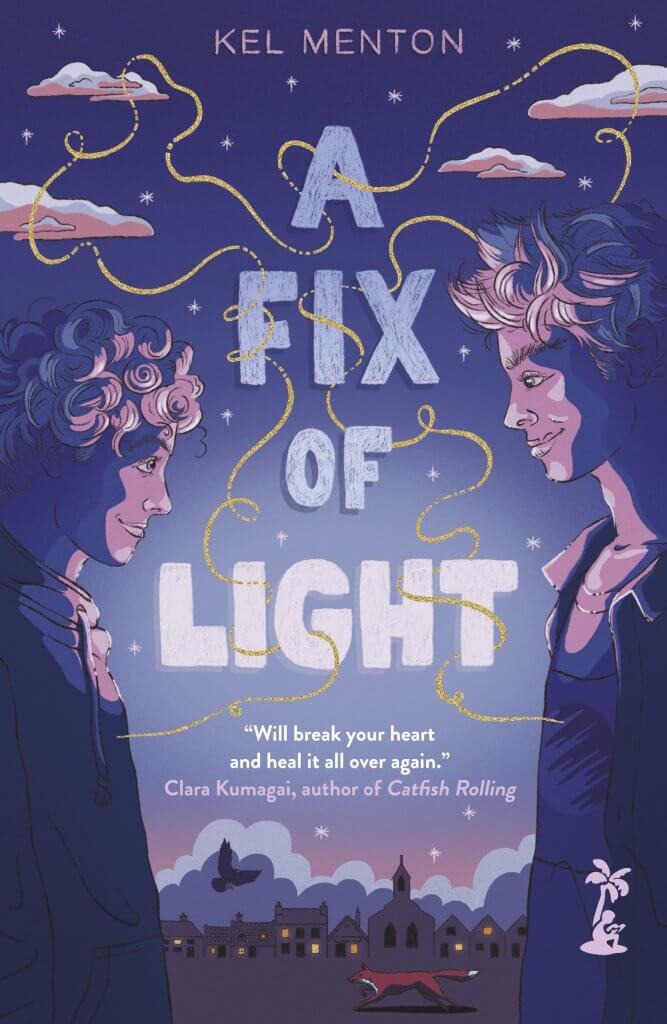
Be Careful. The dark is listening.
The cover blurb on the proof states “The latest YA debut from Little Island is a trans love story with a dark magical twist from an astonishing new voice in Irish writing”…and it doesn’t lie about it being dark! It is definitely not one for a precocious younger reader. The content note is stark:
A Fix of Light contains references to suicide and self-harm, depression, anxiety and episodes of psychosis, as well as other symptoms associated with borderline personality disorder. It also contains graphic depictions of homophobic and transphobic hate speech and physical violence, and references to past sexual assault, Reader discretion is advised.
The prologue sets the tone, as a boy walks into the forest intending to die. To be honest, I found those first few pages extremely difficult to read and wasn’t sure I wanted to continue, but I did, and was quickly drawn into the story of Hanan and Pax. I keep typing sentences and deleting them because they feel a bit too spoilery, but the magical fantasy aspects are woven neatly into a contemporary story of two traumatised teenagers. Dual POV, their worlds very quickly revolve around one another, for better and for worse, with a classic ‘things get worse before they get better’ storyline. The reader is drawn in by their hopeful, tentative connections and the heartbreaking events that test them, it is hard going at times but also a very satisfying read.
Kel wrote a thoughtful piece for TeenLibrarian about writing through the conflicting memories of childhood wonder and teenage angst:
When I was a child, I spent one week every summer with my mom’s side of the family – grandparents, aunts, uncles, cousins and all – in Dingle. It was my favourite week of the year.
We wrote messages to mermaids in the sand, sipped hot chocolate from flasks, shared halved apples, and searched for faeries among the fuschia. I remember staring out across the sea at the Sleeping Giant, hoping to see his chest rise and fall, or standing on top of cliffs and staring down at the shifting water, seeking flashes of mermaid’s tails. I was an explorer, an adventurer, just like the protagonists of my favourite books, and the air was thick with potential and magic.
When I started writing A Fix of Light, I was about 16 years old, and I was becoming increasingly unhappy that with each passing year I grew further from childhood and closer to adulthood. Adults, in my opinion, were disenchanted and miserable creatures. I raged against my descent into such banality. What better way to fight disenchantment than to write?
I knew I wanted A Fix of Light to have magic. I knew I wanted it to be set in Ireland, somewhere by the sea. Looking back, I think I was trying to preserve some of that childhood wonder. Every time I sat down to write a little more, I could steep in those memories, try to conjure up the feelings again and translate them onto a page. The act of writing the book, as well as the finished product, could keep those memories pressed like flowers.
The story, though, and the characters, were born of my teenage self. If you are or have ever been a teenager, you know that self-actualisation is a pretty uncomfortable process. Lots of growing pains. I was figuring out How To Write A Novel and Who I Am at the same time, against the backdrop of idyllic childhood memories. How do I make these contrasting flavours complement each other? How do I make this novel coherent, when it feels like I am trying to cram a thousand of my selves into it?
Phillip Pullman, the author of His Dark Materials and other fantastic works, wrote that “…if we are going to do any good in the world, we have to leave childhood behind” (Introduction to Oxford UP’s World’s Classics ed. of Paradise Lost, 2005). I will never be a child again, and that used to make me sad. It felt like someone had locked the door to my favourite room, and hidden the key on Mars. I wanted to go back, and I never could. That is sad, I suppose. But spending the rest of my life staring at a locked door would be much worse.
Trading your childhood for adulthood is exactly that: a trade. You are not left empty-handed, but exchange your innocence for experience and wisdom. Here’s another great Pullman quote: “Innocence is not wise; wisdom cannot be innocent.” (“The Writing of Stories”, May 2002). I have gained wisdom – and will hopefully continue to collect it forever – which has opened a thousand new doors.
As I got older, I realised that adults are not necessarily miserable and disenchanted creatures. In fact, one of the brilliant things about being an adult is that you become responsible for creating the magic. I can make it with my mind, with my hands, with speech, with writing. I did not have to surrender my wonder or enchantment; I just had to start making my own. That’s how I made my childhood wonder and teenage angst become friends.
That’s how I made A Fix of Light.


Thankyou to Little Island for sending me a proof copy to review and to Antonia Wilkinson for organising the guest post.
A FIX OF LIGHT publishes on the 6th February 2025.

