Trapped in a mansion with a murderer and a family of liars – how would you survive? A mind-blowing thriller from the author of THIS BOOK KILLS, perfect for fans of Holly Jackson and Karen McManus.
When three girls are stranded at the grand Bramble Estate in the middle of a snowstorm, they stumble into a murder plot. Someone has poisoned wealthy Emily Vanforte in the middle of a family dinner – which means Devi, Lizzie and Jayne are trapped in the house with a killer and a mystery to solve. With knives under floorboards, vanishing guns and secret passages in the walls, no one is safe and everyone is a suspect. But in a house of liars and corruption, will the girls save themselves…or learn to fit in?
Ravena Guron’s debut YA, THIS BOOK KILLS, was a brilliantly fun murder mystery set in a school with lots of twisty turns and only a slight suspension of disbelief needed to carry you along to the big reveal and I’d highly recommend it…CATCH YOUR DEATH however, is a million times better than TBK and I implore you to read it immediately!
I don’t want to say a lot about the plot because I don’t want to spoil it for you, which means this is a very short review, but the 3 perspectives are brilliantly rounded characters with distinctive voices (really hard to do) and I honestly gasped aloud at a couple of points, as well as laughing because there is a great use of humour. Definitely add this to your Christmas wishlist as, although it isn’t even remotely festive, it is a perfect read for a cold day.
Ravena Guron
Huge thanks to Usborne for sending me a review copy.
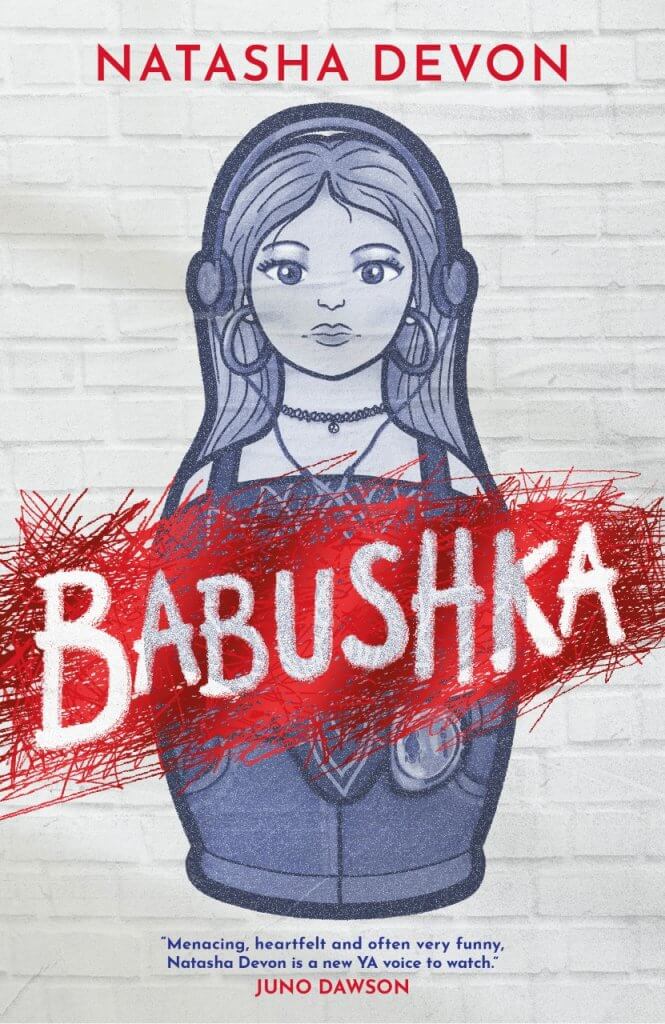
‘A little babushka is made when you’re young and something happens to you that leaves a scar…’
Cerys Williams has swapped her village in the Welsh Valleys for art college in London and the spare room in glamorous Auntie Wyn’s flat. Cerys knows there’s more out there for her in the world; it’s the year 2000 – she definitely doesn’t have to just get married and have babies and wear beige and cook stews for the rest of her life, even if Mam thinks she should.
But Cerys’s London is not glossy or cool or sophisticated, despite what Adept, her favourite magazine, has told her. It’s lonely and overwhelming and confusing. Until, that is, she meets him…
The prequel to Toxic. A coming-of-age novel about love – the love you think you know and the love you never realised you had, all along.
I’m reading BABUSHKA at the moment and am feeling very emotional about the concept of us having babushkas inside us like nesting dolls, reacting to events of today in your subconscious in different ways because of personal experiences and traumas. I was also a 90s teen (went to uni in 2000) so a lot of it is very familiar, I’d love to hear what modern teens make of it. Natasha Devon is a proving to be a great writer of thoughtful and thought provoking YA. Another brilliant YA author, Kate Weston (you must read MURDER ON A SCHOOL NIGHT, it is a hilarious and gripping and maddening all at once thriller), did a Q&A with her for a Waterstones event and I’m very happy to be able to share that with your here:
What was the inspiration behind Babushka?
Babushka is the prequel to my previous novel Toxic. My protagonist Cerys is the mother of Llewella, who is the protagonist in Toxic. At some point it occurred to me that Cerys and I would have been teenagers at the same time – the turn of the century. I wanted to write what about life was like for young women at the millennium, when we’d lived through the kind of inch-deep, Spice Girls inspired feminism of the 90s but were still contending with things like lads’ mags and celebrity magazines which put big red rings around women’s ‘flaws’. I wanted to make the point that some of the things Cerys grapples with – like consent, victim blaming and misogyny weren’t invented by social media. Sure, these problems have shapeshifted for the modern era but they were just as prevalent in the lives of women throughout the ages.
Where did the title come from?
Right at the beginning of the novel, someone says to Cerys that we all have previous versions of ourselves that live inside us, like Russian dolls. In Russia, these are called matryoshka dolls but elsewhere in the world people call them Babushka dolls. I went with Babushka as the title because it’s also the name of a track by Kate Bush, and what with ‘Toxic’ being a Britney track, I thought it would be fun if both my novels had titles which were songs by iconic women.
When during the process of writing and planning Toxic or after that, did you realise that you wanted to write about Loo’s mum’s story?
When people first read Toxic, some said they were surprised by how ‘hands off’ Cerys apparently was as a parent. It’s obvious Cerys really cares about her daughter, but she doesn’t try to micromanage her life in the way that another mother might. I wanted to explore why Cerys became that way and in my head it was all to do with how her mother was (the polar opposite – always interfering and nagging, or at least that’s how Cerys sees it). That’s how the idea for Babushka originally took root.
What’s your process when you’re writing? Do you plot or do you let your characters grow as you go?
Babushka was a very different writing process from Toxic. With Toxic, even though it’s also a character-driven novel, I already had a really strong idea of how the plot was going to play out. With Babushka, I had fleshed Cerys out almost entirely in my head before I even put pen to paper (or finger to keypad, technically), so the story really evolved through the prism of her. It’s fitting, really, because at one point Cerys tells another character that she’s never felt that she didn’t know who she was, just that she was in the wrong place.
You absolutely nailed the vibe or the women’s magazine in 2000 – especially with things like the circle of shame around someone’s cellulite – do you think that culture is in anyway improved? Or has it just moved on to a different format?
Misogyny shapeshifts as patriarchy uses the considerable resources at its disposal to protect itself. Some of the things that used to happen in media at the millennium would be considered unacceptable now, but that doesn’t mean they haven’t found a different way to do the same thing (straightforward fat-or-skinny shaming has now become ‘concern for health’ for example. Pointing out someone’s flaws just for the hell of it has become ‘aren’t they brave for going out like that?’).
What I do think is great is how much more of a breadth of content young women have to choose from, now. There are truly revolutionary content creators, TV series and magazine-style articles that you can get at the click of a button. There also isn’t the sense of ‘everyone’ watching the same thing and therefore absorbing the same beauty paradigms and life advice that we had with, say, Friends or Sex & The City.
There’s a conversation around page 40 between Wyn and Cerys where they discuss whether you would want to be remembered as you are or with certain perceived imperfections changed or “improvements” made. I liked how the conversation focused on “the real you” but avoided mentioning anything about a person’s personality, focusing solely on looks. I imagine this was on purpose because this was very much how things were perceived back then but do you think in 2023 that we’ve moved on from that? Or do you think looks still form the basis of how we’re remembered as a person.
That conversation is based on a thought I have all the time – Does a painting or a sculpture capture the essence of a person better – because artists can draw out certain otherwise intangible qualities – or is a photograph more accurate? And is even a photograph a ‘real’ representation of you when it can’t show how you move, what you sound like or how you smell?
I think in 2023 we’re all David Bowie (bear with me on this one). He talked about how there was a version of him he had curated and sent out into the world and that was what his fans were responding to, not the real him. So there’s a lack of actual connection, there. I think in the age of social media we all do that. We create an avatar of who we wished we were and send it out into the internet to interact with other people on our behalf. And that’s part of the reason there’s been an epidemic of loneliness because in order to truly connect with someone they need to see the whole you, perceived ‘imperfections’ and all.
How do you think the beauty industry has changed since 2001 and what impact do you think that’s having on young people?
Again, the answer is different depending on what end of the telescope you are looking at. On the one hand, we’re seeing more diversity in media and advertising and a greater breadth to the understanding of what it means to be beautiful than ever before and that’s to be celebrated. On the other, the beauty industry has continued to create areas of the face and body for women to feel apologetic about. When I was young the message was ‘be as thin as possible’, which was problematic for a number of reasons and left many people in my generation with eating disorders and other enduring issues. But now there are all these obscure beauty trends dictating exactly what shape and size every single millimetre of your body should be.
We’re also seeing the resurgence of hellish fashion trends we endured in the early 2000s like low rise jeans (just no), so-called ‘heroin chic’ and really thin eyebrows. Although not strictly relevant I do just want to mention to any young person reading this that is thinking of overplucking their eyebrows that, unless you are in the small percentage of people who are genetically blessed, THEY DO NOT GROW BACK.
Do you think that things can get better in terms of the way that the media and society views women and the things that are expected? Or do you think the list of things that we’re disapproved of for will just get longer?
You have to believe it can get better or you’ll just go and live in a hole in the mud somewhere and cry.
I have noticed two things about the women in their early twenties I work with at LBC that are very different from my generation. 1. They’re not afraid to take up space. Nothing about their body language suggests they are trying to make themselves smaller. And 2. They’re so supportive of one another. When I was in my twenties the message to women was ‘there’s a limited slice of the pie for you so every other woman who might have her eye on it is a threat’. A lot of us ended up very ‘pick me’ as a result (and I include myself in this – I’m a Pick Me Girl in recovery). Young women now seem to be all about celebrating each other and raising each other up, which is wonderful.
I want to talk about Darsh a bit without any spoilers. It feels like it would have been really easy to make him into a complete bastard but there’s far more subtle things that he does that are in the guise of protecting her or ‘loving’ her. How did you come up with his character?
I’ve learned through experience that the people who are going to treat us badly in life don’t announce themselves with a giant neon sign saying ‘HEY! I’M REALLY TOXIC AND I’M GOING TO MAKE YOUR LIFE UNBEARABLE!’. If they did it would be really easy to avoid them. The red flags are much subtler, in reality, and therefore easy to miss or overlook. It also had to be believable that someone as clever and independent minded as Cerys would fall for Darsh. Like most f**kboys, Darsh is really charming, exciting, handsome and a little bit mysterious.
I also learned writing Toxic (which is also features a dysfunctional relationship, albeit a platonic one) that creating a good story means it would make sense if told from the perspective of any of the characters. People aren’t generally badly behaved or mean for no reason – There’s always a journey that’s brought them to that point.
What’s next? Are you working on anything you can share with us at the moment?
I’m in the very early ideas stages for another novel but I have no idea if it’ll ever see the light of shelves at this moment. In the meantime, I’m doing my ‘day’ job of visiting three schools a week delivering talks and conducting research on mental health, writing my columns for Teach Secondary and doing my weekly radio show on LBC.
Natasha Devon (photo credit: Jonathan Donovan)Kate Weston
Experience Skulduggery Pleasant as never before – in this fully original graphic novel brought vibrantly to life in full colour.
A small town in the middle of Ireland, a string of unexplained deaths and a monster on the loose. Better call in the experts.
When Skulduggery Pleasant and Valkyrie Cain drive into Termoncara, they discover a town with a dark past and a people haunted by their own secrets. There is a creature stalking the streets – a creature who delights in cruelty, who feeds off the little hatreds, who grows stronger with every drop of blood spilled.
Horror and mystery collide in an original graphic novel by Derek Landy, P. J. Holden, Matt Soffe, Rob Jones and Pye Parr.
What I love most about the Skulduggery Pleasant books is the humour. Without it the darkness would be overwhelming, but it also doesn’t undermine the intensity of some harrowing scenes! I wasn’t sure how much an illustrated fight scene (because, let’s face it, there are a lot of fight scenes) would keep that balance and worried the violence might become the most important part of the story…but it still works! Derek Landy’s script was limned by P.J. Holden, coloured by Matt Soffe and lettered by Rob Jones (I must give thanks to the excellent Comics Review blog post about it for this detail).
Be warned though, it is pitched older than the first novels, there is a 15+ rating on the back cover.
You can read a sample on the Skulduggery Pleasant website to get a taste for it. I’m pleased it wasn’t an adaptation but a whole new story, quite an unexpected but very current storyline about intolerance & guilt that is pretty hard going but very satisfying!
I was given a copy by Harper Collins to review but also knew that I’d have a few students desperate to read it so ordered it for school…my biggest Skulduggery fans absolutely loved it. They inhaled the book and want to see more of Jamie. One said it was too short but another said that they really liked how fast paced it was and found it even more un-put-down-able than the original novels. They then had the disappointment of realising that it is the only one (so far) and they couldn’t move straight onto the next book like they had with the series! The other brilliant thing about it though is that it has tempted some students that have been put off reading the novels because they get quite long, it can definitely live as a ‘stand-alone’ with no prior knowledge necessary.
2019 – Moud is an out gay teen living in Los Angeles with his distant father, Saeed. When Moud gets the news that his grandfather in Iran is dying, he accompanies his dad to Tehran, where the revelation of family secrets will force Moud into a new understanding of his history, his culture, and himself. 1978 – Saeed is an engineering student with a promising future ahead of him in Tehran. But when his parents discover his involvement in the country’s burgeoning revolution, they send him to safety in America, a country Saeed despises. And even worse – he’s forced to live with the American grandmother he never knew existed. 1939 – Bobby, the son of a calculating Hollywood stage mother, lands a coveted MGM studio contract. But the fairy-tale world of glamour he’s thrust into has a dark side…
Set against the backdrop of Tehran and Los Angeles, this tale of intergenerational trauma and love is an ode to the fragile bonds of family, the hidden secrets of history and all the beautiful moments that make us who we are today.
Abdi Nazemian has won numerous awards for his writing in America but this is the first of his books to be published in the UK, so when Little Tiger offered me a review copy I thought it would be worth giving it a go! The story is heartbreaking and soul-mending all at the same time, as intergenerational relationships are shattered, openly discussed, and repaired. I found Saeed’s story the hardest to read, full of emotional gut punches, but they all have moments of happiness and sadness (and realisations about how unfair the world is). It is a thoughtful and thought provoking look at how badly “ordinary people” are let down by their governments and that it is too easy to judge someone (or a group of people) for something we know little about. Moud’s “Peak White Gay” boyfriend is a brilliant foil for a lot of reflection about culture and family. The voices are wonderful and I loved the use of Iranian poetry and references to Persian food. I hope more of Abdi’s work is picked up by UK publishers because this one is well worth a read.
Photo credit: Mandy Vahabzadeh
Only This Beautiful Moment is published in the UK by Little Tiger on the 9th November.
A determined girl gives up on kissing a frog. A fearless heroine comes face-to-face with a not-so Big Bad Wolf. A monstrous princess, held captive on a deserted island, yearns to break free.
Within this book are seven famous fairy tales turned into enchanting, inspiring and sometimes hair-raising stories for today’s world, about girls with their own dreams and desires. These are no damsels in distress, but real young women of flesh and blood – who certainly don’t need rescuing.
Annet Schaap writes in Dutch but Laura Watkinson has done a brilliant job of translating her work into English for Pushkin Press: I’ve read and loved both the Carnegie shortlisted LAMPIE in 2020 and this, her self illustrated collection of short retellings of fairy tales. I loved the sketches, they suit the text perfectly and I wouldn’t be surprised to see it on the [was Kate Greenaway] awards list for illustration next year, so I am pleased to be able to share an extract (click here) and accompanying illustration.
Rumpelstiltskin
The stories are almost instantly recognisable and put a brilliant spin on how the girls could/would/should behave in the various situations. The book was over far too soon!
Annet Schaap
Thank you Pushkin Press for sending me a copy for review, GIRLS is out now.
Return to Babylon 5 as the epic interstellar saga continues with The Road Home. Travel across the galaxy with John Sheridan as he unexpectedly finds himself transported through multiple timelines and alternate realities in a quest to find his way back home. Along the way he reunites with some familiar faces, while discovering cosmic new revelations about the history, purpose, and meaning of the Universe.
I was there…. when Babylon 5 was first broadcast in 1994. God it was a great series when it first came out, and it still stands up today; ok some of the effects look a bit ropey when compared to modern sci-fi shows but the character development and stories that developed slowly and thoughtfully over seasons made it more than worthwhile!
I owned the big box set and purchased the DVD release of The Lost Tales, and although I have not watched the series in over a decade I can still remember the story clearly, starting with : It was the dawn of the third age of Mankind…
Arc driven storytelling at its best!
Babylon 5: the Road Home is a triumphant return to the universe of the Babylon 5. Long enough to be a movie, but still short enough to seem like an extended episode of the series it was a joy to watch from beginning to end! Seriously J. Michael Straczynski has not lost his touch!
Jumping from timeline to timeline and giving Sheridan (and us) a glimpse of what might have been if things had turned out differently in the series was a delight and gives me hope for what may still come if this movie is as big a hit as it deserves to be!
Seeing Starfurys dogfight Shadow Fighters in the lee of Babylon 5 made me very happy!
Watching The Road Home also brought back memories of some of the original actors who have passed away since the end of the series. Rebecca Riedy captured Delenn’s voice perfectly, had I had not known that Mira Furlan had passed away I would not have noticed that she had been replaced, Andreas Katsulas’s G’Kar was one of my favorite characters in the show and Andrew Morgado’s take on his voice was likewise excellent! I also missed Jerry Doyle and Richard Biggs’ voices but hearing Bruce Boxleitner and the voices of the original cast was a pure delight!
Much like the series which took epic, galactic level storytelling and focused it by concentrating on a very human viewpoint The Road Home does not disappoint, providing heart in the throat tension cut with moments of unexpected levity and Zathras.
Babylon 5: the Road Home is out now and I think you should watch it if you are a fan of the series, it will also serve as a solid introduction for those who are new to the series!
Steven is one unlucky closeted sixth former. Whenever he has a strong emotion, be that happiness or sadness, weird things happen. Like, potentially dangerous things. Recently, he kissed another boy for the first time and . . . the boy’s head literally exploded. Steven flees to the miserable town of Grunsby-on-Sea, determined not to hurt anyone else with his “Emomancy”.
With a best friend as determined as Freya, it is impossible to stay hidden for long though, especially when she realises Steven might be in danger after a mysterious organisation called DEMA start asking questions about him. Where Freya goes, her boyfriend Marcus and American friend Troy soon follow. Together, they are determined to find out more about this organisation and what “neutralising” someone like Steven might mean.
By chance, Steven meets a handsome stranger who claims to share his powers and who offers to teach Steven how to control them. But who is he in relation to DEMA? What on earth happened to make Grunsby-on-Sea so lethargic a town? And can you really trust a charismatic stranger you meet in a café bathroom?
I’ve been neglecting the blog over the last few months, but what better to come back to it with than a Q&A with a brilliant debut author, David Fenne. Overemotional, a UKYA queer fantasy set in the most boring town in England, is great fun.
What aspect of Overemotional came to you first?
The concept of the powers came first. I had been rolling the idea around in my head based on conversations I’d had with my husband about how his anxiety manifests. I thought emotion-based powers were an interesting concept to explore, but they would just result in someone just trying to be happy. So I thought, “What if it were reversed?” What would the pursuit of misery do to a person? Almost immediately, Steven’s voice began to form in my head.
How soon in the process of creating the story did you decide to start with a head exploding?
Actually, VERY early on. I wanted something to kick off the plot in an explosive manner … literally! It’s such an extreme scenario, especially after what was a formative first queer experience, that sets up his character arc for the rest of the book. The initial concept was slightly different to how it plays out in the finished book, but I think this way is great at catapulting Steven back in the closet and rasing his walls at the start of the book.
Who was your favourite character to write as?
I find Steven’s voice the easiest because he’s the most similar to me, but I love Troy. He’s so earnest, polite, and optimistic in everything he does, and his fish-out-of-water point of view (being an American in the UK) is a great comedic vein to mine. He’s such a golden retriever that you can’t help but love him.
Writing comedy is notoriously difficult, but the voices were full of humour, was it difficult to balance jokes with tension?
Sometimes. My background is in comedy, being an improv comedian, so humour comes quite naturally during the writing process. I never wanted the humour to eclipse sincerity, though. There are times when it can break the tension or subvert an expectation or trope, but I think people are a little exhausted with “Marvel-quips” that don’t allow moments of genuine sincerity to land. The book gets quite tense at points, so I made sure jokes or funny situations (like throwing breast pumps at a monster) don’t entirely diminish from the tension built up.
Have you thought about what Steven & his friends do next? Or have you finished with their story and moved on to something else?
Well, funny you should ask! I’ve just handed in book 2 in the OVEREMOTIONAL Trilogy! The gang will be heading off to London for university, but not everything is as it seems . . .[CFi ed: I didn’t notice that it was first in a trilogy and I’m so pleased that we’ll meet them again a little older, with the new challenges of uni!]
What are you reading at the moment and who would you recommend it to?
I’m currently reading Murder on A School Night by Kate Weston and I am LOVING IT! It’s a laugh-out-loud funny murder mystery featuring death by period products. It’s so refreshing to have such an overtly feminist, period-positive voice in the YA scene. Did I mention it was funny? It’s VERY funny. Highly recommend to any fans of YA murder mysteries like Holly Jackson’s A Good Girl’s Guide to Murder or just anyone who fancies a good giggle.
As You Grow is written by the Kirk Cameron. This fun story with brilliant art teaches the Biblical truths of the Fruit of the Spirit. Follow Sky Tree’s journey from a small acorn to a mighty tree that provides shade, sustenance, and lodging!
As a tool for proselytizing I think that Brave Books missed a trick here! I feel that had the authors tried to be less inspirational & ‘deep’ and focused on the Sky Tree’s growth along with the changing seasons (miracles in themselves) they could have created a story worthy of Juan Moreno’s art, instead they ended up with a product that feels more like book of inspirational quote posters than a coherent story.
Seriously, Moreno’s art calls out to the reader to take their time poring over the pictures, spotting the different creatures and imagining their stories.
Kirk Cameron has had a long career as an actor and speaker but needs more time & perhaps an editor to stand up to him and help him to find his footing as an author.
I don’t know, I think I will have to read the entire saga from Brave Books to properly appreciate what they were trying to do here, but as the Marvel Cinematic Universe has shown us, you don’t need to rely on the other parts of the series to enjoy the story contained in one part of it.
It would also be interesting to see how this book is handled during a storytime because as a regular storytime provider I think it would be a rather boring story for an audience if it was read without significant ad-libbing to fill in all the blanks.
Johnny is a little boy with a big imagination. One day he pretends to be a big scary dinosaur, the next day he’s a knight in shining armor or a playful puppy. But when the internet people find out Johnny likes to make-believe, he’s forced to make a decision between the little boy he is and the things he pretends to be — and he’s not allowed to change his mind.
As anyone that knows me or has seen my social media feeds may guess, my politics and personal views skew very much to the left. However one of the things I can do without letting my personal biases interfere too much is read and critically examine books for review thanks in no small part to my time as a judge for the Carnegie & Kate Greenaway Awards in the UK.
Johnny the Walrus is a board book and at first glance appears to be a book aimed at children. The majority of the audience of board books are pre-readers. The text makes use of complex words and sentences way beyond the understanding of children, this leads me to believe that the intended audience are adults that have a specific social and political views.
From a purely analytical viewpoint, Johnny the Walrus is way too wordy for a board book, if I completely ignore the words on the protest signs (page 11) and the posters in the woke doctor’s office (pages 12 & 13) the story consists of 267 words (301 with the words from the protest signs and posters).
On the off-chance that Mr. Walsh ever reads this review: board books should have a maximum of around 100 words, 301 is more in line with an average picture book for young readers. It would work better as a picture book after an editor has taken a look at it.
Moving on to the art style, I am not aware of the illustrator K. Reece, their art style leans towards rough sketches as if they did not have time to finish the drawings before they had color added prior to publication.
You can also play spot the author insert – I saw him twice, in a picture on page 3 wearing a diaper and also as the zookeeper.
Overall this book is about as subtle as a brick through a window. This is not to say that there won’t be an audience for this work, as rough as it is but it comes across as written for a specific group of people, to reinforce the viewpoints that they already hold.
While on vacation in London, Sikander Aziz gets his hands on the mythic tablet of destinies. Naturally Sik uses it to get his brother Mo back among the living. His wish is granted, but at a terrible cost. Sik’s troubles multiply a billionfold when the tablet is stolen by the elder god of insanity, Lugal, who brings back Tiamat, the great chaos dragon and mother of all monsters.
Hey quick question: have you read City of the Plague God by Sarwat Chadda? If you have great news you are ready to read Fury of the Dragon Goddess also by Sarwat. If you haven’t, put a pin in this review and hunt down a copy of City of the Plague God because you definitely want it under your belt before you pick up Fury…
Anyway way back at the beginning of April I (very cheekily) asked Sarwat to put in a good word for me with his publisher in the hope of scoring an ARC of Fury of the Dragon Goddess for a number of reasons, firstly he is a phenomenal author and I have loved his works since the Templar Chronicle days (although for my money his Ash Mistry trilogy were the ones that sealed my love of his writing), secondly it is the second book from him that is being published under the Rick Riordan Presents imprint – and forget all about any small recommendation I could possibly make because if you see RR Presents on the cover you KNOW it is going to be beyond amazing. Also I have read City of the Plague God and knew that if there was a chance at picking up the continuing adventures of Sikander Aziz early that I had to take it.
Let me tell you that I did not, and do not regret taking this chance!
Fury of the Dragon Goddess is one of those books that once you start reading it it demands your complete attention. Sarwat has melded Mesopotamian mythology with contemporary action, Islam, the ethics of modern museum collections – I am pretty sure some fans of the British Museum will get their noses put well and truly out of joint (no bad thing really) I laughed out loud at a joke at the expense of of the sticky-fingered nature of British imperialism.
In a world where Muslims are usually portrayed as anonymous, fundamentalist antagonists it is refreshing to have positive portrayals of characters from West Asia. Sikander is a decidedly unheroic hero, preferring to eschew violence as a first resort and instead relying on dialogue and the spirit of compromise before reaching (reluctantly) for weapons and even then preferring to lean on the skills of his friends and allies but being unafraid to throw down if the situation calls for it!
As I get older I have noticed a change in my preferences in reading material, I tend to gravitate more towards books that celebrate family, friendship and standing together against sometimes unthinkable odds instead of books celebrating lone wolf antiheroes willing “to do what needs to be done” to achieve their aims.
Fury of the Dragon Goddess has, if not all the things you are looking for in a book, then at least most of them! Don’t believe me? Check this out:
Look, this list has the potential to go on for ages, but all you need to know is that this book has mass appeal for readers of most ages – you will not regret picking it up (either your own copy or from your local library!), it may turn out to be the best book you read this year!
Trust me I am a librarian!
Fury of the Dragon Goddess by Sarwat Chadda is published by Rick Riordan Presents and will be available from all quality purveyors of books from August 1st 2023.