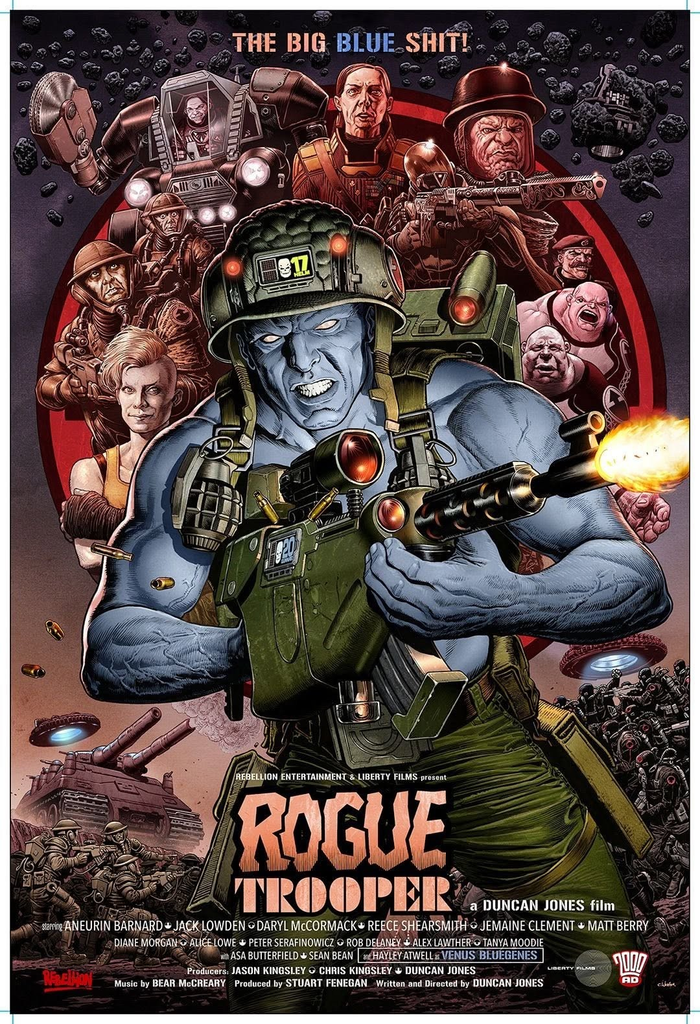
Earlier this month, I attended the London Film Festival for one of the three screenings of Duncan Jones’s new film, Rogue Trooper. I have been eagerly awaiting this opportunity since July 2018, when Jones (best known for Moon and Source Code) first announced his plans to adapt the classic 2000 AD comic.
Animated entirely in Unreal Engine, the movie is a fast, funny, and bold sci-fi adventure. It follows “19” (voiced perfectly by Aneurin Barnard), a blue-skinned, genetically engineered super-soldier and his companions fighting a never-ending war. The stellar voice cast truly elevates the material, featuring Hayley Atwell alongside brilliant comedic performances from Jemaine Clement and Matt Berry as a pair of amoral scavengers. Rather than trying to be a high-brow drama, it is an action-packed, old-school war movie that knows exactly what it wants to be and nails it.
I attended the screening with long-time friend James Swallow, author of the tie-in novel Blood Relative. We both agreed that Jones handled the difficult jump from page to screen with deep respect, fully embracing the bizarre, gritty nature of Nu-Earth without trying to modernise or water down its weird origins. By choosing 3D animation, Jones was able to affordably build a toxic, war-torn world while retaining the dark humour and harsh aesthetic that made the comic a cult favourite. It is clearly a labour of love that captures the wild spirit of the source material while still feeling entirely fresh.
As a bonus for librarians managing young adult collections, this film should directly to today’s teenagers. Its visual style, reminiscent of high-quality video game cutscenes, perfectly bridges the gap between console gaming and the graphic novels sitting on library shelves. It offers young people a highly accessible way to explore mature themes like bioengineering, cloning ethics, and the mental toll of war. As a lifelong fan, I know I am biased, but in a time where comic book films often devolve into indistinguishable slop, Rogue Trooper goes against the grain. It is a refreshing homage to its roots that feels destined for a passionate cult following, if only in the UK.
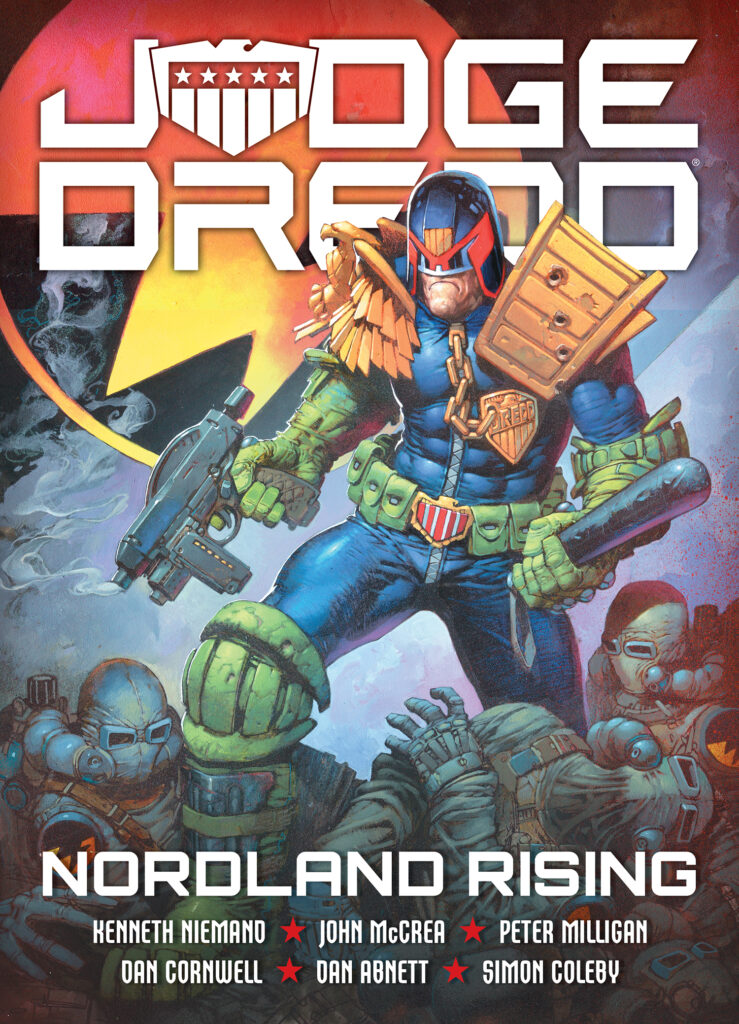
Thanks to advances in Nort technology, War Marshal Josef Jaegir has used the black hole around which Nu Earth orbits as a means of invading other universes.
Reaching out to Sov War Marshal Kazan, he’s joined forces with East-Meg One to subjugate Mega-City One, and in other realities the Norts have allied themselves with the alien Krool, the Geeks, the Volgans and the Nazis. It’s a war on all fronts, with Jaegir demanding nothing less than total victory.
Meanwhile, Venus Bluegenes has used a d-jump device to hop between the universes and recruit fighters from the various affected realities – Bad Company, the V.C.s, Captain Constanta and his Fiends, Major Eazy – and brought them back to MC-1. Now, Dredd, Anderson, Rogue Trooper and Atalia Jaegir – rebelling against her father – have assembled strike-teams to go after the enemy…
I am not always a fan of cross-overs, too often they can feel pandering to fans and do nothing to change the status quo of comic book world. Fortunately 2000 AD as a publisher has never been afraid of shaking up the ant farm and giving some of the ants more advanced weaponry just to see what happens.
Nordland Rising feels as if it was written just for me! They gave me some characters that I had been missing (Atalia Jaegir, Bad Company and Major Eazy), added in some of my regular favourites Dredd, Anderson the Rogue Trooper and a bunch of other fantastic characters, then gave the keys to amazing authors and artists and voila! A story that gives a deeper understanding of the 2000 AD multiverse as it is, and leaves enough story strands trailing for a revisit down the line, but complete enough to be enjoyed if they decide not to revisit it.
Obviously, as with any comic that has been going for almost half a century there is a ton of character lore and quirks that have developed over the decades that long-time fans will get more out of this work than new readers. But it provides a decent jumping on point for new or casual readers.
Nordland Rising, as with many 2000 AD titles takes a jaundiced eye to those who view war and destruction as viable methods of getting their point across, mixing in fun, bloody violence and a take no prisoners approach to saving the Multiverse (I hope that Marvel will take some notes on how to handle a great Multiversal story).
Nordland Rising is out now from 2000AD, buy it AND/or order it form your local library – they need some new comic books!
On the planet Deadworld, the insane Judge Death and his lieutenants Fear, Fire and Mortis have deemed that as only the living could break the law, life itself should be a crime, and living person is due their judgement. As the Dark Judges set out to bring extinction to their world, a small group of rebels led by Judge Fairfax launch a desperate effort to halt their city’s conversion into a Necropolis.
In the midst of all this chaos, the neighbouring Soviet forces launch an attack on their American enemies in a bid to stop the devastation.
You don’t need to know anything about Judge Dredd or the Dark Judges to pick up and read The Fall of Deadworld (but it helps give a deeper appreciation of the story). Being a near lifelong 2000AD reader I have read much of the backstory already, Judge Dredd stories that feature megadeath are pretty much par for the course in a post nuclear war world; who does not love reading about a fascist lawman defending his city and citizens from ever worse threats from beyond the city walls?
If you want to read the first stories of how Dredd and Judges Fear, Fire, Mortis and Death first met go to your local library and learn how inter-library loan works (if you have not already discovered it), you will decades of works to read through. Or you could buy them from the 2000AD shop or even your local comic store!
Enjoying this story is another issue, it is not a fun comic, this story is so bleak, but remains eminently readable and utterly compelling! I have read most of it already in weekly instalments but having the story so far it in one collection it hits harder with no waiting to give you a break from the bleakness and blooms of hope that the characters still have. I found myself poring over the pages, soaking in the art of Dave Kendall and the storytelling skills of Kek-W! These two are perfectly matched for this world! I read it, knowing what the destination is going to be, but knowing where does not tell us how, and in The Fall of Deadworld we are starting to get the answers that have been brewing for years!
For decades now, John Wagner has been my favourite Dredd writer, but lately his place at the top has been threatened by Rob Williams(seriously his run on Judge Dredd has been out of this world!), and more recently by Kek-W mostly thanks to this stunning story.
The Fall of Deadworld is a worthy addition to the Dark Judges mythos, and one that I hope presages stories (and maybe even another Mega-epic) yet to come of their attempts to fulfil the punishment of a world that has been found guilty of the crime of life!
Buy it or borrow it but read it you must! You won’t regret it – trust me, I am a Librarian!
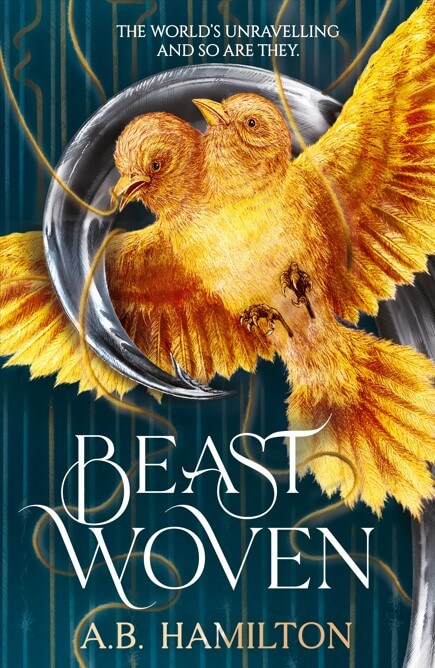
Two girls forced to share a body as they hunt and destroy beasts. The irony? They’re the very beast they must destroy. The first in an incredibly written and dazzlingly original YA fantasy duology, perfect for fans of Leigh Bardugo and Tomi Adeyemi.
Lia and Ali are trained to use their elemental weaving powers to destroy burl beasts – mindless, bloodthirsty monsters created when the threads of their world tangle together. Their secret? They themselves are a burl beast: twin sisters, forced to share one body. Quiet and reserved Lia controlling by day. Outspoken and abrasive Ali leading by night.
When news arrives that an elusive criminal is creating bespoke burl beasts by practising the illegal magic that could finally separate them, the girls jump at the chance to join the team sent to investigate. But as the girls get closer to their new flock and, more importantly, two different boys, it becomes harder to hide who – or what – they really are.
Delving deeper into the dangerous world of flesh-weaving and political intrigue, the girls get closer to the answers they so desperately seek. But is the price of their separation truly worth the risk?
I’ve not seen it talked about much, but I really enjoyed this debut YA from London (UK) based A.B. Hamilton. Sometimes it felt a comfortable fantasy, I knew where it was going, then a spanner would be thrown in the works and I’d be surprised. I was very satisfied with the conclusion (though also left wanting more…). I have a guest post about his writing process for you to enjoy just in time for publication next week!
Ask a hundred writers about their process, and you’ll get a hundred answers. Ask me about my process on a Monday, and you’ll get a different answer than if you’d asked me on Saturday.
Writers tend to fall into two camps (forgive me if you’ve heard this before). You have your gardeners, those who plant the seed of an idea in the soil, give it some water, and watch it bloom. They sit down with a premise, maybe some interesting characters, and see where the story takes them. Then you have the architects, those who meticulously plan the details of their story before they begin writing in earnest. The terms were popularised by an obscure, up-and-coming writer, George R. R. Something – and, for a long time, that’s what I believed writing was: something you either planned or made up as you went along.
Beastwoven started with a simple premise: two girls sharing one body. In the beginning, I fancied myself an architect. That approach made sense to me. Plan everything out, then write it. Simple, right?
So I started planning. I mapped out the characters, outlined their journeys and arcs, worked through the setting, the world, and the magic system. Then I started writing. Six months and half a book later, I realised my mistake.
My story was too big. Too many characters, too many things happening over too great a distance. Ideas that looked great in a plan turned into a sprawling, chaotic mess once it came time to write them.
I had to start again. It was painful, but I knew the story just wasn’t working. Still, I was determined to finish the book. If the architect had failed, I’d put on the gardening gloves and try that approach. I went back to my premise (two girls sharing one body), threw out the rest, and wrote whatever came to mind.
And that approach worked, for a while. Then I ran into different problems. I wrote myself into corners I couldn’t get out of. I introduced ideas that were interesting in the moment but went nowhere. There were glaring plot holes and obvious inconsistencies with the magic. I needed a plan – not a detailed blueprint like the first go-around, but key plot points and beats, character arcs, a beginning, a middle, and an end.
Looking back, it was a combination of both approaches that eventually got the book over the line.
So what does that say about my process? That I’m part architect and part gardener, yes. But more importantly, writing this book made me realise the whole gardener/architect split doesn’t describe what writing actually is – at least not for me.
It was Stephen King’s On Writing that helped me think differently about how we find our stories.
For King, writing is excavation. Writers aren’t architects drawing blueprints or gardeners planting seeds; they’re paleontologists scouting the site, readying their tools, then digging up the story buried beneath the earth one bone (or word) at a time.
That’s the best way to explain my process – not just how I write, but what writing is to me. Stories aren’t something we create. They’re pre-existing things buried somewhere deep, and it’s our job to dig them up and carry them from one world to the next without cracking too many pieces on the way.
When you realise it’s not your job to grow or plan a story, but simply to discover it, then the words flow so much more freely.
Planning, then, is just another tool in the box. That’s why on Monday I might sit and let the words flow while two characters hash out an argument, but on Saturday, when the characters have a detailed heist to enact, I’ll get out the blueprints and plan the next chapter or two. Ultimately, finding your process is about finding what works not just for you, but for the moment, and for the story.
A Note on Reading and Mental Health
I love reading because, even when you’re lonely, your favourite characters feel like they’re there with you. Or, rather, you feel like you’re there with them. You go on their journeys with them, feel their fears and their thrills. For a brief moment, you’re somewhere else, with someone else, and that has actual benefits. Studies back this up: immersive reading lowers cortisol and gives your brain genuine respite. But the deeper gift is empathy. It’s not like watching a movie, where you simply see what the character does on the outside. Reading brings you inside their heads, and inhabiting another mind rewires how you perceive real people. You learn to hold contradictions and forgive flaws, because you’ve seen the world first hand through another’s eyes. And, ultimately, when you read enough books and forgive enough characters for their mistakes, you might finally start to forgive your own mistakes, too.
A.B. Hamilton
Beastwoven is published in the UK on the 8th October by Hachette
Ever since she broke the curse that made her live as a harpy for two years, Jules has worked as a cursebreaker, taking on magical odd jobs for minimal pay and the occasional spot of cake. In a society obsessed with propriety and status, she must tread carefully to maintain her ties to both her aristocratic mother and the wild clamor of harpies with whom she once flew. The delicate balance she has struck is disrupted when her childood friend, Anthony, begs for help with a disgruntled sword. At first, she assumes it will be a job like any other, but the sword soon reveals itself to be an ancient, powerful weapon: the dubious sword forged by the magician Wayland Smith that can literally cut through human certainty. Now, it has awakened to challenge a new law in Parliament that would strip millions of their rights—magical and mundane people alike. The man behind the law, Lord Ventstock, was the very person who once cursed Jules, and she’s determined not to let him hurt anyone else.
A novella of manners and magic set in a Victorian London that never existed but provides a truer reflection of our world than any mirror could ever attempt!
A Dubious Clamor is a delightful, whimsy free celebration of friendship, love, family and standing up for what is right against overwhelming odds. There is a whole lot of story in this deceptively slight book and it gave me pause for thought with regard to traditionally terrifying monsters (Harpies) while indulging my love of British history (in particular the Victorian age) and myth (I am a fan of stories of Wayland the Smith). There is also a hint of Oscar Wilde about the story and some scandalous behavior that brought to mind Ncuti Gatwa’s take on Algernon Moncreiffe in The Importance of Being Earnest.
More seriously, London as a melting-pot was an essential piece of the background being targeted by the villainous Lord Ventwood as was the continuing rise of what was known as the ‘middling sort’ – people finding new paths, lives and employment for themselves and their families, shaking of the shackles of the traditional work that their sort had always done.
The London and world that Marissa has created and only hinted at in this story is one that I will hopefully have the chance to visit again one day (hint, hint).
Lady Ada Quintrall, heir to her grandfather the Duke of Corbridge, wants nothing more than to see her family’s new planet successfully terraformed, restoring their fortune and ensuring them a stable future. That means shutting away her whimsical side (including the beloved Chronicles of Yeneh, a children’s portal fantasy written by her own ancestor)—and refusing the requests of Dr. Zamora, the xenobiologist who is begging to study the planet’s native life before it’s driven extinct.
A rebuke of capitalism and an outright condemnation of colonialism wrapped up in a story that asks the question “What if the stories of fairies and portals to fantastical worlds that enthralled you as a child turned out to be real?”
Jo Miles takes us to a world ruled by a Duke, with a Duchess in Waiting who learns that all may not be as it seems, when an acquaintance from university turns up asking all sorts on uncomfortable questions.
In a world… filled with thousand page, multi-volume series with casts of dozens, The Final Chronicle of Yeneh weighs in at 119 pages and will take you on a journey of discovery and heart that will leave you satisfied and wanting more!
Written by Jo Miles and published by Horned Lark Press The Final Chronicle of Yeneh is available now wherever fantastic books are sold!
Brides are being murdered on their wedding nights. Soaked in blood and draped in lace. With nothing left behind to help them find the killer, the FBI is at an impasse. Their only, desperate hope is to convince Jasper Dent, the son of two serial killers and a former teen prodigy at hunting down such monsters, to emerge from his self-imposed exile.
Barry Lyga’s I Hunt Killers trilogy has long been one of my go-to favorite crime stories. Not just my favorite YA crime fiction but crime in general! Who does not enjoy reading about teens doing stupid, dangerous shit (in this case hunting serial killers), I wrote a review back in 2012, you can read it here.
Last year Barry released Before the Hunt, a collection of short stories and novellas about Jazz and other characters who appear in the original trilogy. For months he has been teasing Every Hunter is Hunted, the first in a new series about Jasper Dent. The story opens with a suitably gory prologue (this is a serial killer story after all) and when we get to Jazz, we find him older, wiser and still as isolated as he was as a teen in the small town of Lobo’s Nod. Every Hunter is Hunted is not a YA novel, although teens who read IHK will no doubt love it as much as I do! It has a slower pace than the stories that came before, Jazz is no longer the gung-ho serial killer hunter that he was in his teen days, as an adult he can no longer do, or get away with many of the things he did a few years previously; well he could, but the consequences if he got caught would be more severe. His doubts about his abilities and the things he did as a youth plague him, and, against his better judgement when the FBI comes calling he reluctantly accedes to their request for assistance in tracking down a serial killer in Seattle.
One of the things I loved about the original stories was the cast of characters, his best friend Howie, girlfriend Connie and Sheriff G. William Tanner are still in Jazz’s life but are conspicuous by their absence throughout much of the story; all of them having grown up (& older) alongside him. This gave the story more verisimilitude than it would have had if they were still revolving around Jazz rather than having moved on with their careers and retirement.
You don’t have to have read I Hunt Killers or the other books before picking up Every Hunter is Hunted, it works as a fresh start, but you will develop a deeper connection with Jazz and his struggles if you do! Plus they are bloody (pun intended) brilliant and well worth a read!
Every Hunter is Hunted is out now and available anywhere you can buy books, plus from your local library – and if they don’t have it you can request it!
Buy it or borrow it and read it! You won’t regret it! Trust me I am a Librarian!
Across 24 short essays spanning school, work, relationships, travel and everything in between, Wells and Schamaun draw on their popular podcast, Neurodivergent Moments, to offer an honest, funny and refreshingly un-self-helpy portrait of neurodivergent life – not as a problem to be fixed, but as a different, and often hilarious, way of being in the world.
Neurodivergent Moments, written by two Comedians Joe Wells & Abigoliah Schamaun is an honest, at times painfully funny and eminently enjoyable work that gave me insights into living with autism and ADHD. It also provided me with a soupçon of self-awareness as, while reading Neurodivergent Moments there were a few moments when I stopped and thought “Wait, am I neurodivergent?” as I saw some aspects of myself reflected in the stories. I have never been tested for neurodivergence although a number of my friends over the years have told me that I have some neurospicy traits.
If you are a book selector for libraries looking for more representative works by neurodivergent authors then I cannot recommend this book highly enough! If you have ever wondered what it may be like to be neurodivergent then this book is for you, if you are neurodivergent and are looking for more representative works, then this book is for you! If you are just looking for a collection of humorous biographical stories then, yes you guessed it, This book is for you!
I am no prognosticator, but I do know that once you have read this book you funny bone will itch for more work by Abigoliah and Joe, fortunately they have an awesome podcast (also called Neurodivergent Moments) that you can listen to.
Look you can also do it the other way around, listen to some of the podcast first and then buy yourself a copy of the book, or ask your local library to order a copy – libraries are great, and librarians love having patrons recommend titles that may not be on their radar yet!
They also have websites where you can find information about their stand up gigs and videos of their comedy specials. Joe’s website is here: https://www.joewells.org.uk/ and Abigoliah’s website is here: https://abigoliah.com/
For those who are not familiar, Martin Amis, an award-winning writer of serious books for serious people (adults) said during an interview:
People ask me if I ever thought of writing a children’s book. I say, ‘If I had a serious brain injury, I might well write a children’s book’, but otherwise the idea of being conscious of who you’re directing the story to is anathema to me, because, in my view, fiction is freedom and any restraints on that are intolerable. [source: https://www.theguardian.com/books/2011/feb/11/martin-amis-brain-injury-write-children]
When I first heard about Mac’s 94.7 % quote my mind immediately went to Amis’ interview, due to the tone-deafness of the words and the opprobrium that resulted. Imagine my surprise then, that, while reading Make Believe I saw that he referred to the Amis incident in a wonderful footnote in chapter one – A Grand Unifying Theory of Children’s Literature. I love footnotes in books; they bring me a lot of joy (and additional information and sometimes humor too).
I am a fan of his books and have been for years, Make Believe, his first book for adult readers is thought-provoking, funny and contains truths and observations that closely resemble ones that I have held for years.
Read in context, Barnett’s Addendum to Sturgeon’s Law makes more sense than the words shorn of the preceding and following chapters. This is not to say I agree with him on this. I personally would never refer to any book as ‘crud’, as a Librarian and long-time lurker in libraries I have learned that not every book is for every reader. This goes for children’s books as well, because we are all individuals and have differing tastes, and kids learn early what types of stories and formats of books they enjoy.
The more I read Make Believe, the madder I got. Not because it is a bad book, but because Mac wrote it with his heart on his sleeve, he is a well-known and beloved author who has worked with some phenomenal illustrators. He makes great points about celebrating children’s literature; as well as the less great books that adults may not always understand but kids love. The thing that made me mad is the fact that his addendum will poison people’s perception of the book and make many less inclined to pick I tup and read it.
I have seen several people online trying to push back against what they perceive as dogpiling on Mac Barnett and others who have read the book without knowing who he is or why so many of us are upset.
If anyone is interested why there has been such a huge pushback, it is because there is a problem affecting books for young readers – and it is not the books, rather there is a movement dedicated to making sure books by and about certain communities or individuals are kept out of libraries (both school & public), ostensibly to ‘protect’ children but the overarching goal is to control who gets to be reflected in our modern literary canon as one prong of an assault trying to push vulnerable minorities out of public view.
Having the current National Ambassador for Young People’s Literature and best-selling author for young readers stand up and say that he fears that 94.7% of kids books are crud gives culture warriors that already have libraries and children’s books in their crosshairs a huge stick to continue to beat us with. It is a massive unforced error, and not only that, but it is also dismissive of most authors who write books for younger readers.
I 100% believe that Mac’s intention was not to denigrate children’s books or those what write them, but in life when harm is done, it is not good enough to say he had good intentions but instead to acknowledge that harm has been done and work on remedying it.
In closing I will say that Make Believe is a good (but flawed) book that is worth reading despite the negative publicity around it but I fully understand and support those that choose not to.
Three life-changing minutes. Two siblings on the run. One choice that changes everything.
Ezra is sixteen. He’s no stranger to crossing the line, but this time it’s serious – and someone might be dead. To escape justice, he’ll have to cross another line: the Northern Irish border. But that means leaving behind the only thing that really matters. His little sister, Evie.
Evie is nine and sees it differently. When she was three, Ezra took her into care, into safety – and to the bookshop that became her lifeline. Ezra understands her. Why shouldn’t she go on the run with him now?
Ezra and Evie are used to feeling invisible. Now they have to become invisible for real.
Set in Derry~Londonderry and Donegal along the Wild Atlantic Way in 2023, Runaway Road is my third novel. My books are all available in independent bookshops, major book chains and online. Please shop local if you can!
A gorgeous YA, set in contemporary Northern Ireland, covering all sorts of “issues” with a deft touch. It is heartbreakingly sad in parts, but also thoughtful, warm, and a gripping read. Sue Divin has produced a wonderful trailer:
and also wrote a piece for us, which I’m sharing just in time for publication on 7th May:
Three life-changing minutes. Two siblings on the run. One choice that changes everything…
In the north-west of Ireland, along the Wild Atlantic Way, there is a sign that says, ‘Welcome to Amazing Grace country.’ That sign sparked some of the thinking behind Runaway Road. Giving Grace, AKA second chances, or ‘cutting people some slack,’ as protagonist Evie puts it, is one of the themes at the heart of the book.
I’m often inspired by the stunning landscapes in the north-west of Ireland, and the ‘Wild Atlantic Way,’ so, when pondering ideas for my third novel, I wanted to set it in Derry and Donegal. This location allowed me to explore the issues facing Northern Ireland (and these islands) about borders and identity. Walking local beaches, I discovered the connection with John Newton – his near-death experience in a storm off the coast, conversion to Christianity and transformation from slave-trader to abolitionist. Being given a second chance allowed him to make a huge, positive difference. Do we give people today that space, that grace, to change? What if a teenager messes up badly? Are they categorised for life? What if, like protagonist Ezra, they didn’t have much of a chance in the first place?
As a writer, I thrive on big themes and emotions blended with hope, humour and a story that keeps readers turning the pages. Whilst my writing inspiration often comes from a sense of place; contemporary issues; and character voice, I’m also seeking something universal that teens (and adults) across the UK and Ireland can connect with. In Runaway Road, that’s about belonging, family and friendship. Ezra (16) and Evie (9) have struggled all their lives to fit. Raised in care, they are used to feeling invisible, but when Ezra commits a crime and goes on the run with Evie, the siblings have to become invisible for real. There are over 4000 children in the care system in Northern Ireland, and one in every 17 school-age children here, like Evie, has an autism (ASD) diagnosis.
Runaway Road is also about inclusion and diversity. Northern Ireland is a place of increasing diversity, and the legacy of Brexit has thrown up big questions. Ezra and Evie are broadly from the British identity in Northern Ireland – something rarely, or stereotypically, represented in British and Irish literature. Alannah’s mixed-race character also poses the question of how we define Irish, Northern Irish or British today. How inclusive are we? I’ve done many author workshops and Q&As with teen readers. In Northern Ireland the response is often that, for the first time in a book, readers ‘feel seen’. Wider afield in Great Britain or the Republic of Ireland the novels provoke connection and empathy around identity as well as a questioning of why Northern Ireland, like Ezra and Evie, is almost invisible. How much does contemporary Northern Ireland feature in your library?
I find many teens are curious to learn more. Whilst textbooks teach the head, novels reach the heart. I’m impressed to see how many teen readers make connections between post-conflict Northern Ireland and all sorts of complex identity, diversity, justice and reconciliation issues in their own lives and communities.
What also makes my heart sing is how teen readers relate to the humour and voices of my characters. (And yes, I’m often asked about ‘Derry Girls’.) The plot, the pace, the twists and turns, the dry wit and self-depreciating humour – it’s kind of part of the culture here and I love ‘putting it on the page’ as Evie would say. I’m into writing the big rollercoaster emotions – and with all the hormones, teens love reading them. Like my previous novels, Guard Your Heart and Truth Be Told, I hope Runaway Road makes readers think, smile, cry and laugh out loud.
Northern Irish YA writing is currently going through a golden phase. Jenny Ireland’s novels, The First Move, The Boy Next Door are popular fiction, highly inclusive of disability. Sheena Wilkinson writes from boarding schools to historic battles for women’s emancipation. Shirley McMillan writes contemporary issues and diversity. Her most recent novel, Grapefruit Moon, is reminiscent of Dead Poets Society. Kelly McCaughrain’s Just Another Dead Boy poses the question if you knew when you would die, would it change how you live? Stephen Daly’s début The Last Death Poet is an urban fantasy set in post-conflict Belfast, and Siobhán Murphy’s Hedge Witch is a queer dystopian fantasy in a world when all the magic used to be locked safely behind a hedge. If you thought that Northern Irish YA was only Joan Lingard’s 1970s Beyond The Barricades, please think again!
For more on books by Northern Irish writers and/or illustrators, check out the 2026 Northern Lights guide published by Children’s Books Ireland and endorsed by the British and Irish Children’s Laureates.