Two girls forced to share a body as they hunt and destroy beasts. The irony? They’re the very beast they must destroy. The first in an incredibly written and dazzlingly original YA fantasy duology, perfect for fans of Leigh Bardugo and Tomi Adeyemi.
Lia and Ali are trained to use their elemental weaving powers to destroy burl beasts – mindless, bloodthirsty monsters created when the threads of their world tangle together. Their secret? They themselves are a burl beast: twin sisters, forced to share one body. Quiet and reserved Lia controlling by day. Outspoken and abrasive Ali leading by night.
When news arrives that an elusive criminal is creating bespoke burl beasts by practising the illegal magic that could finally separate them, the girls jump at the chance to join the team sent to investigate. But as the girls get closer to their new flock and, more importantly, two different boys, it becomes harder to hide who – or what – they really are.
Delving deeper into the dangerous world of flesh-weaving and political intrigue, the girls get closer to the answers they so desperately seek. But is the price of their separation truly worth the risk?
Hachette

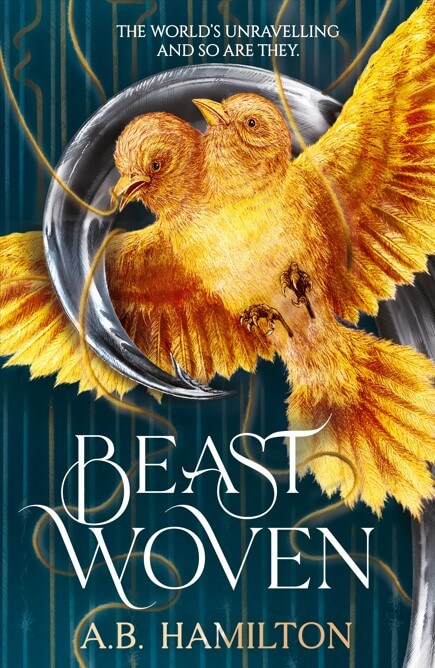
I’ve not seen it talked about much, but I really enjoyed this debut YA from London (UK) based A.B. Hamilton. Sometimes it felt a comfortable fantasy, I knew where it was going, then a spanner would be thrown in the works and I’d be surprised. I was very satisfied with the conclusion (though also left wanting more…). I have a guest post about his writing process for you to enjoy just in time for publication next week!
Ask a hundred writers about their process, and you’ll get a hundred answers. Ask me about my process on a Monday, and you’ll get a different answer than if you’d asked me on Saturday.
Writers tend to fall into two camps (forgive me if you’ve heard this before). You have your gardeners, those who plant the seed of an idea in the soil, give it some water, and watch it bloom. They sit down with a premise, maybe some interesting characters, and see where the story takes them. Then you have the architects, those who meticulously plan the details of their story before they begin writing in earnest. The terms were popularised by an obscure, up-and-coming writer, George R. R. Something – and, for a long time, that’s what I believed writing was: something you either planned or made up as you went along.
Beastwoven started with a simple premise: two girls sharing one body. In the beginning, I fancied myself an architect. That approach made sense to me. Plan everything out, then write it. Simple, right?
So I started planning. I mapped out the characters, outlined their journeys and arcs, worked through the setting, the world, and the magic system. Then I started writing. Six months and half a book later, I realised my mistake.
My story was too big. Too many characters, too many things happening over too great a distance. Ideas that looked great in a plan turned into a sprawling, chaotic mess once it came time to write them.
I had to start again. It was painful, but I knew the story just wasn’t working. Still, I was determined to finish the book. If the architect had failed, I’d put on the gardening gloves and try that approach. I went back to my premise (two girls sharing one body), threw out the rest, and wrote whatever came to mind.
And that approach worked, for a while. Then I ran into different problems. I wrote myself into corners I couldn’t get out of. I introduced ideas that were interesting in the moment but went nowhere. There were glaring plot holes and obvious inconsistencies with the magic. I needed a plan – not a detailed blueprint like the first go-around, but key plot points and beats, character arcs, a beginning, a middle, and an end.
Looking back, it was a combination of both approaches that eventually got the book over the line.
So what does that say about my process? That I’m part architect and part gardener, yes. But more importantly, writing this book made me realise the whole gardener/architect split doesn’t describe what writing actually is – at least not for me.
It was Stephen King’s On Writing that helped me think differently about how we find our stories.
For King, writing is excavation. Writers aren’t architects drawing blueprints or gardeners planting seeds; they’re paleontologists scouting the site, readying their tools, then digging up the story buried beneath the earth one bone (or word) at a time.
That’s the best way to explain my process – not just how I write, but what writing is to me. Stories aren’t something we create. They’re pre-existing things buried somewhere deep, and it’s our job to dig them up and carry them from one world to the next without cracking too many pieces on the way.
When you realise it’s not your job to grow or plan a story, but simply to discover it, then the words flow so much more freely.
Planning, then, is just another tool in the box. That’s why on Monday I might sit and let the words flow while two characters hash out an argument, but on Saturday, when the characters have a detailed heist to enact, I’ll get out the blueprints and plan the next chapter or two. Ultimately, finding your process is about finding what works not just for you, but for the moment, and for the story.
A Note on Reading and Mental Health
I love reading because, even when you’re lonely, your favourite characters feel like they’re there with you. Or, rather, you feel like you’re there with them. You go on their journeys with them, feel their fears and their thrills. For a brief moment, you’re somewhere else, with someone else, and that has actual benefits. Studies back this up: immersive reading lowers cortisol and gives your brain genuine respite. But the deeper gift is empathy. It’s not like watching a movie, where you simply see what the character does on the outside. Reading brings you inside their heads, and inhabiting another mind rewires how you perceive real people. You learn to hold contradictions and forgive flaws, because you’ve seen the world first hand through another’s eyes. And, ultimately, when you read enough books and forgive enough characters for their mistakes, you might finally start to forgive your own mistakes, too.


Beastwoven is published in the UK on the 8th October by Hachette

