The Worlds We Leave Behind

An extraordinary story about friendship and betrayal. Of revenge and retribution but also redemption. Perfect for 11+ readers who enjoy Stranger Things.

Hex never meant for the girl to follow him and his friend Tommo into the woods. He never meant for her to fall off the rope swing and break her arm. When the finger of blame is pointed at him, Hex runs deep into the woods and his fierce sense of injustice leads him to a strange clearing in the woods – a clearing that has never been there before – where an old lady in a cottage offers him a deal. She’ll rid the world of those who wronged him and Hex can carry on his life with them all forgotten and as if nothing ever happened. But what Hex doesn’t know is someone else has been offered the same deal.

When Hex’s best friend Tommo wakes up the next day, he is in a completely different world but he only has murmurs of memories of the world before. Moments of deja vu that feel like Tommo’s lived this day before. Can Tommo put the world right again? Back to how it was? Or can he find a way to make a new world that could be better for them all?

Bloomsbury Children’s Books

The Song From Somewhere Else is a truly beautiful book, in all senses of the word, so when I saw that A.F. was writing another story set in that world also illustrated by Levi Pinfold I was a mixture of “YES PLEASE” and “how can it possibly compare…”. I needn’t have worried though. The Worlds We Leave Behind is completely different but equally enthralling. I asked A.F. Harrold a few questions:

The Worlds We Leave Behind is wonderfully philosophical. I love how you don’t talk down to young readers while also pitching it so as to not go over their heads, do you ever have ideas that you think are too complicated to include in a children’s book?

I imagine there probably are ideas ‘too complicated’ for a kids book, but, much more importantly, there are a million ideas that are perfect. And some of them might look complicated, until you begin to think about them. 

I think about the science ideas a writer like Christopher Edge builds his stories around, or Dom Conlon’s Meet Matilda Rocket Builder – perfect books with big complicated ideas behind them. Of course, those are scientific/engineering ideas, and your question began with a thought about philosophy, but I think it’s much the same, and of course, the scientific explanations throw up ethical and psychological questions. Take Chris’s The Many Worlds of Albie Bright – it shows how quantum physics, alternate universes and ethics are all intertwined, and does it with heart and love. 

It’s important to remember that we swim in a soup, where none of these subjects and ideas are separate, it’s all mixed up together and you can’t look at one ingredient without bumping into another.

Did you know before you started writing TWWLB that it would be one for Levi Pinfold to illustrate?

Yes. It took a long time for me to find out what I could write next, and the key turned and the spark ignited the moment I realised I could just take a character from our previous book together (The Song from Somewhere Else) and continue their story. And so, since it was continuing that world we’d already spent time in, I wrote it with Levi in mind. That isn’t the same as knowing your publisher will agree to let Levi illustrate it when you hand the story in, however. We were fortunate, though, that my editor, Zöe Griffiths, agreed with me that it ought to be Levi. And even more fortunately, when they approached Levi, he said yes, I think without having actually read it, because we didn’t have a final draft at that point. 

Because Levi is such an amazing and in demand illustrator, we knew we had to wait a while before The Worlds We Leave Behind would reach his desk, so Zöe and I were able to work on the story and the text for two years before it reached the final final state. After the first year (draft 3) the story was pretty much what’s in the book, and Levi was in the UK for a rare visit (he lives in Australia), and he came over to my house one afternoon, and we sat in my shed (office at the end of the garden), and I was able to sit with him and tell him the story as we drank tea and looked out at the bare trees. I enjoyed that very much, because he is so delightful a person, so engaged and so talented. He’s about ten years younger than me, but our growing up experiences, in small English towns, kicking around down the rec, were similar enough that we seem to fit together well, and he understands what I’m on about. And then, after that storytelling session, he flew back to Australia and within a couple of weeks the first lockdown was announced and our world changed forever. Zöe and I finessed the 4th draft, the final version, into shape over that summer (while also seeing me and Mini Grey’s The Book of Not Entirely Useful Advice to press – a quite different adventure), and it was only the following February (2021) that Levi got to read it (having heard it almost exactly a year before). 

It was a long process, but it gave everything time to settle into place, all the words, all the action and then, finally, all the pictures.

How soon in the draft process did you get him involved? Did you note what scenes you would like to have illustrated or leave it entirely up to him?

So, as you see from the previous answer, he wasn’t actually involved (as in drawing), until the writing was all done, but that is misleading, because he was involved from the moment I hit the first key on the keyboard and wrote the word ‘Hex’ at the top of the page. (My works in progress are usually just named for the character, titles are a pain in the bum to be thought about years down the line!) Having done The Song From Somewhere Else together I knew the style Levi draws this world in, I had an idea of how it looks because he’s already shown that to me, and so I was able to write with the thought in my head, ‘What would I like to see Levi draw?’ and so that led us into the forest, that gave us big dogs, that gave us brooding shadows and a fairytale cottage… What would you like to see Levi draw next? 

And so, when the time came for illustrating, an editor will normally give an illustrator a brief – we’d like pictures of this scene, that scene and this character, and so on (spaced out evenly through the story, one per chapter, or whatever). But with Levi (and with Emily Gravett, in the books I’ve done with them), because these are intended to be highly illustrated and because the illustrator is of such quality (and know what they’re doing and won’t be daft and draw thirty pictures for the first ten pages and nothing for the next 200!), I think we’re much more inclined to just let them go and do what they want. 

Of course, the process involves roughs and we might make suggestions at that stage, nudging things this way or that, and we get a feel for the shape of it and ask for scenes that have been missed and so on. And then you get the great joy of seeing final art come in, and then I’m able to do little edits in the text to match the things Levi’s drawn better (Hex in jeans, rather than shorts, for example), and I couldn’t be happier seeing what my little words inspired from his magnificent fingers! Gosh but he’s a master.

Interior illustration by Levi Pinfold

Do you have different routines when writing a novel vs poetry, or humour vs atmosphere? Do you favour one over the other?

When I’m working on a (first draft of a) novel, I do try to do something every day. I discovered for this one that getting up very early and writing before going for my daily walk, before looking at e-mails or the internet, was the way to go. I’d come down to my shed, through the silent sunlit morning (it was April/May 2019, and beautiful), put on Morton Feldman’s Piano, Violin, Viola, Cello and spend some time with Hex and Tommo and the others, and then I can get on with my day. And if I’ve done that, made that early start, I can usually return to the manuscript during the day and do some more. 

If, on the other hand, I have let the world step in front first (opened an e-mail, written an invoice…) then I’ll never be able to settle to writing that day. (Editing and rewriting, that’s easy to dip in and out of, but writing new stuff… that’s hard and fickle.) Poems, on the other hand, because of their snackability, they’re much easier to sit down and have a go at at any time. Part of the joy is, of course, that if it doesn’t work you can throw it away and you’ve only lost half an hour, and if it did work… brilliant, you’ve got a new thing in your hand and in your head, that didn’t exist before! There’s a lot less pressure on any individual poem to be good, and so it’s much easier to simply give it a go.

What kind of events do you most enjoy doing?

I like performing poems and being funny. Comedy for kids without the safety net.

What are you reading at the moment and who would you recommend it to?

I’ve just read Gareth P Jones’ No True Echo (2015) (which I read about in a review of TWWLB), a great mind-bending alternative world time travel looping story, for (I guess) maybe 11+ with a good grip on what’s real. Then I read Bridge to Terabithia by Katherine Paterson  (1977), which I’d seen the movie of, but had never read, and it was as moving and heart-sinking as I expected, and typically and nostalgically American – it’s not my culture, not my world, but it’s so familiar from TV and films – which I’d recommend for anyone with a heart who yearns for freedom. And I’ve just finished Wolfstongue by Sam Thompson and illustrated by Anna Tromop (2021), which is your perfectly normal boy-meets-talking-wolf-and-rescues-it-from-the-talking-foxes-and-finds-his-life’s-turned-upside-down-and-he’s-involved-in-a-mythic-battle-underground sort of story, for any kid who likes that sort of thrilling adventure.

What are you working on at the moment?

I’ve written a sort of creepy ghost story story, which I’m waiting to hear if my publisher likes enough to publish. Fingers crossed.

A.F. Harrold
Levi Pinfold

Thank you to Nina Douglas for organising a review copy and the opportunity for a Q&A with A.F. Harrold. THE WORLDS WE LEAVE BEHIND was published by Bloomsbury Children’s Books on 4 August (9781526623881/ £12.99 hardback).

Utterly Dark and the Heart of the Wild

Utterly Dark has a special connection to the sea. But it is tested more than ever before, this autumn on the island of Summertide. Accompanying her uncle as he explores mysterious Summertide, Utterly is witness to strange happenings in the woods. Deep, old magic abounds, and threatens to steal those she loves most. Utterly must face truths about what lies beneath the land, and in her own past, if she is to save anyone. And she must make a sacrifice to the sea . . . An enchanting story of nature, magic and friendship, from the renowned author of Mortal Engines.

David Fickling Books
Cover art by Paddy Donnelly

This is the sequel to the equally brilliant UTTERLY DARK AND THE FACE OF THE DEEP, from one of my very favourite authors, Philip Reeve. I was thrilled to be given the chance to ask him a few questions!

Utterly lives in a magical but realistic historical period, how much research did you do to make it historically accurate?

Not very much, because Wildsea, where most of Utterly Dark and the Face of the Deep is set, is an imaginary island. I always knew it was somewhere you’d get to on a sailing ship rather than a car ferry, so I set the story in a sort of vaguely olden-days 18th or early 19th Century period, and gradually as I wrote I worked out it was happening in 1810.

So that means that Utterly Dark and the Heart of the Wild is happening in 1811, and a lot of it happens on a different island called Summertide, which is a bit bigger and a bit more developed, so I did have to do a bit more research about how grand country houses ran in those days, etc – but of course, if I get something wrong, or want to change something, I can always say, ah, well, they did things a bit differently on Summertide…. 

And a lot of the research I do doesn’t end up in the actual book. One of the characters in Utterly Dark and the Heart of the Wild is an ex-soldier called Figgy Dan, so I spent some time working out when he did his soldiering and what battles he had fought in, but actually that’s not important for the story, you just need to know he’s been a soldier. So the research is important in helping me understand the characters and get a sense of their world, but I try not to let too much of it clutter up the finished book.

Writing for younger readers with Sarah McIntyre must be very different, has working as part of a duo changed the way you approach your solo novels?

It’s not that different, because it’s still about inventing a story and putting it into words, but it’s much more fun, because we get to share ideas and make each other giggle a lot. But I do find ideas seep across from one to the other – I think Utterly Dark and her home in the Autumn Isles has developed out of the same ideas that we used in our first book, Oliver and the Seawigs. And Sarah now gets to read all my solo books while I’m writing them, and we talk about them together, so she’s a big influence on them all. 

All of your solo series are set in such different landscapes with unique characters, do they evolve together or do you spend time worldbuilding before setting to writing story?

I tend to think the best way to do world-building is to just start writing. A lot of people think that if you’re writing about an imaginary world you start off by making a map and then work out its history and language and then set a story there, but I’m not interested in doing that. With the Utterly books I started with a name – ‘Sundown Watch’ – which I knew was the name of a house. And obviously the people who lived in it were watching for something, so I put it on a cliff top, and then I decided the cliff top was on an island, and I drew a tiny little sketch map, but there were no other names on it. Then as I wrote I gradually filled in the map, and changed it a bit to suit the story, and worked out this island had neighbouring islands, so a whole world gradually arranged itself around the characters.

What is your favourite thing or person from any of your stories?

That’s a tricky one – I’m very fond of Utterly herself, and also of Wildsea, and Sundown Watch – I’d like to live there!

Without spoilers, how far ahead have you planned in Utterly’s story? Will it be a trilogy?

I’m not very good at planning! But I think there will be at least three books about Utterly, and I think I could tell many more stories set in the Autumn Isles, either about her and her friends, or with different characters, in different periods of history.

What are you reading at the moment and who would you recommend it to?

I’m reading Roderick Random, by Tobias Smollett. I bought it because I found a second hand edition with lovely woodcut illustrations, but it turns out to be a really good read. It’s one of those rambling, boisterous, 18th Century novels where a young man goes off into the world and has all sorts of adventures. I’m not sure I’d recommend it unless that’s your sort of thing – I guess the language is quite difficult, but you get your head round it after a few pages. And it’s good research for the Utterly books in a way, because there are lots of little details about life in the Eighteenth Century – a bit before Utterly’s time, but people in Wildsea are old-fashioned so they’d probably still talk the same way. 

What are you working on at the moment?

I’m working on a third Utterly Dark book, and a new series with Sarah McIntyre, Adventuremice. And I’ve also decided to make a short film, just as a kind of hobby. It’s an Arthurian fantasy so my writing room is filling up with costumes and bits of armour and I spend all my spare time doodling storyboards and making props – it’s makes a nice change from just writing!

Philip Reeve (photo credit: Sarah Reeve)

Utterly Dark and the Heart of the Wild by Philip Reeve | David Fickling Books | 1st September | £7.99 | Paperback

Philip Reeve grew up in Brighton. He has been writing stories since he was five years old, but the first one to be published was Mortal Engines which won the Nestlé Smarties Book Prize and Blue Peter Book Award. Philip has also provided cartoons and jokes for many books, including Horrible Histories, and co-created young fiction with illustrator Sarah McIntyre.

www.philipreeve.com | Twitter: @philipreeve1 | Instagram: thesolitarybee | #UtterlyDark

David Fickling Books | Twitter / Instagram: @DFB_Storyhouse | davidficklingbooks.com

If You Read This

When Brie was younger, her mama used to surprise her with treasure hunts around their island town. After she died three years ago, these became Brie’s most cherished memories.

Now, on her twelfth birthday, her mama has another surprise: a series of letters leading Brie on one last treasure hunt.

The first letter guides Brie to a special place.

The next urges her to unlock a secret.

And the last letter will change her life forever.

Pushkin Press

WHEN LIFE GIVES YOU MANGOES was one of my favourite books of last year, so I jumped at the chance to read IF YOU READ THIS. Always a worry, reading the follow-up to something brilliant, but I wasn’t disappointed and was very pleased to ask the author, Kereen Getten, a few questions!

What part of ‘If You Read This’ came to you first – the letters or the character of Brie?

I really liked the idea of a treasure hunt, and the character going on a journey of self discovery. The idea was very vague and so I started to think about Brie, who she was and why she would go on a treasure hunt so although the idea of the letters came first, Brie had to be developed before the letters were explored.

I love the Caribbean settings of both your novels, really evocative, are any of the scenes based on particular locations you know well?

When I was eleven years old, we returned to Jamaica for eighteen months. We moved into a gated community called Silver Sands and that’s where I loosely based where Brie lived. Also, Brim’s town is also loosely based on a small seaside town, on the western tip of Jamaica. The rugged, twisty road to Brim’s house is based on the actual road that leads into a rocky landscape overlooking the sea.

Have you thought about writing a story set in the UK?

I have! I actually wrote a short story for Happy Here anthology set in the UK it was called HOME. My historical novel Two Sisters is based in Jamaica and the UK and I’m definitely looking to do more UK based stories in the future. [CF: Oh, of course, I read and loved TWO SISTERS, a brilliant historical novel in the Scholastic VOICES series]

What kind of events do you like to do with readers?

As a pandemic author, I really am just beginning to do in person events, but I have enjoyed many virtual events where I have spoken to multiple schools at the same time. Nothing beats meeting readers face to face though, and some of my favourite moments are talking to readers about my books.

Have you had much feedback from young readers?

Yes! Sometimes I get social media messages from them or their parents after they’ve read my book, or after an event. With Mangoes there were a lot of conversations around the twist! Which I loved.

What are you reading at the moment and who would you recommend it to?

I’ve just finished Leila and the Blue Fox by Kiran Millwood Hargrave. A wonderful book about a young girl’s journey to mending her relationship with her mother while chasing a fox’s journey across the arctic.  I would recommend it to readers who love visual descriptions, stories about relationships, immigration and nature

What are you working on now?

I am currently editing a short fantasy book out next year titled Ada Rue and the Banished about a young girl who moves to a town where magical people are banished from society. I am also editing a detective series where a group of friends in the Caribbean form a detective agency to solve mysteries but they’re terrible at it!

Kereen Getten (photo credit Amy Spinks)

Thank you to Kereen for answering my questions, and Pushkin Press for sending me a review copy and organising the q&a. IF YOU READ THIS is out on 1st September 2022!

Something Certain, Maybe

Something Certain, Maybe is a powerful novel about first love, friendships and embracing the uncertainty of an unknowable future, from Sara Barnard, winner of the YA Book Prize.

Rosie is ready for her life to begin, because nothing says new life like going to university. After years of waiting and working hard, she’s finally on the road that will secure her future.

Except university turns out to be not what she hoped or imagined, and although she’s not exactly unhappy – really – she might be a little bit worried that she doesn’t really like her course much. Or her flatmates. Or, really . . . anything? But it’s normal to be homesick (right?) and everything will have settled in a month or two, and it’s totally fine that her friends seem so much happier than she is, and that the doctors don’t seem to know what’s wrong with her mother.

And then she meets Jade, and everything starts to look a little brighter. At least, it does if she’s only looking at Jade. But is first love enough when everything else is falling apart?

Macmillan

This is the 3rd outing with Rosie and her best friends Caddy and Suze. I thought Beautiful Broken Things was great, all those years ago before I put photos in tweets…

…adored Fierce Fragile Hearts…

…and Something Certain, Maybe was no disappointment…

…so I’m very pleased to be sharing a Q&A with Sara Barnard as part of her blog tour today, A-Level results day!

  • Rosie’s voice is so authentic, as are all your characters, do you eavesdrop on lots of teenagers?

Thank you! I don’t usually eavesdrop on real teenagers, no! The voices of my characters always just come through very clearly to me. My biggest piece of advice for writers writing teenage voices is to not actively try to make them sound like teenagers. Just trust their natural voice.

  • When you wrote ‘Fierce Fragile Things’ were you already planning ‘Something Certain, Maybe’?

Not at all! I wish I had been, because it would have made Something Certain, Maybe much easier to write! One of the most difficult parts of writing this book was making sure it fitted alongside FFH. There are a lot of things I would probably have done differently with FFH if I’d known there’d be another book set over the same period. So maybe it’s a good thing I didn’t know, because I love FFH a lot!

  • Which of the 3 girls came to you first, and who was the hardest to write?

Suzanne, and she came along quite a lot earlier than Caddy or Rosie. I wouldn’t say any one of them is particularly hard for me to write, because I could write all of them all day long and be very happy! But if I had to pick one out of the three, it would probably be Rosie, for reasons that are more to do with her book being the third one than her as a character.  

  • What kind of reaction have you had from teen readers?

Readers generally tend to respond to the friendship between the three girls, though I get the most messages about Suzanne! With Something Certain, Maybe in particular, I’ve been struck by how many people in their 20s and older who have got in touch to say how much the story of a disappointing university experience resonated with them, and how they wished they’d had the book when they were at university. I had hoped to put something on the page that doesn’t really get talked abou, so it means a lot that it has resonated with people in this way. 

  • What kind of reader engagement event, in schools or libraries or elsewhere, do you enjoy most?

YALC is always my favourite, but generally literary festivals are always a joy. There’s something about all those people choosing to be there out of a shared love of books. They’re such engaged audiences and there are usually some great questions. 

  • Have you finished writing about Caddy, Suze, & Rosie or do you think you could be tempted to write about them in their 20s?

I would love to write them in their 20s! I have written bits and pieces of them a little older. But I can’t imagine it would ever be something that would have a life outside of my laptop, sadly! 

  • What are you reading and who would you recommend it to? 

I am very late to the party, but I’m currently reading Life After Life. It is just as brilliant as everyone always said it was. I’d recommend it to everyone who likes reading.

  • What are you working on at the moment?

I’m editing my next YA book, Where the Light Goes, which will be out next year! 

Check out the rest of the tour. Thank you to Macmillan for organising!
Every single one of these books is brilliant.

The Nicest Girl

Sixth-former Anna Campbell is the go-to girl when anyone needs anything. Teachers, friends, random strangers… It never occurred to her that she could say no. After all, Anna Campbell’s always been too ‘nice’ to say no. But Anna is sick of being that girl, the nice girl, and she’s going to do something about it. Only, is she prepared to risk losing everything she cares about – even herself – along the way…?

Sophie Jo

THE NICEST GIRL is Sophie Jo’s debut UKYA and it is brilliantly put together, I felt every page of it! I asked the author a few questions:

How much of yourself is in the book, were you a “nice girl”?

There’s definitely some of me in the book – I’m a bit of a recovering people-pleaser and have felt the pain of being “the nice girl” many a time over the years, especially in my teens and early twenties.

When I started writing the book, I was really keen to hear from friends and acquaintances about their own experiences. It was sad but oddly freeing to learn that people I’d previously viewed as very assertive and “sorted” were struggling to turn down work shifts or stand up to friends or set boundaries in their dating life. I think a lot of us – especially women – are battling against this deep-rooted need to be seen as likeable and easy-going.

Trying not to include spoilers…there are tensions that build up & come to a head in totally believable ways. Did earlier drafts have anything more over-the-top that you decided to tone down?

The tension explosion and resolution has actually stayed pretty much the same throughout the editing process! I did wonder at one point if Anna would decide to cut one particular character out of her life (again, no spoilers…), but I’m glad she doesn’t, and I hope I did a good job at illustrating both points of view when things do erupt.

What would you most like readers to take away from the book?

I’d really love for readers to consider the middle-ground-complexities of the whole topic. You don’t have to turn into an unkind person to set boundaries – it isn’t about forgetting to be respectful or that other points of view exist. It’s about remembering that your feelings are as valid as anyone else’s and there for a reason.

I also hope it shows readers the value of honest, kind communication in friendships and other relationships. Sometimes you see stuff online that’s like, “you don’t owe anybody anything! Set boundaries! Immediately ghost people who don’t treat you right!” and while I am very much on board with anything that teaches people to stand up for themselves, I also think there’s space for most of us to better express expectations/wants/needs so our nearest and dearest at least have a chance to respond to those. Anna means very well and her struggles are relatable, but because she’s quite good at picking up on the emotions of those around her, she often expects them to mind-read in return – and they can’t.

Have you had much opportunity for feedback from teen/YA readers?

I was able to meet some amazing teen and YA readers at this year’s YALC – they’d picked up proofs from my publisher UCLan’s stand and were really excited to read. That was such a lovely experience for me, especially as someone so new to all this. It’s also been cool seeing initial reviews on Goodreads and NetGalley from people who’ve related to Anna and rooted for her throughout.

What would your ideal school visit to promote the book involve?

I would LOVE to sit down with a group of teens and talk about the concept of ‘niceness’ vs assertive communication. Maybe a lil quiz: Nice or Too Nice? A poetry-writing session? I have a million ideas; I’m going to start writing them down.

What are you reading at the moment and who would you recommend it to?

I’m enjoying THREE GIRLS by Katie Clapham, a fellow UCLan author. The voices she’s created for these characters are so strong, and there are these brilliant little drops of humour along the way. It’s quirky and interesting but never try-hard. Would recommend to: anyone who wants a really solid book about teen girl friendship.

I’ve also just finished a proof of GIRL FRIENDS by Holly Bourne, which is definitely one of my new favourites. She just gets women. Every time I read a Holly book I feel like she has crawled into the depths of my soul without judging me. Would recommend to: anyone who grew up reading 90s/00s Sugar magazine articles about How To Get Boys To Like You…

Have you any more stories bubbling away?

I’m currently writing draft one of book two. The main character is quite different to Anna – a lot more cynical and outspoken – so it’s been a real change to write, in a very fun way. I’m also trying out a dual narrative for the first time, which is a whole new challenge in itself. Hopefully we’ll be back talking about the finished book before too long!

THE NICEST GIRL was published by UCLan in August 2022. Thank you to Antonia Wilkinson for organising a review copy and the opportunity for a Q&A.

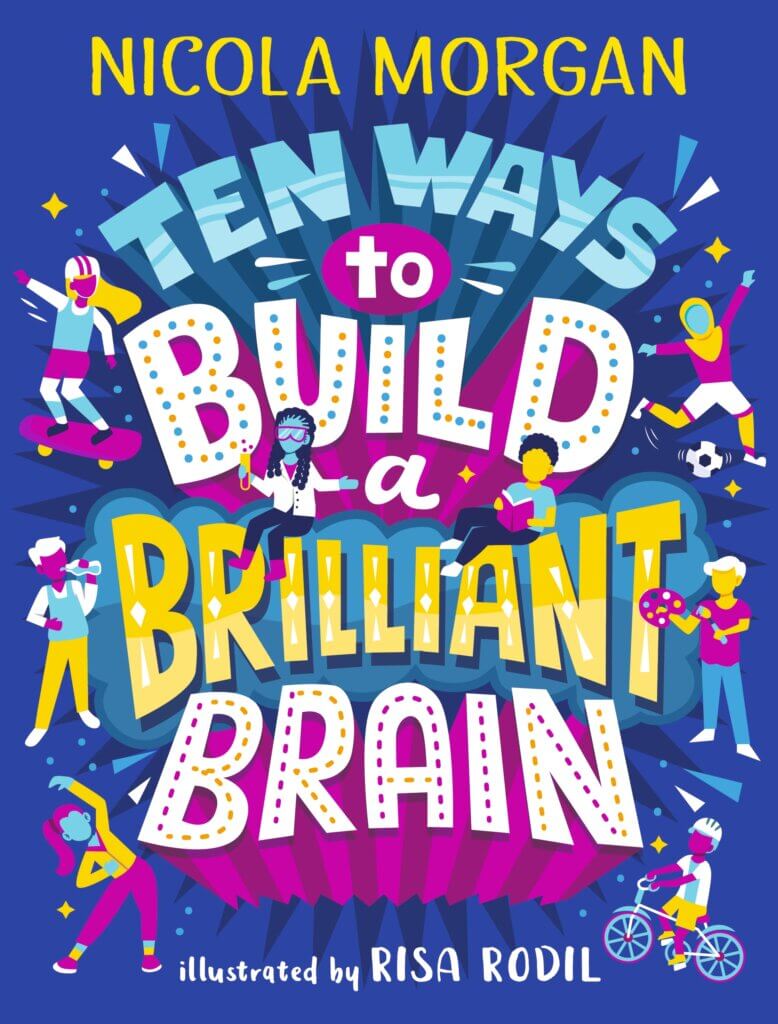
Ten Ways to Build a Brilliant Brain

A fun and practical guide to making your brain brilliant, from well-being expert Nicola Morgan.

Build a brilliant brain with this fun and practical guide for young people from award-winning well-being expert Nicola Morgan. From the benefits of the right food, sleep and exercise, to how to be creative, curious and resilient, discover the incredible science and top advice to make your brain the best it can be. Packed with fascinating facts and brain boosting activities, this illustrated guide gives you the power to build your brilliant brain!

Walker Books

Ten ways your brain is different from the person’s sitting next to you

By Nicola Morgan

One of the most important things a human has to learn is that everyone else is both the same as and different from them. Our brains are wired the same as every human’s for hundreds of thousands of years but we have different psychologies and personalities, influences and experiences, different biology, and so we will not always think, feel, behave or react the same as another person in the same situations. Knowing that is the basis of empathy and of how we make our way through our world.

What are ten specific differences to be aware of as you think about the person sitting next to you?

1. Genes

Our genetic make-up makes each of us literally unique, including in the detail of our brain. We don’t know exactly what the genetic effect is in a given situation but we know it’s there and for some things more strongly than others. For example, we know that dyslexia often has some genetic link.

2. Age

Age makes a difference. Obviously, if the person sitting next to you is two, or 102, and you’re 42, their brain is not the same as yours. And there are biological stages of development that make a typical 12-year-old teenage brain different from both a typical two-year-old brain or a typical 19-year-old or 40-year-old brain. There are some things that older brains can do better than younger brains and vice versa. And we all age differently, too, depending on genes and lifestyle, amongst other things.

3. Past experiences

Everything that happens stamps its mark on our brain and changes us in ways big or small. A significant, perhaps memorable, experience can directly affect how we act later. Someone praising us or not praising us can make a difference to our confidence – we might not remember the original moment but it will leave its mark. No two people have identical experiences.

4. Neuro-divergence

The person sitting next to you might have a neuro-divergence. It could be dyslexia or dyspraxia, ADHD or colour-blindness. Whatever it is, it makes their brain different from yours – even if you also have the same neuro-divergence. No two are really the same even if they have the same name!

5. How time has been spent

The brain of a person who has spent a lot of time playing the violin is physically different from the brain of someone who spent the same amount of time reading books. What we spend time on changes our brain.

6. Introversion/extroversion

Introversion/extroversion is widely regarded as a largely fixed personality trait. It’s a fascinating topic and when I give INSET talks in schools it’s usually the bit that teachers are most intrigued about as it impacts learning so much. It’s not about shyness but a biological level of sensitivity to stimuli, especially when people are the stimuli. Understanding the introverted nature of the people around you will really give you insight into their experience of the world.

7. Type A/B

Another personality aspect is to do with reaction to goals, ambition, success. Type A people are fiercely competitive and beat themselves up when they don’t come top; Type Bs are more laidback and are better at switching off. Their brains behave differently.

8. Support network and friendships

Our mental strength is very much affected and changed by support from the people around us. Do we have people who make us feel confident, people we can go to with a problem or doubt, who we can share success and excitement with? Each friend and connection is part of us and changes us – and therefore our brain.

9. Optimism

Optimism is not a fixed personality trait but more a mindset or learned behaviour. But how optimistic someone is (at the moment) will profoundly affect how they behave or react and whether they go for opportunities. And optimistic or pessimistic thoughts are formed in and by our brains. You can train your brain to think and behave more optimistically and in doing so change your neural pathways. Check out my ‘Pathways exercise’ on my website – or ask me to speak to your staff about building positive neural pathways.

10. Luck

There’s so much we can each control in our lives – and that’s what I focus on, teaching people of all ages that their brains can be ‘in their hands’. But there’s also a lot we can’t control. We should spend very little time thinking about that but it’s worth recognising that a lot that makes our brains how they are is down to luck. Knowing that helps us not be judgmental.

I don’t know who’s sitting next to you. I don’t know you. But I know that your two brains are different in fascinating ways. You could, if you wished and if it is appropriate, start to talk to them and get to know them. Then you’ll know a bit more about what is in their brains – you’ll find similarities and differences. You still won’t know exactly what is going on in their brain, but the endless quest to get closer and closer to the mind of another person is what connects us. It’s pretty much the whole meaning of life – not to feel alone but to be at peace with the brain inside our own head as well as the ones nearby.

Nicola Morgan, aka The Teenage Brain Woman, is an award-winning author and speaker on many areas of well-being and learning. Her best-selling examination of the teenage brain, Blame My Brain, was shortlisted for the Aventis Prize; the prize-winning Teenage Guide to Stress, along with The Teenage Guide to Friends, Positively Teenage, Life Online, Body Brilliant, The Awesome Power of Sleep and Be Resilient, underline Nicola’s unparalleled expertise. In 2018, she was awarded the SLA’s prestigious award for Outstanding Contribution to Information Books. She used to be a teenage novelist and one day will be again. Her new book is TEN WAYS TO BUILD A BRILLIANT BRAIN, published by Walker Books. www.nicolamorgan.com

The English GI: a Yorkshire Schoolboy’s Adventures in the United States and Europe

Jonathan Sandler chose to publish his grandfather’s personal memoir of his life from his schoolboy experiences in Yorkshire to life as a young ex-patriate in New York and being drafted into the US Army in the latter years of the Second World War as a graphic novel – this was a fantastic idea as it immediately opened up access of this work to a wider range of readers than a straightforward text memoir would have. Speaking personally I for one am glad that he did, it is rare to find first-hand stories of soldiers who served, as most (including my grandfather) did not enjoy talking about their experiences during the war.

Brian Bicknell’s art style melds perfectly with Bernard’s spare, unsentimental text, creating a work that is an enjoyable yet informative read allowing the reader a view into his experiences in a world that is now gone; from being footloose and fancy free in 1940’s New York, to basic training as a General Infantryman and his harrowing experiences as a member of the 26th Infantry in France. The vulnerability shown in Bernard’s words, specifically during the scenes in France are at odds with so many portrayals of soldiers today.

The copious notes in the afterword give a depth and context to many of Bernard’s experiences portrayed in the book, from life in New York, the fate of his Latvian family, to the stories of some of his friends he met during basic training as well as his post-war life (including a friendship with Roald Dahl that was cut short due to Dahl’s vile antisemitism).

The English GI was a joy to read and is a work that I will return to again to enjoy the company of Bernard and his adventures! It is highly recommended for all readers!

The English GI was published in April 2022 and is available now!

Johnny Recruit: Interview with Theo Houle Behe

Theo Houle Behe & Johnny Recruit
  • Hi Theo welcome to TeenLibrarian, can you introduce yourself to the audience please?

Hi, I’m a British-Canadian student Theo Behe. I live in London and love football, video games and reading action adventure novels. My favourite subjects are Biology, Spex and History – and I’ve been interested in WW2 and planes since seeing the Duxford airshow when I was two. One of my favourite shows ever is Band of Brothers (its follow-up Masters of the Air is being made in the UK now) and I love having lunch at the Eagle pub in Cambridge a few times per year – which is a historic RAF pilot drinking establishment. I also am particularly interested in the August 1942 Dieppe raid (also one of Johnny’s adventures) – which is now seen as Churchill’s “test-run” for the D-Day landings where over 900 Canadian troops were killed.

  • How would you describe Johnny Recruit to hook a potential reader?

You’re 14 years old – and you’ve just found out your uncle (and mentor) has been captured by NAZIS.  So what do you do? If you’re Big Johnny, you lie about your age and join the war to go RESCUE him.   Big Johnny might only be a young teenager but he’s the BIGGEST kid everyone knows.   An awesome bush pilot and an expert moose hunter, he’s also pretty dominant at ice hockey.   So when Johnny learns that his uncle Bert is being held by Germans across the ocean, he’s 100% sure there is only one person in the whole world who can save his best friend  – HIMSELF.   But when this pompous British pilot named Billy threatens to tell everyone his real age, Johnny faces big tough decisions no kid really should have to make.

  • What inspired the creation of Johnny Recruit?

In primary school, I created a comic book in a notepad about my great uncle, Bert Houle. He was a Canadian World War Two RAF ace who earned two Distinguished Flying Crosses – and he shot down 13½ Nazis.  In this short storyboard I told a little story about his time in Egypt. I was always amazed by what he did. I am very close to my family in Canada and stay all summer with my great uncle’s extended relatives in Northern Ontario every year, including Manitoulin (the world’s largest freshwater island), where the story begins. I also share his name – Houle is my middle name. So when I visited Juno Beach a few summers ago I saw the Dieppe memorial, and my family talked about about Uncle Bert and his heroics. After that it made sense to write an action hero book about him, World War Two, Dieppe, Canada, and Germany. 

  • At age 14 you are the youngest comics writer to ink a deal with publisher Markosia. How did this come about?

I had a football match against Norwich FC U13 Academy last summer. Harry [Markos], the publisher, lives only 40 minutes from the training ground, so we drove up after the game to his house to meet him. In his garden I told him about the idea and story arc – and my dad also helped sell the concept too. Harry’s place was very cool – he has tonnes of graphic novels all over the place. Markosia has published something like 400 titles.  After we signed the deal, I found out Markosia as a publisher has an agent in Los Angeles called World Builder Entertainment. This was very interesting to hear as they had made the Trolls films happen. Although they’re not my cup of tea, they’re a very successful set of movies. I guess that means I have an agent for Johnny Recruit in Hollywood!   We went back up again exactly one year later after another Norwich match, however this time we brought some treats to celebrate the book being released on May 30!  

  • How did you connect with comics artist Thomas Muzzell?

My dad knows lots about comics artists. He had a few in mind but we reviewed the websites of several illustrators in order to find an artistic collaborator who could bring the story to life on the page. We decided to contact Canadian illustrator Thomas Muzzell.  He is a scenic layout specialist so his style was perfect for what we were looking for. In an amazing coincidence, it turned out that Tom also had an ancestor named Bert (no relation to Bert Houle) who had been a captive of the Germans. I guess it was meant to be.

  • Can you let us know how long this project took – from initial concept to publication?

The project took about 18 months – it started with me bouncing ideas off my dad on car journeys to and from football practice. An office wall of random sticky notes was then converted into a storyboard that we shared online with artist Tom.  Next, my dad helped me create a page-scripting matrix template to write out character descriptions, scenic layout, and key actions. As I added details page by page, I also found photographs on the internet which helped show how Tom could imagine scenes, people, places, and objects on the page. Finally, I drew a rough sketch of each page to give Tom an idea of layout for penciling and inking. I was so happy seeing the pages come in – first the pencils (to make any minor changes) then the final inks. That is over 50 exciting emails to open with amazing artwork in each! The publishing bit took about 4 months and my dad covered that off. And now we are promoting the book so it’s definitely not over yet. My dad said I was very disciplined working through the creative process, and I think the final result is a good action story. At the same time it makes the point that things cannot really end happily for child soldiers.  

  • Did you do much research into the history of child soldiers and, underage combatants in WW2?

We researched everything about the book –  the story of Bert, key events in WW2 and small details for each page. As we learned more we realised that thousands of kids were child soldiers in WW2.  The name “Johnny Recruit” was a term used by seasoned troops in reference to soldiers new to the war – even Camel cigarettes ran a successful ad campaign around the term.  But the best marketers at that were brought in to create powerful WW2 propaganda posters.  The book’s double-page spread design are like the campaign posters and popular wartime comic covers – themselves often encouraging enlistment, war bonds purchase or blood donation drives. In the 40s Canadian, British and American “dime comics” featuring mainstream superheroes such as Superman and Wonder Woman battled Nazis, the Japanese – or sometimes just their leaders.   Such influential comics resulted in thousands of underaged kids signing up to fight in WW2, the youngest being Tom Dobney who became an RAF pilot at 14 – only caught out when his father saw a newspaper photo of him shaking hands with the King.  Big Johnny is an epic pilot, an expert shot and leader among his men – this is what many kids dream they might be from believing all the hype and stories of heroism.  I’m sure seeing all the cool war posters and comic covers with superheros leading the charge would make kids go wild about the war, and want to go fight and be the hero.  Even my great uncle Bert was used for the Allied conscription drive. After he was injured he traveled around the Commonwealth telling his war stories to encourage men to sign up to WW2.  But joining a war isn’t like this at all. It’s cold, brutal, painful and deadly.  And for many kids who join wars today such as in Africa, Columbia or the Ukraine –  once they’re in and find out what’s really going on, it’s too late to turn back.  

  • Are you a comics fan? If you are, can you recommend any titles for fans of Johnny Recruit?

I do like superhero comics – they are so well written and illustrated.  I’m not sure if people know the effort the artists put into pencils, ink and colouring each page – it’s so many hours. But I like novels. I used to read all the teen hero books like Alex Rider and Percy Jackson – but now it’s the military, action and history novels like Reacher and from Chris Ryan that I like the most.

  • What advice can you give other aspiring comics creators looking to break into the industry?

Writers should create something they like but will also teach people or other kids a lesson. Looking at the final book, maybe Johnny Recruit could be a good learning tool for the classroom. We talked about making these pages the opposite of “rapid-fire” social media streams. I think the book’s big double- page landscapes encourage people to calmly find the clues to piece the story together. And the reader can use their imagination to fill in the gaps between each page. This is all pretty good for comprehension and analysis.  Most of all I hope Johnny Recruit can show other kids they too can tell a story without being an expert artist or writer – they can work with others to bring it all to life.

  • Have you ever done any talks with teen library groups? If not, is this something you would consider doing in the future, to connect with other teens interested in creating comics?

I would love to do a talk. I handed my book to my school librarian last week and she has scheduled some talks with students – but that probably doesn’t count as I know nearly all of them. I’d be happy to speak to new people and encourage them to work on their projects and ideas. Most teens interested in comics will already have their favourite webcomics and some will have tried their own. Maybe some help working through a story plan and believing in their concepts could help take their own story where they want to go.

Johnny Recruit by Theo Houle Behe & Thomas Muzzell was published by Markosia on June 30th and is available now!

Like Dominoes, the Slow Collapse of Children’s Book Awards

Hot on the heels of the surprise news of the Costa Book Awards being scrapped after 50 years, it was announced today, that after 22 years, the Blue Peter Book Awards have been cancelled.

The 21st Century hast not been kind to book awards that recognize children’s literature.

The first to fall was The Nestlé Smarties Book Prize which ran from 1985 to 2007.

The Booktrust Teenage Prize ran from 2003 to 2010

The Roald Dahl Funny Prize ran from 2008 to 2013.

The Guardian Children’s Fiction Prize ran from 1967 to 2016.

I have been interested in the sponsorship deal for the Carnegie & Kate Greenaway Awards with Yoto that was announced in February and have been poking around finding more information since then. The collapse of the Costa and Blue Peter Awards shows how vital financial security for book awards is to futureproof awards against rising costs and other issues that will inevitable come up.

No matter how worthy and popular book awards are, the simple truth is that they are not cheap, and no matter the good intentions or with the best will in the world, if you cannot fund them adequately then they will fall.

Links

Zo and the Forest of Secrets

When Zo decides to run away from home, she isn’t scared; after all, she knows the island like the back of her hand. But, as she journeys through the once-familiar forest, terrifying creatures and warped visions begin to emerge. With a beast on her heels and a lost boy thrown into her path, could a mysterious abandoned facility hold answers? Zo must unravel the secrets of the forest before she is lost in them forever…

Knights Of

ZO AND THE FOREST OF SECRETS is a brilliantly pacey, thrilling middle grade adventure from children’s debut Alake Pilgrim (already an international award winner for her other writing). She is based in Trinidad and Tobago and Trinidad is the setting for this story, brilliantly brought to life as Zo loses herself in what she thought was familiar forest. I loved the mixture of tech and legends, imagination and realism, friendships and not knowing who to trust…plus the chatty spiders are some of my favourite side characters in a novel, ever.

There are some truly skin-crawlingly terrifying moments in this book, as unimaginable creatures hunt for Zo and her companion, but also some moments of reflection about family and honesty, as well as some pretty funny lines. Zo makes a lot of discoveries about herself as well as the mysterious zoo and Adri, the boy she saves from drowning, but we leave the forest with even more unanswered questions than we went in with, with twists upon turns leaving the reader (me) desperate for book 2!

Alake Pilgrim

Zo and the Forest of Secrets, published by Knights Of is out now, priced £7.99

Check out the rest of the blog tour!

Thank you to ED PR for getting me a review copy and including me on the blog tour.