There’s a murderer on the loose in an elite boarding school… But who is going to be next? This Book Kills is the YA thriller of 2023, perfect for fans of Holly Jackson and Karen McManus.
“I’ll make it clear from the start: I did not kill Hugh Henry Van Boren. I didn’t even help. Well, not intentionally.”
When Hugh Henry Van Boren, one of the most popular and richest kids in Jess Choudhary’s school, is found dead, the student body is left reeling and wondering who the murderer could be… Jess, a student under strict instructions to keep her record clean or risk losing her scholarship, finds herself at the centre of the investigation when it’s revealed that Hugh died in the exact same way as a character in a short story she wrote.
And then Jess receives an anonymous text thanking her for the inspiration.
With time running out, Jess knows if she doesn’t solve this mystery she’ll finally have something in common with Hugh Henry.
This Book Kills is a debut UKYA and bound to be one of the most gripping crime thrillers of 2023. I had the opportunity to ask the author, Ravena Guron, a few questions!
When you thought of a story inspiring a murder, did the murder come to you first or the school setting?
The school setting came first – I wanted to write a book set in a confined space, and the boarding school surroundings were perfect for that. The boarding school also fit in well with the themes of privilege and confidence that I wanted to explore in the book. The set-up for the murder, with the main character, Jess, writing a short story that is brought to life by the killer, came quite quickly after that. Inspiration was sparked by the school setting, because I started thinking about the classes Jess might be having, and how it would be quite easy for her to be assigned a short story to write… And what might happen if that piece of homework took a deadlier turn…
Were you a big writer at school?
I was! I was a massive bookworm, and that translated into wanting to write my own stories. I was very lucky to be taught by some really encouraging English teachers, who told me about short story competitions I could enter. As well as that, I also took part in First Story, which is a charity initiative that brings published authors into schools to work with teenagers from underrepresented communities. It was an incredible opportunity that I’m really grateful for and sparked lots of creativity in me.
Did you do any research into real boarding schools?
Yes! I wanted Heybuckle, the boarding school in This Book Kills, to feel really authentic. Luckily, I had a few friends who had gone to boarding school, or worked in a boarding school, and were willing to let me pick their brains. There were some elements where I knew I would need to use some creative license in order to make the story work, but I wanted things like the timetable to feel realistic, or what the students might be served for dinner… Just day-to-day aspects to make it feel like an actual school.
What kind of events would you like to do for the book (dream event and realistic, if they differ)?
I’d love to go to book festivals – like Edinburgh International Book Festival, and Hay Festival – they always look so incredible! And I went to YALC last year for the first time and had the most amazing day meeting other YA authors and readers – it would be an absolute dream to do a panel. I’d also love to do events at bookshops and libraries all around the country – explore different areas and meet readers all over. I’d love to do all the events!
Have you had much feedback from young readers?
Not yet, but now that I’m published I’m so incredibly excited for This Book Kills to find its way to teenagers!
What are you reading at the moment and who would you recommend it to?
I’ve just finished reading Daughter of Darkness by Katherine and Elizabeth Corr, which is a YA fantasy – it’s inspired by Greek mythology, and it’s super original. I’d recommend it to readers looking for a fast-paced and twisty read.
Can we expect more murders from you?
Yes you can! I’m currently working on my second book – I can’t say too much about it, but there’s murder galore and I’ve had so much fun writing in all the twists…
An extraordinary story about friendship and betrayal. Of revenge and retribution but also redemption. Perfect for 11+ readers who enjoy Stranger Things. Hex never meant for the girl to follow him and his friend Tommo into the woods. He never meant for her to fall off the rope swing and break her arm. When the finger of blame is pointed at him, Hex runs deep into the woods and his fierce sense of injustice leads him to a strange clearing in the woods – a clearing that has never been there before – where an old lady in a cottage offers him a deal. She’ll rid the world of those who wronged him and Hex can carry on his life with them all forgotten and as if nothing ever happened. But what Hex doesn’t know is someone else has been offered the same deal.
When Hex’s best friend Tommo wakes up the next day, he is in a completely different world but he only has murmurs of memories of the world before. Moments of deja vu that feel like Tommo’s lived this day before. Can Tommo put the world right again? Back to how it was? Or can he find a way to make a new world that could be better for them all?
The Song From Somewhere Else is a truly beautiful book, in all senses of the word, so when I saw that A.F. was writing another story set in that world also illustrated by Levi Pinfold I was a mixture of “YES PLEASE” and “how can it possibly compare…”. I needn’t have worried though. The Worlds We Leave Behind is completely different but equally enthralling. I asked A.F. Harrold a few questions:
The Worlds We Leave Behind is wonderfully philosophical. I love how you don’t talk down to young readers while also pitching it so as to not go over their heads, do you ever have ideas that you think are too complicated to include in a children’s book?
I imagine there probably are ideas ‘too complicated’ for a kids book, but, much more importantly, there are a million ideas that are perfect. And some of them might look complicated, until you begin to think about them.
I think about the science ideas a writer like Christopher Edge builds his stories around, or Dom Conlon’s Meet Matilda Rocket Builder – perfect books with big complicated ideas behind them. Of course, those are scientific/engineering ideas, and your question began with a thought about philosophy, but I think it’s much the same, and of course, the scientific explanations throw up ethical and psychological questions. Take Chris’s The Many Worlds of Albie Bright – it shows how quantum physics, alternate universes and ethics are all intertwined, and does it with heart and love.
It’s important to remember that we swim in a soup, where none of these subjects and ideas are separate, it’s all mixed up together and you can’t look at one ingredient without bumping into another.
Did you know before you started writing TWWLB that it would be one for Levi Pinfold to illustrate?
Yes. It took a long time for me to find out what I could write next, and the key turned and the spark ignited the moment I realised I could just take a character from our previous book together (The Song from Somewhere Else) and continue their story. And so, since it was continuing that world we’d already spent time in, I wrote it with Levi in mind. That isn’t the same as knowing your publisher will agree to let Levi illustrate it when you hand the story in, however. We were fortunate, though, that my editor, Zöe Griffiths, agreed with me that it ought to be Levi. And even more fortunately, when they approached Levi, he said yes, I think without having actually read it, because we didn’t have a final draft at that point.
Because Levi is such an amazing and in demand illustrator, we knew we had to wait a while before The Worlds We Leave Behind would reach his desk, so Zöe and I were able to work on the story and the text for two years before it reached the final final state. After the first year (draft 3) the story was pretty much what’s in the book, and Levi was in the UK for a rare visit (he lives in Australia), and he came over to my house one afternoon, and we sat in my shed (office at the end of the garden), and I was able to sit with him and tell him the story as we drank tea and looked out at the bare trees. I enjoyed that very much, because he is so delightful a person, so engaged and so talented. He’s about ten years younger than me, but our growing up experiences, in small English towns, kicking around down the rec, were similar enough that we seem to fit together well, and he understands what I’m on about. And then, after that storytelling session, he flew back to Australia and within a couple of weeks the first lockdown was announced and our world changed forever. Zöe and I finessed the 4th draft, the final version, into shape over that summer (while also seeing me and Mini Grey’s The Book of Not Entirely Useful Advice to press – a quite different adventure), and it was only the following February (2021) that Levi got to read it (having heard it almost exactly a year before).
It was a long process, but it gave everything time to settle into place, all the words, all the action and then, finally, all the pictures.
How soon in the draft process did you get him involved? Did you note what scenes you would like to have illustrated or leave it entirely up to him?
So, as you see from the previous answer, he wasn’t actually involved (as in drawing), until the writing was all done, but that is misleading, because he was involved from the moment I hit the first key on the keyboard and wrote the word ‘Hex’ at the top of the page. (My works in progress are usually just named for the character, titles are a pain in the bum to be thought about years down the line!) Having done The Song From Somewhere Else together I knew the style Levi draws this world in, I had an idea of how it looks because he’s already shown that to me, and so I was able to write with the thought in my head, ‘What would I like to see Levi draw?’ and so that led us into the forest, that gave us big dogs, that gave us brooding shadows and a fairytale cottage… What would you like to see Levi draw next?
And so, when the time came for illustrating, an editor will normally give an illustrator a brief – we’d like pictures of this scene, that scene and this character, and so on (spaced out evenly through the story, one per chapter, or whatever). But with Levi (and with Emily Gravett, in the books I’ve done with them), because these are intended to be highly illustrated and because the illustrator is of such quality (and know what they’re doing and won’t be daft and draw thirty pictures for the first ten pages and nothing for the next 200!), I think we’re much more inclined to just let them go and do what they want.
Of course, the process involves roughs and we might make suggestions at that stage, nudging things this way or that, and we get a feel for the shape of it and ask for scenes that have been missed and so on. And then you get the great joy of seeing final art come in, and then I’m able to do little edits in the text to match the things Levi’s drawn better (Hex in jeans, rather than shorts, for example), and I couldn’t be happier seeing what my little words inspired from his magnificent fingers! Gosh but he’s a master.
Interior illustration by Levi Pinfold
Do you have different routines when writing a novel vs poetry, or humour vs atmosphere? Do you favour one over the other?
When I’m working on a (first draft of a) novel, I do try to do something every day. I discovered for this one that getting up very early and writing before going for my daily walk, before looking at e-mails or the internet, was the way to go. I’d come down to my shed, through the silent sunlit morning (it was April/May 2019, and beautiful), put on Morton Feldman’s Piano, Violin, Viola, Cello and spend some time with Hex and Tommo and the others, and then I can get on with my day. And if I’ve done that, made that early start, I can usually return to the manuscript during the day and do some more.
If, on the other hand, I have let the world step in front first (opened an e-mail, written an invoice…) then I’ll never be able to settle to writing that day. (Editing and rewriting, that’s easy to dip in and out of, but writing new stuff… that’s hard and fickle.) Poems, on the other hand, because of their snackability, they’re much easier to sit down and have a go at at any time. Part of the joy is, of course, that if it doesn’t work you can throw it away and you’ve only lost half an hour, and if it did work… brilliant, you’ve got a new thing in your hand and in your head, that didn’t exist before! There’s a lot less pressure on any individual poem to be good, and so it’s much easier to simply give it a go.
What kind of events do you most enjoy doing?
I like performing poems and being funny. Comedy for kids without the safety net.
What are you reading at the moment and who would you recommend it to?
I’ve just read Gareth P Jones’ No True Echo (2015) (which I read about in a review of TWWLB), a great mind-bending alternative world time travel looping story, for (I guess) maybe 11+ with a good grip on what’s real. Then I read Bridge to Terabithia by Katherine Paterson (1977), which I’d seen the movie of, but had never read, and it was as moving and heart-sinking as I expected, and typically and nostalgically American – it’s not my culture, not my world, but it’s so familiar from TV and films – which I’d recommend for anyone with a heart who yearns for freedom. And I’ve just finished Wolfstongue by Sam Thompson and illustrated by Anna Tromop (2021), which is your perfectly normal boy-meets-talking-wolf-and-rescues-it-from-the-talking-foxes-and-finds-his-life’s-turned-upside-down-and-he’s-involved-in-a-mythic-battle-underground sort of story, for any kid who likes that sort of thrilling adventure.
What are you working on at the moment?
I’ve written a sort of creepy ghost story story, which I’m waiting to hear if my publisher likes enough to publish. Fingers crossed.
A.F. Harrold
Levi Pinfold
Thank you to Nina Douglas for organising a review copy and the opportunity for a Q&A with A.F. Harrold. THE WORLDS WE LEAVE BEHIND was published by Bloomsbury Children’s Books on 4 August (9781526623881/ £12.99 hardback).
Something Certain, Maybe is a powerful novel about first love, friendships and embracing the uncertainty of an unknowable future, from Sara Barnard, winner of the YA Book Prize.
Rosie is ready for her life to begin, because nothing says new life like going to university. After years of waiting and working hard, she’s finally on the road that will secure her future.
Except university turns out to be not what she hoped or imagined, and although she’s not exactly unhappy – really – she might be a little bit worried that she doesn’t really like her course much. Or her flatmates. Or, really . . . anything? But it’s normal to be homesick (right?) and everything will have settled in a month or two, and it’s totally fine that her friends seem so much happier than she is, and that the doctors don’t seem to know what’s wrong with her mother.
And then she meets Jade, and everything starts to look a little brighter. At least, it does if she’s only looking at Jade. But is first love enough when everything else is falling apart?
This is the 3rd outing with Rosie and her best friends Caddy and Suze. I thought Beautiful Broken Things was great, all those years ago before I put photos in tweets…
I #read Beautiful Broken Things by Sara Barnard. Realistic characters & events, perfect "issues" book coz it doesn't read like 1. Fantastic
This is a brilliant book. No easy answers or soppy happy endings, no unrealistic new traumas, just Suzie dealing with every day & new relationships. Which, put that way, sounds dull but it is entirely as it should be. They all feel like real people @saramegan @MyKindaBook https://t.co/fYUiBd8o16
…and Something Certain, Maybe was no disappointment…
I just read this, the 3rd book featuring Rosie, Caddy, and Suze (it stands alone tho)…a realistic year-in-the-life of Rosie as she starts uni. @saramegan is one of the best writers of teen angst there is, it took me right back to my crappy flatmates in my 1st year! #UKYAhttps://t.co/m8efDwV0N4
…so I’m very pleased to be sharing a Q&A with Sara Barnard as part of her blog tour today, A-Level results day!
Rosie’s voice is so authentic, as are all your characters, do you eavesdrop on lots of teenagers?
Thank you! I don’t usually eavesdrop on real teenagers, no! The voices of my characters always just come through very clearly to me. My biggest piece of advice for writers writing teenage voices is to not actively try to make them sound like teenagers. Just trust their natural voice.
When you wrote ‘Fierce Fragile Things’ were you already planning ‘Something Certain, Maybe’?
Not at all! I wish I had been, because it would have made Something Certain, Maybe much easier to write! One of the most difficult parts of writing this book was making sure it fitted alongside FFH. There are a lot of things I would probably have done differently with FFH if I’d known there’d be another book set over the same period. So maybe it’s a good thing I didn’t know, because I love FFH a lot!
Which of the 3 girls came to you first, and who was the hardest to write?
Suzanne, and she came along quite a lot earlier than Caddy or Rosie. I wouldn’t say any one of them is particularly hard for me to write, because I could write all of them all day long and be very happy! But if I had to pick one out of the three, it would probably be Rosie, for reasons that are more to do with her book being the third one than her as a character.
What kind of reaction have you had from teen readers?
Readers generally tend to respond to the friendship between the three girls, though I get the most messages about Suzanne! With Something Certain, Maybe in particular, I’ve been struck by how many people in their 20s and older who have got in touch to say how much the story of a disappointing university experience resonated with them, and how they wished they’d had the book when they were at university. I had hoped to put something on the page that doesn’t really get talked abou, so it means a lot that it has resonated with people in this way.
What kind of reader engagement event, in schools or libraries or elsewhere, do you enjoy most?
YALC is always my favourite, but generally literary festivals are always a joy. There’s something about all those people choosing to be there out of a shared love of books. They’re such engaged audiences and there are usually some great questions.
Have you finished writing about Caddy, Suze, & Rosie or do you think you could be tempted to write about them in their 20s?
I would love to write them in their 20s! I have written bits and pieces of them a little older. But I can’t imagine it would ever be something that would have a life outside of my laptop, sadly!
What are you reading and who would you recommend it to?
I am very late to the party, but I’m currently reading Life After Life. It is just as brilliant as everyone always said it was. I’d recommend it to everyone who likes reading.
What are you working on at the moment?
I’m editing my next YA book, Where the Light Goes, which will be out next year!
Check out the rest of the tour. Thank you to Macmillan for organising!
Sixth-former Anna Campbell is the go-to girl when anyone needs anything. Teachers, friends, random strangers… It never occurred to her that she could say no. After all, Anna Campbell’s always been too ‘nice’ to say no. But Anna is sick of being that girl, the nice girl, and she’s going to do something about it. Only, is she prepared to risk losing everything she cares about – even herself – along the way…?
THE NICEST GIRL is Sophie Jo’s debut UKYA and it is brilliantly put together, I felt every page of it! I asked the author a few questions:
How much of yourself is in the book, were you a “nice girl”?
There’s definitely some of me in the book – I’m a bit of a recovering people-pleaser and have felt the pain of being “the nice girl” many a time over the years, especially in my teens and early twenties.
When I started writing the book, I was really keen to hear from friends and acquaintances about their own experiences. It was sad but oddly freeing to learn that people I’d previously viewed as very assertive and “sorted” were struggling to turn down work shifts or stand up to friends or set boundaries in their dating life. I think a lot of us – especially women – are battling against this deep-rooted need to be seen as likeable and easy-going.
Trying not to include spoilers…there are tensions that build up & come to a head in totally believable ways. Did earlier drafts have anything more over-the-top that you decided to tone down?
The tension explosion and resolution has actually stayed pretty much the same throughout the editing process! I did wonder at one point if Anna would decide to cut one particular character out of her life (again, no spoilers…), but I’m glad she doesn’t, and I hope I did a good job at illustrating both points of view when things do erupt.
What would you most like readers to take away from the book?
I’d really love for readers to consider the middle-ground-complexities of the whole topic. You don’t have to turn into an unkind person to set boundaries – it isn’t about forgetting to be respectful or that other points of view exist. It’s about remembering that your feelings are as valid as anyone else’s and there for a reason.
I also hope it shows readers the value of honest, kind communication in friendships and other relationships. Sometimes you see stuff online that’s like, “you don’t owe anybody anything! Set boundaries! Immediately ghost people who don’t treat you right!” and while I am very much on board with anything that teaches people to stand up for themselves, I also think there’s space for most of us to better express expectations/wants/needs so our nearest and dearest at least have a chance to respond to those. Anna means very well and her struggles are relatable, but because she’s quite good at picking up on the emotions of those around her, she often expects them to mind-read in return – and they can’t.
Have you had much opportunity for feedback from teen/YA readers?
I was able to meet some amazing teen and YA readers at this year’s YALC – they’d picked up proofs from my publisher UCLan’s stand and were really excited to read. That was such a lovely experience for me, especially as someone so new to all this. It’s also been cool seeing initial reviews on Goodreads and NetGalley from people who’ve related to Anna and rooted for her throughout.
What would your ideal school visit to promote the book involve?
I would LOVE to sit down with a group of teens and talk about the concept of ‘niceness’ vs assertive communication. Maybe a lil quiz: Nice or Too Nice? A poetry-writing session? I have a million ideas; I’m going to start writing them down.
What are you reading at the moment and who would you recommend it to?
I’m enjoying THREE GIRLS by Katie Clapham, a fellow UCLan author. The voices she’s created for these characters are so strong, and there are these brilliant little drops of humour along the way. It’s quirky and interesting but never try-hard. Would recommend to: anyone who wants a really solid book about teen girl friendship.
I’ve also just finished a proof of GIRL FRIENDS by Holly Bourne, which is definitely one of my new favourites. She just gets women. Every time I read a Holly book I feel like she has crawled into the depths of my soul without judging me. Would recommend to: anyone who grew up reading 90s/00s Sugar magazine articles about How To Get Boys To Like You…
Have you any more stories bubbling away?
I’m currently writing draft one of book two. The main character is quite different to Anna – a lot more cynical and outspoken – so it’s been a real change to write, in a very fun way. I’m also trying out a dual narrative for the first time, which is a whole new challenge in itself. Hopefully we’ll be back talking about the finished book before too long!
THE NICEST GIRL was published by UCLan in August 2022. Thank you to Antonia Wilkinson for organising a review copy and the opportunity for a Q&A.
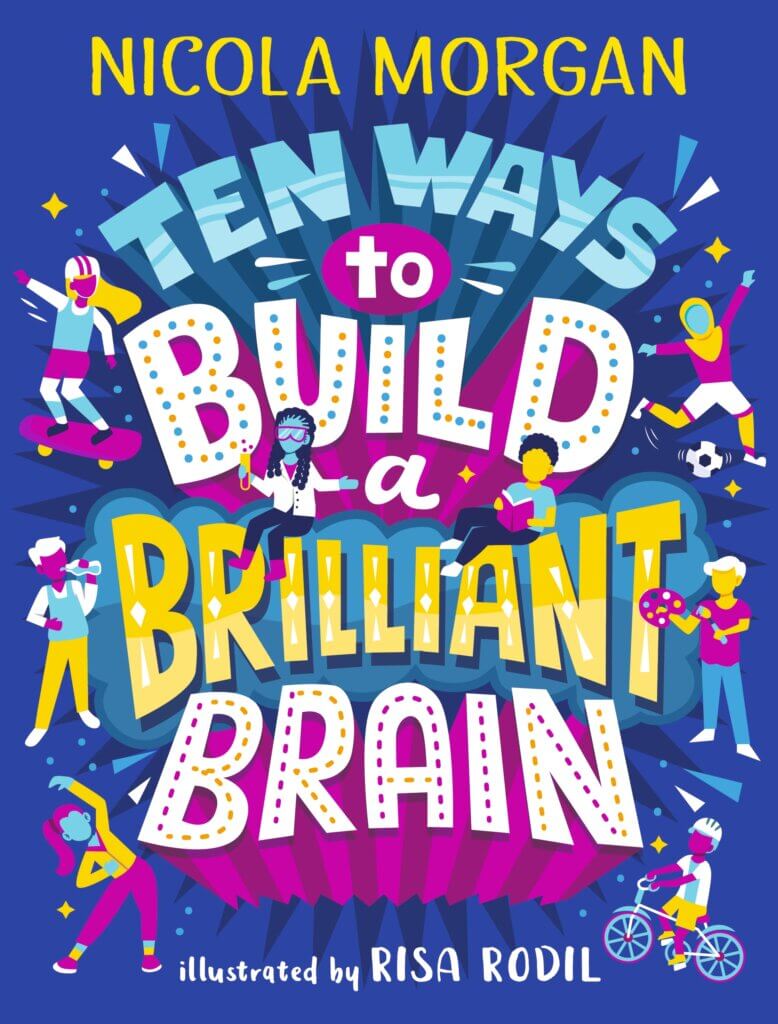
A fun and practical guide to making your brain brilliant, from well-being expert Nicola Morgan.
Build a brilliant brain with this fun and practical guide for young people from award-winning well-being expert Nicola Morgan. From the benefits of the right food, sleep and exercise, to how to be creative, curious and resilient, discover the incredible science and top advice to make your brain the best it can be. Packed with fascinating facts and brain boosting activities, this illustrated guide gives you the power to build your brilliant brain!
Ten ways your brain is different from the person’s sitting next to you
By Nicola Morgan
One of the most important things a human has to learn is that everyone else is both the same as and different from them. Our brains are wired the same as every human’s for hundreds of thousands of years but we have different psychologies and personalities, influences and experiences, different biology, and so we will not always think, feel, behave or react the same as another person in the same situations. Knowing that is the basis of empathy and of how we make our way through our world.
What are ten specific differences to be aware of as you think about the person sitting next to you?
1. Genes
Our genetic make-up makes each of us literally unique, including in the detail of our brain. We don’t know exactly what the genetic effect is in a given situation but we know it’s there and for some things more strongly than others. For example, we know that dyslexia often has some genetic link.
2. Age
Age makes a difference. Obviously, if the person sitting next to you is two, or 102, and you’re 42, their brain is not the same as yours. And there are biological stages of development that make a typical 12-year-old teenage brain different from both a typical two-year-old brain or a typical 19-year-old or 40-year-old brain. There are some things that older brains can do better than younger brains and vice versa. And we all age differently, too, depending on genes and lifestyle, amongst other things.
3. Past experiences
Everything that happens stamps its mark on our brain and changes us in ways big or small. A significant, perhaps memorable, experience can directly affect how we act later. Someone praising us or not praising us can make a difference to our confidence – we might not remember the original moment but it will leave its mark. No two people have identical experiences.
4. Neuro-divergence
The person sitting next to you might have a neuro-divergence. It could be dyslexia or dyspraxia, ADHD or colour-blindness. Whatever it is, it makes their brain different from yours – even if you also have the same neuro-divergence. No two are really the same even if they have the same name!
5. How time has been spent
The brain of a person who has spent a lot of time playing the violin is physically different from the brain of someone who spent the same amount of time reading books. What we spend time on changes our brain.
6. Introversion/extroversion
Introversion/extroversion is widely regarded as a largely fixed personality trait. It’s a fascinating topic and when I give INSET talks in schools it’s usually the bit that teachers are most intrigued about as it impacts learning so much. It’s not about shyness but a biological level of sensitivity to stimuli, especially when people are the stimuli. Understanding the introverted nature of the people around you will really give you insight into their experience of the world.
7. Type A/B
Another personality aspect is to do with reaction to goals, ambition, success. Type A people are fiercely competitive and beat themselves up when they don’t come top; Type Bs are more laidback and are better at switching off. Their brains behave differently.
8. Support network and friendships
Our mental strength is very much affected and changed by support from the people around us. Do we have people who make us feel confident, people we can go to with a problem or doubt, who we can share success and excitement with? Each friend and connection is part of us and changes us – and therefore our brain.
9. Optimism
Optimism is not a fixed personality trait but more a mindset or learned behaviour. But how optimistic someone is (at the moment) will profoundly affect how they behave or react and whether they go for opportunities. And optimistic or pessimistic thoughts are formed in and by our brains. You can train your brain to think and behave more optimistically and in doing so change your neural pathways. Check out my ‘Pathways exercise’ on my website – or ask me to speak to your staff about building positive neural pathways.
10. Luck
There’s so much we can each control in our lives – and that’s what I focus on, teaching people of all ages that their brains can be ‘in their hands’. But there’s also a lot we can’t control. We should spend very little time thinking about that but it’s worth recognising that a lot that makes our brains how they are is down to luck. Knowing that helps us not be judgmental.
I don’t know who’s sitting next to you. I don’t know you. But I know that your two brains are different in fascinating ways. You could, if you wished and if it is appropriate, start to talk to them and get to know them. Then you’ll know a bit more about what is in their brains – you’ll find similarities and differences. You still won’t know exactly what is going on in their brain, but the endless quest to get closer and closer to the mind of another person is what connects us. It’s pretty much the whole meaning of life – not to feel alone but to be at peace with the brain inside our own head as well as the ones nearby.
Nicola Morgan, aka The Teenage Brain Woman, is an award-winning author and speaker on many areas of well-being and learning. Her best-selling examination of the teenage brain, Blame My Brain, was shortlisted for the Aventis Prize; the prize-winning Teenage Guide to Stress, along with The Teenage Guide to Friends, Positively Teenage, Life Online, Body Brilliant, The Awesome Power of Sleep and Be Resilient, underline Nicola’s unparalleled expertise. In 2018, she was awarded the SLA’s prestigious award for Outstanding Contribution to Information Books. She used to be a teenage novelist and one day will be again. Her new book is TEN WAYS TO BUILD A BRILLIANT BRAIN, published by Walker Books. www.nicolamorgan.com
If you loved Heartstopper and need more feel-good LGBTQ+ romance – If You Still Recognise Me is the one for you!
Elsie has a crush on Ada, the only person in the world who truly understands her. Unfortunately, they’ve never met in real life and Ada lives an ocean away. But Elsie has decided it’s now or never to tell Ada how she feels. That is, until her long-lost best friend Joan walks back into her life.
In a summer of repairing broken connections and building surprising new ones, Elsie realises that she isn’t nearly as alone as she thought. But now she has a choice to make…
This is the debut UKYA novel by Cynthia So, and they are definitely one to watch! Loved the enthusiasm & passion blended with uncertainty in protagonist, I knew where the story was going but it was *so* satisfying. And So Much +ve rep! I loved the queer people of all ages, the delight of teens sharing a fandom, intergenerational relationships & intricacies of family life & how people show love…& realising what *isn’t* love…it is a must read this Pride Month.
I was lucky enough to get the chance to ask Cynthia a few questions:
If You Still Recognise Me is your debut novel but you had a short story in the PROUD book, edited by Little Tiger, did you already have the idea of IYSRM? They’re very different, do you have more ideas for your phoenix?
I had started to write IYSRM by the time PROUD came out in March 2019, but I don’t think I had the idea for it when I first drafted my short story “The Phoenix’s Fault” back in March 2018. I didn’t really have any ideas for a novel at all back then! I’ve always adored YA contemporary, and I’ve also always loved fantasy, but something about writing a fantasy book is a little more daunting to me. I have trouble writing things longer than a short story, so I needed to push myself past that self-doubt of “I’ll never write a good novel” by starting with something that to me has a breezy, casual vibe, and IYSRM is what resulted. I was very self-indulgent while writing it. I just wanted to write my dream summer queer YA book, and to have as much fun as possible while doing it.
I don’t have more ideas for my phoenix. I think we left her and her humans in a good place. I could definitely write more queer stories in that universe though, based around different creatures in Chinese folklore and myth. The Legend of the White Snake for example!
The background to the comic, so that the fandom would make sense, feels like you have a whole story planned out! Have you written more that wasn’t included?
There were some little details that I included in earlier drafts that didn’t make it into the final version, but otherwise there’s not a lot in my head that isn’t on the page. I think this is a good lesson for any author, that you need just enough detail to suggest something bigger – you don’t need to have it completely fleshed out, which may be a waste of time if you don’t have a lot of time to dedicate to writing! Coming up with a few specific details goes a long way towards making something seem real.
While you were writing, did you share it with many people or wait until it was finished?
I didn’t share it with anyone while I was writing. I’m an intensely private person! Every author’s different, but for me, to share something with someone before I finish it would be to jinx it, somehow. I feel like I have to be alone with the story, to know that it is, for a time, mine and only mine, to learn to love it properly. The sort of relationship I have with a story changes once I start to share it with others, because I worry so much about what others think. By not sharing it until it’s done, I can hone in on my own vision for the story and honour it to the best of my ability.
And it also gives me the drive and motivation to complete it, because I know that unless I finish it, I’ll never be able to let anybody else read it, and that would be a huge shame after pouring months into trying to write it!
The comic book shop is wonderful, is it based on one that you’ve been to or is it wishful thinking?
It’s not based on any particular comic book shop, but I do love the vibe of any indie bookshop, including comic book shops. Gosh! Comics in Soho is such a lovely, cosy little place, and I also always think fondly of havens like Gay’s the Word. Indie bookshops are truly the best.
Have you had any reaction from teen readers yet? What would you like them to take away from the book?
I don’t think I’ve had any reaction from teen readers yet (that I know of), but there’s lots of things I would like them to take away from the book. Here are a few of those things: 1) I want queer teens who want romantic love to know that they will find that romantic love, even if it takes time, and it may take time. I worry that teens might look at YA romances and feel sad that they don’t have that romance in their lives right now, and believe that that means there’s something inadequate about themselves. Though my book is a YA romance, it also has lots of stories in it about queer people who find love much later on in life, and it’s no less wonderful or beautiful. One day, you will be loved for who you are, by someone who sees you. And you deserve that kind of love. Real love shouldn’t require you to make yourself smaller for it. 2) Coming out doesn’t have to be the end goal. I think when I was a teenager I felt so much angst about not feeling brave enough to come out to people other than a few of my friends. But not coming out to your family doesn’t mean you’re not brave enough. It doesn’t mean you’re ashamed. You can be proud of who you are, without coming out to lots of people. 3) It’s OK to change. It’s OK not to know exactly who you want to be yet. You have time to figure it out.
What are you reading at the moment and who would you recommend it to?
Just finished Gay Club! by Simon James Green – it’s funny and extremely readable like Simon’s books always are, and the characters are a delight, and there’s such a powerful message at the centre of it. I would recommend to all teens who are part of LGBTQ+ clubs at school, or those would like to start one. It’s also so incredible to me to think about the fact that some teens get to be part of LGBTQ+ clubs at school now, so if you’re an adult and you wish you had that kind of support and community as a teen this book is also totally for you.
I also finished I Kissed Shara Wheeler by Casey McQuiston not long ago, and oh my god. This is the queer book of my dreams. It’s all of my fave YA books I read when I was growing up, but QUEER, finally, queer! It’s such a dreamy, exhilarating romance set against the backdrop of a Christian high school between two academic rivals who are utterly obsessed with each other, and the scavenger hunt element is so fun. It’s a fantastically escapist summer read. I would recommend this to everyone who likes John Green, and also anyone growing up in a small town and/or with a religion that makes them feel complicated about their queerness. This book is really uplifting in that regard and full of shining defiance and hope.
What are you working on at the moment?
My second YA contemporary novel with Little Tiger. It’s going to be another queer romance, and it will involve lots of food, and lots of family, and lots of yearning, because those are some of my favourite things to write about. Other than that, I don’t want to say too much – you’ll have to wait and see! 🙂
Thank you so much Cynthia for answering my questions, and writing such a great book, and thanks to Little Tiger for a review copy and facilitating the q&a!
Two very different boys, one new family, a shared struggle and a big secret.
Ryan didn’t want a new mum, let alone a new brother! But when his parents split up and his dad moves in with Naomi, she comes with Tommy – one year older, chucked out of his old school and now joining Ryan’s class. Great. Suddenly sharing a home and a classroom with a complete stranger is a bit much.
Flung together, the two boys clash, but gradually realise that they are more similar than they thought.
The dual perspectives of this story were brilliantly done, two distinct and realistic voices that wouldn’t have worked individually. I was gripped by the story, the way the relationship between the two boys developed, and the relationships with all the grownups. Tommy’s discovery of a secret (and what that secret was) kept my heart in my mouth for him. Also, the dyslexia friendly font is very readable!
Malcom Duffy has written a bit about the inspiration behind the story:
We all face challenges at some point in our lives. My parents divorced when I was a teenager. Many young people face struggles and I like to explore these in my stories, looking at how the drama unfolds, how different characters react to their problems, the mistakes they make along the way, and the solutions they find.
My latest teen novel, Read Between the Lines, is a story of dyslexia, drama and deceit. It tells the tale of 16 year old Ryan, and 17 year old Tommy, two teens who are from different parts of the country, with different backgrounds, and who go to different schools. But they have something in common– they’re both dyslexic. While Ryan has come to terms with his dyslexia and is succeeding at school, Tommy is in denial, and won’t seek support. Tommy’s issue comes to a head when he’s forced to face his greatest fear – reading in public. He turns to the one person he never thought he’d ask for help – Ryan.
The issue of lies also plays a big part in the story. We sometimes try to keep the truth hidden. This can be for many reasons – fear, shame, embarrassment, stubbornness. But lies can come back to haunt us. The novel explores how the truth, however painful, is always better than a lie.
So why did I pick on dyslexia as the theme for my new novel? My teenage daughter, Tallulah, has dyslexia, so I know first-hand about the issues involved, and the effects it can have. I also have experience in screenwriting and was fortunate enough to be asked to write a short film about dyslexia, called Mical. It tells the incredible real life story of Mike and Pat Jones, and how Pat helped her dyslexic son to read and write. Mike had been thrown out of various schools for being difficult, aggressive, and stupid. But his mum knew her son was bright, and that his behaviour was purely down to his learning difficulty. She developed her own teaching techniques to help Mike who went on to be a star pupil. Mike and Pat Jones then set up the online learning platform for dyslexics called Nessy. The film can be found on YouTube, where it’s had over 1.7 million views.
I thought dyslexia would make an unusual subject for a novel, as it’s very common, but often misunderstood. Some dyslexics don’t even know they have it. And it can have a negative impact on lives unless it’s dealt with. I carried out a lot of research into the subject, with my daughter, other family members, as well as experts who have spent years dealing with dyslexia and its impact.
Huge numbers of young people battle with dyslexia. If left untreated it can lead to low self-esteem, behaviour problems, anxiety, aggression, withdrawal. While many get the help they need from parents, schools, specialists, many others don’t. I’d like dyslexics to realise there is help available, and that dyslexia is no barrier to leading a successful, fulfilling life. I’d like non-dyslexics to be more understanding of what it means to be dyslexic, to be kind, supportive, understanding.
I hope the book can achieve this and give the reader a story that is in turns, humorous and heart-warming.
Malcolm Duffy
Malcolm Duffy (photo credit James W. Fortune)
Read Between the Lies by Malcolm Duffy is out now in hardback from Zephyr
Thank you to Fritha Lindqvist for organising a review copy and to Malcolm for his guest post
Tara has been raised by her mam and nan in Derry City. Faith lives in rural Armagh.
Their lives on opposite sides of a political divide couldn’t be more different. Until they come face-to-face with each other and are shocked to discover they look almost identical. Are they connected?
In searching for the truth about their own identities, the teenagers uncover more than they bargained for.
But what if finding out who you truly are means undermining everything you’ve ever known?
Very pleased to be asked to be part of the blog tour for Irish author Sue Divin’s second powerful novel: Truth Be Told, with a guest post!
Writing in a pandemic
What are you working on next?
Like many people, I think the pandemic has disrupted the ‘normal’ of everything in our lives. I spend more of my time not writing than writing – although if I’m not writing at all I can feel quite out of balance. Writing is like a release. Like many writers though, writing is not my full-time job. I had planned to take a year out once Guard Your Heart was published but the Covid pandemic put paid to that.
About six months after Guard Your Heart was published, I did make the decision to change from working full-time in my ‘day job’ to just 4 days a week. That has helped the stress levels a bit! Managing an EU funded Peace and Reconciliation programme for my local council still takes up most of my week – and my favourite bit of that is working with local communities and seeing projects make a difference to people’s lives.
My life circumstances have also made me a single parent to a brilliant teenage son with high-functioning ASD (autism/aspergers). The lockdown/home schooling phases of the pandemic were not fun. Thankfully at this stage of the pandemic, things seem to be becoming a bit more normal again. What keeps me on an even keel are things like walking/hiking and swimming. I’m also a musician – I play guitar and tin whistle. Lattes with friends are top of my favourite-things-to-do list and on a dark winter’s night, I’ll rarely say no to a warm fire, salty popcorn and a good movie.
I don’t have a specific new novel on the go yet, though I’m toying with some characters and a cross-border setting from Derry into Donegal. I’ve a fascination with a place called Fort Dunree in County Donegal. So much so, that I’ve already written two short stories based there – each with connections to my novels. Perhaps it’s time to explore a novel itself having that ingrained into its setting and psyche.
Over the last few months, I’ve started to get invitations to speak at literary festivals and occasional dialogue events. I’m also building up my skills in learning how to mentor other emerging writers and facilitating creative writing workshops. It’s fantastic fun and definitely an area of work that I love but, especially because it’s all quite new to me and because I live in the north-west of Ireland where historical political decisions meant that no motorways were built and the rail network was reduced, it’s quite time consuming. I’ve also been trying to tackle my TBR (to be read) pile but am not winning. This is entirely my own fault – I can resist books and bookshops. Once I’ve finally blethered all these excuses out of my system, I’m pretty sure a third novel will surface. I’m also pretty sure it will still be YA because I can’t resist writing teenagers – they’re the absolute best.
Truth Be Told by Sue Divin is out now in paperback (£7.99, Macmillan Children’s Books)
With a Masters in Peace and Conflict studies and a day job in Community Relations/Peace building in Derry for over fifteen years, Sue’s writing often touches on diversity and reconciliation in today’s Northern Ireland. Her first novel, Guard Your Heart, was shortlisted for the 2019 Caledonia Novel Award, was a Finalist in the Irish Novel Fair 2019 and was longlisted in the Mslexia Children’s Novel Award.
Fifteen-year-old Dua Iqbal has always had trouble minding her own business. With a silver-tongue and an inquisitive nature, a career in journalism seems fated. When her school merges with another, Dua seizes her chance and sets up a rival newspaper, exposing the controversial stories that teachers and the kids who rule the school would rather keep buried.
Dua’s investigations are digging up things she shouldn’t get involved with about family, friends and her community and as exams rattle towards her, she needs to make some hard decisions about when to leave things alone. But when she discovers that some kids at school are being blamed for selling drugs when the real perpetrator is right in front of their noses, she can’t keep quiet any longer.
Muhammed Khan writes such great voices! I’ve talked about his previous two YA novels on the blog before, Ilyas from KICK THE MOON is still one of my favourite fictional teens and I loved the nod to him in MARK MY WORDS, Khan’s newly published high-school based thriller. Khan’s characters make mistakes and sometimes do the wrong thing, Dua is no exception, but they all care deeply about their friends and family and community and always want to make things better. In that, I think they’re very real teenagers, and even if the reader can’t see themselves in the main protagonist they will recognise the well developed side characters and empathise. I’d love to hear the reactions of students from both state and private schools!
I was given the opportunity to ask a few questions as part of the blog tour (see banner below for the rest of the tour):
As a teacher, have you worked in a Minerva or Bodley?
Yes! Covid made me realise I couldn’t afford to be a full-time author and I was really missing the classroom environment. Before I got my current post, I dipped my toe in supply teaching. I got a different school every day and the contrast really jumped out at me. I thought it would be a fascinating dichotomy for a YA novel. Thus, Minerva and Bodley were born!
Dua often thinks about her faith, never doubting it, did you talk to young hijabi women to help with the voice?
I grew up around hijabi women, and a number of my students wear the hijab too, so I was passionate about getting the representation right. I had lots of interesting conversations. Macmillan also got a number of sensitivity readers to make sure the characterisation felt believable.
So many things that can affect young people are broached in the book, what was most important for you to get across?
The story always comes first in my books. Teenagers hate to be preached at. Having said that I hope young people will feel inspired by Dua and her friends to speak out whenever they see wrong and not give up if they are not heard but to have the strength to keep going. We shouldn’t underestimate peer pressure or drugs culture.
Are any of your characters based on students or colleagues?
Definitely! I’m always amazed and inspired by my students and their passions. Dua is based on a few girls I’ve taught who had a level of bravery I could only have dreamed of as a teen. Hugo is based on a student I met at a very posh school.
Sadly, Dua’s mum’s story is also based in reality. In my years of teaching, I’ve heard a number of harrowing stories from colleagues facing discrimination. The power imbalance is something people are finally starting to speak up about without serious recriminations. But there’s lots more to do!
Have you thought about including covid restrictions in a future novel?
I’ve thought about it but I’m kind of hoping, like everyone else, that the restrictions will be over soon!
What are you reading at the moment and who would you recommend it to?
My students have got me into manga in a big way. I’m currently reading Kimetsu No Yaiba (Demon Slayer) by Koyoharu Gotouge. Such a great read with wonderful characters and brilliant world building. I recommend it to every lover of fantasy and horror.
MARK MY WORDS by Muhammad Khan is out now in paperback (£7.99, MCB)
EMPATHY DEFICIT FOR LOCKDOWN GENERATION COUNTERACTED BY POWER OF READING
EmpathyLab launches its 2022 Read for Empathy book collection at a time when empathy has never been needed more. An expert judging panel has selected 60 books for 4-16 year-olds, each chosen to empower an empathy-educated generation.
The primary collection features 35 books for 4-11 year olds; the secondary collection has 25 books for 12-16 year olds. 43% of the collection are by authors of colours, and there are seven illustrators of colour. Many of the books help readers understand the lives of those experiencing tough situations, from becoming homeless, or a refugee. Others help children build their understanding of emotions or inspire positive action towards the climate or animals or people in their community.