Category Archives: Ya

This Song is About Us

When stardom calls, can love survive?

Everyone wants a piece of the Drew Schafer, the talented and troubled lead singer of up-and-coming band The Kerbs. Only his girlfriend Ruby knows the real Drew – the gentle, vulnerable boy beneath the stardust. But no one else even knows that Ruby exists…

Told over three music festivals, this searing new novel from bestselling prize winner Sara Barnard charts the highs and heartbreaks of what it means for a dream to come true.

Walker

I’m clearly not the target audience for This Song is About Us, being well out of my youth, but Sarah Barnard is one of my favourite writers, in any genre for any age group, and this is one of her best. This might seem a strange statement from me if you know that I tend to balk at the idea of “escapist romance”, as this was pitched, but she is just absolutely brilliant at writing the most real characters that the reader ends up rooting for whether they feel they can relate to them or not. I was . It also has that most precious and elusive of things: a satisfying and believable ending (no spoilers)!

The basic idea of idolising musicians isn’t new, I had brilliant festival experiences as a teen and had posters of my favourite bands (though mine came from Kerrang magazine instead of Smash Hits), but I never quite got into a fandom…Sara has written a piece for TeenLibrarian about how her love of pop as a youth inspired This Song is About Us, and how much some things never change…

On your experience with fandom and music as a teen and what that means to you, and how it
inspired This Song is About Us

What did you love as a teenager? I mean, really love. Love in the way that it became a part of you. Love you made a personality out of. Love that made you understand yourself, and explain yourself to the world.

Me, I loved music. I loved books as well; reading and writing and everything in between. But music – specifically, pop music – was something else, because loving pop music, loving a band, means you become something very special: a fan.

The late ’90s and early noughties were a great time to be a fan of pop music, because it was everywhere. It was Radio 1 and Party in the Park. It was the majority of the charts. Most of the 99p singles on sale at Woolworths or ASDA. This was the era of magazines like Smash Hits and TOTP, which were full of posters and interviews, facts and lyrics. Saturday morning kids’ and music TV shows like CD:UK, with performances and comedy skits. The earliest days of official websites, with community spaces like message boards where you could talk to other fans – people who understood.

As a fan, you had access to your idols on what was, at the time, an unprecedented scale. You could go online and watch videos whenever you wanted. Email in questions to be answered on an online Q&A. That seems like a strange thing to say now, in 2025, when social media is ubiquitous and stars post TikToks from their living rooms and livestream their make-up routines. What once felt like precious glimpses into the possible lives of little more than fictional characters is now ordinary, even expected. It’s content.

What hasn’t changed in this new world is the very thing that eluded me as a teenage fan: these popstars aren’t fictional characters. They’re real people, living a real life, just one that is being packaged and sold. This was always true, and it’s the kind of thing that seems obvious as an adult, but in those long-ago days, when I was a teenager breathlessly flicking through Smash Hits for what I honestly believed was a real insight into someone I idolised, I wouldn’t have believed it. I was being sold a product; I was the consumer. Everything about those popstars was carefully curated especially for girls like me.
It’s easy to forget now how much this is still the case, even if the packaging has changed so drastically. The curation may be more about TikTok FYPs and Instagram feeds than Smash Hits interviews and Sunday paper exclusives, but it’s still curation. We are conditioned to believe that the glimpses we see of famous people – celebrities, if we want to use the word – amount to their whole lives, their whole selves, when of course they don’t. They can’t, and they shouldn’t. There’s a big gap between the version we’re sold and the real life they’re living.

It’s this gap that has fascinated me in adulthood, as I continue to love pop music – and other music, too! – and the people who make it. There’s so much that happens in that gap that we never see, and barely even think about. But what does it do to a person, psychologically, to live in it? In a music industry so consistently obsessed with youth, what happens to young stars who never have the chance to develop a sense of self before they’re told who they are by managers and critics, and even their own fans? And when all of this is packaged as a dream, what right do they have to complain? How can they learn to balance giving enough of themselves so it feels authentic to the fans they really do love, appreciate and value, but not so much that they lose themselves along the way?

These are the kinds of questions that make my brain spark, and they’re the reason I wrote This Song Is About Us, which is the story of Drew – talented, troubled and tantalisingly close to fame – and his long-term girlfriend, Ruby, when Drew’s band, The Kerbs, achieves the dream of fame, fortune and success. Ruby and Drew decide to keep their relationship a secret to protect it from the fans, the press and the savage world of social media, because so long as they know what’s true, nothing else matters.

But what does ‘true’ mean in the world of the famous when the headlines and TikToks and Discord posts and blinds are where everyone else looks for answers?

Drew and Ruby are about to find out.

Sara Barnard is a bestselling author of seven novels for young adults. Her debut, Beautiful Broken Things, was a Zoella Book Club Pick, and she went on to win the YA Book Prize with her third novel, Goodbye, Perfect. This Song Is About Us is her second novel with Walker Books. Sara believes that sad books are good for the soul, and happy books lift the heart. She hopes to write lots of books that do both.

Huge thanks to Walker Books for a review copy, This Song Is About Us is out now!

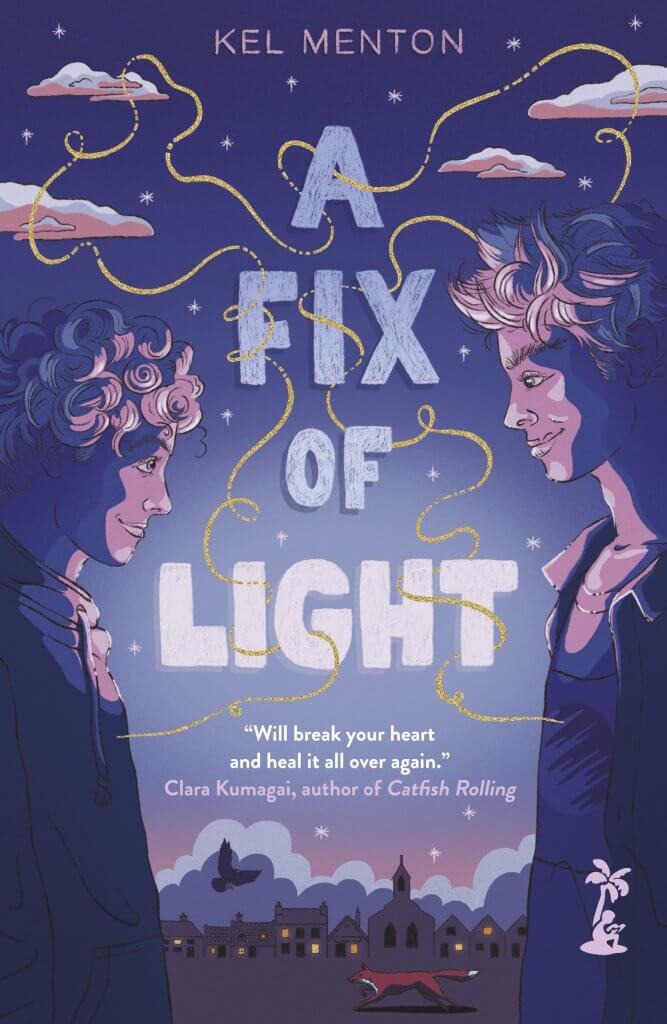
A Fix of Light

Hanan is supposed to be dead.

The forest outside Skenashogue sent him home alive – but changed. A strange new magic makes every emotion a physical force he can’t control.

Bright and gentle, fox-like Pax is everything Hanan is not. And when he touches Hana he mutes his secret power, quiets the curse.

To survive their own darkness they’ll need to open up to each other. But Hanan isn’t sure Pax will like what he finds out …Can their love help them find their way back to the light?

Little Island

Be Careful. The dark is listening.

The cover blurb on the proof states “The latest YA debut from Little Island is a trans love story with a dark magical twist from an astonishing new voice in Irish writing”…and it doesn’t lie about it being dark! It is definitely not one for a precocious younger reader. The content note is stark:

A Fix of Light contains references to suicide and self-harm, depression, anxiety and episodes of psychosis, as well as other symptoms associated with borderline personality disorder. It also contains graphic depictions of homophobic and transphobic hate speech and physical violence, and references to past sexual assault, Reader discretion is advised.

The prologue sets the tone, as a boy walks into the forest intending to die. To be honest, I found those first few pages extremely difficult to read and wasn’t sure I wanted to continue, but I did, and was quickly drawn into the story of Hanan and Pax. I keep typing sentences and deleting them because they feel a bit too spoilery, but the magical fantasy aspects are woven neatly into a contemporary story of two traumatised teenagers. Dual POV, their worlds very quickly revolve around one another, for better and for worse, with a classic ‘things get worse before they get better’ storyline. The reader is drawn in by their hopeful, tentative connections and the heartbreaking events that test them, it is hard going at times but also a very satisfying read.

Kel wrote a thoughtful piece for TeenLibrarian about writing through the conflicting memories of childhood wonder and teenage angst:

When I was a child, I spent one week every summer with my mom’s side of the family – grandparents, aunts, uncles, cousins and all – in Dingle. It was my favourite week of the year.

We wrote messages to mermaids in the sand, sipped hot chocolate from flasks, shared halved apples, and searched for faeries among the fuschia. I remember staring out across the sea at the Sleeping Giant, hoping to see his chest rise and fall, or standing on top of cliffs and staring down at the shifting water, seeking flashes of mermaid’s tails. I was an explorer, an adventurer, just like the protagonists of my favourite books, and the air was thick with potential and magic.

When I started writing A Fix of Light, I was about 16 years old, and I was becoming increasingly unhappy that with each passing year I grew further from childhood and closer to adulthood. Adults, in my opinion, were disenchanted and miserable creatures. I raged against my descent into such banality. What better way to fight disenchantment than to write?

I knew I wanted A Fix of Light to have magic. I knew I wanted it to be set in Ireland, somewhere by the sea. Looking back, I think I was trying to preserve some of that childhood wonder. Every time I sat down to write a little more, I could steep in those memories, try to conjure up the feelings again and translate them onto a page. The act of writing the book, as well as the finished product, could keep those memories pressed like flowers.

The story, though, and the characters, were born of my teenage self. If you are or have ever been a teenager, you know that self-actualisation is a pretty uncomfortable process. Lots of growing pains. I was figuring out How To Write A Novel and Who I Am at the same time, against the backdrop of idyllic childhood memories. How do I make these contrasting flavours complement each other? How do I make this novel coherent, when it feels like I am trying to cram a thousand of my selves into it?

Phillip Pullman, the author of His Dark Materials and other fantastic works, wrote that “…if we are going to do any good in the world, we have to leave childhood behind” (Introduction to Oxford UP’s World’s Classics ed. of Paradise Lost, 2005). I will never be a child again, and that used to make me sad. It felt like someone had locked the door to my favourite room, and hidden the key on Mars. I wanted to go back, and I never could. That is sad, I suppose. But spending the rest of my life staring at a locked door would be much worse.

Trading your childhood for adulthood is exactly that: a trade. You are not left empty-handed, but exchange your innocence for experience and wisdom. Here’s another great Pullman quote: “Innocence is not wise; wisdom cannot be innocent.” (“The Writing of Stories”, May 2002). I have gained wisdom – and will hopefully continue to collect it forever – which has opened a thousand new doors.

As I got older, I realised that adults are not necessarily miserable and disenchanted creatures. In fact, one of the brilliant things about being an adult is that you become responsible for creating the magic. I can make it with my mind, with my hands, with speech, with writing. I did not have to surrender my wonder or enchantment; I just had to start making my own. That’s how I made my childhood wonder and teenage angst become friends.

That’s how I made A Fix of Light.

Kel Menton (they/them) is a non-binary, neurodivergent writer from Cork in Ireland. Kel works in youth theatre as a facilitator and playwright mentor. They were selected as a Young Writer Delegate for the 2021 Dublin Book Festival. They hold a master’s in medieval English literature from University College Cork.

Thankyou to Little Island for sending me a proof copy to review and to Antonia Wilkinson for organising the guest post.

A FIX OF LIGHT publishes on the 6th February 2025.

This Feast of a Life

From the author of If You Still Recognise Me comes a delicious story of two people brought together by a shared love of food as they figure out themselves and each other.

Auden is finding different ways to be themself. The first – using their new chosen name, which feels most authentically them. The second – starting a food blog where they can share their passion for food, through family recipes and the stories behind them. And when the blog brings them Valerie, they discover more than they’d ever expected.

It’s been over a year since Valerie lost her mum – her beautiful, vibrant mum who loved cooking. Since her mum’s death, Valerie and her dad have drifted further and further apart, the kitchen left cold and empty, until Valerie finds Auden’s blog. The blog (and its writer) spark something in Valerie. Could she have found a recipe for happiness?

I interviewed Cynthia when their first novel IF YOU STILL RECOGNISE ME came out, so was very keen to read their next offering and pleased to see that the premise was completely different while still focusing on young people reflecting on their identities and exploring relationships (friendships, romances, and family). I asked a few new questions:

The parents played a significant role in this story. I really appreciated that they weren’t perfect but also weren’t awful, they felt very real. Did you consider making Auden’s parents more or less supportive?

I did think about making them less supportive, but I know that there’s a desire for something a bit more upbeat when it comes to narratives around trans/nonbinary characters. And I didn’t want dealing with unsupportive parents to be a big focus of the book – and if the parents were less supportive, I felt like that would have to take up too much space within the narrative. That wasn’t the story I was trying to tell.

So I did also consider making them more supportive, but I personally don’t find it very satisfying or easy to write about parents who are wholly supportive – maybe because I don’t actually know anyone whose parents are like that. (If your parents are, then I’m thrilled for you!)

That’s why they ended up more in the middle, and I’m glad they seem real!

I *love* all the food references in THIS FEAST OF A LIFE, do you cook yourself?

Yes, I do! Although I don’t think of myself as a great cook, I can follow a recipe well enough and I cooked for myself for years. My wife Olivia now does the majority of the cooking in our household (she’s incredible at it) but I still cook regularly.

When I asked you about the reaction from teens to IF YOU STILL RECOGNISE ME you hadn’t really had any as it was still brand new…what response from readers has the last couple of years brought you?

Readers who have messaged me about how the book helped them through a tough time, how it felt like a warm hug or made them feel less alone – these are the responses I treasure the most. One teen reader I met in a signing queue said they found me inspirational as a person from a different background discovering their identity, which is something I wrote down word for word in my diary because it moved me so much! I’m really glad my books can be there for queer teens who don’t always feel seen.

Have you started working on a fantasy novel yet or can we expect more beautiful contemporary characters?

Yes, I have started working on a fantasy novel – very slowly! It’s a contemporary fantasy though and I’m especially interested in trying to balance a contemporary narrative that includes my usual elements of queer romance and identity – understanding yourself  and figuring out who you want to be in the world – with the fantastical aspects.

Cynthia So (credit Caitlin Wilder)

Cynthia So was born in Hong Kong and lives in London. Their work has been published in speculative fiction magazines such as Uncanny, Strange Horizons and Anathema. They are also one of the new voices in PROUD, an anthology of LGBTQ+ YA stories, poems and art by LGBTQ+ creators, published by Little Tiger in March 2019. When they’re not writing, they can often be found at the theatre, entranced by a play or a musical. They’re also extremely enthusiastic about board games and tabletop role-playing. If You Still Recognise Me – shortlisted for the Waterstones Prize, the YA Prize and the Diverse Book Awards – was their first novel.

THIS FEAST OF A LIFE is out now in the UK, published by Little Tiger. Thanks to Jade for sending me a review copy and co-ordinating interview questions.

The Undying Tower

What if living forever was a death sentence?

Decades after the discovery that a small percentage of the population has stopped ageing, the Avalonia Zone is in crisis. From overpopulation to food shortages, the ‘Undying’ have been blamed for the state’s problems, banished to the fringes of society, and punished for every minor infraction.

When sixteen-year-old Sadie takes the fall for an attack by a rebel group, The Alchemists, she suddenly finds herself wrenched away from her quiet life and from her ailing father. Armed with little help and even less knowledge, Sadie is thrust into a cold and cryptic ‘correctional facility’ – The Tower. Here she’ll have to rethink everything she’s been told about the Undying population in an attempt to save the life she knows, protect a group of unlikely friends, and give voice to the voiceless in a society on the brink of catastrophic upheaval.

Melissa Welliver

After a long silence from me on the blog (sorry), please accept a guest post as an offering, from UKYA author Melissa Welliver all about the journey of her debut title, recently re-released by UCLan Publishing (she has also, in between, had 2 dystopian YA novels published by Chicken House, both of which are great fun):

From Self Publishing to Traditional

In 2019, I signed with my second agent and went out on submission with the book that would become The Undying Tower. We edited over the summer and then in late 2019, we hit the submission trenches… around 4 months before the pandemic hit. Obviously this meant we were submitting to editors that had been sent on Furlough. And this early in the pandemic, the work-from-home strategies hadn’t really been put into action, so we entered a traffic jam of manuscripts all seeking an editor. This went on for 11 months and I quietly lost hope for TUT and started a new project.

In November 2020, almost a year after we went on sub, we had interest from a digital first publisher called Agora Books. They were small but mighty, and really loved the book. They wanted to schedule a 2021 release and, while there was no advance attached, the royalties looked good. It wasn’t quite a traditional publishing deal in all the ways I thought it would be, but it was an offer. I bit their metaphorical hands off and we got going.

The book came out in October 2021 to a small but enthusiastic fan base. Over the next 6 months we sold maybe 500ish copies and I worked steadily on the sequel. In March 2022, the Agora team emailed to ask for a meeting. Assuming it was about book 2, I logged on, eager to chat about future plotlines. But sadly, the future of any plotlines had to go on hold, because the pandemic hadn’t been kind to small publishers. Agora told me they were folding, and the trilogy – plus distribution of book 1 – were going with it.

My editor was great and despite my initial concerns, she gave me all the publication files to allow me to self-publish, in the hopes of earning enough to self-fund book 2. I had signed up to a lot of festivals over the summer of 2022 that I needed to sell the book at, so this was a good short-term solution. However, the sheer workload of self-publishing soon took its toll. By the time I did my last summer gig, a panel at UCLan in late September, I was exhausted.

After the event, the UCLan editorial team pulled me for a chat to say they were pleased with my work and to ask about the book, so I explained it was self-published and in a moment of madness, I pitched the idea to them. They seemed enthusiastic, so I went home and asked my agent to submit The Undying Tower to them directly. And six months later in spring 2023, the mighty UCLan offered – an advance! Bookseller distribution! – for summer 2024.

So I always tell this little book’s story as this: once upon a time, there was a book that wouldn’t die. And The Undying Tower certainly lives up to its name to this day.

Something to be Proud Of

Imogen Quinn is a chaotic bisexual with dreams of becoming a stand-up comedian, crushing stereotypes about autistic people. When she decides to put on a pride festival that’s accessible for everyone, she enlists the help of the openly gay captain of the football team, Ollie Armstrong.

Dealing with the fallout from his parents’ divorce, Ollie is initially hesitant. But it doesn’t take long for him to be swept up by Imogen’s passion, and he’s not the only one. Joined by the (infuriatingly perfect) head girl, musicians, an artist and a star baker – a dream team soon assembles to help plan pride and tackle injustices in their school and beyond. You’d better listen out – they’re getting ready to make some noise.

Packed full of fun, forever friendships and fighting back, this YA debut is perfect for fans of I Kissed Shara Wheeler, Gwen and Art are Not in Love, Feel Good, Heartstopper and Not My Problem.

Little Tiger
Cover illustration by Lucía Gomez Alcaide

SOMETHING TO BE PROUD OF is Anna Zoe Quirke‘s debut novel and published TODAY! I really loved this book, it ticks most of my boxes: realistic teens, humour, friendship, angst (but not too much), romance (but not too much), positive disability rep, unashamedly LGBTQIA+ characters, present but imperfect families…and, a personal highlight: a non-US based author as I am often annoyed by the number of American titles published and highlighted in the UK when there is so much home-grown (or anywhere-else-on-the-globe-grown) talent we could be supporting. I got the chance to ask a few questions!

The book is own-voices but is it autobiographical at all?

Not really. Imogen is an own-voices character as I’m also a queer autistic person, but I definitely wasn’t brave enough in high school to get up to half the shenanigans that they do! (Although there was a photoshopping incident with my headteacher but that was less an act of protest and more a ‘teenager being a little sh*t’ thing.) 

I’ve always thought that I would have been more like Imogen had I known I was autistic and been able to unmask earlier. There are hints at what Imogen used to be like before they fully came into their own and felt comfortable in their identity and those experiences and feelings were definitely inspired by how I felt when I was younger.

If anything, Ollie’s story is the more autobiographical one for me. Nothing was taken directly from my life because, you know, boundaries, but my parents also got divorced when I was in high school, and I’ve had to navigate tricky dynamics with loved ones like he does. Plus, his journey with figuring out what his gender means to him was really special for me to write, as I’ve had to do a lot of figuring out what I wanted my gender to mean to me too.

Was the dual narrative there from the very first draft?

It was. I’m a very character-focused writer so when I’m coming up with a book idea I always know who the characters are first before I know exactly what the plot will be, and Something to be Proud Of was no exception. Both Imogen and Ollie burst into my head and demanded that I write about them, so yes, it was always going to be a dual narrative story – I always knew they both had really important things to say and I felt like they deserved to say them in their own voice. Plus – in my very unbiased opinion – I feel like it’s really lovely that we get to see what their friendship means to them from both their perspectives as it’s developing.

Which character was your favourite to write?

I loved writing all of the characters, but I think I do have to go with Imogen. Writing Imogen’s character was the most fun I’ve had writing ever. They’re funny, silly, unashamedly passionate and I’ll always have fond memories of sitting at my desk cackling out loud to myself and making my dog think I’d lost my marbles while I was writing certain chapters of Imogen’s. However, that being said, all of my absolute favourite moments to write were the ones that were between Imogen and Ollie. Their friendship was an utter joy to write and I’m so grateful that I had them to keep me company during the COVID lockdowns!

What advice would you give to a teen if you’ve inspired them to get involved in setting up an inclusive Pride event in their area?

I love this question and I really do encourage everyone to try and make all their Pride events as inclusive as they can! Here are some thoughts/questions you might want to consider:

–        Think about the specific community you want to do your event in – do you know of any particular needs there that you can take into consideration?

–        What’s been lacking from other pride events you’ve been to? Were they accessible for wheelchairs/people with other mobility aids? Did they cater to different sensory needs?

–        Don’t be afraid to do some research – no one’s expecting you to know absolutely everything straight away, in fact, it’s really important to recognise that you don’t know things. If you think you know everything then you’re closing off the possibility to continue learning. (Also, just as a reminder, when you’re doing research, reading the thoughts and opinions of the groups of people you’re trying to involve in your event is always best, rather than people without that lived experience.)

–        Imagine an environment where you are entirely comfortable, calm, and feel celebrated for who you are. What does that space look like? How can you take even just small steps towards creating that space?

–        If you can, try and gather an amazing team around you. Chances are you’re not the only person that cares about making things more inclusive and besides, everything’s easier with a great team around you so that you can support each other, brainstorm ideas, commiserate when things don’t go to plan and celebrate together when they do.

–        A last reminder: the fact that you’re trying is such a wonderful starting place. You have that softness and that ‘I just want everyone to feel safe’ part inside you, and that’s a really beautiful thing. Be gentle with yourself, and if you feel like you didn’t do something right or forgot something you feel like you should have included, then give yourself grace and just make a note to do that next time. There’s so much pressure to be the ‘perfect’ activist and it’s often really counterproductive. If people worry too much about being perfect, then they might become so anxious that they can’t do anything at all. But doing something is always better than nothing.

What are you reading at the moment and who would you recommend it to?

I’m currently rereading Jane Austen’s Emma. I’d recommend any of Jane’s work (Persuasion is my favourite!) to pretty much anyone. Jane’s stories are so warm, her characters feel so real, and she writes with such wit – she’s a huge writing inspiration of mine.

And then I’m also rereading the Northern Lights trilogy with the students in the ‘Book to Screen Club’ that I run in my library (alongside watching the BBC adaptation) and we’re having an excellent time with it. If you like magic, adventure and high stakes, whether you’re a teen or adult, I definitely recommend those books.

I’ve also just been sent an ARC of Not for the Faint of Heart by my friend, Lex Croucher, which is a historical queer romance/adventure inspired by the story of Robin Hood. Lex’s books are always super fun, laugh-out-loud reads, so I’m very excited to dig into this one.

Will we see more of Imogen or are you working on something different?

Both Imogen and Ollie will always occupy a big chunk of my brain. I have dozens of little snippets of scenes written in my phone notes because I’m always thinking about them and what might have happened in their lives after we leave them at the end of STBPO. Unfortunately though, sequels are pretty rare, so I doubt I’ll ever fully return to the world of STBPO in that way. 

But, I am currently working on edits for another book that’s coming out in 2025. It’s a queer rom-com this time, with similar found family vibes and hijinks to STBPO but alongside themes of mental health and figuring out (or not) the nuances of your sexuality. I feel like I’ve properly fallen in love with this book during the editing process and I can’t wait for people to read it next year!

Anna Zoe Quirke is a queer and autistic author and librarian from the North of England. She currently lives in Manchester with her partner, Rachael, and their very angry tortoise, Sheldon. They’re at their happiest writing stories about queer and neurodivergent people finding and claiming their place in the world, exploring the literary wonders of the UK, or making a big ol’ mess in the kitchen baking things for their loved ones.

Homebody

‘An uplifting, hopeful, empowering memoir that celebrates self-discovery and self-love’ – Alice Oseman, author of the bestselling Heartstopper series

An unmissable graphic novel perfect for fans of the global hit Heartstopper and Juno Dawson’s What’s the T?

Hello! I’m Theo. I like cats, Dungeons & Dragons . . . and I’m trans and non-binary.

Ever since I was young, I’ve been on a journey to explore who I am. To discover the things that make me . . . me.

Sometimes it can feel like the world is trying to fit you into a box, to label you one way or another, but there is nothing more wonderful than finding your true authentic self, whoever you are. Whether you are transgender or cisgender, we are all searching for ways to make our houses feel like homes . . .

In Homebody, Theo tells the heartwarming story of discovering how to live life on their own terms through beautiful illustrations and lyrical text.

Macmillan

The way Theo looks back on their life so far is so honest and eloquent, figuring out how they feel about themselves as well as how to present themselves to the world on their own terms, and could really help teens and adults not only empathise but reflect on their own path and the journey they’re still on. I absolutely *adored* this book and wish everyone that has “concerns” about trans youth would read it to really think about what it means to be comfortable in yourself, something that many people take for granted especially as they get further away from the growing pains of their teen years. Some people will know themselves and hardly change, others will go through lots of different outward expressions before they feel that the world’s view of them matches their own, some are scared to express themselves honestly, while others still will think that they know themselves until they come across something new to them that opens their eyes to an aspect of themselves they’d neglected.

So much of it resonated with me: When I was a teenager I was frequently mistaken for a boy because of my short hair and baggy clothes and I had conversations with family and friends (not all, but enough) about how no one would ever love me if I didn’t change the way I looked…all the thoughts about what girls and boys should like and not fitting in and knowing that it *shouldn’t* matter what your hobbies are or what you wear wear or how you style your hair but that society will tell you that you’re getting it wrong because for some reason it *does* matter. I keep going back to the book because there are so many beautiful, insightful pages. Anyway, a boy did (does) love me, short hair and all, so listen to Theo’s advice below.

I was lucky enough to be given the opportunity to share some pages from the book, and also ask Theo a few questions:

Tell us about your new graphic novel 

Homebody is an uplifting and affirming graphic memoir about life outside of the gender binary. An honest and heartwarming look at the joy and beauty of finding yourself and the positive impact of living as your authentic self. Homebody speaks to a universal experience of exploring what makes us who we are, how we express that to the world and of the relationship we all have between our minds and bodies. Whether you are transgender, cisgender or still figuring it out, we are all searching for ways to make our houses feel like homes, and to come to a place of ease within ourselves.

Which advice would you pass on to your younger self?

Find the people who love and accept you for who you are, exactly as you are, you don’t have to change anything about yourself to be liked. Instead of trying to figure out what other people want or expect you to be, focus on being the person that you want to be and the rest will fall into place.

Homebody is such a unique book, but do you have any titles you could recommend for teens that devour your story?

I have a long list of graphic novels I love! But my top picks for teens who enjoyed Homebody would be: ‘The Girl From the Sea’ by Molly Knox Ostertag- a sweet coming of age sapphic romance with a sprinkle of fantasy.
‘Deadendia’ by Hamish Steele – a funny and imaginative series set in a theme park that’s connected to demonic realms, with a trans protagonist and great LGBTQ+ and neurodivergent representation.
‘Welcome to St Hell’ – a hilarious, honest and relatable autobiography from trans creator Lewis Hancox about his time at high school and figuring out his trans identity. 

Have you any other projects on the go that are developing into full books? After such a personal debut, what would you most like to write about?

I am currently working on my second graphic novel, which is going to be another fairly personal book actually! It’s based on my experiences of moving through the world as neurodivergent but not realising that until much later in life. Beyond that I would love to write fantasy as it’s one of my favourite genres to read.

Homebody is published today by Macmillan, aimed at age 14+

Mina and the Cult

Mina’s having a hell of a family reunion. After the death and chaos of Halloween, Mina and the gang are looking forward to their road trip to Roswell, New Mexico, where they are hoping to be thrilled by the alien stories and have some R & R with Mina’s parents. However, their trip ends abruptly and before they know it, they are back in New Orleans. Instead of enjoying the fall celebrations and renovating the mansion, they find themselves investigating a serial killer who claims to be a real vampire in disturbing letters to the press.
As the city is gripped by fear, a group of believers is planning to disrupt the fragile balance between the humans and the supernatural creatures hiding in the shadows. This threatens the peace that Mina and her friends have been working so hard at maintaining.
Caught between investigating the killer and trying to stop the group’s destructive plans, Mina’s third mystery might be her last…

UCLan Publishing

I horrified Antonia, the publicist that organised this guest post for us by telling her that, in a school library, a book set in the 90s is a historical novel 😁 The Mina series are <historical> horror mystery for teens and YA and should be in all your libraries! The author, Amy McCaw, wrote a piece for us about how she establised the setting.

Why the fascination with 90s nostalgia?

Books, music, fashion and movies from the 90s seem to be more popular than ever. I’m still as obsessed with my 90s favourites as I ever was, and I have a few theories about why the fascination with the 90s persists.


When I started writing Mina and the Undead, I wasn’t sure what year I would set it in. During the very early stages of writing, I realised that the Interview with the Vampire movie came out in 1994, and 1995 was also the deadliest year in New Orleans history, with over 400 people being murdered that year alone. Those two things came together in my imagination to produce a murder mystery where vampires might be responsible for the high crime rates.


Once I’d settled on the 90s, I realised how fun it would be to lean into 90s pop culture in the plot, music, movie references and clothing. The book ended up having the feel of things I loved in the 90s, including Scream, Buffy and Charmed. I was a teenager later in the 90s, and I think enjoying those things so much in my formative years left a lasting impression on me. When I watch my 90s favourites, they’re still great on their own merits, but they also take me right back to that time.


There are a lot of reasons why the 90s might have continued to have such a lasting impact. The music has a distinctive feel, with that grunge and indie sound never really being replicated since. Slashers and paranormal books and TV shows had a real moment, and horror series like Point Horror and Fear Street were at the peak of their popularity. Like me, some people circle back to their old interests, but this can’t be true of younger readers who weren’t born in the 90s. In my experience, teenagers enjoy dipping their toes into a time period that feels relatively recent and yet so different from current pop culture, with an instantly recognisable flavour.


If you’re a fan of 90s pop culture, I highly recommend visiting the original influences I’ve already mentioned. Buffy the Vampire Slayer is still my all-time favourite form of any pop culture, and Scream reinvented the slasher genre, making it self-referential and delighting in outlandish, gory kills.


There are also plenty of YA books set in the 90s or that have that 90s feel that I always crave. Reading anything by Kathryn Foxfield, Cynthia Murphy or Kat Ellis will fill that Point-Horror shaped gap in your life. I also recommend Kendare Blake’s Buffyverse books if you’re looking for something that reads exactly like the Buffy TV show. I recently read The Babysitter’s Coven by Kate Williams, and that’s packed with 90s references and has a feel somewhere between Buffy, Charmed and The Babysitters Club.


I love delving into different time periods in my reading and writing, and I’m delighted that readers seem to agree with me.

Amy McCaw is a YA author and YouTuber. She’s the author of the Mina and the Undead series, YA murder mysteries set in 1995 New Orleans. She also co-curated the A Taste of Darkness horror anthology with Maria Kuzniar. Her main interests are books, movies and the macabre, and her novels have elements of all of these. Unsurprisingly, she’s a huge Buffy the Vampire Slayer fan and has gone to conventions to meet James Marsters more times than she cares to admit.


If you want to talk with Amy about books or 90s movies, you can find her on Twitter, Instagram, Tiktok and YouTube.

Mina and the Cult, the last in the trilogy, is published in the UK by UCLan Publishing on 4th April 2024

Trigger

An unflinching verse novel about a teenage boy who is sexually assaulted in an attack he struggles to remember.

Jay wakes in a park, beaten and bruised. He can’t remember what happened the night before. But he has suspicions.

Jay realises he has been raped — and that his ex-boyfriend may have been involved.

Counselling sessions cause Jay to question everything. His new friend Rain encourages his pursuit of justice. Jay wants answers, but his search will lead him down a perilous path.

Warning: sexual assault 

Little Island

TRIGGER is not an easy read by any means, definitely YA+, I read it in one sitting with my heart in my mouth. It is definitely one to spark conversations but also definitely one that requires talking about because it could bring up a lot of feelings for some readers. It ends with hope but isn’t unrealistic about how such a traumatic event affects a victim’s life in an ongoing way. If you’re feeling up to an emotional rollercoaster in verse, it is a gripping read!

I was given the opportunity to ask the author, C.G. Moore, a few questions:

Your very first novel was prose and then your second was verse, as is TRIGGER. What prompted you to try verse? How different is the process?

Both TRIGGER and GUT FEELINGS are deeply personal novels. When I was having a relaxing weekend in the Lake District, everything clicked into place and I started to write GUT FEELINGS it in verse. It was all very natural. Initially, I tried to write TRIGGER in prose but as someone who was a victim of sexual assault, I often felt like I couldn’t talk about it and there was shame attached to my experience (like I had brought it upon myself which is obviously not the case). I couldn’t find my voice in the moment so when approaching TRIGGER, it became clear that it needed to be in verse with each word carefully weighted. Writing in free verse is a massive challenge and it has its limitations but it makes you hyperaware of the words on the page and how they contribute to the plot, characterisation and narrative of the story.

Do you think you’ll only write in verse now or does it depend on what you’re writing about?

I have no plans to write in verse going forward although I am sure I’ll return to it at some point. With that said, I have a lot of ideas that play with form so we’ll see. For now though, I’m focused on prose.

TRIGGER is, unsurprisingly given the title, about a very emotive subject. How did you balance writing an impactful story with the potential for sensationalising or downplaying the ongoing impact of rape on the victim?

There are also different ways to approach subjects like this but I think that inferring the rape was more important than showing it and making it somewhat gratuitous. I wanted consent to be one of the key focuses of the story, and for the book to facilitate discussion and engagement around this. The main character’s – Jay’s – experiences are not my experiences. It was definitely a challenge tapping into the emotions of my past without letting those memories and experiences seep into my writing. One of the key messages I wanted readers to take away was to think about what consent means and how it might apply to them in their own lives. I was also conscious of the audience I was writing for and ensuring the reading experience allowed them to explore some issues that are often considered taboo, but doing so in a way that was sensitive and considered.

In your author’s note you mention that you had similar experiences yourself. Do you think that made it harder or easier to write this?

I think it was easier to write than GUT FEELINGS in some ways. I’d already written a verse novel and although I won the KPMG Children’s Books Ireland Book of the Year Award, I didn’t feel any pressure or concern in being compared to GUT FEELINGS. I had a clear idea of Jay’s experience, what happened and how the story would turn out which made it easier to write.

Was the ending different when you first wrote it or did you know what you wanted to happen (if you can answer that without spoilers)?

The ending was always the same but I wrote Jay as having a gun but agents found it a bit sensationalist and unrealistic, and I agreed.

Who, do you think, is the target audience of TRIGGER?

I would say readers aged 13+ but although it’s considered Young Adult, it shouldn’t stop adults picking it up. I wrote in a way that could bridge that gap and appeal to both audiences without patronising teenage readers.

What are you working on at the moment?

I can’t say too much about it but it will definitely be told in prose. It’s a YA “coming out” story with a massive twist.

C.G. Moore

C. G. (or Chris) Moore is the published author of three books. His second book – Gut Feelings – explored his own experiences living with chronic illness and was nominated for the Yoto Carnegie Medal and won the KPMG Children’s Books Ireland Book of the Year Award 2022. His new book – Trigger – is inspired by his own experiences of sexual assault and looks at consent. Chris has also contributed a poem to Our Rights – an anthology endorsed by Amnesty International. He previously taught on the BA and MA in Publishing programmes at the University of Central Lancashire. When Chris isn’t writing, he can be found walking his Jack Tzu, Lola, baking or caffeinating at his local coffee shop.

When We Become Ours

A groundbreaking and must-read young adult fiction anthology written by adoptees of all backgrounds, for adoptees, that inclusively represents diverse experiences of youth adoptees, edited by award-winning authors Shannon Gibney and Nicole Chung. Includes a letter from the editors as well as a foreword by Rebecca Carroll and an afterword by JaeRan Kim.

Two teens take the stage and find their voice . . .

A girl learns about her heritage and begins to find her community . . .

A sister is haunted by the ghosts of loved ones lost . . .

There is no universal adoption experience, and no two adoptees have the same story. This anthology for teens edited by Shannon Gibney and Nicole Chung contains a wide range of powerful, poignant, and evocative stories in a variety of genres.

These tales from fifteen bestselling, acclaimed, and emerging adoptee authors genuinely and authentically reflect the complexity, breadth, and depth of adoptee experiences.

This groundbreaking collection centers what it’s like growing up as an adoptee. These are stories by adoptees, for adoptees, reclaiming their own narratives. 

With stories by: Kelley Baker, Nicole Chung, Shannon Gibney, Mark Oshiro, MeMe Collier, Susan Harness, Meredith Ireland, Mariama J. Lockington, Lisa Nopachai, Stefany Valentine, Matthew Salesses, Lisa Wool-Rim Sjöblom, Eric Smith, Jenny Heijun Wills, Sun Yung Shin.

Foreword by Rebecca Carroll. Afterword by Jae Ran Kim, MSW, PhD

Harper Teen

Today we have a guest post from one of the editors of this new anthology, Shannon Gibney:

It is a very strange thing to never see yourself represented, and then when you do, to
not even recognize yourself.

And yet, this is often the experience of the more than five million American adoptees,
and millions more around the globe.

Don’t get me wrong: adoptees and “orphans” are well-represented in American popular
culture – especially in KidLit. From Harry Potter to Loki to Peter Parker, adoptees are
imbued with magic powers, enact elaborate schemes to seek revenge, and generally
misunderstood by all the “normal” non-orphans and non-adoptees around them. Our
lack of an origin story is seen as a mysterious advantage, something that not only sets
us apart from mundane others, but also conveys a sense of specialness, an ethos that
something else of consequence (not just to us, but the world) is buried and waiting to be
uncovered.

In real life, of course, things are different.

We feel strange in a culture that so deeply values at least the appearance of a
seamless individual or family history, not having any. And as a result of this condition,
we are unable to prepare for or even acknowledge any troubling health issues (such as
breast cancer in my family) that may be hereditary.

If we are transracially adopted, that is, a BIPOC child adopted into a white family, we
may keenly feel the loss of not just our first family and community, but also our culture
and racial identity.

All of these losses are rarely if ever present in mainstream narratives of adoption –
whether they are imaginary or real. Adoption is presented as an uncomplicated and
beneficent act on the part of the adopters, and the positives that adoptees gain
(economic mobility, educational stability, etc.) are seen to eclipse any possible
negatives.

And of course, this is because the vast majority of these stories are written by non-
adoptees. They are written by people who have never felt strange in their own bodies
because they don’t look like anyone in their family/school/town. They are penned by
people who never had to process the loss of a first mother’s embrace as a baby, the
lack of that primary first attachment present in every cell of their body.

Historically, these stories have been written by white adoptive parents, either
intentionally or not intentionally putting forth a very different view of the adoptee
experience, occupying a very different location in the adoption triad. But lately, many of
these stories are being written by non-adopted BIPOC writers, many of whom use
troubling tropes of adoption as shorthand (this character is mentally ill because of
adoption; due to her blackness in this white family, this secondary character
demonstrates the cluelessness of the white protagonists; etc.).

When this is the territory of adoptee stories, as it has been for generations, it becomes
clear why it is absolutely necessary for adoptees to write our own. And why a book like
When We Become Ours, the first anthology of stories by adoptees about adoptees, is
resonating so deeply with adoptee readers and allies.

Edited by myself and Nicole Chung, this collection features sci-fi, fantasy, horror,
straight literary, and even graphic stories from fifteen of the best adoptee writers today.
Our writers are straight and queer; youngish, oldish, and middleish; cis-gender and
gender queer; Black, Korean American, mixed, Latina, Chinese American, Taiwanese
American, and Native American; and hail from all over North America and the world (we
have one contributor who is Canadian, and another who lives in New Zealand). Their
stories are as broad and inclusive as their experiences. And as adoptees, they each
have an embodied understanding of living as an adoptee in a world that has little idea
what this is actually like.

All of this turns out to be very important, in terms of how readers engage with the
stories. Although the book has only been out for two months, the response from
adoptee communities has been overwhelming. I had one Chinese American adoptee tell
me she never expected to see herself in her favorite genre: sci-fi. She called the
experience, “mind-blowing.” A group of transracial adoptees at the same event told me
that although they appreciated the honesty and craftsmanship of many adoptee
memoirs, the emotional rawness of this genre was just too close. But in the imaginative
realms of short stories by and about adoptees, they could confront some difficult truths
of their lives far more easily.

We are in an era of incredible adoptee-authored cultural output, and I am here for all of
it. Adoptees telling our own stories, on our own terms, in our own voices is transforming
inner and outer landscapes: our own, and those of the people we love.

Adoption — the institution, and the stories we tell about it – will never be the same.

Shannon Gibney is a writer, educator, and activist in Minneapolis. Her newest book is
When We Become Ours: A YA Adoptee Anthology (HarperTeen, 2023), co-edited with
Nicole Chung.

Catch Your Death

Trapped in a mansion with a murderer and a family of liars – how would you survive? A mind-blowing thriller from the author of THIS BOOK KILLS, perfect for fans of Holly Jackson and Karen McManus.

When three girls are stranded at the grand Bramble Estate in the middle of a snowstorm, they stumble into a murder plot. Someone has poisoned wealthy Emily Vanforte in the middle of a family dinner – which means Devi, Lizzie and Jayne are trapped in the house with a killer and a mystery to solve. With knives under floorboards, vanishing guns and secret passages in the walls, no one is safe and everyone is a suspect. But in a house of liars and corruption, will the girls save themselves…or learn to fit in?

Usborne

Ravena Guron’s debut YA, THIS BOOK KILLS, was a brilliantly fun murder mystery set in a school with lots of twisty turns and only a slight suspension of disbelief needed to carry you along to the big reveal and I’d highly recommend it…CATCH YOUR DEATH however, is a million times better than TBK and I implore you to read it immediately!

I don’t want to say a lot about the plot because I don’t want to spoil it for you, which means this is a very short review, but the 3 perspectives are brilliantly rounded characters with distinctive voices (really hard to do) and I honestly gasped aloud at a couple of points, as well as laughing because there is a great use of humour. Definitely add this to your Christmas wishlist as, although it isn’t even remotely festive, it is a perfect read for a cold day.

Ravena Guron

Huge thanks to Usborne for sending me a review copy.

CATCH YOUR DEATH publishes today!