My friend and former colleague from my Fish Hoek Library days wrote a fantastic history about the creation of Masiphumele Library. She has given me permission to share it here. Highly recommended reading for anyone with an interest in Library Services and what people with vision and the will to be the change in the world can do.
Topeka & Shawnee County Public Library targeted by Book Banners
A recent news article in the Topeka Capital-Journal about the GOP in Shawnee County Kansas targeting the library caught my eye the other day:
Shawnee County GOP targets books in public library children’s section
Much like many library folk I keep an eye out for news on attempted and actual book bans & attacks on libraries that take place in the US and abroad. This particular attack is a bit closer to home than most as it targets Topeka and Shawnee County Public Library, the largest library system to the west of me in Kansas where I currently reside.
On the surface the article reads as if parents and politicians are in uproar about unsuitable books on the shelves of the children’s library.
But, if you take a ever so slightly deeper look at the books mentioned in the article and shown in the related photograph, namely :
It’s totally Normal by Monica and Asha Mehta
Beyond Bananas and Condoms by Dee Whitnell
You, Me and Infinity by Deb Caletti
Here’s to Us by Becky Albertalli & Adam Silvera
and spend a few minutes on the TSCPL catalog, you will find that all the abovementioned books are shelved in the Young Adult collection in the library.
There is also an edited phone video that was released in the online TCJ on the same day:
Shawnee County residents have concerns with books at local library
The video features attorney Kathy Brown (allegedly the Kansas chapter leader of MassResistance a ‘pro family’ anti-LGBTQ+ group) reading quotes from Gender Queer a graphic memoir by Maia Kobabe. Brown claims “That is a quotation taken from a book in the juvenile library, recommended for children as young as 10”
Except that it is not a children’s book, Gender Queer is an adult non-fiction graphic memoir; physical copies appear to be no longer available in the Topeka and Shawnee County Public Library, but when they were, they were shelved in the Graphic Novel section, not in the Children’s or YA sections of the library. Gender Queer is rated as mature and according to Common Sense Media, the recommended reading age is 16+ Indeed Maia Kobabe is on record as saying I don’t recommend this book for kids!
You can view photographs from the meeting on the USA Today Network Reuters Connect website:
The video also artfully pans across a shelf in the YA section featuring non-fiction books by and about transgender people and their experiences, before cutting to two concerned residents, Republican State Representative Candidate Lanell Griffith “We got to protect the kids. You know the GOP is all about protecting children in every way possible” and Toni Stewart, Kansas State Director of the Concerned Women for America “We want to protect children in every way possible…put the books in the adult section where maybe they are more governed by ages instead of just kids wandering in and pulling a book off the shelf and going, ‘What’s this Mom?'”
The video then cuts back to the bookshelf and a patron pulls a book from the shelf, the book is Naked: Not your Average Sex Encyclopedia by Myriam Daguzan Bernier – another book available in the young Adult collection.
The video is slickly cut together, it shows a selection of books, that, if actually shelved in the Children’s Library rather than the Young Adult collection may cause consternation. The talking heads, all speak about ‘protecting the children’, although protecting them from what is never made clear; accurate sex education perhaps, but that is protecting their parents from questions that may make them feel uncomfortable.
I feel the need to stress again, that all the books mentioned are Young Adult and not Children’s books as the original article and concerned residents claimed. Except for Gender Queer by Maia Kobabe which is an adult Graphic Memoir.
Public Libraries in the US do not act in loco parentis, indeed in all the libraries I have visited, worked in or read about in the US the view that the only people that can determine the appropriateness of what children read is their parents (or other legal guardians).
In closing if you are an adult concerned about parental rights when it comes to children selecting books from the library, you have the right to browse the library shelves with your child and discuss their potential choices in the moment and not blaming library workers if you trust your child to go to the library unchaperoned and they come home with something that upsets you.
Edited to add: the response by TSCPL CEO Marie Pyko in defense of the library’s first amendment rights to provide a diverse collection is worth reading in its entirety:
Reform UK and Public Libraries
Reform UK, also known as the Reform Party, is a right-wing populist and far-right political party in the United Kingdom.
Reform has an outright majority in 24 councils across Great Britain and is the largest party in 10 more but does not have an outright majority in those.
You may be asking yourself, “What does this have to do with libraries?” the answer is relatively simple, Public Libraries in the UK (& elsewhere) often function as a canary in a coalmine for society at large, they are usually the first places to see changes in policy being enacted. The first collections attacked are those in the Children’s and Youth areas of the library; the figleaf excuse most often used is that only books and materials that are “inappropriate” for those ages are being targeted. However, the process for determining what is inappropriate is opaque and the decisions are made by those in power.
This is a partial list of the local authorities run by Reform that have limited or banned outright Pride displays and other events that they find distasteful from the Library Services that they control.
Essex County Council
Leading council member Chris Hossack instructed the county’s 74 libraries to scale back on highlighting events that do not relate directly to day-to-day council services, pausing social media communications and dedicated displays.
After a petition set up in protest at this move gained over 17,500 signatures, a council spokesperson clarified that events are not banned, but promotional activities remain under review.
It was announced that promotional book displays will require approval from senior managers, with the leader citing that some Pride displays may have contained “inappropriate” material for certain visitors.
Kent
Lancashire
Norfolk County Council
Norfolk Libraries shared a post by the County Council on Facebook addressing the news reports. You can read it here: https://www.facebook.com/share/p/15zHbaScDAR/
Local news outlet Eastern Daily Press has been covering this story and has a great article here:
Staffordshire
Warwickshire
St Helens, Merseyside
The throughline from Reform leadership in all the councils is that libraries (and other council services) are to remain “politically neutral”.
Leaving aside the observation that identity and lived experience is not political, the argument that libraries should be neutral is one that I and many others find to be specious. To quote Archbishop Desmond Tutu: If you are neutral in situations of injustice, you have chosen the side of the oppressor. If an elephant has its foot on the tail of a mouse and you say that you are neutral, the mouse will not appreciate your neutrality.
Libraries should be non-partisan, not endorsing one ideology or political party over another and remain open forums for fostering dialogue and offering access to information and ideas.
Reclaiming Knowledge, Empowering Futures: South African Library Week 2026


South African Library Week 2026 Theme:
“Reclaiming Knowledge: Empowering Futures”
Dates: 16 – 22 March 2026
The South African Library Week (SALW) 2026 theme, “Reclaiming Knowledge, Empowering Futures”, reflects a critical moment for libraries and information services in the region. In an era marked by rapid technological change, misinformation, and widening knowledge gaps, libraries stand as guardians of authentic information and catalysts for inclusive development. This theme underscores two interconnected imperatives:
Reclaiming Knowledge
Knowledge is a shared heritage that shapes identity, culture, and progress. However, barriers such as digital divides, loss of indigenous knowledge, and inequitable access threaten this heritage. By reclaiming knowledge, libraries commit to preserving cultural memory, promoting open access, and ensuring that communities have reliable, diverse, and contextually relevant information. This involves digitization of local content, fostering multilingual resources, and advocating for intellectual freedom.
Empowering Futures
Access to knowledge is not an end in itself, it is a means to empowerment. Libraries empower individuals and communities by equipping them with skills for lifelong learning, digital literacy, and critical thinking. In a knowledge-driven economy, libraries are strategic partners in education, innovation, and social transformation. Through inclusive programs, technology integration, and partnerships, libraries enable citizens to navigate complexity, seize opportunities, and shape sustainable futures.
Why This Theme Matters Now
Southern Africa faces challenges such as socio-economic inequality, climate change, and the need for digital transformation. Libraries are uniquely positioned to bridge these gaps by reclaiming marginalized voices and democratizing access to information. SALW 2026 calls on stakeholders, libraries, governments, educators, and communities to reaffirm the role of libraries as engines of empowerment and resilience.
Strategic Focus Areas for SALW 2026
- Digital Inclusion: Expand access to digital resources and skills for all.
- Knowledge Preservation: Safeguard indigenous knowledge and local content.
- Community Empowerment: Design programs that foster innovation, entrepreneurship, and lifelong learning.
- Advocacy & Partnerships: Strengthen collaboration to influence policy and resource allocation for libraries.
By embracing this theme, SALW 2026 positions libraries as transformative spaces where knowledge is reclaimed and futures are empowered, ensuring that no one is left behind in the information society.

Resources and Links to Information on Staying Safe at Protests, ICE monitoring and more
Wired has provided paywall-free access to their article How to Protest Safely in the Age of Surveillance
How to Protest Safely: What to Bring, What to Do, and What to Avoid
Revolts Without Revolution: Adrian Wohlleben on Gen Z uprisings, anti-ICE logistics, and the uncertain leap beyond liberalism. https://illwill.com/print/revolts-without-revolution
Zines about How to Report ICE, with versions for different locations
From the ALA’s OIF: Libraries and Immigration Enforcement
The Office of the Minnesota Attorney General released this document Know Your Rights
With ICE
The Immigrant Legal Resource Center Red Cards
How to Use the Red Cards: Illustrated & Multilingual
COPAL (Comunidades Organizando el Poder y la Acción Latina)
Handbook for Constitutional Observers
Whistle resources:
Resources for Whistle Warriors: https://www.pilsenartscommunityhouse.org
How the whistle became an anti-ICE rallying cry in Minneapolis
3D Printed Whistles
We ship community protection whistles for free. Need some? Click the email link below & tell us how many you need (between 100 – 1000) & where to send them: https://linktr.ee/3Dwhistles
The Librarians
Yesterday evening (Tuesday June 24th) at the urging of my wife I took myself off to opening night of the Free State Festival, to watch a documentary called The Librarians.

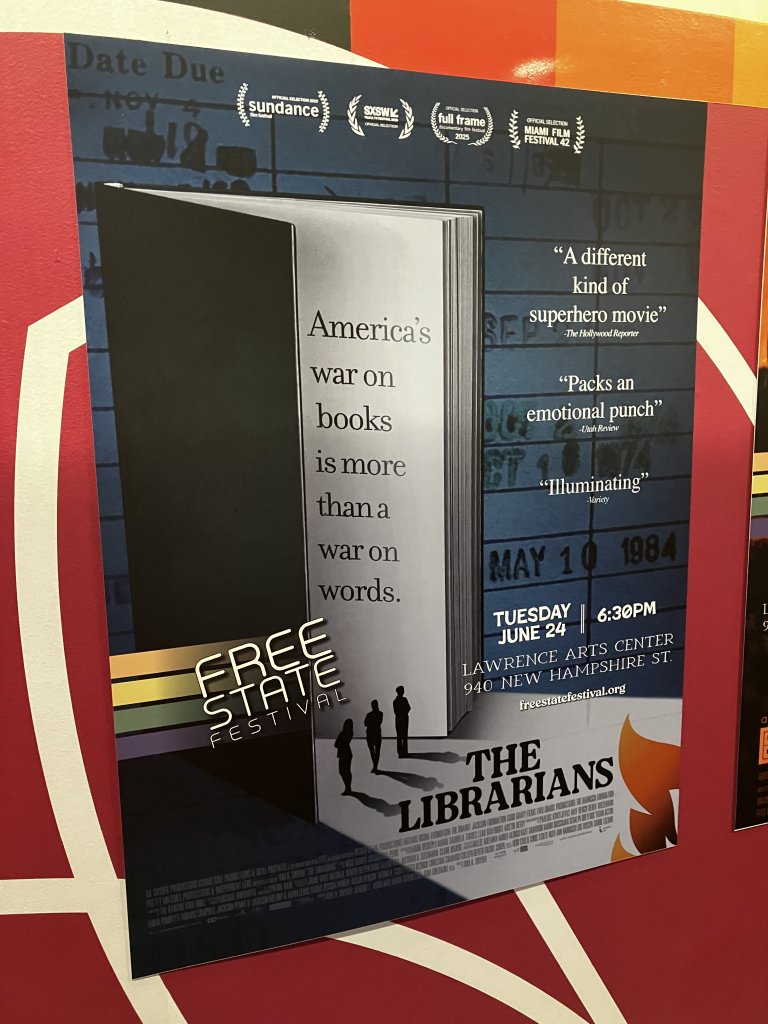
In Texas, the Krause List targets 850 books focused on race and LGBTQIA+ stories – triggering sweeping book bans across the U.S. at an unprecedented rate. As tensions escalate, librarians connect the dots from heated school and library board meetings nationwide to lay bare the underpinnings of White Christian Nationalism fueling the censorship efforts. Despite facing harassment, threats, and laws aimed at criminalizing their work – the librarians’ rallying cry for freedom to read is a chilling cautionary tale.
I have worked in Libraries for 30-odd years now and for most of those years I have been an advocate for library services and a front-line activist pushing back against those who view libraries as an anachronism or worse, an obstacle to be destroyed so they can enact greater control over what information and materials citizens can access.
I would describe myself as terminally online and plugged in to the national (& international) library news network so I was already aware of much of what was shown and discussed in the documentary but I went in knowing that it would probably be aimed at viewers who do not have an in-depth knowledge of the forces arrayed against public & school libraries and library workers. I will start by saying that this film is essential viewing for anyone wishing to know more about the threat to library services, staff and books by and about minorities in the United States of America!
So, sitting in an audience made up of library folk from my local Lawrence Library, Topeka, KU Libraries and further afield, as well as lovers of libraries and independent cinema the documentary began.
Having watched in real time the assaults against the first and 14th amendment rights of young readers to access materials from libraries as well as the threats made against library workers; seeing them woven together in a coherent story still came as a visceral shock at how wide-spread and pervasive the hate and misinformation about “pornography in libraries” is. I was glad to be in an audience as I feel, that if I had watched it on my own I may have collapsed in despair, but surrounded by like-minded individuals helped better appreciate the speciousness and sheer ridiculousness of the attacks on books by and about LGBTQ+ people and people of color. At points during the film we laughed at the buffoonery on display from elected (& often unelected) people pushing to remove books that offended their limited sense of propriety and our cheers at the bravery of colleagues across the country as time and time again they put their jobs and safety on the line to defend the right to read and see oneself mirrored in the pages of books.
After the showing there was a Q&A With Film Producer Janique L. Robillard, Dean of KU Libraries Carol Smith and Robin Hastings of Northeast Kansas Library System, moderated by Former Kansas Legislator Christina Haswood.

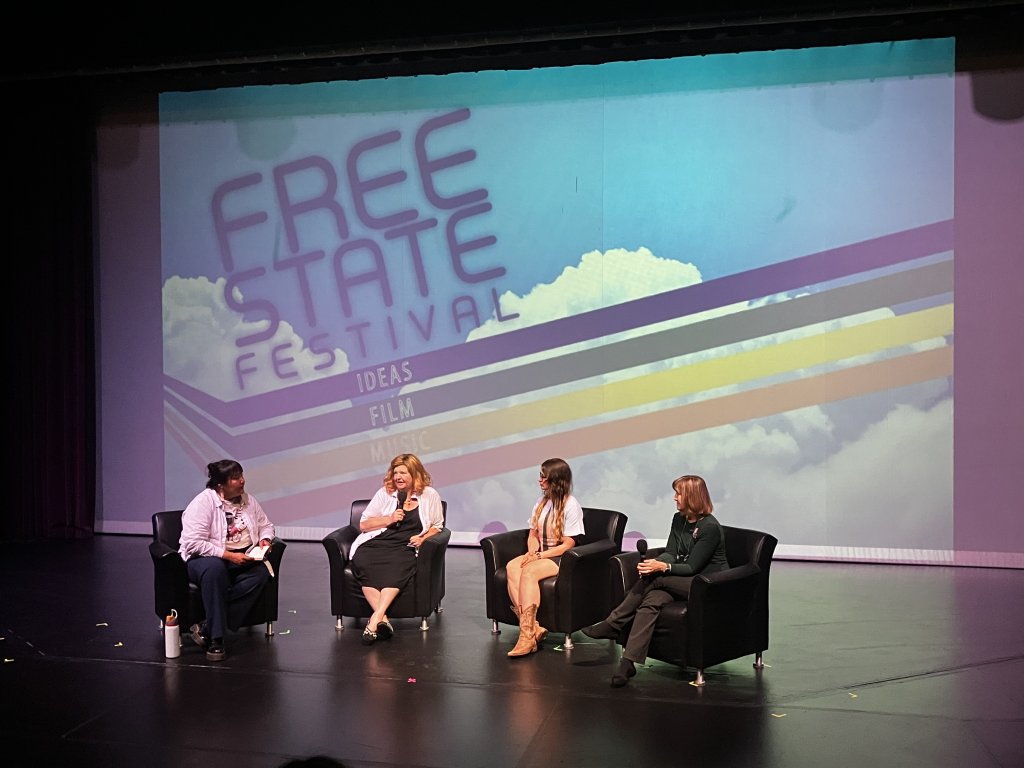
If I had my druthers the panel discussion would have lasted far longer than it did, the same for the informal discussion in the foyer of the Lawrence Arts Center afterwards, but that is down to my love of making connections and chatting to colleagues about library stuff. I was fortunate to have the opportunity to spend a minute or two speaking to the producer Janique about my experiences with book banners and I thanked her for the work she and the other filmmakers had put into The Librarians. As was said during the documentary, we don’t put ourselves forward and often prefer to remain in the background helping patrons access the services libraries offer, but in this film I felt that the makers had not only seen us, but understood why we do what we do and accurately portrayed it on the screen.
If you work for a library or know any organization that may be able to host a screening of The Librarians or want to find out how to get involved with fighting for intellectual freedom, there is more information here:

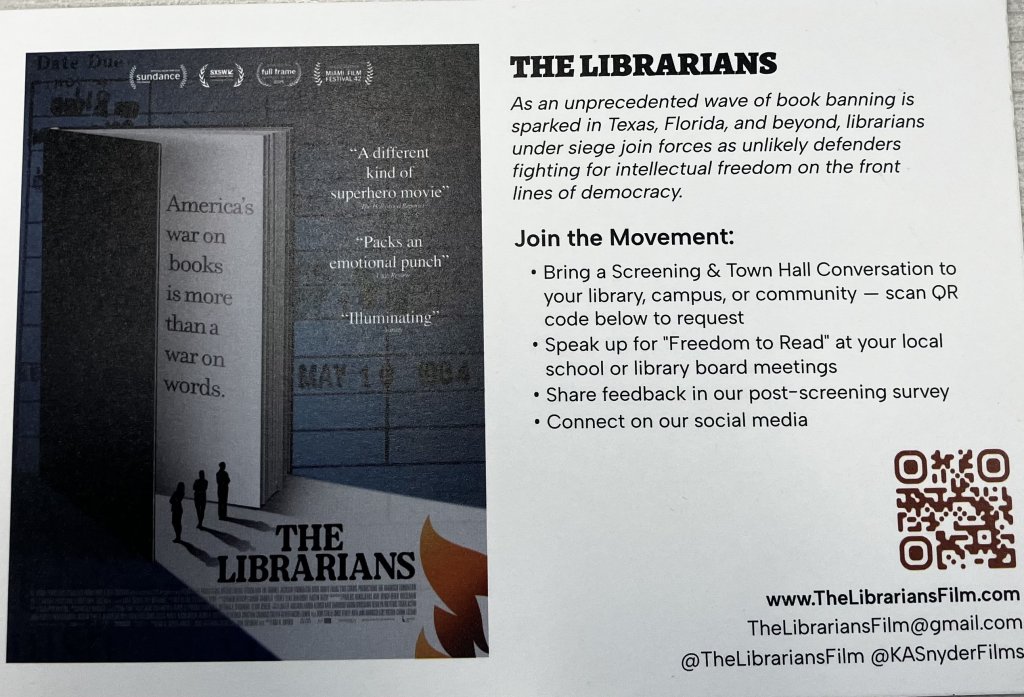
The Librarians is an award-winning film directed by Kim Snyder, and Produced by Janique L Robillard, Maria Cuomo Cole & Jana Edelbaum. You can find out more about this team here: https://thelibrariansfilm.com/filmmakers/
The Free State Festival celebrates the free spirit of the state of Kansas with films that challenge, inspire, and entertain. This signature annual event brings independent films, live music, comedy and art to venues across the vibrant college town of Lawrence. The festival is produced by the Lawrence Arts Center and made possible through programming support from community partners, grants and individual sponsorships and is running now, until Sunday, June 29.
First Amendment cannot be used to challenge book removals in Public Libraries (according to the Fifth Circuit Court of Appeals)
The Fifth Circuit Federal Appeals Court ruled en banc that the First Amendment cannot be used to challenge book removals in Public Libraries as a library’s collection decisions are government speech and
therefore not subject to Free Speech challenge.
ACLU Attorney Josh Block has a comprehensive thread on Bluesky that covers this breaking news:
You can read their ruling here:
The ruling is summarized as: Plaintiffs have a First Amendment right to read books. They don’t
have a First Amendment right to force a public library to provide them. So I
agree that we should reverse, and accordingly concur.
The ruling was not unanimous as three judges dissented, the dissent is also included above and is worth reading in full. The dissent begins with: Because the majority forsakes core First Amendment principles and
controlling Supreme Court law, I dissent.
and ends with: Because I would not have our court “join the book burners,” I dissent.
The Fifth Circuit Court is widely considered to be the most conservative court in the US. It remains to be seen if this ruling will be overturned on appeal, but it is concerning that the activist judges on the court are trying to remove the First Amendment from the arsenal of people fighting to prevent book bans ad censorship in libraries.
You can find out more about the court case Little vs Llano county here: https://www.aclu.org/cases/little-v-llano-county
Links to More Information
5th Circuit rules Texas library patrons have no First Amendment right to information – Austin-American Statesman
Libraries Hit by IMLS Defunding
Libraries across the country have started feeling the effects of the IMLS being effectively shut down and having grants cancelled. If you search for IMLS on any social media site you will see dismayed reports from Libraries and Library Workers documenting in real time what is happening in their branches.
The Hoopla digital service has become an early casualty in a number of library services affected by the cuts. The Columbus-Lowndes Public Library, Tombigee Regional Library System, Jackson George Regional Library System, and the First Regional Library System are services that have posted on their social media sites that due to grants being cancelled Hoopla was no longer available to their patrons.


Hoopla is a relatively expensive service for libraries to provide and even before DOGE took aim at the IMLS libraries were letting their subscriptions to the service lapse.
On March 24, Sacramento Public Library announced that they were discontinuing Hoopla on May 4th. While the timing could have been coincidental, coming soon after DOGE first entered IMLS headquarters, it may be that they moved to preemptively offset a potential loss of grant funding.
As Libraries discover what the loss of essential grants entail, it is likely that more will be forced to cancel their subscriptions to popular, yet costly digital services.
I will be documenting the effects of the IMLS cuts as and when news from libraries across the US breaks. If any library workers and/or patrons discover what is happening in their libraries you can contact me confidentially here if you wish to share this information.
The Dixie Regional Library System and Blackmur Memorial Library have also announced a pause on Hoopla due to IMS defunding. The Library of Hattiesburg, Petal, and Forrest County has announced a reduction from eight to four monthly loans on Hoopla, they are currently able to do this thanks to continuing county support.
State Libraries have started receiving notifications that their LSTA grants have been terminated:


The California State Library has been notified by the federal Institute of Museum and Library Services (IMLS) that, effective April 1, 2025, the 2024-25 federal grant awarded under the Library Services and Technology Act (LSTA) has been terminated.
Maine State Library response
(Don’t Create) the Library Torment Nexus
I have been doing some deep thinking about the use of AI in Libraries, and like many other colleagues I reached the inescapable conclusion that there is currently no ethical way to use generative AI at all, let alone within Libraries.
As information professionals, Library Workers have historically and contemporaneously firmly positioned ourselves on the side of copyright protection and against piracy and intellectual property theft. It is widely documented that generative AI programs have been trained on illegally downloaded and stolen materials so I am constantly being surprised and horrified when I see colleagues gushing about how much fun they are having learning to use generative AI in their libraries, “It saves so much time”, “I no longer have to think too much about creating lesson plans”. I have been urged not to worry too much about it as AI is the wave of the future and that there is a push to get governments to regulate the companies creating AI programs to make sure that AI training is done legally, but the genie is out of the bottle on that one and barely a day goes by without authors and artists posting more evidence that their works have been stolen by multi-billion dollar organizations to feed the beasts that are their generative AI programs.
Libraries are not immune to the looming threat of generative AI, there have already been reports of AI slop (this is a real term for works created by AI trained on pirated works) appearing on digital platforms such as Hoopla that are available through libraries. I fear that in the not too distant future library services will incorporate AI programs to complement and eventually cut down on paid staff.
Databases containing information about read-alikes, pen names, ghost writers, genres as well as every user-generated tag and category you can think of will be fed into a program that will be able to spit out recommendations when a patron types in a question looking for more books in specific genres or on certain subjects. If such a program is integrated into library management software it will eventually be able to create a patron profile and generate suggestions based on a patron’s reading history and general preferences as well as their use of library digital media and what they access online through library computers. The potential for privacy violations aside, this type of program may end up funneling readers into a reading cul-de-sac, keeping them reading books that they like, which may not seem like a problem but this could prevent them from finding new authors, or reading outside their comfort zones and broadening their reading horizons.
If library services are outsourced and run by for profit entities that own publishing companies, it is entirely possible that an AI program will eventually have enough data scraped from library users to determine the most popular items loaned out by the library; books and stories can then be algorithmically generated, then published by the publishing arm of the company (or just be made available in e-format to keep physical costs down), the local authority that pays the company to run their libraries will be charged for these slop titles that are placed into the collection. They will be catalogued by another AI program and made generally available for library users, eventually it will become a perfect circle of AI generated works based on other slop works that were once based off actual works created by humans.
This horror story may seem like the stuff of paranoid fantasy, but with the current push for AI in all industries it is only a matter time before it is integrated into pubic services and services that once relied on human interaction will be rolled into an customized library AI program.
Responses to the IMLS Raid from Libraries across the USA
This is a round up of responses to the DOGE raid on the IMLS from Libraries and Library Associations from around the United States. Obviously it is not an exhaustive list but I will add links as they pop up on my radar.
Michigan
Michigan Library Association https://www.milibraries.org/index.php?option=com_content&view=article&id=1744%3Ajoint-statement-on-imls-from-michigan-libraries–museums–and-archives—advocacy—news—michigan-library-association&catid=27%3Anews-mla&Itemid=292
Peter White PL Michigan https://pwpl.info/post-4169/#
California
San Carlos Library (California) https://sancarlosfriendsofthelibrary.org/2025/03/20/library-supporters-take-action-now/
California Library Association: https://www.cla-net.org/news/news.asp?id=696351
California infographic https://cdn.ymaws.com/www.cla-net.org/resource/resmgr/legislative/legislative_priorities/savelsta_funding.pdf
Montana
Montana Libraries: https://montanansforlibraries.org/mla-statement-on-the-executive-order-to-eliminate-imls/
South Dakota
South Dakota https://www.sdlibraryassociation.org/page/Advocacy
Minnesota
Minnesota Library Association: https://www.mnlibraryassociation.org/news/696318/MLA-Statement-on-the-Executive-Order-Targeting-the-Institute-of-Museum-and-Library-Services-IMLS-.htm
Wisconsin
Madison Wisconsin: https://www.cityofmadison.com/news/2025-03-19/local-museums-and-libraries-rally-support-for-the-institute-of-museum-and-library
Kenosha Library Wis: https://mykpl.info/blogs/post/building-opportunity-why-imls-funding-matters/
New York
New York Library Association: https://nyla.memberclicks.net/assets/ADVOCACY/Legislative-Initiatives/NYLA%20-%20Statement%20on%20EO%20to%20eliminate%20IMLS.pdf
Massachusetts
Massachusetts Library Association: https://www.masslib.org/public-statements.html
Massachusetts Board of Library Commissioners: https://mblc.state.ma.us/mblc_blog/ & https://mblc.state.ma.us/federal-cuts.php
Vermont
Vermont Library Association: https://vermontlibraries.org/vermont-library-association-statement-of-support-of-the-institute-of-museum-and-library-services
Brooks Memorial Library Vermont: https://brookslibraryvt.org/2025/03/21/imls-executive-order/
Springfield Town Library Vermont: https://www.facebook.com/100064776275606/posts/1067704085398791/?_rdr
New Hampshire
Portsmouth Public Library NH https://www.portsmouthnh.gov/library/news/IMLS
Paul Memorial Library NH https://newfieldslibrary.org/important-info-on-library-services-in-nh/
Manchester Libraries NH https://manchesterlibrary.org/read/36990
Maine
Maine State Library https://teenlibrarian.co.uk/2025/04/01/maine/
Maine Libraries Association: https://www.mainelibraries.org/News/13476036
York Public Library Maine https://yorkpubliclibrary.org/the-institute-for-museum-and-library-services-york-public-library/
New Jersey
New Jersey Library Association https://www.njla.org/news/institute-of-museum-and-library-services-imls
Pennsylvania
Pennsylvania Library News: https://compendium.ocl-pa.org/imls-update/
Virginia
West Virginia
Brook County Libraries West Virginia https://www.brookecountylibs.org/post/imls-funding-issues
Indiana
Pulaski County Public Library Indiana https://www.pulaskicounty.lib.in.us/blog-entries/federal-imls-funding-cuts-how-might-affect-pcpl
Illinois
Illinois RAILS https://railslibraries.org/news/120102
Illinois Heartland Library System: https://www.illinoisheartland.org/news/content/march-14-executive-order-imls-funding
Missouri
Boonslick regional Library MO https://www.boonslickregionallibrary.com/2025/03/18/new-executive-orders-potential-impact-on-libraries/
Cass County Library MO https://www.casscolibrary.org/library-funding-in-jeopardy/
Kentucky
Kentucky Library Association https://www.thelakenews.com/articles/state-library-executives-send-out-call-for-kentuckians-to-support-the-institute-of-museum-and-library-services/
Mississippi
Mississippi Library Association https://mla42.wildapricot.org/
Louisiana
Livingstone Parish Library Alliance Louisiana https://www.facebook.com/permalink.php?story_fbid=pfbid02q3vD79suuSTcJUb7hrUmdCCNtVE58W8duBm5HJ6caNz2MTNGSzRu9LNVGJLbK7Srl&id=100085642450138
Oklahoma
Friends of Libraries in Oklahoma https://www.facebook.com/FOLIOOKFriends/photos/update-on-imls-funding-from-the-oklahoma-state-librarian-natalie-curriethe-imls-/1047848477368568/?_rdr
Kansas
Johnson County Library Kansas https://jocolibrary.org/our-stories/imls-executive-order-what-know
Kansas Library Association: https://www.facebook.com/kansaslibraryassociation/posts/pfbid02AeMp3LYqwztdoJPY72Gg5ZWRRUKxTdo65gLijNRtaL9hmx85wEjCe6dqd1YUZnJtl
Other
Mid America Arts Alliance https://www.facebook.com/kcmaaa/posts/-urge-your-senators-and-representatives-to-protect-imls-funding-share-this-alert/1481718886531930/
Asian Pacific American Librarians Association (APALA) https://www.apalaweb.org/apala-statement-on-executive-order-to-dismantle-imls-2025/