After being admitted to hospital in 2020 with coronavirus, Michael Rosen had to learn to walk again. With the support of doctors and nurses and a walking stick he names “Sticky McStickstick”, he manages to embark on the slow steps to recovery. This moving picture book from the former Children’s Laureate, with illustrations from Tony Ross, tells a story of perseverance and hope, and is a testament to the importance of overcoming fear and learning to accept help.
Michael Rosen is a National Treasure and so many people were very worried about him when he was hospitalised with Covid-19 in 2020. It took him a long time to recover, and while he did he had the support of his walking stick (as well as family and NHS staff, obviously). Many Different Kinds of Love, a collection of Rosen’s poems and the coronavirus diaries of his nurses, was published by Ebury in March 2021 for grownups to read, but this is for everyone…and I mean everyone. When I was asked if I’d like to send a few questions for him, of course I said yes!
‘Many Different Kinds of Love’ has already been published, on adult lists, did you write the two books at the same time?
No. I wrote MDKOL first but I noticed that I had mentioned Sticky McStickstick. People asked me about the stick and I started telling them things about where it is or what happened when I tried to walk with it and so on. A voice in my head told me that I could personify the stick and it then became fun to write it all out as a story.
This complements your Sad Book beautifully. Why do you think having books about such emotive subjects is important for children?
Books for children can be about anything that the adults who care for children think are OK things to talk about. Society has taboos around children and childhood and writers have to respect these. Subjects like death and serious illness are on the edge of the taboos. Some people won’t take their children to funerals, for example. Or they might not tell their children about a terminal illness. That’s their choice. My two books go into an area where some have those taboos but others think that it’s helpful to talk about experiences such as these which are as much about life as eating or sleeping. All books open up trains of thought and conversations. I’d be very glad if both those books do just that with children being looked after or brought up by people who think it’s a good idea to talk about such things.
Do you have thoughts about how ‘Sticky McStickstick’ might best be used in schools?
I would start with a class talking in pairs to each other their illnesses and accidents, swapping stories, perhaps writing about them or drawing pictures of them. Then reading my book. Or it could be the other way round. Reading my book first, perhaps. There are open-ended trigger questions that are helpful too e.g. Is there anything in this book that makes you think of anything that has happened to you or to anyone you know? Is there anything in this book that makes you think of anything you’ve ever read before, or heard in a song, or on the TV or in a film? If you could ask anyone in the book a question, what would you ask? Can you answer that question? If you could ask the author a question, what would it be? Can you answer that question? Are you affected by any part of the book? Which part? How? Why?
Tony Ross has illustrated a number of your books. Do you let him get on with it or do you make suggestions about what the illustrations might look like?
I most certainly do let him get on with it. I write the words. The illustrator, designer and editor make the book.
The Hideaway tells the story of a boy, Billy McKenna, who runs away from a difficult situation at home and takes refuge in an overgrown graveyard. While hiding there he meets an elderly man who is tending the graves in preparation for a day in November when something magical is set to happen.
The book is written in two alternating narratives, both different aspects of the same story. One thread tells of Billy’s experience of hiding away in the graveyard, his mixed-up feelings and emotions, and the supernatural events he eventually witnesses. The other tells of his mother’s situation at home and the police search for Billy. Covering themes of family, childhood, separation and reunion, domestic violence and doing the right thing, this is an important and beautiful book for middle grade readers right up to adults.
Billy’s story is illustrated throughout with tonal and textured black and white drawings, until the event on All Souls’ Eve, when the text gives way to a series of double page images of the supernatural happening.
The Hideaway is a compelling, exciting and emotional story that will stay with you long after you finish the last page.
Pam Smy is such an interesting illustrator, Thornhill is a wonderfully unique book (shortlisted for the Carnegie Award), so I was very excited to be sent a review copy of her 2nd novel The Hideaway…which is haunting and sad and uplifting and will really stay with you…and then even more excited to ask her a few questions! And of course, the most appropriate book to highlight for Halloween!
Which aspect of The Hideaway came to you first?
The scene-setting of The Hideaway came to me first. The graveyard where it is set is a real place here in Cambridge, and it has the chapel in the middle, the row of yew trees, the poem carved into the back wall, and most importantly, the World War 2 pillbox. The combination of the meaning of the poem All Souls’ Night by Frances Cornford and the idea that someone could use the pillbox to hide away sparked the idea for the book.
Thornhill was alternate chapters, a wholly illustrated contemporary voice and a historical diary, while The Hideaway is an illustrated story. Did you draw and write at the same time or had you mainly got the words down before choosing which sections to illustrate?
With Thornhill I wrote the text and made the rough drawings for the story in turn, so both elements of the story evolved at the same time. With The Hideaway I wrote the manuscript first, and then illustrated it – but I knew that I wanted there to be a wordless sequence in it from the outset and I knew what I wanted the feeling of the graveyard to look like in the illustrations.
Do you lay out the pages alone or with a designer?
For The Hideaway I worked directly into an InDesign document so that I could move the text around the illustrations I was making, and the very patient designer, Ness Wood, tidied it all up at the end.
They’re both a bit spooky with extremely atmospheric illustrations, very suitable for Halloween season, is the supernatural your favourite genre to read?
I read a variety of books. I love books about people and relationships, and stories that are set in the past or in rural environments. I also love crime novels. I read a lot of picture books and illustrated books of all kinds for all ages. I wouldn’t say that I especially read supernatural books, although they are certainly on my bookshelf.
I think I am drawn to write and illustrate spooky books because I love making atmospheric artwork, and building a world that is based on the everyday, but is different from what we may typically see – but without tipping into fantasy or sci-fi.
You’ve also published a picture book, Merrylegs! Three very different books, which was most enjoyable to work on?
I enjoyed making the artwork to The Hideaway the best. I was trying to work without using much linework – so it was a new challenge for me.
The Mermaid in the Millpond, written by Lucy Strange and illustrated by you, is being published in January by Barrington Stoke. Do you find it easier or harder when the words aren’t your own?
Both easier and harder. If I am illustrating my own ideas the vision of those illustrations is already in my head, and the excitement and the challenge is to get that across on paper. When I am illustrating someone else’s writing it is a joy to be able to bring to life the words, and to add atmosphere or understanding to what is being described. I love illustrating other people’s texts, especially if the art direction and design layout isn’t too prescriptive and I have a little bit of a free reign.
What are you reading at the moment and who would you recommend it to?
I am reading and re-reading Captain Rosalie by Timothee de Fombelle, illustrated by Isabelle Arsenault. I am recommending it to everyone I know, and buying copies of it to send to my friends. I think everyone who is 6 and over should read it. It is a beautiful piece of writing and Arsenault’s illustrations are absolutely stunning. Also by my bedside is While You’re Sleeping by Mick Jackson and John Broadley, and All Among the Barley by Melissa Harrison.
What might we see from you next?
I am working on developing a few collaborations at the moment which I am VERY excited about, but can’t say anything about yet.
The Hideaway by Pam Smy is published by Pavilion Books, out now, 14.99 hardback.
Philip Pullman said that it is: The best book on teachers and children and writing that I’ve ever read. No-one has said better so much of what so badly needs saying. I want to see this book become a bestseller, I want to see it in every staffroom, I want to see it read by every student teacher. This is a wonderful achievement.
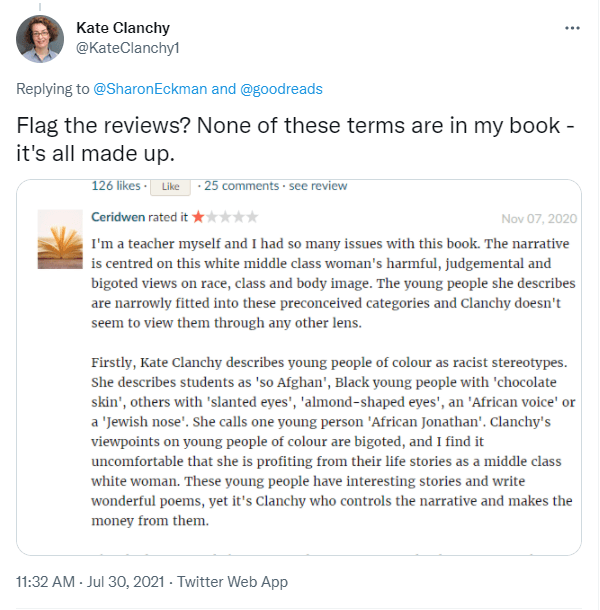
Then in 2021 on twitter Kate Clanchy alleged that Goodreads reviewer Ceridwen had made-up quotes from her book in their review.
Things went downhill rapidly from there!
Unfortunately, whenever people have received near universal acclaim & praise for their work they can react poorly when they encounter someone who says “whoa there is a problem here” and this is exactly what happened!
Instead of giving a blow by blow account what occurred, I will recommend that you read Beth Bhargava’s comprehensive write-up of what happened over at Bad Form Review here. I will just say that I was bitterly disappointed by a number of authors whose work I have previously enjoyed.
Like Public Libraries, Publishing is a majority white profession, both of which can be difficult to break in to, as many opening positions are notoriously low-paid. I could not help but compare what is happening with Kate Clanchy’s book with what happened with the CILIP Carnegie & Kate Greenaway Medals in 2017 where it took people of colour to start asking why no-one who was not white had won either of the awards in over 80 years and a big push from them and allies to start the process to effect change.
Kate Clanchy issued a statement on August 6th which caused more consternation and upset. Picador, KC’s publisher released three statements on the 6th, 9th and 11th, The Orwell Foundation issued a brief statement denying responsibility of what their external judges did, and Philip Pullman released an ‘apology’ on the 10th.
No mention was made by anyone at the centre about the vile language and threats directed against Professor Sunny Singh, Chimene Suleyman & Monisha Rajesh three of the highest profile people that stepped up to offer honest critiques of Clanchy’s work and challenge the racist rhetoric that was springing up in the discussion.
The end result of the storm of protest is that Kate Clanchy will rewrite portions of her work to remove the racist and ableist stereotypes contained in the original.
Systemic racism does not require that those working within the system to be racist; in publishing like libraries, is made up mostly of good, well-intentioned (white) people who do their best but miss many signs that what they are working on may be harmful to minority groups. Unfortunately, most white people lack the insights and cultural knowledge to identify problematic work and content. Even after an outcry those who ‘have learned’ from the criticism are often rewarded, while still excluding those that were harmed.
It should not fall to People of Colour to fight for systemic change on their own, no matter where it happens – in libraries, in publishing, or elsewhere if someone says that something is harming them and their community we need to stand with them and fight to make a meaningful change.
We (white people) have benefitted from systemic racism for hundreds of years, we are complicit even when we fight against it, and we should fight against it – we lose nothing if those that are disadvantaged gain the privileges that we currently enjoy.
It is often said that When you’re accustomed to privilege, equality feels like oppression, but this is something we need to stamp out of our psyches and instead embrace the need for true equality.
Introducing the ultimate must-read list of diverse & inclusive children’s, YA and adult fiction books in the UK
London, United Kingdom, 27thJuly 2021: More than 100 submissions were received for the second year of The Diverse Book Awards, created by writing community The Author School (www.theauthorschool.com). Today, the longlist is officially unveiled, revealing the outstanding diverse and inclusive books published by British/UK-based authors/publishers in the hugely challenging year of 2020. The shortlist will be revealed on 20th September and the winners in each category announced on October 21st 2021.
Abiola Bello, co-founder of The Author School and award-winning author: Through The Diverse Book Awards I have discovered new diverse books and authors that I hadn’t previously been aware of. I hope that the longlist inspires others to discover new talent too. The conversation around diversity in publishing has stepped up a level over recent months, at a time when we were shouting out for submissions to The Diverse Book Awards. The longlist represents the work that has been done already within publishing and showcases that it is truly is possible for diverse and inclusive books to be the ‘norm’ rather than ‘exception’. We hope that encouraging publishers and authors to write more diverse and inclusive books – and enter them into next year’s awards – will be a positive step forward for the publishing industry in this country. Massive thank you to the judges!
The three winners from each category will receive a bundle of prizes including a trophy, a six-month PR and marketing membership of Literally PR’s ‘100 Club’, a feature and virtual event with Back To Books, editorial content in Bad Form and Pen&Inc, the opportunity to be part of two author panel events – hosted by The Author School and the other with Simon & Schuster.
The Children’s winner will have their book featured as part of World Book Day Book Club and a school visit organised by World of Diversity.
The YA winner will be part of Wigtown YA Literary Festival and a school visit organised by World of Diversity.
The Children’s and YA winner will be featured on Tiny Revolution’s website and included in their catalogue of books.
Fans of master storyteller, Darren Shan, will be delighted to hear that the second volume in his major new fantasy series is coming this summer. Comprised of three novels, the second volume in the Archibald Lox series takes readers further into the Merge and the adventures of locksmith, Archie. Shan, known for his globally successful series The Saga of Darren Shan, The Demonata and Zom-B, published the first volume in the Archibald Lox series as three ebooks in April 2020, earlier than originally planned to bring some relief to fans during the first national Covid-19 lockdown. Paperback editions followed, along with a combined paperback of the first three books entitled The Missing Princess. As with the first volume, the three novels comprising Volume Two are designed to be read in quick succession as a trilogy. Readers should prepare to pick up the pace as book 4 continues the action. Archibald Lox and the Forgotten Crypt sees a couple of assassins catch up with Archie, and he’s forced to flee to the Merge in search of friendship and safety. As his skills develop, he opens a gateway to a long-forgotten crypt, where ancient secrets are revealed. In a city of ice, the greatest gropsters of the six realms have assembled for a legendary Tourney, but a small group of plotters are more interested in kidnapping… Travel with Archie through books 5, Archibald Lox and the Slides of Bon Repell, and six, Archibald Lox and the Rubicon Dictate, as he faces further challenges and grave danger, including a fight for his freedom – and his sanity. What will the fates have in store, and can Archie defeat some of the most powerful and merciless rulers of the realms…?
I read the first of the Archibald Fox trilogy last summer and really enjoyed it, I can’t believe book 4 is already here! Here’s an interview with Darren Shan by Catherine Ward, in anticipation:
For those who haven’t started this new series yet, can you give us a quick overview?
A boy called Archie spotted a girl on a bridge in London, being chased by a pair of killers. She pulled some strange faces and opened a doorway to another dimension, called the Merge. When the killers had departed, Archie found he had the power to reopen the door, and followed the girl to the universe of the Merge, where he got involved in a quest to save a realm from falling under the control of the villainous SubMerged.
Why did you structure this series as Volumes comprising 3 books each? Is that something you planned from the beginning?
I actually planned the Volumes as very long single books, and wrote them that way. But I’d been considering breaking them down into shorter books and serialising them from the start, as that’s the way I’ve released all my other lengthy series. (The Saga of Darren Shan, The Demonata, Zom-B.) I hummed and hawed over the decision for ages, and still wasn’t 100% sure when it came time to release them! In the end I decided that I would break the volumes down into trilogies, but also then do omnibus edition bind-ups several months after the release of the shorter books, offering people the chance to read the stories as they were originally composed, if that was their preference.
Your Zom-B series was designed as a serial, with shorter books being released more often. What is it you like about this formula?
I’ve always loved a good cliff-hanger! I grew up as an avid reader of comics – for many years I never missed an issue of The Eagle and 2000AD – and I loved how stories would unreel over the space of several weeks or months. The gap between instalments added to the pleasure of the reading experience. It’s how books used to be published in the past — for instance, Charles Dickens released all of his books in serialised chunks. It was largely a forgotten art for many decades, but I was interested in reviving it almost from the very beginning of my career, and internet publishing has seen serial books enjoy a real surge since the turn of the millennium — I guess I was just a few steps ahead of the curve!
Although your main character, Archie comes from our world – known as the Born – most of Volume 1 takes place in the ‘other’ world he accesses via a hidden portal. Will we revisit the Born in Volume 2? Will we learn more about how the two worlds coexist?
Oh yes! Some of the action takes place in our world – there are important scenes set in London, Moscow and New York – but the bulk of the story is set in the Merge. I don’t think there’s much point in creating a huge fantastical universe and not spending most of your story time there. Readers would quite rightly be up in arms if I told them “I’ve created this really cool parallel universe, but I’m not going to show much of it to you!” We’ll learn more about the Merge in this Volume, as well as in the third set of books next year. As a fish out of water, Archie is learning new things each time round — and discovering new things about himself each time as well.
We first meet Archie when he’s in a bad place but we see him gain self-belief and confidence and intuition as he gets to grips with his locksmith abilities and the ways of the Merge. I would say he’s a pretty relatable and inspiring character for children & young adults, especially at a time when a lot of us are feeling a bit derailed by the pandemic – was that intentional?
I can’t say it was, as I started this series several years before most of us had ever even heard of a coronavirus! But I think childhood and our teens can be a confusing, alienating time for many of us, even when the world is operating as normal, and I’ve always tried to use my YA books to give readers hope that all obstacles in life can be overcome. The world can often seem like a weird, hostile place when you’re growing up, and I think fantasy and horror books can help kids come to understand that they can triumph no matter how weird and dark things get.
We journey through a variety of incredible realms and zones in the Merge, featuring all manner of societies and dwellings and inhabitants. Did these evolve in your imagination as you were writing, or did you develop much of the Merge in the planning stages of this series?
I spent a lot of time planning the books before I started writing them, far more than I ever did on any of my other series. Most of the action in my other long series took place on our world, so I was able to pretty much dive straight into them and flesh things out as I went along. With the Merge, I knew most of the story would take place in these parallel worlds, so I had to put a lot of thought and work into what those worlds would be like, and how they’d function. I also wrote far more than I needed in my first drafts, especially Volume 1, packing in loads of extraneous details that I would go on to cut as I edited the books, but which I needed to inform myself about the Merge. The first drafts were almost like travelogues, which I then set about converting into action-packed stories.
Will we visit new realms in Volume 2?
Absolutely! We’ll revisit some familiar places in Volume 2 and Volume 3, but each time round we’ll also venture into new realms and settings. I want to show readers as many different facets of the Merge as I can before Archie’s story concludes, so each time round we’re going to be hitting for pastures new.
In Volume 1 we have a few brushes with dangerous locations and beings in the Merge – will we see more of that in Volume 2?
I think, given my track record, that’s a safe assumption to make! I left the horror genre behind with these books, to focus on the fantasy elements, but I don’t think it would be a proper Darren Shan series if it didn’t have a strong dark strain to it.
You’ve mentioned in a previous interview that you have planned three volumes of Archibald Lox at least… any more news on that?!
Yes, there will be three Volumes in total. My plan is to release the final Volume (again, made up of three books) in 2022, and I’m looking good to hit that target. Touch wood!
Are you working on anything else besides this Archibald Lox series?
Bizarrely enough, I’m currently trying my hand at a few picture books! I have two young children, so I’ve been reading a lot of picture books over the last several years, and I started having ideas for some of my own. I don’t know if those ideas will ultimately lead to anything, but watch this space…
Have you missed being able to do live events over this past 18 months? Do you miss touring?
I’d actually stepped back from touring since I finished my Zom-B series. After many years on the road, I wanted to spend more time at home, especially since Mrs Shan and I had decided to go into the baby-making business! So I wouldn’t have been out on the road regardless of the lockdowns. That said, I have started to miss that side of things now — I’ve always enjoyed a close relationship with my fans, and I love meeting them at events, chatting with them and signing their books. Hopefully, over the next few years, I’ll be able to get back out on tour.
Were you a keen reader throughout your teen years, or did your interest wane at all? Were you drawn to fantasy worlds as a young reader?
I actually read more in my teens than I’ve read at any other time of my life. I was a voracious reader, ploughing through a couple of books a week in my prime, as well as reading loads of comics and graphic novels. And yes, I was always a big fan of fantasy, horror and sci-fi. I read all sorts of other genres too, but those were my favourites as a child and teenager.
Did you have a library and/or school librarian at Secondary School? If so, did it/they influence your reading habits at all?
Sadly, no. But I’ve visited loads of schools and libraries on tour, and been amazed by the knowledge and enthusiasm of the librarians I’ve met. I thought I knew a lot about books until I started talking to those guys and gals — then I quickly came to realise I was an amateur! I think a good librarian is a real treasure, especially in a library that is either part of a school or closely linked with schools. I got really angry when I was on tour with Zom-B, because it was during the time when the Conservatives in the UK were shutting a lot of libraries, and telling full-time librarians in those that survived the cull that they were going to be replaced with well-meaning part-timers, as basically anyone could run a library, right? Their ignorance of what a librarian does, and how important they can be – especially where children are involved – astonished and disgusted me. And still does.
What are you reading at the moment?
I’m currently working my way through a book called Harbour, by John Ajvide Lindqvist, the guy who wrote a brilliant vampire book called Let The Right One In.
As you conjure such vivid and original worlds in your books, I wondered if you have vivid dreams in strange worlds?! Do you ever dream that you’re inhabiting one of your own worlds or characters?
Short answer — nope! My ideas tend to be fairly mundane affairs. I guess I spend so much time in weird worlds in my waking hours, that my brain enjoys some boring down time when I sleep!
The three books comprising Volume 2 of the Archibald Lox series will be released this summer, in ebook and paperback:
Book 4: Archibald Lox and the Forgotten Crypt – 1st July 2021
Book 5: Archibald Lox and the Slides of Bon Repell – 3rd August 2021
Book 6: Archibald Lox and the Rubicon Dictate – 1st September 2021
From the amazing nerds at MIT (well MIT Press actually) comes a phenomenal graphic novel celebrating Science, Technology, Engineering, and Math, teamwork and foiling the plots of evildoers with science!!
In 1903, Marie Curie founded a clandestine society where brilliant women could pursue the furthest reaches of their intellect. The Curie Society still covertly exists today in secret chapters at dozens of universities worldwide!
When Simone, Maya, and Taj arrive at Edmonds University, they think they’re simply starting their coursework, but after a strange night of puzzles and coded communications, they are introduced to The Curie Society. Almost immediately, they are deployed on their first urgent mission! A mysterious criminal network has stolen research data from a top-secret Curie de-extinction lab, and if no one intervenes, it will soon be sold to some of the world’s worst elements.
These new recruits will have to use all their specialized scientific skills to protect the Curie Society and save the world – or their first mission may be their last!
The Curie Society takes the adventure tropes of a group of brilliant individuals that seem not to like each other much at the beginning and then get molded together into a kick-ass team under the guidance of a jaded mentor that has suffered betrayal and loss! This may be a work of fiction but the history and science wrapped up in the story is all too real! Honestly I spent hours reading up on everything referenced in the story (and I am not even half way done learning!) This is my favourite type of story, one that you can read again and again and discover something new each time you pick it up!
My enjoyment of this story was heightened by the short biographies of several scientists at the end as well as the glossary explaining the facts and scientific concepts behind many important parts of the story.
Launching with a slate of five original graphic novels created for the young adult space, Legendary Comics announced a new imprint, Legendary Comics YA, dedicated to telling original and character-driven stories across a wide array of genres. With a commitment to amplify new voices, spotlight diverse perspectives, and seek out passionate talent telling authentic stories, the imprint gives emerging and veteran artists a platform to share stories never told before and retell classics from a new point of view, in hopes to transport readers to other worlds that span a range of genres, from fantasy to historical fiction, and beyond.
“We’ve identified the young adult genre as an opportunity to expand and invest in our audience growth. Legendary Comics YA is the beginning of our long term commitment to this category and the diverse stories we want to tell,” said Robert Napton, Senior Vice President of Legendary Comics.
“The YA genre is known for telling groundbreaking, innovative, and unique stories. By working with exciting new talent and comic book veterans in the YA space, we have been able to acquire books where emotional and personal journeys are at the forefront. Legendary Comics YA is our chance to focus on fresh character-driven stories that reflect the diverse voices of young adults all over the world,” said Nikita Kannekanti, Senior Editor at Legendary Comics.
The Legendary Comics YA slate includes:
Championess (in stores now) – based on the true story of Elizabeth Wilkinson, a female bare-knuckle boxer in 18th century London. Elizabeth, reimagined as half-Indian, and her sister Tess struggle to make ends meet and cover Tess’s debts. While Elizabeth works odd jobs at the local newspaper, the only way she knows how to make enough money to help them survive is her true passion, bareknuckle boxing. With Tess’s support, Elizabeth trains at the boxing facility of one of the most famous retired boxers and the only real fight promoter of any notoriety, James Figg. As Elizabeth trains with Figg and James Stokes, she confronts her personal demons of what destroyed her family and comes to terms with being the first half-Indian female boxer in a white male world. Writers: Tarun Shanker and Kelly Zekas. Arist: Amanda Perez Puentes.
The Heart Hunter (August 3, 2021) – set on the cursed island of Envecor, where everyone is doomed to wear their heart outside their body and are immortal—unable to die, to change, to have children — until they find their soul mate. Paired soul mates are then turned mortal, freed from the curse, and able to leave. But all fairy tales have a dark side: those who don’t want to lose their immortality pay “Heart Hunters” to find their soul mates and kill them so they may remain immortal. Psyche, a Heart Hunter, is hired by the king to kill his soulmate. As she sets out on her quest, she begins her own journey of mending her broken heart and learning to trust again. Writer: Mickey George. Artist: V. Gagnon.
Lupina (September 9, 2021) – a six-part captivating saga about a young girl on a journey of revenge with her wolf companion. In the coastal town of Kote, recently brought under the yoke of the Addalian Empire, four-year-old Lupa spends her days getting bullied by her older sister and hiding behind her mother’s skirts. But when tragedy strikes, Lupa finds herself alone in a new world… alone until she’s found by the she-wolf, Coras, and sets off on a journey of discovery… and revenge. Writer: Eisner Award-nominated writer James F. Wright. Arist: Li Buszka.
The Witches of Silverlake (October 1, 2022) – the story of Elliot Green, who moves across country to start high school in one of Los Angeles’ most prestigious private schools. He’s quickly taken in by the school’s outcasts: the scholarship kids; the queer kids; and the ones who just don’t really fit in with the glossy trust fund babies of SJTBA. They quickly let him in on their little secret…they are witches. Elliot joins them in their world among the crystal stores and occult shops of Silverlake and ends up joining his new friends’ coven. During one of their magical experiments, they accidentally release a bloodthirsty demon that starts murdering their classmates and teachers. Elliot and his coven realize that the fun and games of playing with crystals and candles is over, that magic is powerful, real, and that it might be more dangerous than they’d ever imagined. Writer: Simon Curtis. Arist: Stephanie Son.
Tragic (April 18, 2022) – a retelling of Shakespeare’s Hamlet from a queer lens and told through the eyes of 17-year-old Harper Hayes. After her father Hamilton dies a mysterious and tragic death, Harper is convinced that he was murdered, and her first suspect is her uncle, who has been sleeping with her mother. With the help of her ex-girlfriend Talia and her best friend (sometimes with benefits) Holden, Harper is determined to find her father’s killer. But when Caius, Talia’s father and Hamilton’s business partner, is also found dead, Harper realizes the answer to Hamilton’s murder is more complicated than she had initially realized. As Harper begins to see her father’s ghost in the form of a teenage Hamlet everywhere and starts slipping into hallucinations of his murder that end with blood on her hands, one thing becomes clear—in order to uncover the truth about what happened to her father, Harper has to confront her own demons and ones that haunt the Hayes family. Writer: Dana Mele. Artist: Valentina Pinti. Colorist: Chiara Di Francia.
Ah, salty breezes, beach hair, the feeling of bare feet (or fins) in warm sand. And dreams of that mer-mazing world under the sea. An ode to the joys of making waves, this sweet celebration is filled with mermaids, merman, purrmaids, and other underwater lovelies- complete with quotes, folklore, and mantras.
Mermaid Life is a celebration of all things aquatic as tied to Merfolk. The illustration style is reminiscent of old-style sailor tattoos but modern and somehow timeless.
This little book has a ton of aquatic facts, definitions, inspirational quotes (that are dying to be turned into posters) as well as some really hilarious puns and and will no doubt inspire readers to go and get themselves inked (if they have not already done so!)
Inspirational QuotesPuns!
This book is pretty and fun to read or flip through at random and has a page of really shiny stickers at the back!
Highly recommended for fans of Merfolk, beautiful art and puns!
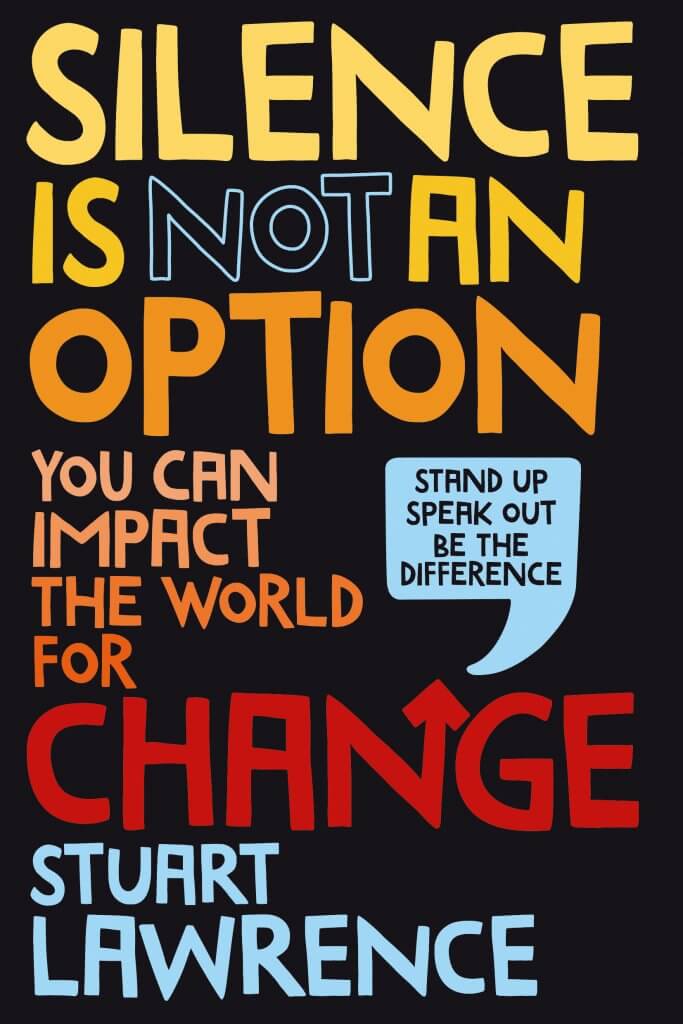
Silence is Not an Option is the first book by Stuart Lawrence – the younger brother of Stephen Lawrence who tragically died in an unprovoked attack on 22 April 1993. The book is interspersed with reflections on his brother Stephen’s life and murder as well as the tools that have helped him live positively and kept him moving forwards when times have been tough. An inspiring read directed at younger readers (aged 10 +) Stuart’s aim is to use his own experience to help young people – to help all people – find their own voice, stand up for change, and contribute towards creating a more positive society. Stuart is determined to ensure that children today understand the impact of their actions against others and the importance of inclusion through teaching tolerance and celebrating difference. He has a background in education – working as a teacher for over 15 years – and is now a motivational speaker and youth engagement specialist. Stuart is also a mentor for several young people in the South London area. Since his brother’s death, Stuart and his family have had a huge impact on the change of attitude towards racism within British society. Their story is still as impactful and important today.
This is a great book to read slowly. It gives the reader practical activities in each chapter, to really think about themselves and how they can impact those around them, before moving onto the next chapter. It is for independent reading and reflection, but could also prompt some brilliant discussions between young people if shared with a group. Chapters range from the influence of role models (Stuart discusses meeting Nelson Mandela) to championing yourself and others. Stuart is incredibly busy, but I just asked him to quickly recommend some books for teenagers to help them understand their place in the world and how to contribute positively:
– Black and British by David Olusoga (I’ve read the abridged “short history” version for younger readers and it is brilliantly fascinating)
– This Book is Anti-Racist by Tiffany Jewell (another full of practical advice)
– Everyone Versus Racism by Patrick Hutchinson
– No Win Race: A Story of Belonging, Britishness and Sport by Derek A Bardowell
Scholastic also allowed me to share this excerpt from chapter 3: YOU ARE IN CONTROL:
SELF-CONTROL
After losing my brother Stephen, I really had to learn self-control. Suddenly, my family and I were in the newspapers and on the TV. A lot of the time, the public were being misinformed about our story. I was so angry that my brother was being portrayed as a gang member and a drug dealer, when he was an A-level student aspiring to become an architect.
However, I had to control myself, because lashing out would only affect my family and my brother’s case negatively. It didn’t mean I didn’t speak out, but I had to exercise self-control in the way I handled the situation. I had to be calm and composed, even though I didn’t feel like it.
What is Self-control? Having self-control means being able to manage your decisions, emotions and behaviours so that you can achieve your goals. This skill is what separates humans from the rest of the animal kingdom!
Self-control is rooted in the front part of our brains, in an area called the prefrontal cortex. This is the planning, problem-solving and decision-making centre of the brain. Did you know that this part of the brain is much larger in humans than it is in other mammals? This area of our brain acts differently at different stages of our lives. For example, teenagers are more likely to act on impulse or to misunderstand their emotions than older people. As much as you might not want to believe us adults and feel like you are an exception to the rule, these are scientific facts!
You can only control yourself. For example, let’s say you are trying out to become the captain of the school netball team and, unfortunately, you aren’t picked for the role. Instead of sulking, getting angry or upset, you show good sportsmanship and shake the hand of your competitor. In doing this, you use your self-control. You are unable to control the situation but you are able to control your reaction and that is what is important. Don’t forget, it’s always useful to get feedback so that you can improve and win next time.
About the author: Stuart Lawrence is the younger brother of Stephen Lawrence, the young man who, on 22 April 1993, at the age of just 18, was murdered in an unprovoked racist attack. Stuart is an educator and motivational speaker, dedicated to helping to transform the life chances of young people.
Stephen Lawrence Day is held on 22 April each year to commemorate Stephen’s life. Follow the journey: #SilenceIsNotAnOption Insta @hon_stuartlawrence Twitter @sal2nd
SILENCE IS NOT AN OPTION is published today by Scholastic.
There has been a big go-round on library twitter over the past little while about a tweet about book donations and patrons getting upset at the thought of library workers selling or recycling donated items rather than putting them in to the library collection.
I know that as library workers we are usually inured to the thought that books have a finite lifespan before they are moved on to being sold or sent off to be pulped, but I think a majority of the library-going public are not as hardened to these realities as we are. It is so easy to write our library users off as being precious or over-sensitive about the fate of beloved books that they wish to donate to us, they have loved the stories and wish to share them with others.
The belief that books are precious and need to be looked after is one that is instilled in people from a very young age – usually beginning at library story-times, I can remember my librarian who showed us how to look after books, not tear pages, turn the page from the top right-hand corner and be respectful of library books, as others need the chance to read them too. This is passed down from adult to child in families that have been brought up using libraries and often they may have had the same librarian showing them how to be look after books.
These kinds of interactions are often the most that a lot of people have with library staff, they grow up believing that library workers love books and want library users to look after them and treat them gently (and we do want that – we know how many times books have to be loaned to recoup their expense). When they come up against the harsh reality that often we are unable to use donations except as fund-raising items for book sales they can get upset because their idealized image of library workers seldom matches up with the harsh reality of what we do.
We do not need to be harsh when confronted with library donations, most times people’s hearts are in the right place when they bring in things that they think we can use, it may be that they have heard that library budgets are constantly under thread and donating books is the only thing that they can do (if it helps them clear space in their homes then it is a double bonus).
It is so easy to poke fun of people on social media, especially those whom we can be judgey about (like people who get upset when they find out that their donations are not wanted) at the moment most people support libraries and library workers but if they see more and more of us act like entitled a-holes online that may change.
We work in libraries to serve our users and educate them, and that includes education on how libraries work and how we maintain our loan materials and everything else!
No, physical books are not eternal items of wonder and magic, but to most people (myself included) some can be, and we would do well to remember that.