For those who are not familiar, Martin Amis, an award-winning writer of serious books for serious people (adults) said during an interview:
People ask me if I ever thought of writing a children’s book. I say, ‘If I had a serious brain injury, I might well write a children’s book’, but otherwise the idea of being conscious of who you’re directing the story to is anathema to me, because, in my view, fiction is freedom and any restraints on that are intolerable. [source: https://www.theguardian.com/books/2011/feb/11/martin-amis-brain-injury-write-children]
When I first heard about Mac’s 94.7 % quote my mind immediately went to Amis’ interview, due to the tone-deafness of the words and the opprobrium that resulted. Imagine my surprise then, that, while reading Make Believe I saw that he referred to the Amis incident in a wonderful footnote in chapter one – A Grand Unifying Theory of Children’s Literature. I love footnotes in books; they bring me a lot of joy (and additional information and sometimes humor too).
I am a fan of his books and have been for years, Make Believe, his first book for adult readers is thought-provoking, funny and contains truths and observations that closely resemble ones that I have held for years.
Read in context, Barnett’s Addendum to Sturgeon’s Law makes more sense than the words shorn of the preceding and following chapters. This is not to say I agree with him on this. I personally would never refer to any book as ‘crud’, as a Librarian and long-time lurker in libraries I have learned that not every book is for every reader. This goes for children’s books as well, because we are all individuals and have differing tastes, and kids learn early what types of stories and formats of books they enjoy.
The more I read Make Believe, the madder I got. Not because it is a bad book, but because Mac wrote it with his heart on his sleeve, he is a well-known and beloved author who has worked with some phenomenal illustrators. He makes great points about celebrating children’s literature; as well as the less great books that adults may not always understand but kids love. The thing that made me mad is the fact that his addendum will poison people’s perception of the book and make many less inclined to pick I tup and read it.
I have seen several people online trying to push back against what they perceive as dogpiling on Mac Barnett and others who have read the book without knowing who he is or why so many of us are upset.
If anyone is interested why there has been such a huge pushback, it is because there is a problem affecting books for young readers – and it is not the books, rather there is a movement dedicated to making sure books by and about certain communities or individuals are kept out of libraries (both school & public), ostensibly to ‘protect’ children but the overarching goal is to control who gets to be reflected in our modern literary canon as one prong of an assault trying to push vulnerable minorities out of public view.
Having the current National Ambassador for Young People’s Literature and best-selling author for young readers stand up and say that he fears that 94.7% of kids books are crud gives culture warriors that already have libraries and children’s books in their crosshairs a huge stick to continue to beat us with. It is a massive unforced error, and not only that, but it is also dismissive of most authors who write books for younger readers.
I 100% believe that Mac’s intention was not to denigrate children’s books or those what write them, but in life when harm is done, it is not good enough to say he had good intentions but instead to acknowledge that harm has been done and work on remedying it.
In closing I will say that Make Believe is a good (but flawed) book that is worth reading despite the negative publicity around it but I fully understand and support those that choose not to.
In his new book Make Believe: on Telling Stories to Childrenhe has written “I have a nagging fear that children’s literature suffers from a slightly higher crud percentage than literature as a whole…maybe more like 94.7 percent of kids’ books are crud.“
A hyperbolic statement? Almost certainly, but also utterly tone deaf and incredibly dismissive of the tens of thousands of authors across the world who write books for children and young readers. Who gets to chose which books are worthy and which ones are, not to put too fine a point on it… crud?
Mac is not alone in believing that this, there are people and organizations around, like Moms for Liberty and their fellow travelers, who believe that many kids books are crud, full of themes, ideas and people that they do not want their children exposed to. Mac’s belief gives cover and credence to these people and their hateful views.
Who knows, Mac’s book may be a paean to children’s literature, extolling its virtues, but sadly the nagging fear that he shares may be all that many people take away from it. This negative publicity may in fact deter people who may benefit from reading it from picking it up. I have ordered a copy and will read (and review) it as I have long been a fan of his work, but honestly he (or his editor) should have thought about that sentence before the book was published.
If this is something he truly believes then he should resign the position of ambassador and let someone who truly sees the value young people’s literature assume the position!
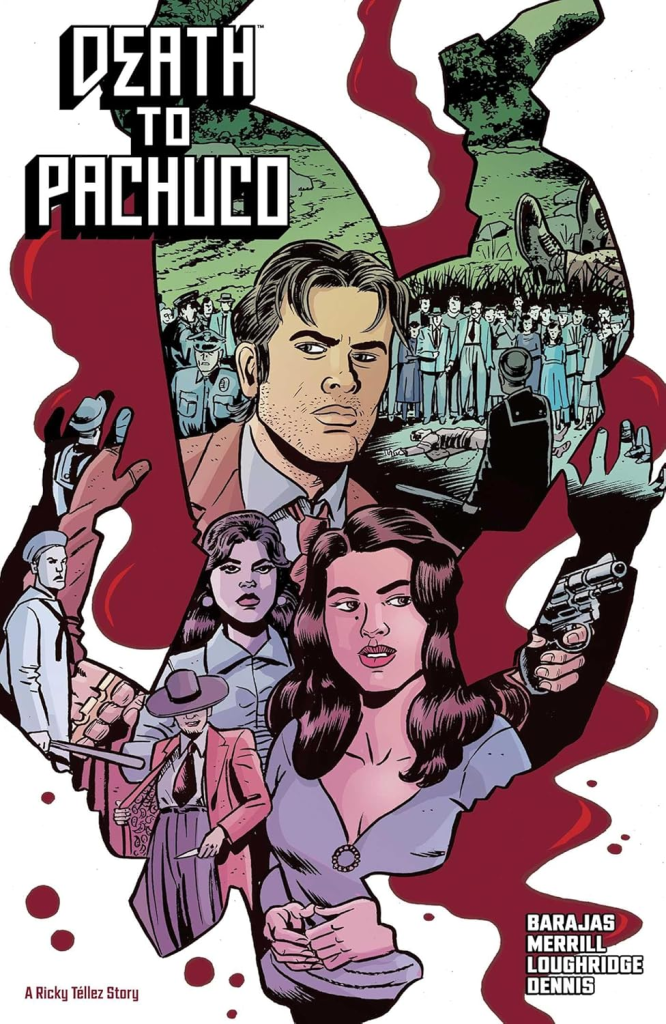
Hello, and thank you for taking the time to answer a few questions about Death to Pachuco. Before we begin, could you please introduce yourself to those reading this who may not be aware of who you are? I’m Henry Barajas. My roots are in Tucson but I live in Los Angeles. My passion is making comic books. My most notable work is La Voz De MAYO Tata Rambo art by J. Gonzo, letter art by Bernardo Brice, and edited by Claire Napier.
Are you able to give an elevator pitch to convince a potential reader to pick up a copy of Death to Pachuco?Death to Pachuco is a chicano noir taking place during 1940s war-time Los Angeles centered around racist events: the Sleepy Lagoon Murder Trial and Zoot Suit Riots.
How did you and Rachel come to collaborate on Death to Pachuco A mutual friend shared Rachel’s “Adult Romance” comic online. I was looking for an artist to work with on DTP and her sensibilities and inking style drew me to her work. I respect that she has her own style when there tends to be a homogenized artistic standard. She’s not trying to draw like anyone else, but good at extracting her influences.
How did you and Rachel come to work together? Was there a strict separation between writing and art or was it a more back-and-forth collaborative approach? Thankfully, she started working on Gil Thorp with me. This was our chance to fine tune the band and get us ready for something larger than what we’re used to doing. I write full scripts. She would do some breakdowns; ultimately, we went straight to inks for DPT because she had an idea of what I was looking for. She is good at taking notes but also shows the professional attitude to learn and apply it to her craft. I also letter the comic, so I was able to make adjustments to my script to fit the structure of the page. The editor, Will Dennis, was key to bridging a lot of communication and having a third person to have a more objective voice to what worked and what didn’t.
Originally, this was going to be black and white. But the comic book gods blessed us with Lee Loughridge. He was able to fit us in his busy schedule and made the whole book sing.
What is the background to the story of Death to Pachuco? The background for me is the uncomfortable truths and history this country would much rather forget than learn from. Immigration and Customs Enforcement (ICE) has been supercharged for the purpose of terrorizing and maintaining white supremacy. This was what happened during the 1943 Zoot Suit Riots. The sailors took justice upon their own hands and tried to beat, strip, and burn Mexican counterculture appropriated by Black jazz musicians. I tried to make that clear without spelling it out for people.
How much research went in to creating this story?La Voz de MAYO was a four-and-half year long journey of research. I learned from that. Story supersedes research. You can have all the answers, but if your story sucks, no one will care. Thankfully, that wasn’t the case with La Voz. But I could’ve done one more project in those five years. I give myself a year of pre-production that usually takes place while I’m working on something else. But I’m getting older and slower, so I am starting from scratch again with my current project.
For people who may be interested in L.A. in the 1940’s and the Zoot Suit Riots what works can you recommend? I would say Manuel Ramos’The Skull of Pancho Villa and Other Stories. He’s the godfather of Chicano noir. The obvious is Raymond Chandler’s Phillip Marlowe series, and The Good Asian by Pornsak Pichetshote, Alexandre Tefenkgi, and Loughridge. DTP is the first comic I have woven film as a major reference in my work. I would say the 1952 classic No abras nunca esa puerta by Carlos Hugo Christensen is a gem I watched thanks to the Noir City Film Festival.
For those readers who after finishing DtP may want to read more of your works, what can you recommend? (either in print or online) My work with the Civics For All group that educates the NYC public students. I wrote two comics for hispanic history, one on Dolores Huerta and migrant farmworkers and Sal Castro. Free to read and download.
What are you reading at the moment? I am inspired by Jazmine Ulloa’s El Paso nonfiction book on the incredible relationship the US has with El Paso specifically. It’s truly the Ellis Island of the Southwest.
Thank you for giving up your time to answer these questions! Thank you for reading and supporting our work!
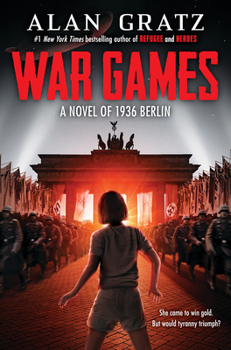
However, according to the famously balanced & impartial Heartlander News (archived link here) War Games by Alan Gratz is apparently a “diversity, equity and inclusion (DEI) graduate seminar inside a story about the theft of gold from the German National Bank during the Olympics.“
I have bumped up against Heartlander before as detailed here, and they have targeted libraries in the Kansas City metro a number of times over the years but I am astounded by how scant the evidence is that they are using to back up their assertions. I took the time to look up War Games on Common Sense Media, and their coverage of this book showed no reason for even the most concerned of parents to be worried.
This is the description of Diverse Representation in War Games from CSM:
Karl Hühnerbein is German and gay and Ursula Diop is biracial (her father is from Senegal and her mother is White and German), which means she’s considered “physically and morally degenerate” by the Nazis. Solomon Monday is White and British and Heinz Fischer’s mother is Jewish. Hitler believed the Olympics would showcase the superiority of White athletes, something that was shattered when Black American Olympian Jesse Owens won four gold medals. While only 18 athletes on the US team were Black (16 men and 2 women), they would win 14 medals, eight of then gold.
It appears that merely the presence of Black, Gay and Jewish characters in a book is enough to get it branded as “DEI”. I have requested a copy of War Games and will read and review it here next week.
I have also reached out to Alan Gratz through his agent and if he has any comment I will post it here if I hear back.
During the summer of 1943, Los Angeles became a hotbed of tension and conflict as a series of fierce clashes erupted between U.S. Navy members and Mexican American youth stemming from the murder of Carlos Urbano. Private eye Ricardo “Ricky” Tellez needs to find the Sleep Lagoon Killer before the racist mob kills him in the Zoot Suit Riots.
The clock is ticking—and it’s a bad time to be a Mexican.
TL;DR Review: A bloody brilliant example of Chicano Noir that belongs in any (& every) collection! Henry and Rachel’s writing and art complement each other in this grim and engrossing historical mystery! Buy it and read it – you will not regret it! Trust me I am a Librarian!
—
Just in case you were wondering: Pachuco: (slang) a young Mexican-American having a taste for flashy clothes and a special jargon and usually belonging to a neighborhood gang Thanks to Merriam-Webster
I got pulled into appreciating noir early in life, thanks in part to being exposed to Chinatown and The Maltese Falcon as a child. In recent years comic noir has held my interest due to the works of Ed Brubaker, Frank Miller, Jason Aaron and Greg Rucka to name but a few! To my personal canon of favorite graphic novel noir yarns I have now added Death to Pachuco by Henry Barajas and Rachel Merrill. A dark detective yarn that took me down the gritty streets of the 1940’s City of Angels, serving up action, mystery, morally ambiguous characters and shining a light on the historical plight and experiences of Mexican-Americans in California. All in all a phenomenal introduction to the Chicano Noir subgenre that has left me wanting more! Fortunately this is only the first of what I hope will be many stories about Ricky Tellez.
One of the things I love about reading is, that almost without exception I learn something new no matter what I am reading. Death to Pachuco introduced me to so many things I had no idea existed or only had a passing knowledge about, from the Zoot Suit Riots and the Sleepy Lagoon Murder to the Tongva people, the history of Los Angeles (Calle Olvera, Rancho Rodeo de las Aguas and other places – I have bookmarked a number of sites to read at my leisure and indulge my joy of learning about history).
I have been a fan of Henry’s work for a few years now, thanks to an interview with him I heard on All Things Considered where he discussed Helm Greycastle and discussed La Voz De M.A.Y.O.: Tata Rambo based on the oral history of Ramon Jaurigue, an orphan and WWII veteran who co-founded the Mexican, American, Yaqui, and Others (M.A.Y.O.) organization. I also highly recommend those two works, they are phenomenal and would make worthy additions to personal and library collections!
In Ricky Tellez, Henry Barajas has created a quintessential noir protagonist, damaged, flawed and haunted by his past but still driven to do the right thing. Rachel Merrill’s art style is perfect for noir storytelling!
Death to Pachuco was created by Henry Barajas and Rachel Merrill. It is published by Image Comics and will be available wherever comics can be purchased on April 14.
You can also find Henry and Rachel collaborating on long-running sports comic strip Gil Thorp.
Wild Song by Candy Gourlay was my book of the year for 2023. This is a heart-wrenchingly beautiful book told in a first-person narrative by Luki, one of the protagonists of Candy’s previous book Bone Talk.
You can find out more about Bone Talk in this 2018 interview with Candy in which I discovered that the foundations of Wind Song had already been laid.
If you have not already read Bone Talk I urge you to do so, as it will give you context for Wild Song; as Candy says in the interview: I actually wanted to write another book, set in a World Fair in 1904 where American exhibited Filipinos in a human zoo. But it would have been a disservice to the tribal people AND to Americans not to show the context of that story. So I decided to begin at the beginning, when the United States invaded the Philippines in 1899 and annexed it as “unincorporated territory”. We became a republic in 1945 but Puerto Rico, which was annexed by the US on the same year, continues to be unincorporated territory. It’s odd how so much of the world has no idea of this. I realise that the Philippines is a small state that doesn’t do much to influence the world, but the United States is a major world power.
Wild Song uncovers a piece of forgotten history of the world – a tale that takes us from from the mountains of Bontoc in the Philippines, to the city of St Louis, Missouri, the site of the 1904 World’s Fair, that played host to the largest human zoo in history.
It is the story of Luki, running away from her village to find her place in the world, Samkad who follows her, her frenemy Tilin and her little sister Sidong, as well as people from the other mountain tribes of northern Luzon in the Philippines, known collectively as the Cordilleran peoples. It is about discovering the wider world and one’s place in it and it is about the end of innocence and discovery that people who wield power do not always do so well or justly. It is also an indictment of white saviorism and the commodification of the culture and bodies of Black & Indigenous People of Color by white people, an ongoing practice that is still hotly debated!
Until I read Bone Talk and Wild Song I had no idea that the Philippines had been a territory of the United States, or that the people of the Philippines had been subjected to a war of conquest and subjugation after Spain had sold it to the US at th econclusion of the Spanish-American War. Seriously I learned more about US imperialism in the late 1800s and early 1900s thanks to Candy than I had ever done so before.
Candy wove historical figures and organizations into this story and provided short biographies about them at the end of Wild Song including Lieutenant Walter Loving and the Philippine Constabulary Band, the most present was Truman K. Hunt, a former lieutenant governor of Bontoc Province who befriended the Igorot and persuaded many to accompany him to St. Louis to participate in the World’s Fair, he gained and lost a fortune off the backs of the peoples he displayed there, and in other parts of the US. He was (no major spoilers here) an utter scumbag, whose mistreatment of the Igorot was so scandalous that he was eventually pursued and arrested by the Pinkerton Detective Agency.
Wild Song is a beautifully told, by turns uplifting, sad and hopeful! Keep an eye out for it on awards lists and make sure that you purchase a copy or request it from your local library in March!
This evening while trawling through Bluesky I noticed a disturbing post by author Kyle Lukoff that Penguin Random House imprint Dial Books for Young Readers is being shut down:
Penguin Random House decided to shut down Dial Books for Young Readers and fire my editor, who shepharded "Too Bright To See" and "I'm Sorry You Got Mad" into the world. Devastated and gutted isn't half of what I'm feeling.
Digging into this, I found posts by other authors backing up this assertion:
@cherylklein.bsky.social Not Kyle obviously, but can confirm the bad news. If you haven't heard from your editor at Dial by now I'm guessing you will soon.
The South African Library Week (SALW) 2026 theme, “Reclaiming Knowledge, Empowering Futures”, reflects a critical moment for libraries and information services in the region. In an era marked by rapid technological change, misinformation, and widening knowledge gaps, libraries stand as guardians of authentic information and catalysts for inclusive development. This theme underscores two interconnected imperatives:
Reclaiming Knowledge Knowledge is a shared heritage that shapes identity, culture, and progress. However, barriers such as digital divides, loss of indigenous knowledge, and inequitable access threaten this heritage. By reclaiming knowledge, libraries commit to preserving cultural memory, promoting open access, and ensuring that communities have reliable, diverse, and contextually relevant information. This involves digitization of local content, fostering multilingual resources, and advocating for intellectual freedom.
Empowering Futures Access to knowledge is not an end in itself, it is a means to empowerment. Libraries empower individuals and communities by equipping them with skills for lifelong learning, digital literacy, and critical thinking. In a knowledge-driven economy, libraries are strategic partners in education, innovation, and social transformation. Through inclusive programs, technology integration, and partnerships, libraries enable citizens to navigate complexity, seize opportunities, and shape sustainable futures.
Why This Theme Matters Now Southern Africa faces challenges such as socio-economic inequality, climate change, and the need for digital transformation. Libraries are uniquely positioned to bridge these gaps by reclaiming marginalized voices and democratizing access to information. SALW 2026 calls on stakeholders, libraries, governments, educators, and communities to reaffirm the role of libraries as engines of empowerment and resilience.
Strategic Focus Areas for SALW 2026
Digital Inclusion: Expand access to digital resources and skills for all.
Knowledge Preservation: Safeguard indigenous knowledge and local content.
Community Empowerment: Design programs that foster innovation, entrepreneurship, and lifelong learning.
Advocacy & Partnerships: Strengthen collaboration to influence policy and resource allocation for libraries.
By embracing this theme, SALW 2026 positions libraries as transformative spaces where knowledge is reclaimed and futures are empowered, ensuring that no one is left behind in the information society.
Tuesday 10 March 2026: The Carnegies, the UK’s longest running and best-loved book awards for children and young people, run by the UK’s library association, CILIP, announced their 2026 shortlists at the London Book Fair this afternoon.
Identity, belonging, relationships, and the meaning of home have emerged as themes throughout both Medal shortlists, with creative storytelling ranging from the deeply personal to the historic and mythical.
Exciting innovation appears across both shortlists, with the Medal for Writing featuring subversive storytelling, reimagined folklore, and inventive verse and chronology, whilst the Medal for Illustration showcases a range of artistic styles from typography to kirigami, the Japanese art of paper cutting and folding.
Two graphic novels feature on the Medal for Illustration shortlist including an adaptation of Lord of the Flies illustrated by Aimée de Jongh, a classic text also recently adapted for the BBC by acclaimed screenwriter Jack Thorne.
Kengo Kurimoto and Oboh Moses are shortlisted on the Medal for Illustration for their debut books, alongside five illustrators who are brand new to the Carnegies. Only Kate Rolfe returns for a consecutive time after being shortlisted in 2025.
Patrick Ness is shortlisted for a fifth time, fourteen years after his Medal for Writing win in 2012, with the chance of an unprecedented third win in the category.
Three more previous Medal for Writing winners are also shortlisted, including Jason Reynolds whowonin 2021, Katya Balen who won both the Medal for Writing & Shadowers Choice in 2022, and Tia Fisher, winner of the Shadowers’ Choice2024.
Writers and illustrators from around the UK including Birmingham, Dumfries, London, Norwich, and Suffolk havebeen shortlisted for both awards.
Walker leads the field for publisher nominations with 3 titles shortlisted across both Medals, closely followed by Andersen Press, Faber & Faber, and Lantana who each have two titles shortlisted.
The Carnegies celebrate outstanding reading experiences in books for children and young people. They are unique in being judged by librarians, with the Shadowers’ Choice Medals voted for by thousands of reading groups in schools and libraries in the UK and around the world, who shadow the judging process and choose their own winners.
16 books have been shortlisted in total, with eight in each category for the Carnegie Medal for Writing and the Carnegie Medal for Illustration; whittled down from 37 longlisted titles by the judging panel, which includes 14 children’s and youth librarians from CILIP’s Youth Libraries Group. The awards aim to spark a lifelong passion for reading by connecting more children with books that will change lives.
The 2026 Carnegie Medal for Writing shortlist is (alphabetical by author surname):
Ghostlines by Katya Balen (Bloomsbury Children’s Books)
Not Going to Plan by Tia Fisher (Hot Key Books)
Popcorn by Rob Harrell (Piccadilly Press)
The Boy I Love by William Hussey (Andersen Press)
Chronicles of a Lizard Nobody by Patrick Ness, illustrated by Tim Miller (Walker)
Wolf Siren by Beth O’Brien (HarperCollins Children’s Books)
Twenty-Four Secondsfrom Now by Jason Reynolds (Faber & Faber)
Birdie by J. P. Rose (Andersen Press)
The 2026 Carnegie Medal for Illustration shortlist is (alphabetical by illustrator surname):
The Playdate by Clara Dackenberg, written by Uje Brandelius, translated by Nichola Smalley (Lantana)
The Endless Sea by Linh Dao, written by Chi Thai (Walker)
Lord of the Flies: The Graphic Novel illustrated & adapted by Aimée de Jongh, written by William Golding (Faber & Faber)
The Sleeper Train by Baljinder Kaur, written by Mick Jackson (Walker)
Wildful by Kengo Kurimoto (Pushkin Children’s Books)
Freedom Braids by Oboh Moses, written by Monique Duncan (Lantana)
The Paper Bridge by Seng Soun Ratanavanh, written by Joelle Veyrenc, translated by Katy Lockwood-Holmes (Floris Books)
Wiggling Words by Kate Rolfe (Two Hoots)
Stella Hine, Chair of Judges for The Carnegies 2026, said:
“The 2026 judges have worked tirelessly to curate two outstanding shortlists. The lists meet young readers where they are, asking searching questions about identity, belonging, community and how we respond as life changes around us. These shortlists offer a wide scope of everyday life including friendship, wellbeing, courage, consent, respectful relationships, and empathy in the face of prejudice. Innovation in form is particularly exciting with inventive verse and chronology, subversive storytelling and reimagined folklore, alongside more traditional narratives. Together, these books reflect our world and empower young people to live and act with all their being and with hope. Huge congratulations to every shortlisted author and illustrator. Your works will impact generations to come, starting with our shadowing groups who have the joy of exploring these books deeply over the next few months as do we, the judges.”
THE SHORTLISTS IN MORE DETAIL
Patrick Ness is in the running for an unprecedented third win for the Medal for Writing, 14 years after winning with A Monster Calls in 2012. His shortlisted title, Chronicles of a Lizard Nobody, is a ‘laugh out loud funny’ illustrated tale that is ‘completely absurd but so clever’ in the way it ‘subverts’ norms and narrative voice, and tells a unique story of anxiety, depression and friendship whilst ‘advocating uniqueness and individuality’. Rob Harrell has also explored mental health in his illustrated young fiction novel, Popcorn. Told through the eyes of an anxious young boy on school photo day, Harrell offers a ‘window into what someone with anxiety lives with’ written with empathy, hope and humour.
Mental health is also explored in Kengo Kurimoto’s Medal for Illustration shortlisted book, Wildful, one of two graphic novels on the shortlist. Judges loved the ‘filmic quality’ Kurimoto has brought to his story of a young girl discovering the joy and magic of a hidden woodland near home, as she processes the grief of losing her grandmother. The second graphic novel on the shortlist is Lord of the Flies, adapted and illustrated by Aimée de Jongh. The judges said reading this book is an ‘uncomfortable experience but one you don’t want to let go’, praising de Jongh for her ‘extremely strong and impactful’ retelling of a much-loved classic.
On the Medal for Writing shortlist, debut author Beth O’Brien, was inspired by Red Riding Hood to write her feminist reimagining, Wolf Siren. In this ‘rich and layered’ story, O’Brien uses ‘beautiful and lyrical’ language to transport readers to a small village and magical woodland filled with wolves and secrets. The connection between a small community and nature is also particularly strong in Ghostlines, written by 2022 Medal for Writing and Shadower’s Choice winner, Katya Balen. Set on a small island home to thousands of puffins and very few people, this is a ‘compelling’ story about what home means to different people. Home is also explored in The Playdate, illustrated by Clara Duckenberg. On the surface, this is a story about a young girl excited to visit her friend for a playdate, but Duckenberg’s illustrations reveal a ‘multi-layered’ secondary story that depicts a hardworking mother cleaning the friend’s home, whilst the children are innocently unaware of the social divide.
Connection through journeys emerges as a theme in the Medal for Illustration shortlist this year. The journey to reach a neighbouring town in The Paper Bridge is innovatively explored by Seng Soun Ratanavanh using intricately detailed paper scenes that have been lit and photographed, providing an ‘exquisite’ and ‘memorable’ reading experience. Linh Dao’s striking visual contrasts between home and journey in The Endless Sea convey a poignant story of a refugee family traveling from Vietnam. Judges loved the ‘highly emotive’ colour palette, and use of light and dark silhouettes to build the mood. In Baljinder Kaur’s illustrations for The Sleeper Train, there is a ‘vibrant Indian twist’ to the colour palette and distinctive borders used throughout, creating a real sense of ‘movement and journey’ and an ‘excellent visual experience’ of a young girl’s train journey across India.
Historical settings are prevalent this year, with William Hussey setting his Medal for Writing shortlisted title, The Boy I Love, in the WW1 trenches. Judges praised the sense of ‘depth’ and ‘tension’ in this ‘outstanding’ love story of two young men on the frontline. A 1950s Yorkshire mining town is the setting of J.P. Rose’s shortlisted novel, Birdie. Featuring a determined pit pony and an even more headstrong young girl, this ‘affecting and emotional’ story spotlights Birdie’s struggle with racism and belonging as she moves to a new home. Black identity in history is explored on the Medal for Illustration shortlist with Oboh Moses’ debut, Freedom Braids, a picture book about the liberation of enslaved African women during the Transatlantic Slave Trade. Moses uses his bold and vivid digital illustration style to portray fear alongside the love of a community of women with great ‘impact and power’.
Two YA novels on the writing shortlist focus on teen relationships. Former medal winner Jason Reynolds is shortlisted forTwenty-Four Seconds from Now, a story ‘full of heart’about the moments leading up to a young man’s loss of virginity. Told backwards in time from the tender moment, judges praised the ‘fresh’ framing device and ‘skill’ used to write a gentle moment so powerfully. Another previous winner, Tia Fisher, has been shortlisted for her verse novel, Not Going to Plan. A powerful story about sexual consent and unplanned pregnancy, the judges praised the way Fisher constructed the poems and played with language to evoke emotion and highlight the characters’ relationships.
Kate Rolfe, who was shortlisted for her debut picture book in 2025, also uses typography in her 2026 Medal for Illustration shortlisted title, Wiggling Words. Offering an insight into dyslexia, Rolfe’s illustrations develop from panicked chaos to ordered creativity, celebrating the boundless potential of neurodiversity through typography and ‘striking’ high contrast colours.
The winners will be announced and celebrated on Tuesday 23June at a live and streamed ceremony at the Cambridge Theatre, home of the Royal Shakespeare Company’s multi award-winning Matilda The Musical. The ceremony will be hosted by multi award-winning author and illustrator Catherine Rayner, who previously won the Medal for Illustration in 2009 and has been shortlisted a further six times. Originally from Yorkshire, Catherine studied Illustration at the Edinburgh College of Art and still lives in the city with her family and a small menagerie of animals who inspire her creative work. Her books for children have sold over two million copies worldwide, been translated into 35 languages, and adapted for television, theatre and musicals.
The winners will each receive a specially commissioned medal and a £5,000 Colin Mears Award cash prize. The winners of the Shadowers’ Choice Medals – voted for and awarded by children and young people – will also be presented at the ceremony. They will receive a medal and £500 worth of books to donate to a library of their choice.
As the official book supplier, Scholastic are working with CILIP to donate shortlist packs to 10 schools in disadvantaged areas to allow them to also take part in the shadowing and widen the reach of engagement with the awards. Applications will be open from 23 – 30 March with packs to be sent out immediately afterwards to the selected schools.
As Shadowing resource partners, the English and Media Centre (EMC) and the Centre for Literacy in Primary Education (CLPE)have developed engaging reading resources for each shortlisted book, complete with activity ideas and discussion prompts. EMC focuses on writing resources, while CLPE provides resources on illustration. See here for more information about the Shadowing resource partners.
The 2026 Carnegie Awards are supported by three key sponsors: Scholastic, the official book supplier; ALCS; and Sora, the official digital partner. The longlist and shortlist can be ordered from Scholastic now. The Sora student reading app will provide access to available longlisted titles and free access to all available shortlisted digital books for shadowing groups, enhancing inclusivity and fostering a love of reading among young people. First News are the official media partner.
Lara Marshall, RNIB’s Library Services Manager, said: For children with vision impairment reading opens up a world of imagination and information that’s vital in enriching their lives and developing their education. RNIB’s Library ensures children with vision impairment always have access to books in accessible formats such as braille and audio so they can delve into the stories they love and hear and feel them come to life. What better way to celebrate World Book Day than to recognise literature in all its forms – and the life-changing impact accessible formats can have for children – enabling them to access stories on a par with their sighted peers.
The 2026 World Book Day books are available in braille and audio with help from RNIB. Call 0303 123 9999 or email helpline@rnib.org.uk.
Children with vision impairment have also been invited to a very special event in partnership with the British Library, World Book Day, Penguin Random House, The Roald Dahl Foundation and VICTA – a charity which supports children with vision impairments – set to take place at the British Library on March 15. Author Sibéal Pounder, one of this year’s World Book Day writers will be leading three sessions for children with vision impairment based on her Willy Wonka book, Chaos at the Chocolate Factory. Other events will follow later in the year.
To access books throughout the year, readers of every age with a vision impairment or sight loss will find more than 52,000 books in accessible formats including audio and braille from the Royal National Institute of Blind People (RNIB). Visit the RNIB Library for audio or braille books at www.rniblibrary.com and RNIB Reading Services for digital downloads at readingservices.rnib.org.uk
Students and Education Professionals can also access education resources in accessible formats through RNIB Bookshare: www.rnibbookshare.org