Just heard that the Library of Congress is working on updating its subject headings to reflect the Gulf of Mexico being unilaterally renamed The Gulf of America, they appear to be doing the same to Denali to reflect the reversion to Mount McKinley.
Mount Denali LCSH change
Professional Library Organizations are always too close to those in power to actually do much for the actual people that work in libraries or those that actually use libraries. To keep libraries going sure they make recommendations and run events but to remain close to those with their hands on the levers of power, the organizations that profess to represent libraries and librarians remain silent (& complicit) in erasure.
Changing subject headings (we are oft told) takes time, it is the same with library classification systems – look at how horrible the Dewey Decimal System still is in parts even with decades of protest and library workers pleading with the OCLC to make Dewey truly representative of the world we live in. The sudden lurch of the Library of Congress to reflect the will of the current administration is shocking, more for the speed of this change, rather than the change itself which appears to be incredibly unpopular amongst a large number of library workers.
These changes have not yet been approved and there is still time to register disapproval of these proposals but it remains to be seen if it will slow down or even stop these proposed changes. You can find out how to protest here
Change does not come from above, it is the library workers on the frontlines that help the people they are serving change their lives often in spite of the directives from those running the libraries they work in.
Just behind the front lines of a war they call ‘civil’, the shifter called Coyote is tough, fast, ugly-and known for taking jobs nobody else will.
THE JOB
Marge’s sister is locked in a prison camp civilians shouldn’t know about, deep in enemy territory. Rescuing her will take a plan made of weapons-grade insanity.
THE TRICK
To get in, all Coyote has to do is get caught.
THE PAYOFF
None, unless the satisfaction of killing an old enemy counts. And maybe a few small bounties from murdering fascist clones…
RUN, COYOTE. RUN.
Bloody and brutal while being utterly engrossing, I found Coyote Run to be exactly what I needed when Horned Lark sent me a review copy juuuuuust before the election last year. I finished reading it on November 4 and was quietly confident that the fascist future we feared would not happen just yet.
Well I was wrong!
I picked up Coyote Run on November 6 and reread it again, filled with bile and fury that so many people had listened to the hate spewed on the election trail and thought “Yup, that’s the guy for us!” Coyote Run did not bring me peace on the second reread, but I achieved a visceral satisfaction at the bloody violence and retribution meted out on the fascist lackeys that got in Coyote’s way during her mission.
War is, as they say, Hell, but in this future dystopia our guide through the Inferno that the Disunited States has become is not Virgil, but rather a genetically modified shapeshifter named Coyote. She will get you to where you need to go and possibly save some lives on the way!
Coyote Run is stripped down storytelling, just muscle, bone and connective tissue, everything extraneous feels like it has been surgically removed! The sights, sounds and ambience is masterfully described in a text so spare, but you can still feel the dirt under your feet, the heat of the sun and the burn of alcohol that is (barely) a step up from engine degreaser. You also feel the hurt and anger that Coyote carries, as well as the burning need for revenge. This is not just a roaring rampage story, there is also empathy and heart to balance out the fury. It is so damn good!
Lilith Saintcrow is an artist; be warned though, Coyote Run is more Guernica than Sistine Chapel but it will still hold your attention and rip your breath away!
If you are looking for something to remind you that fascists can not only be fought, they can be beaten and left hanging in a town square then coyote Run is the book for you. It is also great if all you want is a two-fisted tale of war and retribution, and maybe even a glimmer of hope for the future!
Coyote Run is written by Lilith Saintcrow and published by Horned Lark Press antifascist and in your face – check them out and see what else they have available!
Buy this book (available wherever good books are sold), or request that your local library purchase copies – they generally listen to their patrons when it comes to adding books to their collection, that way you can recommend it to everyone you know and maybe get together with them and talk about it afterwards! Honestly building, and sustaining communities is one of the ways we will get through the next few years!
The newly launched GLL Literary Foundation has selected 17 children’s authors from across the UK to receive bursary placements for 2025 worth up to £4,000 each.
The Foundation was established in November 2024 to support ‘up and coming’ children’s authors who are based in Bromley, Dudley, Greenwich, Lincolnshire and Wandsworth – all areas where GLL operates public libraries under its ‘Better’ brand.
Authors across all genres of children’s literature were encouraged to apply, including picture books, early readers, chapter books, poetry, non-fiction, novels graphic and verse novels. Nominations were accepted from the authors’ publishing representative with the entry criteria stating that applicants be required to have published between one and three books in the past five years.
Entries were assessed by a board of trustees drawn from GLL libraries, children’s librarians and the publishing world. The successful authors for 2025 are:
Marcela Ferreira – Bromley – OUP UK
Alex Falase Koya – Bromley – OUP UK
Adeola Sokunbi – Bromley – Nosy Crow
Alom Shaha – Bromley – Scribble UK
Jesse Kaur – Dudley – Mantra Lingua
Janelle McCurdey – Greenwich – Faber and Faber
Sharada Keats – Greenwich – Scholastic
Robert Pearce – Greenwich – Graffeg
Hannah Moffatt – Greenwich – Everything With Words
Each of the successful authors will receive £750 alongside additional ‘in kind’ support that includes being partnered with a local librarian mentor (Literary Foundation Champion), who will help deliver a series of author events and provide networking opportunities with local booksellers, publishers, literary festivals and schools. Authors will also be offered three online training courses on brand identity, marketing and business planning.
Rebecca Gediking, Head of Libraries for GLL said: “We are delighted to welcome such a great and inspiring group of authors to be part of the GLL Literary Foundation. We look forward to bringing together all people locally and nationally to support our authors, encourage reading and champion public libraries.”
Renowned children’s author and GLL Literary Foundation trustee Mo O’Hara added: “I’m so excited that our first cohort of GLL Literary Foundation authors is being announced. This is such an amazing opportunity for them to learn new skills and gain confidence in so many aspects of our industry. I hope that they’ll build up a great network with their librarian champions and also with each other. It’s so great to have a ready-made support group in an industry with so many challenges. Well done to our fantastic GLL team for 2025!”
Alom Shaha, GLL Literary Foundation supported author from Bromley said: “I’m delighted and honoured to have been awarded a GLL Literary Foundation fellowship. Growing up as an immigrant on a council housing estate, my local library, and the librarians who worked there, were a hugely positive influence on me. They didn’t just help develop my love of books, they also provided a safe place to play with toys and activities which I didn’t have access to at home.
“I have gained so much from my use of public libraries throughout my life and I am so excited about this fellowship. I know I will gain a lot from the experience, but I hope there will also be lots of opportunities for me to give something back.”
I was an early fan of Google, from managing to get an early invitation to Gmail, playing with Picasa and following it when it was purchased by Google and eventually became Google Photos, using and enjoying Google Docs and the other offerings in its Office Suite. My first smartphone ran Android (it was the HTC Desire), I ran library lessons on using Google products when I was a School Librarian and I enjoyed the ease of use and interconnectedness Google products offered.
Sadly over the years I have watched Google move from the days of “Don’t Be Evil” and fear that they are approaching their “I’m With Evil” phase, in fact they may already be there.
I have slowly been in the process of Degoogleing my life, and the other day I decided to share (via Bluesky) some replacements for Google products:
Instead of Google search try DuckDuckGo Instead of Chrome try FirefoxInstead of Gmail try ProtonMailInstead of Google Docs etc try LibreOfficeInstead of Google Photos try EnteFor every Google product there are multiple replacements you can try. The above suggestions are just examples to try
That skeet has proven to be extremely popular. So popular in fact, that I decided to create this post with more in-depth suggestions with regard to replacing Google products and services. I will caution at the outset that sometimes there are not like for like products that work in exactly the same way, but for each I will suggest at least one potential replacement you can try out.
Remember when looking to swap out apps and programs from companies that have taken a stance you disagree with, you should take the time to test out and research potential replacements- it is good to take heed of suggestions but find something that fits your particular needs and ethics.
I have limited this list to free to use products. Depending on your needs (& budget) there are a number of subscription services that may meet your needs that you can find with a quick search on your search engine of choice (see below for some examples).
The frustrating thing about this is that Proton offers email, a calendar, cloud storage, a password manager and a VPN all of which are free to use at the basic level. I have included links to these services if your need to deGoogle your life trumps (no pun intended) your dislike of the current US administration.
I have started a new series on my long-dormant podcast. I have called the series Bad Librarians, in it I am casting a critical eye at librarians who have harmed both the profession as well as the communities they were supposed to serve.
I was going to start with the so-called “father of modern librarianship” Melvil Dewey but due to what is currently happening in the US and elsewhere I decided to jump right in with Nazi Librarians. You can take a listen below.
The 2025 Carnegie Medal for Writing longlist is (alphabetical by author surname):
On Silver Tides by Sylvia Bishop (Andersen Press)
You Could Be So Pretty by Holly Bourne (Usborne)
I Am Wolf by Alastair Chisholm (Nosy Crow)
Treacle Town by Brian Conaghan (Andersen Press)
Sisters of the Moon by Marie-Louise Fitzpatrick (Faber & Faber)
The Things We Leave Behind by Clare Furniss (Simon & Schuster)
The Final Year by Matt Goodfellow, illustrated by Joe Todd-Stanton (Otter-Barry Books)
Island of Whispers by Frances Hardinge, illustrated by Emily Gravett (Macmillan Children’s)
If My Words Had Wings by Danielle Jawando (Simon & Schuster)
King of Nothing by Nathanael Lessore (Bonnier Books UK)
Little Bang by Kelly McCaughrain (Walker)
Glasgow Boys by Margaret McDonald (Faber & Faber)
Trigger by C.G. Moore (Little Island Books)
All That It Ever Meant by Blessing Musariri (Head of Zeus)
Play by Luke Palmer (Firefly Press)
Fallout by Lesley Parr (Bloomsbury Publishing)
The Wrong Shoes by Tom Percival (Simon & Schuster)
Louder Than Hunger by John Schu (Walker)
Us in the Before and After by Jenny Valentine (Simon & Schuster)
The 2025 Carnegie Medal for Illustration longlist is (alphabetical by illustrator surname):
The Last Zookeeper by Aaron Becker (Walker)
The Invisible Story by Wen Hsu Chen, written by Jaime Gamboa, translated by Daniel Hahn (Lantana)
Grey by Lauren Child, written by Laura Dockrill (Walker)
Flower Block by Hoang Giang, written by Lanisha Butterfield (Puffin)
I Love Books by Mariajo Ilustrajo (Quarto)
The Dictionary Story by Oliver Jeffers and Sam Winston (Walker)
Clever Crow by Olivia Lomenech Gill, written by Chris Butterworth (Walker)
Dive, Dive into the Night Sea by Thea Lu (Walker)
Letters in Charcoal by Juan Palomino, written by Irene Vasco, translated by Lawrence Schimel (Lantana)
Homebody by Theo Parish (Macmillan Children’s Books)
The Bridges by Tom Percival (Simon & Schuster)
Wolf and Bear by Kate Rolfe (Macmillan Children’s Books)
Flying High by Yu Rong, written by Cao Wenxuan, translated by Simone Monnelly (UCLan Publishing)
Do You Remember? by Sydney Smith (Walker)
Grandad’s Star by Rhian Stone, written by Frances Tosdevin (Harper Collins Publishers)
The Wild by Yuval Zommer (Oxford University Press)
The Carnegies celebrate outstanding achievement in children’s writing and illustration and are unique in being judged by children’s librarians, with the Shadowers’ Choice Medals voted for by children and young people. The awards aim to spark a lifelong passion for reading by connecting more children with books that will change lives. The longlists were chosen from 119 nominations by the judging panel which includes 14 children’s and youth librarians from CILIP’s Youth Libraries Group.
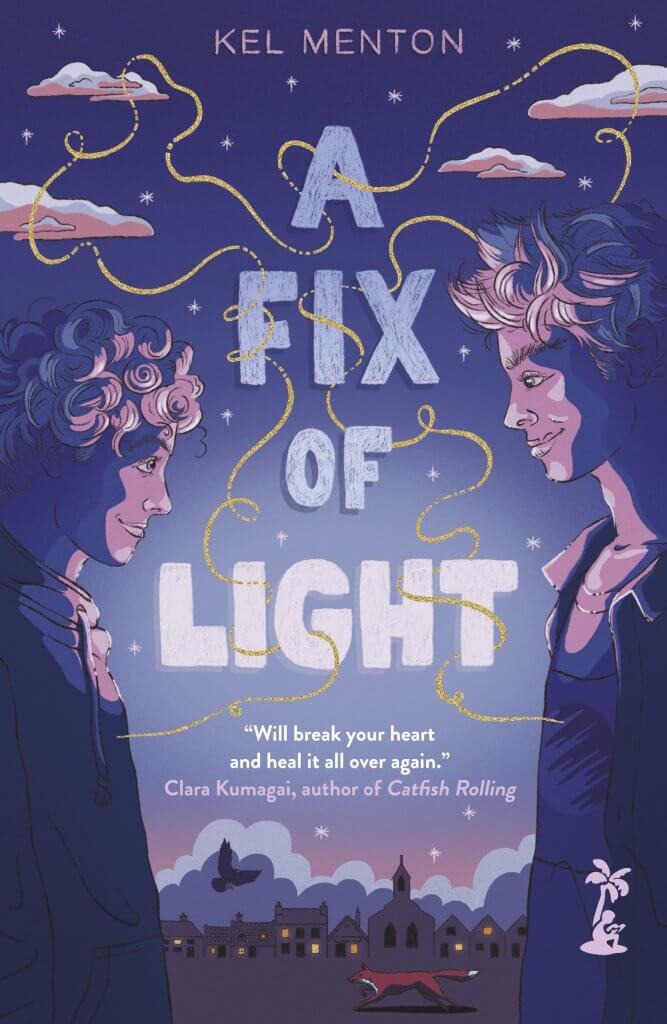
The forest outside Skenashogue sent him home alive – but changed. A strange new magic makes every emotion a physical force he can’t control.
Bright and gentle, fox-like Pax is everything Hanan is not. And when he touches Hana he mutes his secret power, quiets the curse.
To survive their own darkness they’ll need to open up to each other. But Hanan isn’t sure Pax will like what he finds out …Can their love help them find their way back to the light?
The cover blurb on the proof states “The latest YA debut from Little Island is a trans love story with a dark magical twist from an astonishing new voice in Irish writing”…and it doesn’t lie about it being dark! It is definitely not one for a precocious younger reader. The content note is stark:
A Fix of Light contains references to suicide and self-harm, depression, anxiety and episodes of psychosis, as well as other symptoms associated with borderline personality disorder. It also contains graphic depictions of homophobic and transphobic hate speech and physical violence, and references to past sexual assault, Reader discretion is advised.
The prologue sets the tone, as a boy walks into the forest intending to die. To be honest, I found those first few pages extremely difficult to read and wasn’t sure I wanted to continue, but I did, and was quickly drawn into the story of Hanan and Pax. I keep typing sentences and deleting them because they feel a bit too spoilery, but the magical fantasy aspects are woven neatly into a contemporary story of two traumatised teenagers. Dual POV, their worlds very quickly revolve around one another, for better and for worse, with a classic ‘things get worse before they get better’ storyline. The reader is drawn in by their hopeful, tentative connections and the heartbreaking events that test them, it is hard going at times but also a very satisfying read.
Kel wrote a thoughtful piece for TeenLibrarian about writing through the conflicting memories of childhood wonder and teenage angst:
When I was a child, I spent one week every summer with my mom’s side of the family – grandparents, aunts, uncles, cousins and all – in Dingle. It was my favourite week of the year.
We wrote messages to mermaids in the sand, sipped hot chocolate from flasks, shared halved apples, and searched for faeries among the fuschia. I remember staring out across the sea at the Sleeping Giant, hoping to see his chest rise and fall, or standing on top of cliffs and staring down at the shifting water, seeking flashes of mermaid’s tails. I was an explorer, an adventurer, just like the protagonists of my favourite books, and the air was thick with potential and magic.
When I started writing A Fix of Light, I was about 16 years old, and I was becoming increasingly unhappy that with each passing year I grew further from childhood and closer to adulthood. Adults, in my opinion, were disenchanted and miserable creatures. I raged against my descent into such banality. What better way to fight disenchantment than to write?
I knew I wanted A Fix of Light to have magic. I knew I wanted it to be set in Ireland, somewhere by the sea. Looking back, I think I was trying to preserve some of that childhood wonder. Every time I sat down to write a little more, I could steep in those memories, try to conjure up the feelings again and translate them onto a page. The act of writing the book, as well as the finished product, could keep those memories pressed like flowers.
The story, though, and the characters, were born of my teenage self. If you are or have ever been a teenager, you know that self-actualisation is a pretty uncomfortable process. Lots of growing pains. I was figuring out How To Write A Novel and Who I Am at the same time, against the backdrop of idyllic childhood memories. How do I make these contrasting flavours complement each other? How do I make this novel coherent, when it feels like I am trying to cram a thousand of my selves into it?
Phillip Pullman, the author of His Dark Materials and other fantastic works, wrote that “…if we are going to do any good in the world, we have to leave childhood behind” (Introduction to Oxford UP’s World’s Classics ed. of Paradise Lost, 2005). I will never be a child again, and that used to make me sad. It felt like someone had locked the door to my favourite room, and hidden the key on Mars. I wanted to go back, and I never could. That is sad, I suppose. But spending the rest of my life staring at a locked door would be much worse.
Trading your childhood for adulthood is exactly that: a trade. You are not left empty-handed, but exchange your innocence for experience and wisdom. Here’s another great Pullman quote: “Innocence is not wise; wisdom cannot be innocent.” (“The Writing of Stories”, May 2002). I have gained wisdom – and will hopefully continue to collect it forever – which has opened a thousand new doors.
As I got older, I realised that adults are not necessarily miserable and disenchanted creatures. In fact, one of the brilliant things about being an adult is that you become responsible for creating the magic. I can make it with my mind, with my hands, with speech, with writing. I did not have to surrender my wonder or enchantment; I just had to start making my own. That’s how I made my childhood wonder and teenage angst become friends.
That’s how I made A Fix of Light.
Kel Menton (they/them) is a non-binary, neurodivergent writer from Cork in Ireland. Kel works in youth theatre as a facilitator and playwright mentor. They were selected as a Young Writer Delegate for the 2021 Dublin Book Festival. They hold a master’s in medieval English literature from University College Cork.
Thankyou to Little Island for sending me a proof copy to review and to Antonia Wilkinson for organising the guest post.
A FIX OF LIGHT publishes on the 6th February 2025.
The Regular Show follows the lives of best friends Mordecai and Rigby, whose lazy afternoon adventures always seem to be interrupted by zombies and misadventures with their gang of friends Benson, Pops, Muscle Man, Hi-Five Ghost, Skips, Thomas, Margaret and Eileen or sometimes even dealing with Death himself.
Ok, I am going to preface this review with the caveat that I am extremely tired today! The reason for this will be explained in my review, so I ask for your forbearance while you read and I will say upfront that you need this cartoon series in your life! It came out while I lived in the UK at a time when I did not own a television so when it was originally showing it bypassed me completely, but now that it is in my life I am rejoicing as it is that good! Now on to the review!
Is The Regular Show the greatest cartoon series ever made?
No! But it is up there!
Can you explain?
Sure! Pull up a chair and I’ll get started.
I received a review box set of this delightfully odd cartoon yesterday (Monday, Feb 3rd) so I have not been able to make too great a dent into the 245 episodes (and a movie), but what I have seen I have enjoyed.
Strike that! I have loved the episodes I have viewed so far!
The Regular Show is fucking weird! No, no this is a good thing, well for me anyway – I grew up watching cartoons in the 80’s and I enjoy weird! But weird and compelling stories – that is something I do not always find!
It also has, from what I have seen, an internal consistency and loose arc development and AND it has what is possibly the best homage to one of the greatest ever 70’s New York gang movies – Warriors, a movie that I first watched when I was way too young but it burned itself into my long term memory.
I spat out my tea onto my computer at 3:30 this morning. Ok why was I up at 3:30am? Well, my daughter has been ill and I was sitting up with her while she slept because she asked me to – and I can’t say no to a tearful request from my sickly child.
While she dozed I plugged an external DVD player into my laptop and bounced through the box set at random, until I landed upon episode 22 of series 4. It is called Picking Up Margaret – I watched it three times giggling like a loon all the while and admiring the storytelling chops of the writers and cartoonists. This episode draws on the plot of the afore-mentioned Warriors and it caught me completely by surprise! I only twigged when one of the Wickets called out: Moredcai put your phone away! That was the line that caused me to spit my tea – and it has been running through my head all day!
The Regular Show box set is out on general release today, you can find out more about it and where to get your hands on it here.
I am a fan of physical media and love owning things, if you are the same then look for The Regular Show wherever films and TV shows are sold. If you are running out of space then check with your local library, and if they don’t have it in stock yo can request that they purchase it (it is one of the things that most public libraries are happy to do!
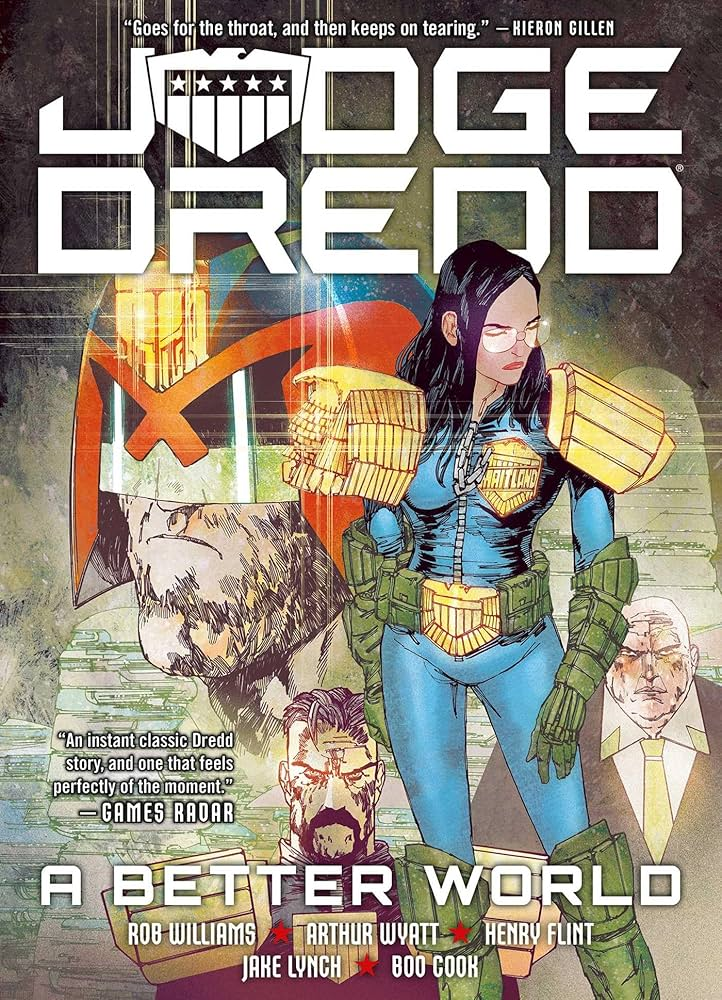
Judge Maitland has a plan to lower the crime rate of Mega City One: divesting funds from Justice Department into education and services that would benefit the average citizen. She is given one year to improve one sector of Mega-City One; one year to succeed, and create a better world.
But when her plan begins to work, and Justice Department decides to roll it out over ten more sectors, citizens like vid-news mogul Robert Glenn and Judge Hernandez – who have a vested interest in keeping the status quo – step in to spoil the experiment using whatever means are at their disposal.
Judge Dredd started out as a satire of British and American culture, with a focus on authoritarianism and police brutality. As I have grown older and slightly more jaded I have looked at the ramping up of militarized policing around the world and begun to wonder if some people have looked at these comics and thought “Hey this is a good idea!” instead of “Gosh this is a bit much – maybe we should not go down this road!”
Dredd has never been the good guy, in his words he is The Law. Judgement and punishment doled out without fear or favor to the deserving and often to those who commit crimes like eating sugar, or taking their teacher a fresh apple. It was ever a warning, given with a nudge and a wink but the joke has never been funny (except for the stories that were written to elicit a laugh).
A Better World is a Judge Dredd story that is as near to perfect as you will read, Rob Williams has become one of my favorite Dredd writers and, though it may be heresy to say, his take on the lawman of the future often builds upon and surpasses the works of John Wagner. This story is a timely take on the defund the police movement that has been rolling around the United States in recent years, except in this case, that call comes from within the Justice Department. Judge Maitland is a young Judge that earned the trust of Judge Dredd in one of his earlier cases and provides insights and thoughts that Dredd himself, due to his nature cannot envision or express.
Mega City One has been through a lot over the decades and the Judges and what citizens are left after Apocalypse Wars, Zombies, Dark Judges and more eventually something will have to give. So when Maitland approaches Dredd after her research shows that ploughing money, education and services into deprived areas will change the lives of the citizens of MC1 and make them less liable to become perps she has to take it before the ruling council (of five) of the City.
Hope is dangerous, if you are not careful it will get you killed!
I have been a fan of 2000AD for most of my life, and loved the Dredd stories in particular, but living i a country where firearms are fetishized to the nth degree and the police are lauded as incorruptible paragons of virtue while given billions in funding at the expense of other services it taints my enjoyment somewhat as the line between satire and reality is so indistinct as to be invisible! Oh I love this story, I want to push it into the hands of everyone (and particularly those who hold financial control over towns and cities).
A Better World *is* possible, not just in the pages of Judge Dredd but in our world too. I would like to thank Rob and Arthur for creating a story that elicited a bone-deep feeling of despair and hope within me that I feel every time I read this work.
Get yourself a copy! In its pages you may just find your favorite graphic story of the year.
Broadly speaking, AI is intelligence shown by machines, particularly computer programs. It is a field of research in computer science dedicated to developing and studying software and methods that allow machines to perceive their environment and use their intelligence, bolstered by learning to take actions that will allow them to increase its chances of achieving defined goals.
Are any machines or computer programs actually intelligent?
To put it bluntly no, currently all publicly available “AI” programs are basically a type of machine learning programs known as “large language models” (LLMs) that have been trained on massive amounts of text and images, and with set parameters can generate text and images. True machine intelligence has been hypothesized in science fiction but until the AI singularity occurs true Artificial Intelligence will remain in the realm of science fiction.
What is the AI Singularity?
This is the hypothetical point at which AI systems will achieve the ability to surpass human ingenuity and be able to improve itself and soon after this achieve true intelligence and then (possibly) attempt to destroy humanity.
So how are ‘Large Language Models” trained?
The people programming them load vast quantities of text and images into the program to allow the program to analyze these and learn how to write similar works.
Where did they get these vast quantities of text?
They scraped the entirety of the world wide web and downloaded everything they could find to feed the digital beasts they were creating.
And did they pay for all the works not in the public domain that they downloaded?
Why did they not just use materials that are in the public domain?
To quote a spokesman from OpenAI (creator of the LLM program ChatGPT): “copyright today covers virtually every sort of human expression – including blog posts, photographs, forum posts, scraps of software code, and government documents – it would be impossible to train today’s leading AI models without using copyrighted materials. Limiting training data to public domain books and drawings created more than a century ago might yield an interesting experiment, but would not provide AI systems that meet the needs of today’s citizens.”
So they didn’t want to pay to access all copyrighted material to train their programs because it would have been too expensive?
The creators of LLM AI programs claim that it is fair use to use copyrighted materials to train their programs: we believe that legally copyright law does not forbid training.
So a legal grey area that will have to be fought out in the courts?
mmmmm
OK but is it ethical?
Is it ethical to use a program that has been created using pirated materials in libraries? To quote article 4 of the American Library Association’s Code of Ethics: We respect intellectual property rights and advocate balance between the interests of information users and rights holders. I think as Library Workers we should not be using tools that have been created using methods that may be considered legally, ethically or morally suspect. Most, if not all of us are aware that a majority of authors, musicians and artists struggle to survive on the money they make from what they have created, so to give tacit approval to companies owned by billionaires stealing what they have labored over for years by using Generative AI products so we can push a button to create a generic library lesson plan or library poster that may have one too many fingers or other weird digital glitch is not worth it.
What if I really want to use Generative AI programs at work?
Well I can’t stop you, but I will encourage you to read up on the ethics of using such programs as well as the impact they have on the environment and author incomes. I will put some links to articles below if you would like to start here.