Writing is akin to alchemy – taking the magic of ideas and by pinning them down on paper with ink making them real.
CJ is a fantastic author – I have read and loved her Night School series, Carina is a new author to me but has had over a dozen books published in France – none of which are currently available in English!
After having read The Secret Fire I have seriously started thinking about learning French just so I could read her earlier works!
The initial review I wrote made use of so many hackneyed phrases that I deleted it and started again.
Then I thought, just because the words get used so often does not make them untrue!
So yes…
The Secret Firehas no holds barred
and indeed is a thrill a minute
My heart did leap into my throat (that one scene with Sacha and Antoine on the top of the building in chapter 2 did it)
It also include ancient organisations dedicated to fighting evil, at least one evil organisation dedicated to revenge at all costs.
The Secret Fire is brilliant! It is a pure old-school thriller with paranormal aspects woven in so subtly that they are accepted almost without notice. At no times does the sense of danger and mystery seem forced!
I have seen a number of YA thrillers coming out this year and by all means you should read those – but if you listen to one bit of advice I give (and really you should listen to most of my advice – especially about libraries) then read this book!
Go to your library either the one at school* or your public library and request it if it is not already on the shelves or you can even buy a copy yourself. It is not just a thrilling book it is also a beautiful work of art that will complement your shelves wonderfully.
*if your school does not have a library or librarian then organise a protest about that and do the same if your local library is under threat of closure – this advice you should take!
I was introduced to the James Bond novels after seeing the film Live and Let Die while visiting my cousins and then discovering the novel at my local Library.
I read the books out of order over the course of two or three years and was dismayed to find that Ian Fleming had died and there would be no more. Then one holiday I discovered Colonel Sun by Robert Markham – a new James Bond adventure, I enjoyed it and even after reading a number of other books by famous authors it remained my favourite non-Fleming Bond novel.
The stories that came after were not bad, they were just not (for me) ‘real’ Bond stories. The James Bond I had come to enjoy was a creature of the cold war, a damaged, driven man who can and does do questionable things for his country; a hero only by virtue of his foes being worse than he is.
I was fortunate to win a signed, early proof of Trigger Mortis on twitter, a book by Anthony Horowitz – a writer whose works I love in print and on television.
When I started reading Trigger Mortis my love of James Bond was reawakened, Anthony Horowitz’s writing mirrored Ian Fleming’s style so closely that at times it felt that I was reading his words – and for a part of the story I was. Trigger Mortis is the first Bond novel by another author to include original material by Ian Fleming.
Trigger Mortis is a direct sequel to Goldfinger and brings back one of the most iconic Bond girls – Pussy Galore. It also examines James personality, foibles and looks at why none of his relationships ever last.
I devoured it over the course of three evenings, it has been one of the hardest books to put down drawing me in with nazi rocket science, murder, a nightmare dash around the Nürburgring and an obligatory scenery chewing supervillain aiming at disrupting the US space programme. Oh yes and there is Jeopardy Lane an awesome female agent who is more than a match for our Mr Bond.
It is a phenomenal nerve-wracking read – pure classic Bond. In my mind’s eye the only way I can see Anthony Horowitz channelling Fleming’s voice so wonderfully was by snorting a line of Fleming’s ashes to contact the man and then hallucinating James Bond standing behind him with gun drawn so that he gets it right.
He got it right!
Trigger Mortis is the best Bond novel for decades, even beating out some of my Fleming favourites!
It is now my fondest wish that if and when the time is right that Horowitz writes more Bond! Hopefully he will also include a cameo by a certain famous teenage spy!
Hi Linda, welcome to Teen Librarian for the Eight Questions With… interview! The first question I ask all authors is: can you please introduce yourself to the audience?
Hi Matt and hi to all you lovely readers out there, so, who am I? Good question. I’m lots of different people depending on what novel I am writing (I get so into the book I do feel as if I am the main character and am living their lives!), but I suppose there’s an external consistency to who I am: I’m an Oxford University economist by training but a novelist by nature. I spent seven years working as an investment banker in London, New York and Eastern Europe, being exposed to more potential plots than was decent. Then I escaped and wrote my first book, Nest of Vipers. Longbow Girl is my twelfth book.
I’ve lived in various parts of the world.
I spent three years living in Peru and more recently eight years living in the Middle East. In 2005 my husband and I were kidnapped at sea by Iranian government forces and held hostage in Iran for two weeks before being released after high-level intervention by the British government. I wrote about that in my first non-fiction book, Hostage.
I am married and have three great children are who occasionally drive me mad but then they’d no doubt say the same about me. My family play a big part in my books. My husband reads various drafts aloud to the children and me, then they all give me their brutally honest opinion. I then slink away to try and write a better draft!
I also have two dogs, Rhodesian Ridgebacks called Boudicca and Beowulf, and a desert cat called Cutie. We live near the sea in Suffolk, where I try to swim all year round.
Longbow Girl is a thoroughly gripping tale set in the Wales of the modern era as well as the late Tudor period, how much research went into writing it?
One way and another, I’ve done a lot of research, both years ago and recently. The roots of Longbow Girl are very personal and go back to my own childhood. When I was eight years old, my father gave me a longbow for Christmas. I would shoot it for hours, perfecting my aim, practising until my hands were covered in calluses. My older brother, Kenneth, also had one. We would shoot cans off walls and also, rather terrifyingly, we’d aim for the high wires on the electricity pylons. Happily, we missed!
As a girl, I just wielded my longbow for fun, but I always used to feel different whenever I picked it up. Longbows are lethal weapons. They changed the course of history. This October sees the six hundredth anniversary of the Battle of Agincourt, an ‘unwinnable’ battle, won by the Longbow against all the odds. I did a lot of research into this and also the battle of Crécy in 1346, another ‘unwinnable’ battle won by the Anglo-Welsh longbowmen.
I didn’t really need to research the locations. The setting of Longbow Girl, in the Brecon Beacons and in the Black Mountains, was close to where I grew up. When I was a girl we would regularly go on forced family marches up Pen Y Fan in all weathers. I used to grit my teeth until we got to the top, and then run all the way down to the Storey Arms with my brothers. I never thought that I would write about it, but I love that journey back in my head to the mountains of my youth. It’s my very own form of time travel! I went back several times when I was writing Longbow Girl as well, just to see it all with fresh eyes. It’s such a beautiful and atmospheric part of the world. Revisiting was a joy and an inspiration.
The historical aspect of Longbow Girl took a lot of research. I read widely about the Tudor period, both in factual books but also via fiction. Sometimes it is fiction that gives you a much more vivid portrait of a time and place. Here is a photo of some of the books I’ve either read or repeatedly delved into for my research. Are you a fan on the Mabinogion and are you able to recommend any particular translations of the text?
I am a huge fan of the Mabinogion. My father had a copy of the 1989 Everyman revised edition (translated by Gwyn Jones and Thomas Jones, one of whom signed it but with an illegible signature!) and he gave that copy to me over twenty years ago. I always had a sense even then that I would write something linked to it. Recently, my brother Roy gave me an Oxford University Press hardback Mabinogion published in 2007. It’s lovely but my late father’s copy will always be my favourite.
Much like Merry, you grew up using a longbow, have you kept up proficiency in its use?
Absolutely I still have Huntress. If you have a look at my website: www.Lindadavies.com, you will see a video clip of me shooting arrows with Huntress. I practice every few weeks. I wish I could say I can consistently hit an empty can on a wall 50m away… but I’d be lying! I can consistently hit my standard archery target from 30m away and if I sneak a bit closer I can periodically get a bull’s-eye or what archers insist on calling the ‘gold’ at the centre of the target.
Are any parts of Longbow Girl based on actual historical events or have you just woven historical characters into a fictional setting?
Yes, they are! A particular historical fact that I discovered about six years ago acted as a catalyst to writing Longbow Girl. I learned that Henry VIII issued an edict ordering the destruction of wild Welsh ponies under a certain height in order to improve his stock of destriers, or war horses. I was outraged on their behalf! The other childhood inspiration for Longbow Girl was my own black Welsh Mountain Section B pony, Jacintha. I was horrified by the idea of her ancestors being hunted down and destroyed, just because they were small! I dreamt of being able to go back in time to rescue some of those ponies, and then I thought, what if a young girl did just that…
So I came up with the brave, strong and wonderful Merry – the fifteen-year-old heroine of Longbow Girl. She is a supreme archer, the first longbow girl in a tradition of longbow men that stretches back seven hundred years to the Battle of Crécy. She’s also a great rider. One day, while out on her pony Jacintha, Merry discovers a treasure that offers her the chance to turn back time. She travels back to the brutal kingdom of Henry V111. Fighting against battle-seasoned men, she has to wield her longbow to save her family. To save herself… and a few ponies too!
In a strange co-incidence, mirroring one of the central plot lines from Longbow Girl which I dreamed up over five years ago, I recently discovered that in 1346 the Longbowmen of Llantrisant (the village right next to where I grew up!) fought for the Black Prince at the Battle of Crécy and saved his life.
The grateful Prince granted them a piece of land to be held in perpetuity. To this day, nearly seven hundred years later, the direct descendants of those longbowmen hold that parcel of land in Llantrisant.
Here’s another personal link that goes all the way back to the Battle of Crécy. During the battle, the Black Prince claimed the emblem of the defeated Bohemian King: three ostrich feathers. This emblem has been adopted by every Prince of Wales since. I was given a ‘Royal’ ring bearing the crest with the three ostrich feathers when I was a little girl when our current Prince Charles was invested as Prince of Wales. My father was involved in the Investiture and gave me the ring to mark the occasion. I still wear it now! I have never taken it off.
Have you ever read The Gauntlet by Ronald Welch? I read it about 25 years ago now, Longbow Girl reminded me a bit of it as they share a slightly similar time-slip plot and it is also set in Wales.
I’ve never come across it till now. It sounds intriguing! I’ve just ordered it.
Although the main storyline was tied up there were a couple of plot threads dangling at the end – do you have any sequels planned?
There are a few dangling threads aren’t there…? And yes I would dearly love to write a couple of sequels exploring what and where Merry goes next. I’ve just started plotting a different book, also Y/A/middle grade and will write that one first.
I am also a big fan of your Djinn books and reviewed the first two back in 2009 & 2010, moving away from Longbow Girl for just a moment can you let me know when Djinn War is due out?
Thank you so much! I am delighted to hear that. War of the Djinn is currently filed away, both in my brain and on my PC. I have done some work on it and hope to reprise it one day. At the moment, the wonderful Tanabi Films is deep in the process of putting together a deal to make an animated movie of Sea Djinn and then hopefully the rest of the Djinn books after that, so watch this space!
Thank you so much for giving up your time!
Is my absolute pleasure Matt. Thank you for your interest in my books and for your support and kind words.
I have only written two novels so it’s difficult to say precisely what sort of writer I am. Furthermore, who knows what I’ll end up writing next. But it is true to say that in my first two books I have grafted the magical and the supernatural onto the real world in which both stories take place. I’m not entirely sure why this is because it’s just been a natural process of storytelling for me, but I’ll have a go at trying to give you some reasons as to why I think it might be.
Certainly I have always been a bit of a daydreamer, a person who likes to imagine ‘what if’ and escape the confines of the real world in which we live. It has therefore seemed a logical step to do this in my writing too, where a blank page gives me the opportunity to imagine anything I want to and make it come alive with words. I have also been a big observer of people too, making me slightly detached from the real world. Perhaps a combination of these two traits adds a twist to the stories I try and write?
Or perhaps it’s just because I’m lazy, that I can’t be bothered to world build a huge alternative universe so I just take a few magical elements and graft them onto the ordinary world that I know and can describe. Or maybe it’s down to the things that I have read that influence my writing. For example I like poetry and this can be quite hyper real or even surreal sometimes, using heightened, powerful language as a lens through which to view the world. (I often think of reading poetry like looking through a child’s kaleidoscope and seeing lots of different things at once, such can be the power of the words sometimes). It could be that I haven’t really grown up and that my inner child is still quite strong and influencing the way I write, infusing it with a slightly magical view of the world.
I don’t seem to be very good at pinning this down!
So perhaps I should try a different approach and look elsewhere for an answer. After all whatever there is in my personal make up that makes me put the real and the magical together does not really make me unique because there are lots of writers who write novels in a similar vein, who write stories in ways that put a unique spin on the world we know. Some people define it as magical realism whilst others don’t. Regardless of what label to use, this type of writing seems to be a genre defined by the fact that it is quite difficult to define, flirting as it does with various other genres and where anything is possible in the story, limited only by a writer’s imagination.
Another notable trait of this form of storytelling is that to enable the magical element to resonate the normal world has to feel very real too. So magical realist writers, whilst being imaginative and off kilter, have to be very gritty realists as well, showing us the real world in a finely tuned manner. I think this realism is one of the key strengths of this type of work.
However, I think the best way to portray magical realism is by describing the feeling it engenders when read, namely a vague dislocation of normality, a slightly skewed vision of the world that can make a reader giddy, putting them off balance. In other words, books of this type can be constantly surprising.
So why is it such a popular genre for writers (me included) to work in? Well, I think it might be because writers are explorers, weighing up what they have been told about the world (what their brains have stored up through childhood, adolescence and beyond) and how it functions. Through the process of storytelling they are working things out for themselves about life without necessarily drawing conclusions.
For example, David Almond, whose work is often described as magical realism, talks a lot about the impact of his Catholic upbringing in many of the interviews I have read, and he is aware of how wrestling with it has impacted on his writing, namely that of negotiating the tension between rational and magical thinking, of what to believe:
When you are at a limit, you pray. At the end of rationalism that’s what’s left. My work explores the frontier between rationalism and superstition and the wavering boundary between the two.
This idea that writers are working things out for themselves may be one reason why magical realism is popular in YA and also MG. Children and adolescents usually accept they don’t know everything about the world and are in the process of trying to work it all out too. There is, perhaps, a sense of collaboration between these readers and magical realist writers within the arena of storytelling. I like to think those adults who read magical realism – whether YA, MG or the literary stuff for grown ups – are ones who still have enough sense to realize they don’t know everything about the world either, that they aren’t overpowered by hubris.
So I think magical realism is a powerful tool for exploring and feeling one’s way in the world, allowing the reader and the writer the freedom to react to the odd, the strange, and the downright mysterious. I like to think this is one reason for why I have written the books I have so far. But I can think of another reason too.
One further spin off from this genre is that readers’ imaginations are given a work out. I know from my own experiences of writing that creativity is a muscle – it needs to be inspired to grow stronger – and if books that fuse the magical, the fantastical and the mysterious with the real help to inspire and fuel creativity in other people then that has to be a good thing. Maybe that’s the real reason I write the way that I do, to inspire readers and make them think and question and imagine for themselves…?
The Carnegie UK Trust works to improve the lives of people throughout the UK and Ireland, by changing minds through influencing policy, and by changing lives through innovative practice and partnership work.
Nottingham Trent University won the Teaching Excellence Award for The Dawn of the Unread online, interactive comic.
Incensed by the closures of libraries and low literacy in 21st-century Britain, the famous historical literary figures of Nottingham rise from the grave to wreak revenge.
The remit of Dawn of the Unread is not to thrust ‘complex’ books on people to read. It’s to create a thirst for knowledge. To tease, tantalise and inspire. To use digital technology to enable numerous routes into literature knowing that our reading paths are ultimately solitary and taken at different speeds. And if kids go on to the library to get out books it will be because they want to learn more.
Read the full manifesto for Dawn of the Unread here
If you are interested in becoming a teen librarian or helping out with working with young people in public libraries then check out YALSA’s competencies, developed through decades of work with young people.
YALSA first developed these competencies in 1981, which were revised in 1998, 2003, and 2010. The competencies can be used as a tool to evaluate and improve service, a foundation for library school curriculum, a framework for staff training and a set of guiding principles for use when speaking out for the importance of services to teens in libraries.
Audiences for the competencies include:
Library educators
School and library administrators
Graduate students
Young adult specialists
School librarians
Library training coordinators
Public library generalists
Human resources directors
Non-library youth advocates and service providers
I have spoken about the love I have for Roman Dirge’s work before; it is a weird, slightly disturbing love that would have a restraining order out against it if it were not so lazy and just waited for comics by Mr Dirge to be delivered.
The latest item to be delivered was Roman Dirge’s The Cat with a Really Big Head. It is a collection of textual works with illustrations by the man himself and it is totally disgusting* (and sickeningly cute)! It reminded me of something my cat threw up, if fact there is an illustration of something the cat did throw up!
Please note that I am not saying that I disliked this work – no not at all! It is wonderful and disturbing, the stories contained within are fairly simple and incredibly entertaining but it is the artwork that makes this volume sing.
There are three stories contained within – the first one being the titular cat, and anyone who has owned a cat will recognize the illustrations as being horribly accurate (although not everyone will have owned a cat with a huge head).
The second story, A Big Question, told in verse is my favourite tale it is a fairly short intermission between the two main stories and concerns Little Alisa McGee who was as cute as could be… needless to say it does not end well but it does put the ‘awwww’ in autopsy.
The second chapter is The Monsters In My Tummy which is sort of like the Star Trek Mirror Universe version of Pixar’s Inside Out except it was written years before it came out.
This story is for anyone who has been in love and had their heart pulled out and ripped to shreds by the one they loved.
The stories Cat with a Really Big Head is recommended for anyone who loves their stories dark and disturbing but with a really good rhythm.
It goes without saying that it may not be suitable for the very young, sensitive or those that take a dim view of gratuitous dark humour…
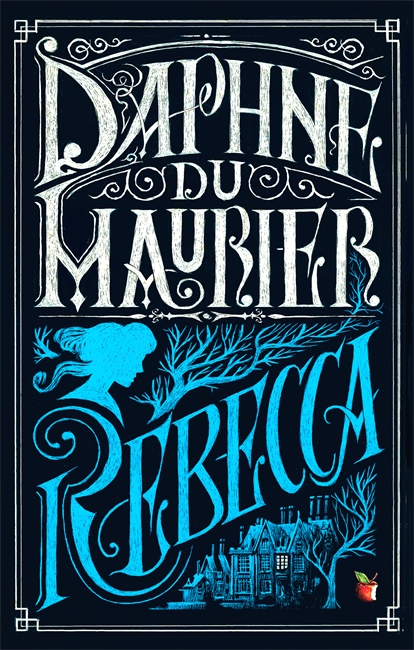
On a trip to the South of France, the shy heroine of Rebecca falls in love with Maxim de Winter, a handsome widower. Although his proposal comes as a surprise, she happily agrees to marry him.
But as they arrive at her husband’s home, Manderley, a change comes over Maxim, and the young bride is filled with dread. Friendless in the isolated mansion, she realises that she barely knows him.
In every corner of every room is the phantom of his beautiful first wife, Rebecca, and the new Mrs de Winter walks in her shadow.
It has been over 20 years since I first picked up the book and when I started reading the chills crawled down my spine.
It was the opening line that did it;
Last night I dreamt I went to Manderley again.
I have never experienced a reread so viscerally as I did with Rebecca!
This read was haunted by the ghost of past reader me who hung over my shoulder reliving the feelings I experienced back then.
I would have been around 11 going on 12 when I first encountered it, I heard the girls in my class whispering about it – it was always whispers with Rebecca. The only other book that was spoken of in hushed tones was Flowers in the Attic by Virginia Andrews – but talking about that book is a topic for another time!
I was a nosy child, I still am depending on whom you ask; so I asked them who Rebecca was, and was told that “Rebecca is not a ‘who’ Rebecca is a ‘what’ and she showed me the book but would not let me touch it.
I managed to get a copy from my school library (a medium-sized room full of books), I can remember that it was old and creased but I did not care as I loved reading.
Rebecca was first published in 1938 and stands up well against modern fiction. The pacing is slower than late 20th/early 21st century works but the language is rich and draws you in, painting a rich tapestry in your mind with beautifully descriptive passages. I found that reading it as an adult gave me a greater appreciation for du Maurier’s skill as an author and her ability to give me chills on a second reading.
Rebecca is a wonderful and near perfect example of a gothic novel; it is dark, bleak and has enough twists to keep the reader guessing. If this tome is new to you then get yourself ready to stay up all night visiting with the second Mrs. de Winter in her lovely home!
If you have already read Rebecca don’t you think it is time to go to Manderley again?