This is not the title of a new penny dreadful featuring our Children’s Laureate versus a fearsome octopoid from the depths; rather it is news that this year The Kitschies Black Tentacle, the judges’ discretionary award for special achievements, was this year, awarded to Dame Malorie Blackman OBE.
The Kitschies, presented by The Kraken Rum, reward the year’s most progressive, intelligent and entertaining works that contain elements of the speculative or fantastic.
The prize is now entering its fifth year.
The Kitschies Tentacle Awards are some of the most amazing looking awards available for writers.
The Tentacle Awards are:
THE RED TENTACLE
The Red Tentacle is awarded annually to the novel containing speculative or fantastic elements that best fulfills the criteria of intelligent, progressive and entertaining.
The winner receives a £1,000 prize, a hand-crafted tentacular trophy and a bottle of the Kraken’s finest black rum.
THE GOLDEN TENTACLE
The Golden Tentacle is awarded annually to the debut novel that best fits the criteria of progressive, intelligent and entertaining. The book must be the author’s first published work of novel-length fiction in any genre.
The winner receives a £500 prize, a hand-crafted trophy and a bottle of The Kraken’s black spiced rum.
THE INKY TENTACLE
The Inky Tentacle is named in honour of The Kraken itself and is awarded to the year’s finest cover art, as selected by a panel of visual arts experts.
The winning artist or designer will receive a £500 prize, a hand-crafted Tentacle trophy and an appropriately inky bottle of The Kraken’s finest dark rum.
THE BLACK TENTACLE
The Black Tentacle is a special achievement award. It is handed out at the discretion of The Kitschies’ board, which is comprised of editors, authors, marketers and social entrepreneurs.
The prize is awarded for a work or body of work that does not otherwise fit The Kitschies’ criteria. The winner receives a hand-crafted tentacle and a bottle of The Kraken’s black spiced rum.
For full details about the Kitchies and for a ful run down about the prizewinners please follow this link: http://www.thekitschies.com/
I am currently heading home after attending the launch party for Weirdos vs Quimboids by Natasha Desborough (on the left in the photo) on the right is Vicky Barker – the artist that designed the cover.
It was a brilliant evening Downstairs at The Square Pig and Pen in Holborn. Pip at Bounce Marketing had invited me and as I had not seen her or Non from Catnip for absolute ages I thought I had better attend. I did also want to meet Natasha as I thought that the original title “Weirdos and Cameltoes” was one of the best titles ever (I remain at heart a teenager with the attendant sense of humour).
Natasha is brilliant, after Non’s introduction in which she described Weirdos… as one of the funniest books she had read while editing Natasha read the opening pages which had the audience in stitches.
I saw some familiar faces in the crowd including Laura of SisterSpooky fame, Bella from Cheezyfeet Books and Rhys from ThirstforFiction. I chatted to my fellow bloggers for a while as well as Non and Liz from Catnip Books and spent a good part of the evening speaking to Vicky and her husband Gareth who it turns out is Clive Barker’s nephew. I do not think I geeked out too badly when I found out.
I chatted to Natasha and her husband about books and music before she signed my copy of Weirdos and Quimboids and I had to dash off to catch a train home.
Natasha reading from the Understanding Levels of Shame section at the beginning of Weirdos vs Quimboids
Weirdos vs Quimboids title page, signed by the author and the artist.
What influenced your decision to write for Teenagers?
I have two teenage children, a boy of fifteen and a girl of thirteen and I really wanted to write the sort of books that would keep them and other teenagers reading, despite all the distractions of phones, friends and Facebook.
How do you get into the heads of your characters?
I listen to my own children and their friends and sometimes I try to think back to my own feelings as a teenager but very often I imagine that I am the character and I talk to myself!
Do you know instinctively what will appeal to Teens or is it more a hit or miss process?
Like readers of any age, teens love gripping stories but the important thing is to have characters whose lives and emotions they can relate to. I’m writing crime fiction for teens at the moment and although the crimes in the stories may be very similar to those in an adult novel my detectives are very different. They are teenage boys and girls, not raddled old cops with alcohol problems and rocky marriages!
What is the most satisfying part of the writing process for you?
Sitting down at the computer and writing a phrase, a sentence, a paragraph or a page that conveys exactly what I can see or hear in my head.
Do you ever read the works of other Teen/YA authors? If yes what can you recommend?
Yes, I read lots of Teen/YA novels. One of my favourite books is Guantanamo Boy by Anna Pereira. For older Teens I would recommend Tanya Byrne’s Heart Shaped Bruise and for younger ones Wonder by R.J. Palacio
Are any of your novels based on personal experiences?
Not directly in terms of plot but I think that some of the emotional reactions of the characters come from my own experience of pain, conflict or loss.
Are you working on anything new at the moment or do you have anything planned?
Yes I am writing a crime novel about an Afghan girl whose family come to London to escape the Taliban. It’s at the very early stages at the moment but when her brother is accused of a terrible crime she turns detective to expose a massive conspiracy.
Do you ever do Library visits to Teen Reading Groups? If yes, what is the best way to get into contact with you or your agent about it?
Yes, I do a lot of school, library, and reading group visits. The best way to contact me is via my www.samosmanbooks.com website
What influenced your decision to write for Teenagers?
I’ve always loved children’s literature and YA. I didn’t make a conscious decision to try and write for teenagers, but when I started plotting ‘The Skull in the Wood’, my characters Matt and Tilda just emerged as aged 12 and 13. I feel very happy writing that for age group, and I’m interested in writing for an older YA readership too.
How do you get into the heads of your characters?
It’s a cliché that your characters take over, but they genuinely do. I try and imagine how they behave in all sorts of situations, not just the ones on the pages of the book. I even wrote a few scenes that I never intended to appear in the book, just so that I knew how Matt and Tilda had reacted at crucial times in their lives.
Do you know instinctively what will appeal to Teens or is it more a hit or miss process?
Mostly I write about what appeals to me – I don’t consciously gear it to a particular age group. If I get excited about it, I hope that teens will too.
What is the most satisfying part of the writing process for you?
Writing the early drafts is amazing – a story just seems to take shape out of nothing and the process is utterly magical. But I like the detailed editing too – I think you have enjoy that if you’re ever going to finish a novel, because if you get bored at any stage, your readers will too.
Do you ever read the works of other Teen/YA authors? If yes what can you recommend?
At the moment I’m reading Patrick Ness’s ‘Chaos Walking’ trilogy and really enjoing it. Meg Rosoff’s ‘How I Live Now’ blew me away, as did Sally Gardner’s ‘Maggot Moon’. And I loved Louis Sachar’s ‘The Cardturner’ – it just amazed me that you can construct a whole novel around playing bridge!
Are any of your novels based on personal experiences?
Not really – I like to make things up, and none of my characters are based on real people. But of course, things that have happened to me do have a knack of edging in where I least expect them.
Are you working on anything new at the moment or do you have anything planned?
I’m in the early stages of a new novel – but it’s way too soon to talk about it!
Do you ever do Library visits to Teen Reading Groups? If yes, what is the best way to get into contact with you or your agent about it?
I’m going to do some library and reading group visits in the autumn, and I’m always happy to do more – it’s great to meet committed readers! At the moment it’s best to email on tina(at)doublecluck.com at my publishers and requests will be passed on to me. And I’ll have a website up and running soon.
I’ve been asked to talk a bit about the idea of Dystopia, which has, of course, been a major trend in novels, movie, and television for the last few years. But why? What makes it so popular?
It’s an interesting question – one you could probably write a university thesis on, if you wanted to.
Dystopia has become a catch-all phrase that means every kind of semi-sci-fi, or post-Apocalyptic, or “bad society of the future” story out there. The Apocalypse is a great equalizer, and these stories always have some major cataclysm that starts the world on a downward spiral into darkness. It can be a war, or a global blight, or alien invasion, but something has to light the match that causes society to implode.
What’s left is a lot like what happens when fire strikes shrub forests. Everything’s razed to ash, and it looks like a wasteland, but soon, something amazing happens. You see, there’s a handful of flower species that only bloom after such a blaze. They need the destruction as their spark of life, and right there in the middle of all that monochrome rubble and devastation, they burst into full color, bringing life that never would have been seen otherwise.
The main characters in most Dystopias are like that. They only flourish after the burn; that’s when they shake off the ashes and stand up to be seen while everything else falls apart into smoking heaps around them. Everyone wants to be that kind of person. Everyone wants to be able to say: “Don’t look at the destruction, look at me. I’m still here; I’m alive and I’m perfect for this situation.”
Dystopia is society-soup. It doesn’t matter who or what they anyone was before the fire – only after counts. Money means nothing when there’s no economy. Power shifts based on who’s in charge at the moment and how much they can trust the person standing behind them. All the rules go out the window and people who had no voice are suddenly on even footing with those who used to be in charge.
Basically, everything’s high school, if high school had zombie viruses and killer robots.
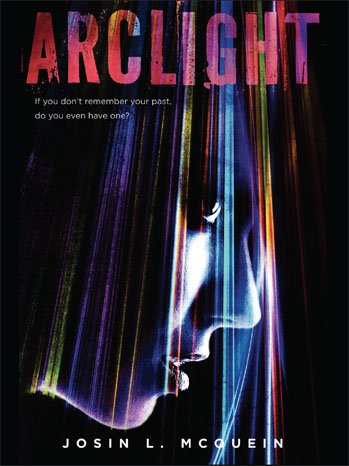
In my novel, Arclight, the flash point was a medical disaster. I won’t go into it too much because of spoilers, but basically the world fell to someone’s good intentions gone wrong. Now, all that’s left of human society is one outpost that has to live in a state of perpetual daylight because there are monsters called the Fade outside their walls that thrive in the darkness.
Into this world steps a girl who is the only person known to have ever faced these creatures and survived, unfortunately, she can’t tell anyone how she did it. The trauma of losing her family and her home, on top of running from the darkness and the Fade for days caused a mental block, meaning she literally doesn’t know her own face when she sees it. She’s blank. She’s got desolation inside and out, and she’s trying to figure out how to flourish despite that.
A lot of people would crumble under that kind of pressure, but such people do not make good heroines for novels. Marina perseveres, and I honestly think the draw of Dystopian novels and movies is that simple. It’s not about the destruction or the death, and it’s not about the fear or the loss. It’s about hope and life, and finding the strength to stare death in the face and say “no more.” They aren’t depressing at all.
Great Dystopians stand up after the fire and dance in the ashes like they’re playing in the snow, and who doesn’t love that?
HI Sara, thank you so much for agreeing to be interviewed! For my first question would you be able to summarise Half Lives in 10 words? (if you can- more words can be used if necessary)
That’s a difficult challenge, but here goes…
Two stories of survival; separated by time but bound by a deadly secret.
Half Lives is two stories – one set at the end of our world as we know it and the second on the cusp of a new civilisation arising – how long did it take you to write the story?
The spark for the story came in November 2009 when my editor at Little, Brown sent me a link to an article on Slate.com’s Culture Gabfest. The article was titled “Atomic Priesthoods, Thorn Landscapes, and Munchian Pictograms: How to communicate the dangers of nuclear waste to future civilizations.” It discussed how a US Department of Energy panel planned to label the site of an underground nuclear waste repository.
The topic may sound dull, but the more I thought about it, the more it fascinated me. Some types of nuclear waste are deadly for more than 10,000 years – that’s longer than the world’s oldest civilization. Who knows what the world will be like even a thousand years from now? What language will we speak? What symbols will have meaning? The article sparked something in my brain and I couldn’t stop thinking about it.
I developed the novel on and off from the moment I read that article in 2009. The more I wrote and researched, the more I found that I wanted to explore.
(If you want to read more about the article that started it all and the issues behind the story, you can visit my web site at: http://www.sara-grant.com/half-lives/half-live-discussions/)
Was it difficult keeping the protagonists voices separate?
The voices, settings and time periods were so different that keeping the stories separate in my head wasn’t difficult. Also I initially wrote the two stories in Half Lives as separate novels. Once I was sure the stories were satisfying on their own then I knitted them together, endeavouring to show the reader the complete story by withholding and revealing information in each narrative.
The idea of a culture and religion based around modern day youth slang and culture is brilliant – what inspired you to come up with that concept?
It’s an idea I’ve been kicking around for a long time, maybe even since the 1995 Joan Osborne song One of Us with the chorus, “What if God was one of us. Just a slob like one of us. Just a stranger on the bus, trying to make his way home.”
Until Half Lives, I hadn’t found the story that would allow me to explore these ideas. What’s more fascinating than religion? Not only organized religion but also the systems of belief, faith and superstition that everyone creates to make it through the day.
Half Lives as a title works on a number of levels – the stories of Icie and Beckett, their lives being trapped by fate and circumstance and the time it takes radioactive materials to decay. Did the title come first or did you have the story planned and written before you named it?
Half Lives was the title from the very first proposal and outline. That happens sometimes; the title comes as part of the initial spark.
The covers of the British & American editions are very different – which one do you prefer?
I like both covers for different reasons. They both represent similar aspects of the novel. Both covers show the connected dark and light sides of the story. The US cover was designed to match the re-designed cover of my first teen novel Dark Parties. I must admit that my favourite detail appears on the UK cover; it’s a black cat sauntering across the ISBN bar code. (A black cat plays a significant role in the novel.) Details like this make me appreciate how much my publishers invest in and understand my work.
Did you have any involvement in the design?
I have two amazing publishers with fantastic art departments. They showed me initial designs, and I gave feedback, but they are responsible for the cover concept and design. I leave the visual art to the professionals.
The breakdown between Icie, Chaske, Tate and Marissa was as heart-breaking as it was inevitable – is it difficult to write scenes like this in your novels? I am aware that some authors have very public near breakdowns when talking about bad things happening to their characters.
Many scenes in Half Lives were difficult to write. If I’m heart broken when writing or upset or scared then that emotion often translates onto the page. Many scenes had to be written in layers. It’s easier to deepen difficult scenes over time rather than in one initial rush. I’m a planner so I know most of what will happen from the initial outline. But surprises happen along the way, and it can be devastating when you realize that something horrible must happen to one of your characters. Chaske surprised me the most in Half Lives. He was a mysterious character that revealed himself to me over the course of several drafts.
Was Half Lives written as a warning against the dangers of nuclear waste and weapons of mass destruction or was that just an added extra?
The novel sprang from an article about these issues so they were fundamental to the story from the very beginning. The more I researched about these topics the more unbelievable it became. Creating a substance that will be deadly for tens of thousands of years definitely seems like science fiction, something right out of a superhero comic book.
While reading the book I had no idea how you were going to bring the two strands of the story together separated as they were by time and culture. Did you start with the idea of how they would converge or did they converge together as you wrote?
I created a grid that outlined the plot points in the two novels and noted how and where they would intersect. The difficult aspect of this novel was that if I changed something in one story, I had to consider the ripple effect it would have in the other.
The Just Sayings that prefaced each chapter of Beckett’s story are brilliant – are there any plans to put them together and make them all available to the reading public?
That’s an interesting idea. I do have a bigger list of Just Sayings. I’m a bit obsessive about details like that so I have a grid that notes the origin of the Just Saying and where it appeared in the book. But my reference documents are sometimes only understandable to me. Maybe I’ll get that organized and post it on my web site. Thanks for the suggestion, Matt!
Finally – what are atomic priesthoods?
The phrase ‘atomic priesthoods’ comes from the article I mentioned that served as the spark for Half Lives. The article discussed how the US planned to mark the site of a nuclear waste repository and the conundrum of how you communicate with future generations that most likely won’t speak the same language we do nor understand the same symbols. Here’s the extract from the Slate.com article:
“In the early 1980s, the semiotician and linguist Thomas Sebeok wrote a paper for the U.S. Office of Nuclear Waste Management titled “Communication Measures To Bridge Ten Millennia,” which proposes a folkloric relay system to pass along information: “The legend-and-ritual, as now envisaged, would be tantamount to laying a ‘false trail,’ meaning that the uninitiated will be steered away from the hazardous site for reasons other than the scientific knowledge of the possibility of radiation and its implications; essentially, the reason would be accumulated superstition to shun a certain area permanently.” Sebeok further suggested a Dan Brown-like “atomic priesthood” of physicists, anthropologists, semioticians and the like who would preserve the “truth.”” (http://www.slate.com/articles/health_and_science/green_room/2009/11/atomic_priesthoods_thorn_landscapes_and_munchian_pictograms.html)
This was one idea for how to warn away future generations from these deadly burial grounds with only a select few – so called atomic priests – who know the truth. Thankfully this wasn’t the final recommendation. Atomic Priesthoods sounds like a great name for a rock band though.
Thank you so much for taking the time to be interviewed!
You are very welcome, Matt! Thanks for reading Half Lives and being my first official interview on the book.
Book:A Monster Calls – Patrick Ness
I don’t want to talk about it. Don’t touch me. Song:Who Knows Where the Time Goes – Fairport Convention
As a writer, I should be embarrassed that I can’t put into words how beautiful this song is, but perhaps that’s what makes it beautiful, that there’s nothing you can add to it. It’s enough.
Film:Blue Valentine
There are dozens of films that have made me cry more than Blue Valentine – Titanic, Philadelphia, The Shawshank Redemption – but I was expecting those films to kick me in the heart, but I didn’t know what Blue Valentine was about so I wasn’t prepared for how it would affect me. There’s no manipulation here, no one’s dying, it’s just a straight up story about a relationship unravelling. But there’s the rub: the story is so simple – and so bone-breakingly honest – that I cried for hours afterwards. I still can’t think of the last scene without welling up. It broke my heart.
Book:Never Let Me Go – Kazuo Ishiguro
I thought I was going to make it to the end without crying, I really did, but no. I cried myself to sleep. A remarkable book. Song:Smother – Daughter
Again, there are so many songs that I could have added to this list but this made me cry the first time I heard it. It’s exquisite as it is, but add in the fact that the opening reminds me of Friday Night Lights and I want to wrap it in tissue and tuck it in a drawer so nothing happens to it.
Do you have difficulty in deciding which book to read next?
While we chatted we were painting Dark Angels Space Marines.
There are many like it, but this one is mine!
Andy is an excellent host and all-round geek and nice guy. We chatted for ages between filming; about comics (He showed off his Spiderman signed by Stan Lee) I drooled over his Batman/Joker Animated Adventures, Doctor Who and the literary merits of Terry Pratchett versus J.R.R. Tolkien (Andy is a die-hard Middle Earther while I tend more towards the Discworldian view). He played the voice of Kring the magic sword in The Colour of Magic.
The video was made to promote and celebrate the release of
Which is a sequel to:
Both of whom were written by:
The Batman?
Noooooooooooo not the Batman – although that would have been amazing!
They were actually written by BatmAndy Robb.
The last few photos were taken at the book launch, which was held at the Waterstones on Kensington High Street. The launch was fantastic with a number of people dressing up as comics characters (my favourites being Walter ‘Rorschach’ Kovacs and The Big Figure from Watchmen), I was too busy enjoying myself to take photos.
This is Andy and Cristina of Crisckracker Films who filmed the interview.
Important Note:Each of the bloggers has a unique coda at the end of their videos so be sure to watch them all!
Teen Librarian is proud to feature an interview with Jon Mayhew, author of Mortlock, The Demon Collector, The Bonehill Curse and the soon to be published The Eye of Neptune, first book in the Monster Odyssey series.
1. You have chosen a young Prince Dakkar – better known as Captain Nemo as the (anti?) hero of your story. Is there any particular reason you chose a pre-existing character in the public domain rather than creating someone new for the story?
I have a bit of a track record for using past works of literature as a springboard for my writing. The character of Sergeant Major Morris in The Bonehill Curse is taken from WW Jacobs’ story The Monkey’s Paw. I quite like imagining the characters before the events of a story and the best characters allow you to do that. I’ve always been fascinated by the character of Captain Nemo and so when Bloomsbury asked me to do an adventure series, he sprang to mind straight away. I wanted to write undersea and historical so inventing anew Captain Nemo, seems a bit pointless. There’s also the challenge of doing something new but something that has a ring of truth about it.
2. Obviously in his youth he was merely Prince Dakkar, will your series touch on how he became Nemo (no-one) and eventually refused to step on to inhabited land? Or is it going to be a swash-buckling tale of derring-do and adventure?
Both, I hope! What intrigues me about Nemo is that he had a past. It is referred to in Mysterious Island. He returns to India at the age of 30 and marries but becomes embroiled in the Indian Uprising of the 1850s. His wife and child die and he goes to an island with some compatriots and builds the Nautilus. But that doesn’t really explain how he knew how to build a submarine, or why he was so driven to save the oppressed or why he wept bitterly whenever he killed men. It didn’t tell us how he became educated, where he got his encyclopaedic knowledge of the sea or his love of Art from. I wanted to explore how his character forms. For example, he is obviously an inspiring leader, so in one book he may encounter famous generals, emperors and politicians of the time. It would be a shame to miss such an opportunity for swash-buckling tales of derring-do and adventure, though!
3. There is also (according to the Amazon page) a Girl but she is only referred to as ‘a Girl’ – is her identity going to be a surprise or can you share a bit more information with us?
She is a fictional character. Georgia Fulton, a niece of one of the other characters, she’s a fist-fighting, All-American girl who generally acts as a foil to Dakkar’s Princely pomposity. In other words, she punches his lights out when he gets too big-headed!
4. I read 20,000 Leagues Under the Sea and The Mysterious Island when I was a youth and loved it (also the Disney Movie which I enjoyed as a child) and did not give the character any thought for years until I read Alan Moore’s The League of Extraordinary Gentlemen series. There is a Nemo graphic Novel by Alan Moore & Kevin O’Neill due out in February focusing on the captain‘s daughter. Have you read any of the works featuring Captain Nemo (apart from the Verne originals)? There is a lot of Nemo-inspired material out there! I loved the League of Extraordinary Gentlemen but wondered why Moore made him a Sikh. Dakkar would either be Hindu or more likely, Muslim. I’ve read a manga Captain Nemo which was great fun but I’ve avoided other texts. I also enjoyed the films and various cartoons that have popped up through the years.
5. Prince Dakkar was portrayed as being virulently anti-British and anti-imperialist in general, will your novels be showing how he became this way?
I hope so. It is interesting to look back at how Dakkar was portrayed because in early English translations, he came to England to improve his country, in American translations of the time, he came to ‘learn the ways of his oppressors.’ In the original versions of Verne’s books, Dakkar was Polish and hated Russia. This was quickly changed when France and Russia became close allies. All fascinating and the reason why MY Prince Dakkar is mentored by a Polish nobleman in exile from his home country!
6. Apart from Prince Dakkar will any other literary characters be making an appearance in the series?
Probably not literary characters but certainly historical characters from the time I have set the books. So in Book one, Dakkar meets Jean Lafitte, notable American/French pirate, he meets Robert Fulton, real inventor of the first Nautilus submarine. In the second book, Napoleon crops up amongst others!
7. You are currently working on a sequel to Monster Odyssey, will this series be finite in length or is it going to be more open-ended?
As open-ended as possible! I have an ending in mind and a broad character arc for Dakkar but anything could happen on the way!
8. How much research went in to developing the story?
Obviously, I needed to reread the originals and then it’s a question of interrogating the year I set the first book. Dates and chronology proved tricky as there were inaccuracies in the originals which I discuss here: http://jonmayhem.blogspot.co.uk/2012/11/dating-nemo.html It also involves reading around certain key events such as the Battle of Waterloo and getting a feel for that time. Verne wrote speculatively at the time but he pinned a lot of his work down with what he believed to be scientific fact. The beauty of writing in Verne’s world is that you have an essentially recognisable world but tinges of fantasy. A good example of this would be the fact that Verne thought it plausible that undersea craft could survive much deeper below the sea than we now know is possible. So we can go deeper.
Thank you for taking the time to answer these questions