Author Archives: Caroline Fielding

Chartered School Librarian, CILIP YLG London Chair, Bea-keeper

Reader Beware! Some Favourite YA Horror Reads from Cethan Leahy

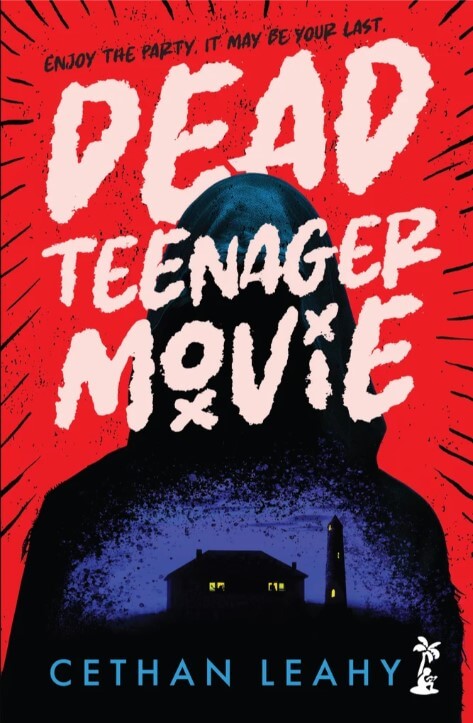
Dead Teenager Movie

In this YA slasher, a horror-obsessed girl joins a group of wealthy teens for a wild weekend in a remote house, only to discover that the local murder rumours may be far more real – and far closer – than she imagined.

She loved scary movies… until she had the starring role.

A spree of murders is haunting Cork city, leaving behind stories of ghost parties and dismembered janitors, of dead diner owners and folkloric entities.

Die-hard horror buff April ignores it all for one perfect weekend of debauchery with Carl and his group of rich, hot and dangerously irresistible friends.

Together, they head to the West Cork countryside for an unforgettable trip before college begins. But in a remote mountainside house with views to die for, the dream party turns into a nightmare. Because some stories don’t stay stories. And someone, or something, inside the house wants more than fear. They want blood.

Little Island
Enjoy the party. It may be your last.
Dead Teenager Movie
Cethan Leahy

This book was inspired by a derogatory term the critic Roger Ebert used to describe crappy slasher movies. Despite spending my youth reading Point Horror and Stephen King novels, I rarely pick up horror books nowadays. Every now and again, a title catches my eye. Also, of course, everything Little Island publishes is worth reading! I was glad I did read this, as it was very satisfyingly twisty turny. Some gory detail, not too explicit but enough to have a reader squirming and desperate to turn the page.

Cethan has shared some of his favourite YA horror reads, and having said I don’t read much horror I have read (and loved) half of them…must get hold of the rest too:

Reader Beware! Some Favourite YA Horror Reads from Cethan Leahy

Teenagers and horror have been a natural combination ever since the 1950s when drive-in cinemas showed movies of plucky young people fighting weird lobster aliens or gelatinous blobs from beyond the stars up to the modern day with Scream and Stranger Things. My new novel Dead Teenager Movie is something of a homage to the teen horror of all varieties, so here is a selection of YA horror from my bookshelf. These suggestions are based on some of the inspirations for my own novel, recent reads and just some personal favourites I think you might enjoy.

POINT HORROR by Various

When I was a teen, my major source of frights was the Point Horror series – made up of individual novels and short story collections that showed that there was no end of scares in high schools across the USA. Filled with dead boyfriends, cursed objects and dangerous school dances, they were the perfect in-between Goosebumps and Stephen King. There were so many of them (over a hundred at last count!) it would be impossible to pick one so I recommend if you see one second hand you like the look of, go for it! One direct influence on Dead Teenager Movie is its scary taglines on the cover. When we needed one for my own front cover, I went back to the OG for inspiration and came up with “Enjoy the party. It may be your last.”

SAY HER NAME by Juno Dawson

Speaking of Point Horror, Juno Dawson’s Say Her Name is a fun recent novel that captures the thrills and spills of a classic Hollywood horror while taking place in the UK. A girl in a boarding school takes part in a Halloween dares to say the name “Bloody Mary” in a mirror – unsurprisingly this has dire consequences. Urban legends are a great source of supernatural scares and this is no exception, combining The Ring with the burst of realistic British YA in the mid 2010s. Recently reissued with a stylish new cover, it’s a great time to say her name.

ESCAPE ROOM by Maren Stoffels

Fans of my book will enjoy Maren Stoffels’s Escape Room, a recent discovery for me. A quick and exciting story translated from the original Dutch, it is the story of a group of friends who find themselves in an escape room that in an extreme case of False Advertising is impossible to escape. Secrets will be revealed and the plot unfolds in a very satisfactory way, delivering twists on a regular basis like clockwork. Bonus points for including a touch of the paranormal with one character who can anticipate injuries that her friends will receive.

PERFECTLY PREVENTABLE DEATHS by Deirdre Sullivan

I am a big fan of Deirdre Sullivan’s work (we share a sometimes publisher in Little Island too) which navigates the world of the creepy and unsettling with humor and an eye for Irish folklore. She has many great books but I chose this one on the basis of an AI bot once mistakenly telling me that my first book and this took place in the same village which was deeply inaccurate but a fun head canon. It concerns two twins who move to a village in the west of Ireland and notice some powers start to develop as they settle into their new home, unfortunately these abilities come with some accompanying dangers…

HARROW LAKE by Kat Ellis

Dead Teenager Movie is a book that’s particularly movie buff friendly and so it’s no surprise that I am a fan of Harrow Lake, a smart and self-aware thriller written by Kat Ellis about Lola, the daughter of a cult film director, who returns to the town where he filmed his famous horror movie. This book explores the world of fright flicks and filmmaking in a fun and eerie manner that builds to a creepy ending.

ANYA’S GHOST by Vera Brosgol

I was always a fan of horror comics, going back to stealing my sister’s Buntys and Mistys to see what dismal supernatural fate has befallen the girls but today is truly a bumper time for YA horror graphic novels. However my personal favourite is Anya’s Ghost, an appealing supernatural tale that explores the truth that the only thing worse than a ghost is being a new and unusual girl in school. With a muted palette and eye-catching art, this is a great read if you are looking for something spooky season-esque but not too frightening.

It was impossible to include everything – in fact here are some honourable mentions: The Haunted by Danielle Vega, I Feed Her to the Beast and the Beast is Me by Jamieson Shea, Birdy by Jess Valance – but I hope at least one of them is your flavour of scares this spooky season!

Dead Teenager Movie is out now from Little Island Books

UK Black History Month 2026

Black History Month is in October in the UK, and this year’s theme is Honouring our Communities, do have a look at the resources on the site. Despite having basically given up on social media now (I occasionally post on Bluesky), I don’t want to stop highlighting my annual faves! I try to prioritise books by UK based Black authors and illustrators but a few from elsewhere or another ethnicity sneak in, and some are a little more than a year old but I only read them since last October…

And for the 31st, have 3 bonus books:

The 25th (!) anniversary edition of Noughts and Crosses by Malorie Blackman
A new Penguin bind up of some of the iconic poetry of Benjamin Zephaniah.
I just received a proof of the 10th Anniversary edition of The Hate U Give by Angie Thomas

Last year’s post is here

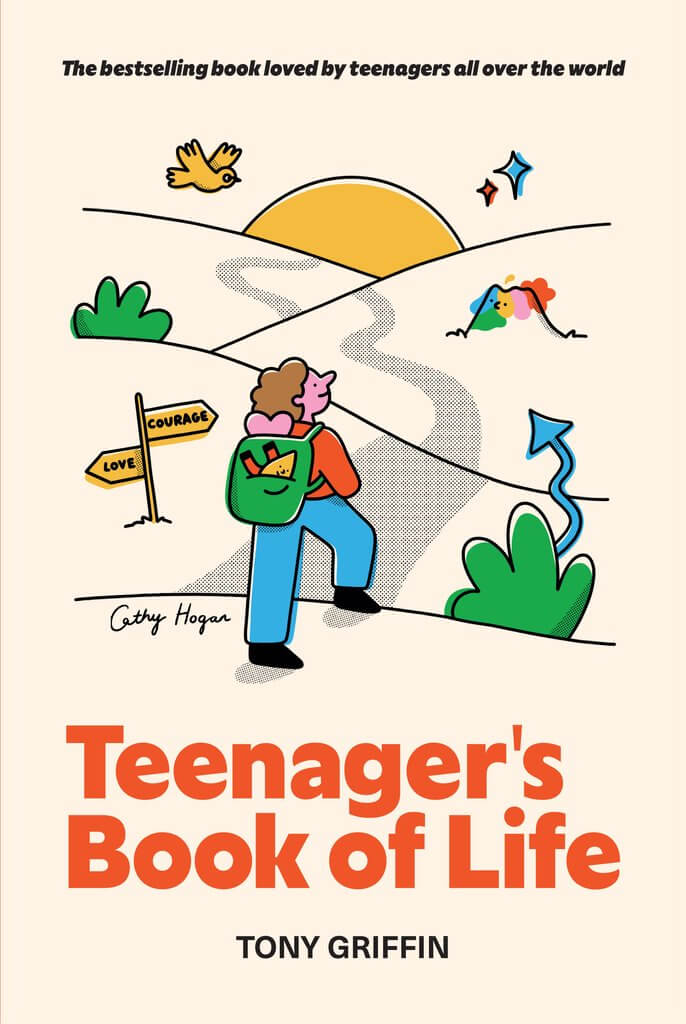
Teenager’s Book of Life

The ultimate guide to being a teenager – filled with real stories, honest advice and illustrated with inspiring quotes to help you navigate growing up with confidence.

Being a teenager has never been simple. In a world shaped by constant pressure, comparison and uncertainty, young people are facing challenges no generation has experienced before. And for parents, teachers and caregivers, knowing how to support them can feel just as overwhelming.

After spending more than a decade listening to the fears, hopes and dreams of over 30,000 teenagers through his work, youth potential champion and former All-Star hurler Tony Griffin wrote the Teenager’s Book of Life as a compassionate, honest and empowering guide for both teenagers and the people raising them.

Filled with powerful real-life stories, practical wisdom and inspiring quotes to live by, this vibrantly-illustrated book speaks directly to young people in a voice they can trust. It encourages self-discovery, resilience and self-acceptance – without ever pretending life is easy.

From everyday pressures to life-changing moments, the book explores:

  • Emotions & Feelings
  • Dreams & Goals
  • Friendship
  • Family
  • Love
  • Self-Esteem & Self-Acceptance
  • Grief & Loss
  • And more.

The Teenager’s Book of Life is a book to return to again and again – a reminder to every young person that you are not alone, that your struggles are valid and that you are capable of becoming everything you were born to be.

Little Island

Something a bit different for you today: an extract from a new edition of this wide ranging and thoughtful guide for young people.

The book is published in the UK tomorrow (15th October)

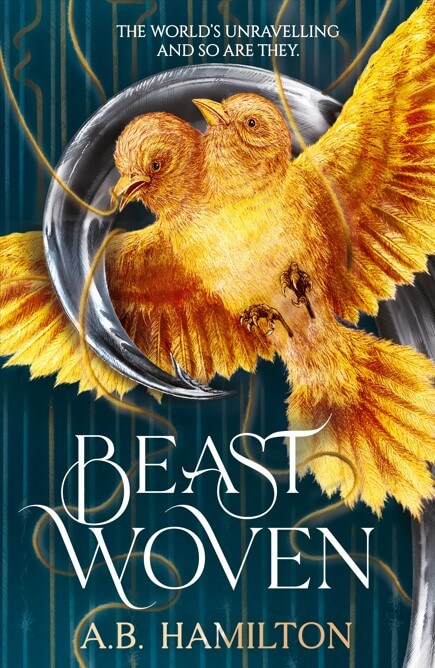
Beastwoven by A.B. Hamilton

Two girls forced to share a body as they hunt and destroy beasts. The irony? They’re the very beast they must destroy. The first in an incredibly written and dazzlingly original YA fantasy duology, perfect for fans of Leigh Bardugo and Tomi Adeyemi.

Lia and Ali are trained to use their elemental weaving powers to destroy burl beasts – mindless, bloodthirsty monsters created when the threads of their world tangle together. Their secret? They themselves are a burl beast: twin sisters, forced to share one body. Quiet and reserved Lia controlling by day. Outspoken and abrasive Ali leading by night.

When news arrives that an elusive criminal is creating bespoke burl beasts by practising the illegal magic that could finally separate them, the girls jump at the chance to join the team sent to investigate. But as the girls get closer to their new flock and, more importantly, two different boys, it becomes harder to hide who – or what – they really are.

Delving deeper into the dangerous world of flesh-weaving and political intrigue, the girls get closer to the answers they so desperately seek. But is the price of their separation truly worth the risk?

Hachette

I’ve not seen it talked about much, but I really enjoyed this debut YA from London (UK) based A.B. Hamilton. Sometimes it felt a comfortable fantasy, I knew where it was going, then a spanner would be thrown in the works and I’d be surprised. I was very satisfied with the conclusion (though also left wanting more…). I have a guest post about his writing process for you to enjoy just in time for publication next week!

Ask a hundred writers about their process, and you’ll get a hundred answers. Ask me about my process on a Monday, and you’ll get a different answer than if you’d asked me on Saturday.

Writers tend to fall into two camps (forgive me if you’ve heard this before). You have your gardeners, those who plant the seed of an idea in the soil, give it some water, and watch it bloom. They sit down with a premise, maybe some interesting characters, and see where the story takes them. Then you have the architects, those who meticulously plan the details of their story before they begin writing in earnest. The terms were popularised by an obscure, up-and-coming writer, George R. R. Something – and, for a long time, that’s what I believed writing was: something you either planned or made up as you went along.

Beastwoven started with a simple premise: two girls sharing one body. In the beginning, I fancied myself an architect. That approach made sense to me. Plan everything out, then write it. Simple, right?

So I started planning. I mapped out the characters, outlined their journeys and arcs, worked through the setting, the world, and the magic system. Then I started writing. Six months and half a book later, I realised my mistake.

My story was too big. Too many characters, too many things happening over too great a distance. Ideas that looked great in a plan turned into a sprawling, chaotic mess once it came time to write them.

I had to start again. It was painful, but I knew the story just wasn’t working. Still, I was determined to finish the book. If the architect had failed, I’d put on the gardening gloves and try that approach. I went back to my premise (two girls sharing one body), threw out the rest, and wrote whatever came to mind.

And that approach worked, for a while. Then I ran into different problems. I wrote myself into corners I couldn’t get out of. I introduced ideas that were interesting in the moment but went nowhere. There were glaring plot holes and obvious inconsistencies with the magic. I needed a plan – not a detailed blueprint like the first go-around, but key plot points and beats, character arcs, a beginning, a middle, and an end.

Looking back, it was a combination of both approaches that eventually got the book over the line.

So what does that say about my process? That I’m part architect and part gardener, yes. But more importantly, writing this book made me realise the whole gardener/architect split doesn’t describe what writing actually is – at least not for me.

It was Stephen King’s On Writing that helped me think differently about how we find our stories.

For King, writing is excavation. Writers aren’t architects drawing blueprints or gardeners planting seeds; they’re paleontologists scouting the site, readying their tools, then digging up the story buried beneath the earth one bone (or word) at a time.

That’s the best way to explain my process – not just how I write, but what writing is to me. Stories aren’t something we create. They’re pre-existing things buried somewhere deep, and it’s our job to dig them up and carry them from one world to the next without cracking too many pieces on the way.

When you realise it’s not your job to grow or plan a story, but simply to discover it, then the words flow so much more freely.

Planning, then, is just another tool in the box. That’s why on Monday I might sit and let the words flow while two characters hash out an argument, but on Saturday, when the characters have a detailed heist to enact, I’ll get out the blueprints and plan the next chapter or two. Ultimately, finding your process is about finding what works not just for you, but for the moment, and for the story.

A Note on Reading and Mental Health

I love reading because, even when you’re lonely, your favourite characters feel like they’re there with you. Or, rather, you feel like you’re there with them. You go on their journeys with them, feel their fears and their thrills. For a brief moment, you’re somewhere else, with someone else, and that has actual benefits. Studies back this up: immersive reading lowers cortisol and gives your brain genuine respite. But the deeper gift is empathy. It’s not like watching a movie, where you simply see what the character does on the outside. Reading brings you inside their heads, and inhabiting another mind rewires how you perceive real people. You learn to hold contradictions and forgive flaws, because you’ve seen the world first hand through another’s eyes. And, ultimately, when you read enough books and forgive enough characters for their mistakes, you might finally start to forgive your own mistakes, too.

A.B. Hamilton

Beastwoven is published in the UK on the 8th October by Hachette

Traitors’ Nest by Frances Hardinge

Castles traded places sometimes. Everyone knew that. It was always something that might happen, except that it never had.

Until all of a sudden it did.

Far above the valleys and villages of the Kingdom of Thaletal, a Great Game is played. Players move castles around the realm like chess pieces – and the ordinary villagers are mere pawns at the whim of their tactics.

When 15-year-old Burr’s peaceful village is disrupted by the arrival of an ominous new castle, he decides he’s had enough. But what starts as a plucky coup soon escalates – and soon the castle is wrenched away to a far-flung corner of the kingdom, where whispers mount of a mysterious ancient maiden whose magpies collect her debts at dangerous prices.

Here, the stakes are higher than the tallest turrets, and every move counts. Burr must work with his sisters and friends – and rely on the unexpected help of a strange and intriguing heiress – to unravel the secrets of the Magpie Maiden and the origins of the Great Game before he becomes just another casualty of the Players’ deadly contest.

First Ink
Illustrations by Nick Hayes

I love Frances Hardinge, she is without a doubt my favourite living author and a new book from her is a bright spot in a dark world. I was lucky enough to ask her a few questions in advance of publication of Traitors’ Nest, her brilliantly inventive new YA.

I am always astonished by the premise of your books, absolutely wild ideas that couldn’t possibly go anywhere but somehow they work. Do you have ideas percolating and distracting you or are you able to focus on one at a time?

Thank you very much!

I always have a store of ideas that are waiting for me to find a use for them. Many of these are what I think of as ‘partial ideas’. These are ideas that aren’t robust enough to justify a story by themselves, but which might come to life in combination with other nuggets of inspiration. In fact, a story concept is often the union of several ‘partial ideas’ combining in the right way and galvanising my imagination.

Usually I work on one project at a time, with a fair amount of tunnel vision. The other ideas in my store usually take a number and wait politely for their turn. Sometimes they wait for years.

How did this story in particular begin, and is the process much different between books?

I came up with the main concept of Traitors’ Nest when I was on holiday in French Catalonia with friends. We had been visiting quite a few wonderful castles on both sides of the French-Spanish border, some of which had changed hands several times as different forces fought for control over the area.

I wondered what it would be like being an ordinary local in the area. What could they do but duck and cover when a new army marched into the area? And then, when the dust settled, they might find that the local castle had fallen, and that the whole area was now ruled by somebody new. How frightening would that be? Would the new leader be reasonable or cruel? Would he inflict new taxes, new rules, or a manhunt for those loyal to the last ruler?

Then I asked myself, what if the change was even more sudden and complete? What if the poor locals woke up one morning and discovered an entirely new castle standing in the place of the old?

How easily do the characters come to you? Do you have a favourite?

I find it a lot easier to understand my characters once I have a grasp on my setting. People don’t pop into existence from a void, they are shaped by the world in which they live.

In some cases I do get a strong sense of a character’s personality quite early, though. I can hear their voices quite clearly in my head, and in some cases (Eponymous Clent in Fly by Night, Myrtle in The Lie Tree) I have trouble getting them to shut up! In Traitors’ Nest, the main character Burr has an eleven-year-old sister called Pirin. She is quite fiery and strong-willed, sometimes unreasonable and at other times startlingly astute. I had a clear sense of her personality from a very early stage.

When it comes to the more complicated and cagey characters, I sometimes I have trouble persuading them to ‘talk to me’. In Traitors’ Nest there’s a teenage character called Lady Berenice who is quite self-contained, calculating and complex, and I definitely had trouble getting her to open up to me! (Characters like that have no respect for the fact that I’m their author, and need to know what they’re thinking.)

My favourite character in a book is nearly always the protagonist, even though my relationship with them is usually turbulent. I inflict countless torments on them, testing them to breaking point and exposing their dark sides and rawest emotions. Burr, the main character of Traitors’ Nest, is a decent, conscientious boy who works hard and loves his family. He definitely doesn’t deserve everything I put him through. But of course the ordeals and challenges he face are the means by which he comes to understand himself better, so that he can decide who he wants to be.

There’s a supernatural character in the book called the Mapgie Maiden, who subjects the heroes to various gruelling tests so that they can prove themselves. I suppose I’m a little like the Maiden, in terms of the way I treat my characters!

What kind of school/library events do you prefer to do?

When I visit schools, I sometimes give presentations, using a particular book as a way of talking about inspiration, my writing process, and so forth. However, I slightly prefer ‘in conversation’ events or interviews, because I think they’re a bit more interesting for the audience. A two-way discussion is often more fun than watching one person talking non-stop!

I also enjoy running workshops, though I try to limit these to no more than thirty students. That seems to be a good size for discussions. I’m often deeply impressed by the story ideas that that students concoct at very short notice, and sometimes the conversation has gone down some interesting rabbit holes. One group ended up having an in-depth discussion of the nature of fate, prophecy and free will…

Whenever I visit a school, I always love seeing the library. A school needs a library the way that cities need green spaces.

Do you get much opportunity to hear the reactions of readers?

Writing is a strange job. Sometimes it feels like we’re performing to an audience we can’t see, and who might not even exist. We just have to take it on faith that they’re out there.

Having said that, I do sometimes hear from my readers. I meet them at literary festivals, science fiction conventions and school visits. I hear from them through social media, or the contact form on my website. Sometimes I even receive paper letters from other countries, forwarded by my agent. There is still something special about a real letter, particularly if it also includes fan art, or something of that sort!

When you are writing, does background noise help or distract?

I usually like to have as few distractions as possible. Most of my writing takes place at the kitchen table, with no music playing. Occasionally, though, I will start to associate a particular piece of music with a certain book, character or scene. When that happens, I play the same track over and over again as I write. (I use headphones, so that I don’t drive my neighbours up the wall.)

What are you reading at the moment and who would you recommend it to?

I was lucky enough to be sent an advance proof of Liz Hyder’s The Teller of Tall Tales. It’s a haunting and touching story told in the second person, featuring the new friendship between the nameless teenage protagonist and the grandmother they have only just met. There are unhealed wounds in the family, but the friendship offers an escape, and the grandmother has a talent for telling stories…

What can we expect from you next?

As you might expect, I have started work on something else. For now, though, I’m afraid I will need to be mysterious about it!

Frances Hardinge, photo credit: Urszula Soltys

Traitors’ Nest by Frances Hardinge featuring interior illustrations by Nick Hayes is published with First Ink on Thursday 27 August (RRP £16.99).

Zero Override by Steve Blackman

 i, Robot meets Alex Rider: a high-stakes adventure debut for readers of 10+, featuring a group of young underground hackers who steal from the rich in a world populated with bots and AI.

Scholastic

In a near-future London where humans and humanoid bots live side by side, a sophisticated virus is infiltrating the national system. If it uploads fully, every intelligent machine in the country – from home assistants to hospital bots to android enforcers – will shut down.
Zero, a thirteen-year-old hacker whose day job is to sneak into high-security server rooms and ‘liberate’ funds from undeserving corporations, has a serious distrust of bots – and no real interest in saving the world. But the virus threatens the life of Grace, his younger sister, who – as a result of the car crash that killed their parents ten years ago – now has a machine heart.
No one will work harder than Zero to stop the upload. Except perhaps Andi, a mysterious humanoid bot who has appeared with secrets of his own. Zero doesn’t trust him. He doesn’t even like him. But with only hours on the clock, the only way to protect Grace might be to partner up. And along the way, he must come up against MI6 – and unravel his own past…

We have a great guest post from the author of this thrilling Robin-Hood-style adventure:

The Curators of Curiosity

There’s a box my wife wants me to send to recycling. Spoiler alert: it’s never going to happen. That box has been with us through house moves and renovations. It’s been with me since I was 14. Inside are hundreds of copies of 2000AD, which is a comic that would arrive every Saturday morning and I’d savour it until the next one came.

Back then my dad didn’t really understand. He knew why I loved books and films because he loved those things too. But comics, Dungeons & Dragons and Choose Your Own Adventure stories? He thought they were frivolous.

He was wrong, of course. And what he couldn’t see was that I was mining all those mediums for storytelling. That was the connective tissue between them all. Each one of them offered worlds to explore, characters to follow and problems to solve. They taught me how stories work.

The same remains true for many young people today, especially boys. The difference is that the storytelling ecosystem has become much bigger. Manga, gaming, YouTube, podcasts, graphic novels and social media all compete for attention alongside books. Yet too often we treat these interests as separate, when in reality they are connected by the same motivation: the desire for great stories. And that is where libraries represent one of our most valuable – and perhaps most underused – resources.

For too long, discussions about reading have fallen into a false choice between books and everything else. But libraries have the unique power to bridge those worlds. They are one of the few places where someone can discover a graphic novel, borrow an audiobook, attend a gaming session, explore coding, research a favourite topic and leave with a novel that speaks directly to their interests.

If someone walks into a library because they love Minecraft, Roblox, manga or AI, the goal shouldn’t be to persuade them to abandon those interests. The opportunity exists to show them where those interests can lead. Libraries can make connections that many people – not just young people – don’t make for themselves: between gaming and storytelling, between technology and imagination, between curiosity and reading.

That matters because today’s young readers are among the first generation who will never know a world without AI. They are growing up surrounded by intelligent systems, algorithms and technologies that shape their everyday lives. Naturally, they have questions. What happens when technology fails? Can AI be trusted? What does it mean to be human in a world filled with intelligent machines?

Interestingly, these are questions that young people are already exploring through entertainment. Stories about technology going wrong are often the best stories. Whether it’s rogue systems, failed experiments or worlds thrown into chaos, we’re drawn to them because malfunction tends to be more interesting than perfection. And these stories provide a safe space to explore uncertainty, risk and responsibility.

When I wrote my debut novel, Zero Override, I wanted to create exactly that kind of experience. My aim was to attract reluctant readers, particularly boys, through the things many of them already love: exciting tech, high-stakes adventure, and young people challenging powerful systems. At the same time, I wanted to explore the idea that technology itself is neither inherently good nor bad. Ultimately, it depends on how we choose to use it.

The challenge is not that young people have stopped loving stories. Far from it. They consume stories every day across multiple formats and platforms. The challenge is helping them recognise reading as part of that wider landscape.

Libraries are uniquely placed to do exactly that. They can meet young people where they are, validate the interests they already have and guide them towards new discoveries. In a world overflowing with content, libraries remain trusted curators of curiosity. And that makes them far more than places that lend books. They are gateways to stories in all their forms.

Zero Override is published in the UK by Scholastic, and is out now!

Runaway Road

Three life-changing minutes. Two siblings on the run. One choice that changes everything.

Ezra is sixteen. He’s no stranger to crossing the line, but this time it’s serious – and someone might be dead. To escape justice, he’ll have to cross another line: the Northern Irish border. But that means leaving behind the only thing that really matters. His little sister, Evie.

Evie is nine and sees it differently. When she was three, Ezra took her into care, into safety – and to the bookshop that became her lifeline. Ezra understands her. Why shouldn’t she go on the run with him now?

Ezra and Evie are used to feeling invisible. Now they have to become invisible for real.

Set in Derry~Londonderry and Donegal along the Wild Atlantic Way in 2023, Runaway Road is my third novel. My books are all available in independent bookshops, major book chains and online. Please shop local if you can!

Sue Divin

A gorgeous YA, set in contemporary Northern Ireland, covering all sorts of “issues” with a deft touch. It is heartbreakingly sad in parts, but also thoughtful, warm, and a gripping read. Sue Divin has produced a wonderful trailer:

and also wrote a piece for us, which I’m sharing just in time for publication on 7th May:

Three life-changing minutes. Two siblings on the run. One choice that changes everything…

In the north-west of Ireland, along the Wild Atlantic Way, there is a sign that says, ‘Welcome to Amazing Grace country.’ That sign sparked some of the thinking behind Runaway Road. Giving Grace, AKA second chances, or ‘cutting people some slack,’ as protagonist Evie puts it, is one of the themes at the heart of the book.

I’m often inspired by the stunning landscapes in the north-west of Ireland, and the ‘Wild Atlantic Way,’ so, when pondering ideas for my third novel, I wanted to set it in Derry and Donegal. This location allowed me to explore the issues facing Northern Ireland (and these islands) about borders and identity. Walking local beaches, I discovered the connection with John Newton – his near-death experience in a storm off the coast, conversion to Christianity and transformation from slave-trader to abolitionist. Being given a second chance allowed him to make a huge, positive difference. Do we give people today that space, that grace, to change? What if a teenager messes up badly? Are they categorised for life? What if, like protagonist Ezra, they didn’t have much of a chance in the first place?

As a writer, I thrive on big themes and emotions blended with hope, humour and a story that keeps readers turning the pages. Whilst my writing inspiration often comes from a sense of place; contemporary issues; and character voice, I’m also seeking something universal that teens (and adults) across the UK and Ireland can connect with. In Runaway Road, that’s about belonging, family and friendship. Ezra (16) and Evie (9) have struggled all their lives to fit. Raised in care, they are used to feeling invisible, but when Ezra commits a crime and goes on the run with Evie, the siblings have to become invisible for real. There are over 4000 children in the care system in Northern Ireland, and one in every 17 school-age children here, like Evie, has an autism (ASD) diagnosis.

Runaway Road is also about inclusion and diversity. Northern Ireland is a place of increasing diversity, and the legacy of Brexit has thrown up big questions. Ezra and Evie are broadly from the British identity in Northern Ireland – something rarely, or stereotypically, represented in British and Irish literature. Alannah’s mixed-race character also poses the question of how we define Irish, Northern Irish or British today. How inclusive are we? I’ve done many author workshops and Q&As with teen readers. In Northern Ireland the response is often that, for the first time in a book, readers ‘feel seen’. Wider afield in Great Britain or the Republic of Ireland the novels provoke connection and empathy around identity as well as a questioning of why Northern Ireland, like Ezra and Evie, is almost invisible. How much does contemporary Northern Ireland feature in your library?

I find many teens are curious to learn more. Whilst textbooks teach the head, novels reach the heart. I’m impressed to see how many teen readers make connections between post-conflict Northern Ireland and all sorts of complex identity, diversity, justice and reconciliation issues in their own lives and communities.

What also makes my heart sing is how teen readers relate to the humour and voices of my characters. (And yes, I’m often asked about ‘Derry Girls’.) The plot, the pace, the twists and turns, the dry wit and self-depreciating humour – it’s kind of part of the culture here and I love ‘putting it on the page’ as Evie would say. I’m into writing the big rollercoaster emotions – and with all the hormones, teens love reading them. Like my previous novels, Guard Your Heart and Truth Be Told, I hope Runaway Road makes readers think, smile, cry and laugh out loud.

Northern Irish YA writing is currently going through a golden phase. Jenny Ireland’s novels, The First Move, The Boy Next Door are popular fiction, highly inclusive of disability. Sheena Wilkinson writes from boarding schools to historic battles for women’s emancipation. Shirley McMillan writes contemporary issues and diversity. Her most recent novel, Grapefruit Moon, is reminiscent of Dead Poets Society. Kelly McCaughrain’s Just Another Dead Boy poses the question if you knew when you would die, would it change how you live? Stephen Daly’s début The Last Death Poet is an urban fantasy set in post-conflict Belfast, and Siobhán Murphy’s Hedge Witch is a queer dystopian fantasy in a world when all the magic used to be locked safely behind a hedge. If you thought that Northern Irish YA was only Joan Lingard’s 1970s Beyond The Barricades, please think again!

For more on books by Northern Irish writers and/or illustrators, check out the 2026 Northern Lights guide published by Children’s Books Ireland and endorsed by the British and Irish Children’s Laureates.

Sue Divin

Runaway Road Publishes 7th May, First Ink

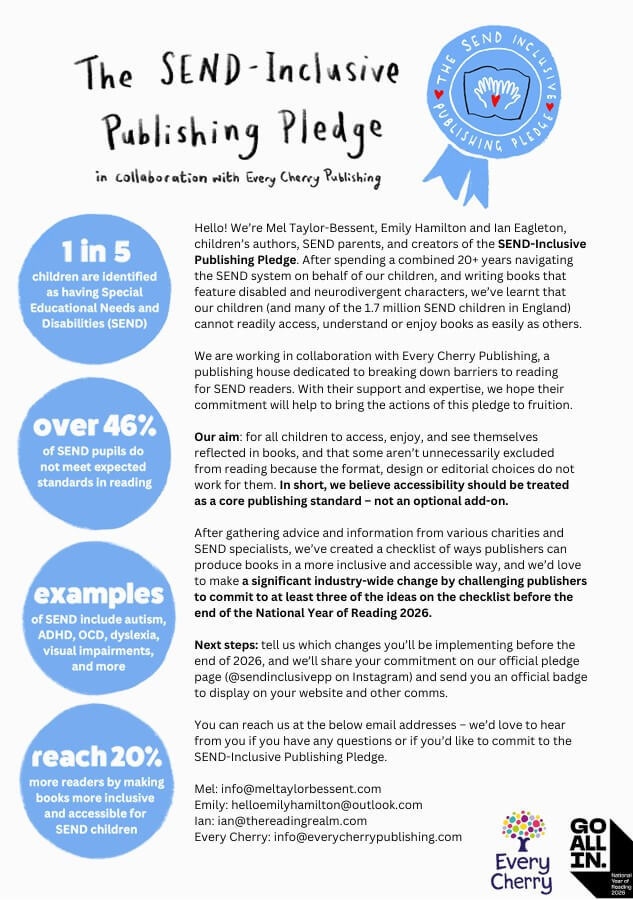
The SEND-Inclusive Publishing Pledge

Our aim: for all children to access, enjoy, and see themselves reflected in books, and that some aren’t unnecessarily excluded from reading because the format, design or editorial choices do not work for them. In short, we believe accessibility should be treated as a core publishing standard – not an optional add-on.

Mel Taylor-Bessent, Emily Hamilton and Ian Eagleton, children’s authors, SEND parents, have created the SEND-Inclusive Publishing Pledge, working in collaboration with Every Cherry Publishing, a publishing house dedicated to breaking down barriers to reading for SEND readers. I think this is a great idea, a number of their ideas are the kind of thing that I’ve been wishing for for the students in my library!

[if on a desktop, right click the individual images to open them and zoom in]

Publishers can reach them at the below email addresses with any questions or to commit to the
SEND-Inclusive Publishing Pledge:
Mel: info@meltaylorbessent.com
Emily: helloemilyhamilton@outlook.com
Ian: ian@thereadingrealm.com
Every Cherry: info@everycherrypublishing.com

Black History Month UK

October is Black History Month in the UK, this year the theme is Standing Firm in Power and Pride and there are some brilliant resources and articles on the official website.

I used to do a thread on twitter of the best books by (mainly) Black British creators I’d read in the preceding year, then 2 years ago wrote this blog post, then somehow last year passed me by…In November last year CLPE released their 7th Reflecting Realities survey about publishing in the UK in 2023 demonstrated what I thought I’d noticed: that the uptick in publishing of diverse voices was faltering:

For the first time in its history, the annual CLPE Reflecting Realities survey reports an overall drop in the percentage of racially minoritised characters featured in published children’s books reviewed – from 30% in 2022 to 17% in 2023.

The report shows the number of racially minoritised main characters has dropped by half to 7% in 2023, compared to 14% in 2022.

The more recent IBC Excluded Voices report makes a similarly dispiriting observation. So, I thought it important to highlight some amazing books published over these 2 years!

Thirst

Nobody talks about the strange happenings in Maimsbury. No one speaks of the hooded figures glimpsed in the woods, nor the children’s game that went so horribly wrong. But most of all, nobody dares whisper their doubts about the river they have worshipped for centuries.

Like everyone in Maimsbury, Gorse is used to the sacrifices made every spring to the River Yeelde. The life of a farm animal – in return for a year of plenty – seems a fair trade. That is, until a tragedy leads Gorse to a blood-curdling discovery.

Because this year is a Brim Year, and after giving so much, the river needs more than an animal’s life to sate its thirst…

Pushkin Press
Cover illustration by Natalie Smilie

This was actually the first book by Darren Simpson I’ve read, though I’m not sure why because I’ve seen lots of praise on social media from teachers and librarians for him on social media. I think he might be one of those authors I avoided because where others rave I’m often ‘meh’…but I was certainly biting my nose off to spite my face because, when I sat down to read this, I was hooked from the first page and had to finish it the same day. It raises some big thoughts about whether it can be justifiable to do a bad thing, how decisions affect more than just your own loved ones, and having the courage to say no. All wrapped up in a wonderfully gruesome folklore-ish tale set in the vividly imagined world of a small village.

I asked Darren a few questions:

You write dark but hopeful stories. Do you start with a theme or the world or a character…or something else?

Each book seems to have started with a different thing. Scavengers was inspired by the sight of cats scrapping over a sandwich at a recycling centre, which got me thinking about animals and humans living on landfill. The Memory Thieves was driven by the desire – prompted by the time I crashed my car and went through a rough patch – to encourage emotional openness in young people. In contrast, Furthermoor evolved from the conundrum of how to use a vivid, fantastical setting in an urban, realist story. And my latest book, Thirst, came from an itch to write horror (leaning into that darkness, I guess), and from a growing appreciation of folklore and the part it still plays in our lives today.

As you can see, I have worryingly little control over where my inspiration comes from. But one thing I do have is the instinct to spot it, grab it and see where it takes me.

Without spoilers, are there any bits that you thought might be too scary or that editors asked you to tone down?

There are a couple of scenes I thought I’d have to tone down or take out altogether. But it turned out I didn’t have to do any of that.

As much as Thirst has its grisly moments, they’re never excessive or gratuitous. There’s one scene in particular I thought I’d never get away with in young fiction. But my editor, Sarah Odedina of Pushkin Press, didn’t bat an eyelid. When I quizzed her over this, she said the scene plays a powerful part in saying a lot about a certain antagonist. And as much as the scene is heartbreaking, its events are implied rather than described.

So again, I don’t feel Thirst is gratuitous. Any nastiness in it serves a purpose, not only in saying something, propelling the story or stirring readers’ emotions, but also in delivering within the horror genre. I love horror stories, and would feel let down if I read one that didn’t at some point leave me a little shaken or disturbed. That’s all part of the thrill, isn’t it? That’s why we watch horror movies, ride rollercoasters and tell spooky stories around the campfire.

What kind of author event do you enjoy doing most?

As much as I love giving author presentations, it’s usually creative workshops that give me the biggest buzz. It’s always a joy to watch students warm to a creative task and come up with such brilliant, original, funny things. My workshops focus more on teamwork, imagination and invention than on producing written work, and the freedom of expression that this allows pupils tends to nurture a relaxed, open, even gleeful atmosphere. Encouraging young people to see how much fun inventing and writing can be is the most rewarding thing, and their engagement always leaves me feeling inspired – even though the inspiring is supposed to be my job!

What are you reading and who would you recommend it to?

I’m currently reading Hyperion by Dan Simmons. It’s epic, ultra-ambitious sci-fi and it’s blowing my mind. A perfect mix of literary goodness and downright entertainment. I’d recommend it to anyone who likes their sci-fi lofty, eclectic and original. It’s very adult in places, though. In terms of books for younger readers that I’ve recently enjoyed, The Twelve by Liz Hyder, Greta by Manon Steffan Ros and The Worlds We Leave Behind by A.F. Harrold and Levi Pinfold all come to mind. I’d recommend each of them heartily.

What will we see from you next?

I’m working on something quite special – and very different – with illustrator Keith Robinson. We’ve been chipping away at this project for a couple of years now, and it’s going to be so exciting to finally see it become a reality next year, thanks to Puskin Press. I can’t say too much just yet, but it’s going to be eerie, poignant, and more than a little bold. I can’t wait for folk to see it.

Thirst is published this week by Pushkin Press. Thank you to Vicki Berwick for organising a review copy and the Q&A.