A total of 36 books have been recognised, with 19 books selected for the Yoto Carnegie Medal for Writing longlist, and 18 for the Yoto Carnegie Medal for Illustration – common themes include hidden worlds and alternate realities, forgotten histories highlighted or reimagined, and environmentalism and the power of nature. Click here to read more about the fantastic books that have been chosen.
The lists include:
One title longlisted in both Medal categories – Tyger by SF Said, illustrated by Dave McKean, published by independent publisher David Fickling Books. Said and McKean were previously nominated together for Phoenix in 2013. McKean has also been shortlisted six times previously.
Four previous winners of the Medal for Illustration; two-time winner Sydney Smith for My Baba’s Garden, Bob Graham for The Concrete Garden, Jon Klassen for The Skull and Catherine Rayner for The Bowerbird.
Former Carnegie Medal for Writing winner Anthony McGowen for Dogs of the Deadland, a tale of survival inspired by the 1986 Chernobyl nuclear disaster.
Previous Shadowers’ Choice Medal for Illustration winner, Sharon King-Chai for Colours, Colours Everywhere, a tactile picture book teaching children about different colours, written by Julia Donaldson.
Waterstones Children’s Laureate and previous shortlistee Joseph Coelho for The Boy Lost in the Maze, one of four verse novels recognised for the Medal for Writing. The other three are by New York Times bestselling author Kwame Alexander and debut authors, Cathy Faulkner and Tia Fisher.
Eight-time shortlisted author Marcus Sedgwick, who has been longlisted posthumously for Ravencave, the follow up to Wrath, longlisted in 2023.
A further four previous shortlistees; Kwame Alexander (2019), Phil Earle (2022) and Candy Gourlay (2019) for writing and Poonam Mistry,who has been shortlisted three times (2019, 2020 and 2021) for illustration.
18 British or dual-British heritage authors in the Writing category.
Seven titles from Walker Books for the Illustration medal.
Maura Farrelly, Chair of Judges for The Yoto Carnegies 2024, said:
Huge congratulations to all of our longlisted authors and illustrators in what has been a fantastic year for books for children and young people. It has been a joy and a privilege to chair an enthusiastic and dedicated panel of judges as we read, debated and considered the nominated titles before arriving at two exciting longlists. These are books that play with language and show how powerful words and illustrations can inspire imaginations and encourage empathy as well as helping young readers make sense of an increasingly confusing world and give them hope for a brighter future.
The 2024 Yoto Carnegie Medal for Writing longlist is (alphabetical by author surname):
The Door of No Return by Kwame Alexander (Andersen Press)
The Song Walker by Zillah Bethell (Usborne)
Away with Words by Sophie Cameron (Little Tiger)
The Little Match Girl Strikes Back by Emma Carroll, illustrated by Lauren Child (Simon & Schuster)
The Boy Lost in the Maze by Joseph Coelho, illustrated by Kate Milner (Otter-Barry Books)
Choose Love by Nicola Davies, illustrated by Petr Horáček (Graffeg)
Electric Life by Rachel Delahaye (Troika Books)
Until the Road Ends by Phil Earle (Andersen Press)
Digging for Victory by Cathy Faulkner (Firefly Press)
Crossing the Line by Tia Fisher (Bonnier Books UK)
Wild Song by Candy Gourlay (David Fickling Books)
Boy Like Me by Simon James Green (Scholastic)
Safiyyah’s War by Hiba Noor Khan (Andersen Press)
Steady for This by Nathanael Lessore (Bonnier Books UK)
The Swifts by Beth Lincoln, illustrated by Claire Powell (Penguin)
Dogs of the Deadland by Anthony McGowan, illustrated by Keith Robinson (Oneworld Publications)
Tyger by SF Said, illustrated by Dave McKean (David Fickling Books)
Ravencave by Marcus Sedgwick (Barrington Stoke)
Greenwild: The World Behind the Door by Pari Thomson, illustrated by Elisa Paganelli (Macmillan Children’s Books)
The 2024 Yoto Carnegie Medal for Illustration longlist is (alphabetical by illustrator surname):
The Tree and the River by Aaron Becker (Walker Books)
Wolves in Helicopters by Paddy Donnelly, written by Sarah Tagholm (Andersen Press)
April’s Garden by Catalina Echeverri, written by Isla McGuckin (Graffeg)
The Concrete Garden by Bob Graham (Walker Books)
Deep by Stephen Hogtun (Bloomsbury Children’s Books)
Lost by Mariajo Ilustrajo (Quarto)
Colours, Colours Everywhere by Sharon King-Chai, written by Julia Donaldson (Macmillan Children’s Books)
The Skull by Jon Klassen (Walker Books)
The Wilderness by Steve McCarthy (Walker Books)
Tyger by Dave McKean, written by SF Said (David Fickling Books)
To the Other Side by Erika Meza (Hachette Children’s Group)
The Midnight Panther by Poonam Mistry (Bonnier Books UK)
The Bowerbird by Catherine Rayner, written by Julia Donaldson (Macmillan Children’s Books)
Global by Giovanni Rigano, written by Eoin Colfer and Andrew Donkin (Hachette Children’s Group)
The Search for the Giant Arctic Jellyfish by Chloe Savage (Walker Books)
My Baba’s Garden by Sydney Smith, written by Jordan Scott (Walker Books)
The Boy Who Lost His Spark by Daniela Jaglenka Terrazzini, written by Maggie O’Farrell (Walker Books)
What Feelings Do When No One’s Looking by Aleksandra Zając, written by Tina Oziewicz (Pushkin Press)
London, Thursday 1 February 2024.Bookshop.org is today launching the charitable initiative Read It Forward, in partnership with BookTrust, where 10% of every sale of a children’s book made in February will be donated to the charity, while also supporting independent bookshops as per the platform’s ongoing mission.
Launching on the first day of the month, just in time for half-term, and lasting until the end of February, Read It Forward encourages all parents, teachers, guardians and educators to consider purchasing books from Bookshop.org, with a portion of the profit of each kids’ book donated to the UK’s largest children’s reading charity.
The aim of the initiative is to inspire a love of reading in the next generation, with the money raised by the Bookshop.org drive going towards BookTrust’s work of getting children reading – especially those from low-income families or vulnerable backgrounds.
Each year BookTrust reaches millions of children with books, resources and support for families to get every child reading regularly and by choice. A research-led charity, their specially designed programmes and products help children from all backgrounds experience the many benefits of shared reading. In addition, every sale on Bookshop.org supports independent bookshops across the UK, giving them an additional stream of income and keeping them thriving.
Lizzie Catford, Director of Children’s Books at BookTrust, said: “We’re thrilled to partner with Bookshop.org on the Read it Forward initiative, a wonderful opportunity for readers to make a meaningful impact. This collaboration not only supports independent bookshops, vital pillars of our literary community, but also contributes directly to our mission of fostering a love of reading among children, particularly those facing challenges. At BookTrust, we believe in the transformative power of shared reading, and the funds raised through this initiative will support our vital work across England, Wales and Northern Ireland. This wonderful partnership emphasisesthe collective strength of readers, booksellers, and charities in building a brighter reading future for all children.”
Nicole Vanderbilt, Managing Director ofBookshop.org UK, said: “This February, you can feel even better about buying books online. We are incredibly excited to launch a charitable book drive with BookTrust, marking our first collaboration with them. This month, we are giving parents and educators one more reason to buy books from Bookshop.org. In addition to supporting independent booksellers across the UK, this month we will be donating 10% of each children’s book sale to BookTrust, contributing to their mission to develop a love of reading.”
A beautiful and uplifting story from L.D. Lapinski, author of The Strangeworlds Travel Agency, about how to make your own place when the world doesn’t think you fit anywhere.
Jamie Rambeau is a happy 11-year-old non-binary kid who likes nothing better than hanging out with their two best friends Daisy and Ash. But when the trio find out that in Year Seven they will be separated into one school for boys and another for girls, their friendship suddenly seems at risk.
And when Jamie realises no one has thought about where they are going to go, they decide to take matters into their own hands, and sort it all out once and for all.
https://www.ldlapinski.com/jamiebook
cover illustration by Harry Woodgate
I adored L.D. Lapinski’s debut (trilogy) about the STRANGEWORLDS TRAVEL AGENCEY, and when their next title was announced I was surprised by how different it was as I’d already pigeonholed them as a fantasy/adventure author (sorry…though I am enjoying their return to fantasy in ARTEZANS: THE FORGOTTEN MAGIC, publishing soon!). Last year JAMIE was published and I adored it equally but differently. To celebrate JAMIE being one year old, and to kick of LGBT+ History Month in the UK, I have a wonderful personal guest post from L.D. which explains how JAMIE came to be:
How old were you when you first saw a character in a book who reminded you of yourself? Or are you still waiting to find them?
I was at university, aged nineteen, when I first picked up a book with an LGBTQ+ cast, as part of an eye-opening English Literature module that would go on to change my creative and personal life in ways I’m sure the tutors didn’t anticipate. It was as though a curtain had been pulled back, and suddenly all the hidden workings of my life were accessible, in a university library.
I grew up under a law known commonly as Section 28 – a legislation brought into effect in 1988 (the year after I was born), and not retracted until 2003 (the year I left Year Eleven). This meant that I grew up in an educational universe where LGBTQ+ people were not spoken about. Literally, teachers and librarians could have lost their jobs for doing so. Being queer was something to be bullied about, a stain on your personality, and bullies would not even be told what they were doing was wrong. LGBTQ+ characters in fiction were like unicorns – probably not real and certainly no one seemed to have ever seen one.
By the time I started writing children’s books, the disappointment I felt over the lack of representation in my own past had turned into creative fuel. I wanted to make up for the fact that I’d never seen a queer kid at magic school, or solving crimes, or having an adventure. Whilst there were now some LGBTQ+ books for young people on the shelves, they were often romances, or angst-ridden tales with tragic endings… I didn’t want to write those stories (though I often read them – other people are better at those!). I wanted to write the magical adventures and school-based dramas I’d loved as a kid, but starring young people like me.
I needed to be brave. My first series, The Strangeworlds Travel Agency is queer in a blink-and-you-miss-it way. Both of the lead characters are queer, but the story is driven by magic and mystery, and the characters just happen to be LGBTQ+. I was, and still am, extremely pleased with it – I got queer kids to go to magic school, and the world was still standing! By the time the last book came out in 2023, there was a wealth of LGBTQ+ literature for kids and young people. We were making up for lost time, and we were putting ourselves into the stories we had never had.
But despite these victories, it’s no secret that in the past few years, right-wing driven opinion pieces and social media rage-for-clicks have fuelled an increase in transphobia in the UK. As a non-binary person, I have felt increasingly unsafe, fearful for my friends, and outraged on behalf of the young people being let down by our government. I had been asked by my wonderful publisher to write another fantasy trilogy. I sat down to write it.
And JAMIE came out of my keyboard, instead.
JAMIE is a joyful story, about a non-binary kid being asked to choose between a secondary school for boys, and another for girls. It’s a story of friends coming together to raise awareness, of found family supporting one another, and of non-binary happiness. JAMIE is not a true story – I went to a mixed secondary, but as a kid who had never heard the term non-binary and just thought I was performing my gender wrong for decades. But JAMIE is still intensely personal. I wrote it as proof that trans happy endings exist. That there are adults out there who will listen and take young people seriously. That changes can be made, even if it’s one small step at a time.
Some of the events in JAMIE are entirely fictionalised. Some artistic liberties have been taken with paperwork – and others are no longer accurate due to governmental changes since it was written. But the support and joy are real. The story can be real, and it will be real. I am writing it into existence. I have to make it exist. I owe it to myself as an eleven year old, who never saw themselves in a story. I have written them a happy ending.
When she enters her country’s most beloved baking competition, Shauna Wickle’s goal is to delight the judges, charm the nation, and make a few friends along the way. But when a fellow contestant is poisoned, it falls to her to apprehend the culprit while avoiding premature elimination from the UK Bakery Tent…and being the poisoner’s next victim!
When an uptight and unpopular contestant in the UK Bakery Tent ends up in intensive care can amateur baker (& sleuth) Shauna Wickle unmask the culprit and prevent rising temperatures in the tent from causing the entire show to melt down.
Gently poking fun at one of Britain’s remaining cultural institutions and those that participate in it, The Great British Bump Off is a joy to read again and again. Fans of Agatha Christie will notice nods to the Queen of Crime’s novels and lovers of The Great British Bake Off will recognize the tropes and types that have become synonymous with the show.
Will Shauna and her friends be safe from elimination long enough to unmask the culprit, are the contestants safe or will the poisoner strike again before filming wraps on the latest season of UK Bakery Tent?
Written by John Allison and illustrated by Max Sarin, better known for their collaboration on the award winning series Giant Days, their latest series, is a gingham-wrapped murder mystery set under the canvas of Britain’s favourite baking show.
A groundbreaking and must-read young adult fiction anthology written by adoptees of all backgrounds, for adoptees, that inclusively represents diverse experiences of youth adoptees, edited by award-winning authors Shannon Gibney and Nicole Chung. Includes a letter from the editors as well as a foreword by Rebecca Carroll and an afterword by JaeRan Kim.
Two teens take the stage and find their voice . . .
A girl learns about her heritage and begins to find her community . . .
A sister is haunted by the ghosts of loved ones lost . . .
There is no universal adoption experience, and no two adoptees have the same story. This anthology for teens edited by Shannon Gibney and Nicole Chung contains a wide range of powerful, poignant, and evocative stories in a variety of genres.
These tales from fifteen bestselling, acclaimed, and emerging adoptee authors genuinely and authentically reflect the complexity, breadth, and depth of adoptee experiences.
This groundbreaking collection centers what it’s like growing up as an adoptee. These are stories by adoptees, for adoptees, reclaiming their own narratives.
With stories by: Kelley Baker, Nicole Chung, Shannon Gibney, Mark Oshiro, MeMe Collier, Susan Harness, Meredith Ireland, Mariama J. Lockington, Lisa Nopachai, Stefany Valentine, Matthew Salesses, Lisa Wool-Rim Sjöblom, Eric Smith, Jenny Heijun Wills, Sun Yung Shin.
Foreword by Rebecca Carroll. Afterword by Jae Ran Kim, MSW, PhD
Today we have a guest post from one of the editors of this new anthology, Shannon Gibney:
It is a very strange thing to never see yourself represented, and then when you do, to not even recognize yourself.
And yet, this is often the experience of the more than five million American adoptees, and millions more around the globe.
Don’t get me wrong: adoptees and “orphans” are well-represented in American popular culture – especially in KidLit. From Harry Potter to Loki to Peter Parker, adoptees are imbued with magic powers, enact elaborate schemes to seek revenge, and generally misunderstood by all the “normal” non-orphans and non-adoptees around them. Our lack of an origin story is seen as a mysterious advantage, something that not only sets us apart from mundane others, but also conveys a sense of specialness, an ethos that something else of consequence (not just to us, but the world) is buried and waiting to be uncovered.
In real life, of course, things are different.
We feel strange in a culture that so deeply values at least the appearance of a seamless individual or family history, not having any. And as a result of this condition, we are unable to prepare for or even acknowledge any troubling health issues (such as breast cancer in my family) that may be hereditary.
If we are transracially adopted, that is, a BIPOC child adopted into a white family, we may keenly feel the loss of not just our first family and community, but also our culture and racial identity.
All of these losses are rarely if ever present in mainstream narratives of adoption – whether they are imaginary or real. Adoption is presented as an uncomplicated and beneficent act on the part of the adopters, and the positives that adoptees gain (economic mobility, educational stability, etc.) are seen to eclipse any possible negatives.
And of course, this is because the vast majority of these stories are written by non- adoptees. They are written by people who have never felt strange in their own bodies because they don’t look like anyone in their family/school/town. They are penned by people who never had to process the loss of a first mother’s embrace as a baby, the lack of that primary first attachment present in every cell of their body.
Historically, these stories have been written by white adoptive parents, either intentionally or not intentionally putting forth a very different view of the adoptee experience, occupying a very different location in the adoption triad. But lately, many of these stories are being written by non-adopted BIPOC writers, many of whom use troubling tropes of adoption as shorthand (this character is mentally ill because of adoption; due to her blackness in this white family, this secondary character demonstrates the cluelessness of the white protagonists; etc.).
When this is the territory of adoptee stories, as it has been for generations, it becomes clear why it is absolutely necessary for adoptees to write our own. And why a book like When We Become Ours, the first anthology of stories by adoptees about adoptees, is resonating so deeply with adoptee readers and allies.
Edited by myself and Nicole Chung, this collection features sci-fi, fantasy, horror, straight literary, and even graphic stories from fifteen of the best adoptee writers today. Our writers are straight and queer; youngish, oldish, and middleish; cis-gender and gender queer; Black, Korean American, mixed, Latina, Chinese American, Taiwanese American, and Native American; and hail from all over North America and the world (we have one contributor who is Canadian, and another who lives in New Zealand). Their stories are as broad and inclusive as their experiences. And as adoptees, they each have an embodied understanding of living as an adoptee in a world that has little idea what this is actually like.
All of this turns out to be very important, in terms of how readers engage with the stories. Although the book has only been out for two months, the response from adoptee communities has been overwhelming. I had one Chinese American adoptee tell me she never expected to see herself in her favorite genre: sci-fi. She called the experience, “mind-blowing.” A group of transracial adoptees at the same event told me that although they appreciated the honesty and craftsmanship of many adoptee memoirs, the emotional rawness of this genre was just too close. But in the imaginative realms of short stories by and about adoptees, they could confront some difficult truths of their lives far more easily.
We are in an era of incredible adoptee-authored cultural output, and I am here for all of it. Adoptees telling our own stories, on our own terms, in our own voices is transforming inner and outer landscapes: our own, and those of the people we love.
Adoption — the institution, and the stories we tell about it – will never be the same.
Shannon Gibney is a writer, educator, and activist in Minneapolis. Her newest book is When We Become Ours: A YA Adoptee Anthology (HarperTeen, 2023), co-edited with Nicole Chung.
It is a widely-shared belief that Public Libraries are one of the greatest things that society has come up with. For well over a century they have grown and evolved as places that are safe for all segments of society to use and see themselves reflected in the collections and made to feel welcome.
I am a believer in the potential of Public Libraries and a lifer in the service (30 years as student volunteer and library professional this year). However I do not believe that they are an eternally safe and secure space. Over the decades I have seen libraries under threat from those who should be supporting and defending them. I have seen branches crumble and fall, shedding staff like trees dropping leaves in the fall.
As much as many Public Library workers attempt to live up to the publicly stated ethos and values of the profession, Libraries have always been controlled by local government, through the boards that oversee the rules and regulations that govern how libraries are managed and run, and, if right wing individuals gain control of these boards they can negatively affect the services that libraries offer.
You can read previous articles I have written about this subject here:
Gaza’s libraries have been destroyed over the course of the last several months of bombing. The Edward Said Public Libraries, the first English-language libraries in the region, have been at risk for months and require support for their continued existence.
During this virtual event, free to attend and streaming on YouTube, preeminent writers will offer short readings in a show of solidarity with the literary and reading communities of Palestine, and a confirmation of the vital nature of literature and access to written culture.
Doaa al-Masri and her family were killed in an Israeli airstrike on December 7th 2023.
Doaa receives a group of schoolgirls at the Edward Said Library in Gaza
Why have I focused on Doaa you may ask. Well, we shared a profession and belief in public service, and it is hard to get one’s head around the scale of the tragedy and loss of life that has been unfolding in the Middle East; from the 1,139 Israeli lives lost in the Hamas attacks on October 7th to the sheer brutality of their response across Gaza.
To paraphrase a statement allegedly made by Stalin: 20,000 deaths is a statistic, one death is a tragedy.
It is not easier to acknowledge a single death that 20,000 but it is less numbing. Each of the thousands of lives lost to this violence will have a ripple effect on thousands more, but their faces blur and get lost in the scale of this tragedy and they become numbers, rather than individuals.
In their tribute to her memory, the Middle East Children’s Alliance (MECA) captured in part her spirit and dedication to her community:
…Doaa Al-Masri was killed with her family on Thursday night. Doaa was the librarian at the Edward Said Public Library in Gaza. She was a kind and energetic young woman who organized many activities for children and youth at the library including reading groups, classes, and field trips for schools.
Doaa was also a volunteer in many other projects. During each Israeli attack on Gaza, she joined her colleagues at MECA partner Youth Vision Society in procuring, packing, and delivering emergency aid to children and families. Just last week, in the midst of intense Israeli attacks, she joined two other volunteers to provide warm clothes to children in northern Gaza.
We mourn the loss of Doaa, a loss for MECA, for the many children whose lives she touched, and for Palestine. We will miss her smile and her radiant energy. Doaa is one of tens of thousands of people killed in Gaza over the last 64 days. Each one is a terrible loss to those who knew and loved them.
Let’s be honest, when one thinks of Gaza and the West Bank, Libraries are not the first thing that pop into your mind. No matter who they are or where they live people enjoy reading and need to find information – and those are two of the core functions of public libraries.
The Gaza Municipal Library and the Rashad al-Shawa Cultural Center that was the home of the Diana Tamari Sabbagh Library that contained more than 100.000 books and was founded by Haseeb Sabbagh in the memory of his wife Diana Tamari, have both been razed by Israeli forces. There is currently no news on the current condition of the Edward Said Public Library in North Gaza.
The remains of the Gaza Municipal Library
The Gaza Municipality has alleged that the destruction of libraries by Israeli forces during the conflict has been a deliberate act and has called on the United Nations Scientific and Cultural Organization (UNESCO) to intervene and protect cultural centers and condemn the occupation’s targeting of these humanitarian facilities protected under international humanitarian law.
Public Libraries form one of the cornerstones of a society that nurtures and cares for the people that comprise its individual parts. Apart from educating and entertaining their users, libraries function as repositories of history and cultural knowledge. To destroy a society first you wipe out the commonalities that bind them together, their shared history, their art, anything that ties them together and the fastest way to do that is to start with destroying their libraries and those that care for them.
When Libraries in Sarajevo were bombed people stood up and protested, when al Qaeda attacked the library in Timbuktu there was eventually a book celebrating those who stood up to save priceless, ancient manuscripts, when Russia invaded Ukraine there was a massive outpouring of support for Ukrainian Libraries and Library workers. In Gaza there is proof of libraries being destroyed and one confirmed report of a Librarian (& her family) being killed in an aerial attack and nothing – where is the outrage?
Understand me when I write that I unequivocally condemn Hamas for their bloodthirsty action on October 7th, but the heavy-handed response by the Israeli War Cabinet and the IDF is just as reprehensible!
Articles 6, 7 & 8 of The Rome Statute of the International Criminal Court specifically outlaw Genocide, Crimes Against Humanity & War Crimes.
Article 33 of the fourth Geneva Convention specifically outlaws collective penalties, pillage & reprisals:
No protected person may be punished for an offence he or she has not personally committed. Collective penalties and likewise all measures of intimidation or of terrorism are prohibited.
Pillage is prohibited.
Reprisals against protected persons* and their property are prohibited.
* The term “protected person” means any person entitled to protection under one or more of the Geneva Conventions, including civilians not taking an active part in hostilities, military personnel placed out of combat by sickness, wounds, or detention, and military medical or religious personnel.
Do the actions of Hamas and the IDF rise to these levels of criminal wrong-doing? I think they do, but untrained as I am in international jurisprudence I may be wrong; I do however know that the murder unarmed civilians is wrong, no matter who does it!
Trapped in a mansion with a murderer and a family of liars – how would you survive? A mind-blowing thriller from the author of THIS BOOK KILLS, perfect for fans of Holly Jackson and Karen McManus.
When three girls are stranded at the grand Bramble Estate in the middle of a snowstorm, they stumble into a murder plot. Someone has poisoned wealthy Emily Vanforte in the middle of a family dinner – which means Devi, Lizzie and Jayne are trapped in the house with a killer and a mystery to solve. With knives under floorboards, vanishing guns and secret passages in the walls, no one is safe and everyone is a suspect. But in a house of liars and corruption, will the girls save themselves…or learn to fit in?
Ravena Guron’s debut YA, THIS BOOK KILLS, was a brilliantly fun murder mystery set in a school with lots of twisty turns and only a slight suspension of disbelief needed to carry you along to the big reveal and I’d highly recommend it…CATCH YOUR DEATH however, is a million times better than TBK and I implore you to read it immediately!
I don’t want to say a lot about the plot because I don’t want to spoil it for you, which means this is a very short review, but the 3 perspectives are brilliantly rounded characters with distinctive voices (really hard to do) and I honestly gasped aloud at a couple of points, as well as laughing because there is a great use of humour. Definitely add this to your Christmas wishlist as, although it isn’t even remotely festive, it is a perfect read for a cold day.
Ravena Guron
Huge thanks to Usborne for sending me a review copy.
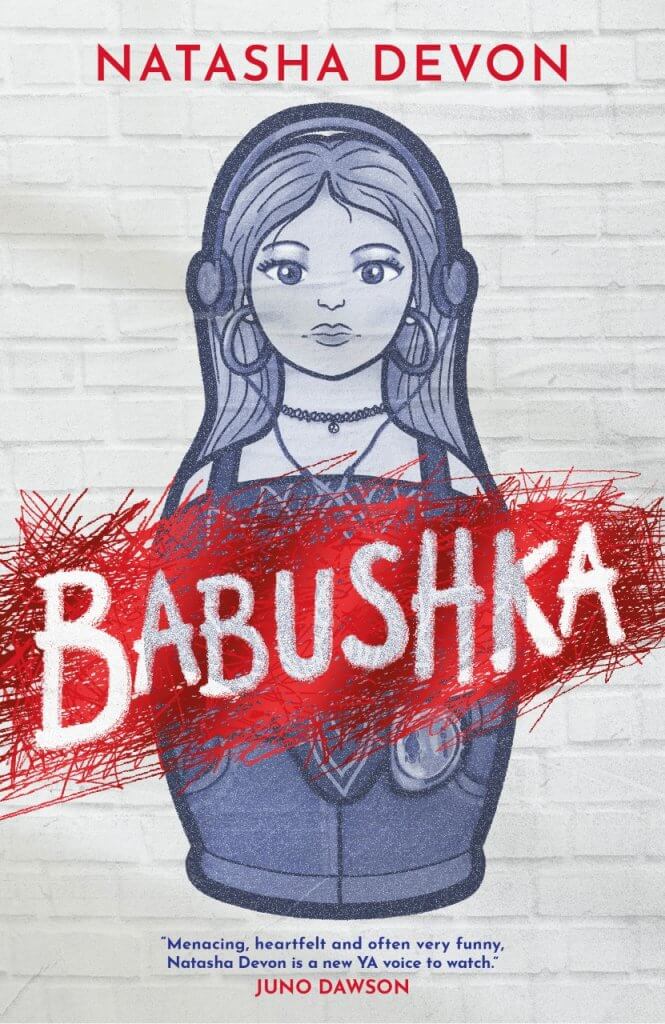
‘A little babushka is made when you’re young and something happens to you that leaves a scar…’
Cerys Williams has swapped her village in the Welsh Valleys for art college in London and the spare room in glamorous Auntie Wyn’s flat. Cerys knows there’s more out there for her in the world; it’s the year 2000 – she definitely doesn’t have to just get married and have babies and wear beige and cook stews for the rest of her life, even if Mam thinks she should.
But Cerys’s London is not glossy or cool or sophisticated, despite what Adept, her favourite magazine, has told her. It’s lonely and overwhelming and confusing. Until, that is, she meets him…
The prequel to Toxic. A coming-of-age novel about love – the love you think you know and the love you never realised you had, all along.
I’m reading BABUSHKA at the moment and am feeling very emotional about the concept of us having babushkas inside us like nesting dolls, reacting to events of today in your subconscious in different ways because of personal experiences and traumas. I was also a 90s teen (went to uni in 2000) so a lot of it is very familiar, I’d love to hear what modern teens make of it. Natasha Devon is a proving to be a great writer of thoughtful and thought provoking YA. Another brilliant YA author, Kate Weston (you must read MURDER ON A SCHOOL NIGHT, it is a hilarious and gripping and maddening all at once thriller), did a Q&A with her for a Waterstones event and I’m very happy to be able to share that with your here:
What was the inspiration behind Babushka?
Babushka is the prequel to my previous novel Toxic. My protagonist Cerys is the mother of Llewella, who is the protagonist in Toxic. At some point it occurred to me that Cerys and I would have been teenagers at the same time – the turn of the century. I wanted to write what about life was like for young women at the millennium, when we’d lived through the kind of inch-deep, Spice Girls inspired feminism of the 90s but were still contending with things like lads’ mags and celebrity magazines which put big red rings around women’s ‘flaws’. I wanted to make the point that some of the things Cerys grapples with – like consent, victim blaming and misogyny weren’t invented by social media. Sure, these problems have shapeshifted for the modern era but they were just as prevalent in the lives of women throughout the ages.
Where did the title come from?
Right at the beginning of the novel, someone says to Cerys that we all have previous versions of ourselves that live inside us, like Russian dolls. In Russia, these are called matryoshka dolls but elsewhere in the world people call them Babushka dolls. I went with Babushka as the title because it’s also the name of a track by Kate Bush, and what with ‘Toxic’ being a Britney track, I thought it would be fun if both my novels had titles which were songs by iconic women.
When during the process of writing and planning Toxic or after that, did you realise that you wanted to write about Loo’s mum’s story?
When people first read Toxic, some said they were surprised by how ‘hands off’ Cerys apparently was as a parent. It’s obvious Cerys really cares about her daughter, but she doesn’t try to micromanage her life in the way that another mother might. I wanted to explore why Cerys became that way and in my head it was all to do with how her mother was (the polar opposite – always interfering and nagging, or at least that’s how Cerys sees it). That’s how the idea for Babushka originally took root.
What’s your process when you’re writing? Do you plot or do you let your characters grow as you go?
Babushka was a very different writing process from Toxic. With Toxic, even though it’s also a character-driven novel, I already had a really strong idea of how the plot was going to play out. With Babushka, I had fleshed Cerys out almost entirely in my head before I even put pen to paper (or finger to keypad, technically), so the story really evolved through the prism of her. It’s fitting, really, because at one point Cerys tells another character that she’s never felt that she didn’t know who she was, just that she was in the wrong place.
You absolutely nailed the vibe or the women’s magazine in 2000 – especially with things like the circle of shame around someone’s cellulite – do you think that culture is in anyway improved? Or has it just moved on to a different format?
Misogyny shapeshifts as patriarchy uses the considerable resources at its disposal to protect itself. Some of the things that used to happen in media at the millennium would be considered unacceptable now, but that doesn’t mean they haven’t found a different way to do the same thing (straightforward fat-or-skinny shaming has now become ‘concern for health’ for example. Pointing out someone’s flaws just for the hell of it has become ‘aren’t they brave for going out like that?’).
What I do think is great is how much more of a breadth of content young women have to choose from, now. There are truly revolutionary content creators, TV series and magazine-style articles that you can get at the click of a button. There also isn’t the sense of ‘everyone’ watching the same thing and therefore absorbing the same beauty paradigms and life advice that we had with, say, Friends or Sex & The City.
There’s a conversation around page 40 between Wyn and Cerys where they discuss whether you would want to be remembered as you are or with certain perceived imperfections changed or “improvements” made. I liked how the conversation focused on “the real you” but avoided mentioning anything about a person’s personality, focusing solely on looks. I imagine this was on purpose because this was very much how things were perceived back then but do you think in 2023 that we’ve moved on from that? Or do you think looks still form the basis of how we’re remembered as a person.
That conversation is based on a thought I have all the time – Does a painting or a sculpture capture the essence of a person better – because artists can draw out certain otherwise intangible qualities – or is a photograph more accurate? And is even a photograph a ‘real’ representation of you when it can’t show how you move, what you sound like or how you smell?
I think in 2023 we’re all David Bowie (bear with me on this one). He talked about how there was a version of him he had curated and sent out into the world and that was what his fans were responding to, not the real him. So there’s a lack of actual connection, there. I think in the age of social media we all do that. We create an avatar of who we wished we were and send it out into the internet to interact with other people on our behalf. And that’s part of the reason there’s been an epidemic of loneliness because in order to truly connect with someone they need to see the whole you, perceived ‘imperfections’ and all.
How do you think the beauty industry has changed since 2001 and what impact do you think that’s having on young people?
Again, the answer is different depending on what end of the telescope you are looking at. On the one hand, we’re seeing more diversity in media and advertising and a greater breadth to the understanding of what it means to be beautiful than ever before and that’s to be celebrated. On the other, the beauty industry has continued to create areas of the face and body for women to feel apologetic about. When I was young the message was ‘be as thin as possible’, which was problematic for a number of reasons and left many people in my generation with eating disorders and other enduring issues. But now there are all these obscure beauty trends dictating exactly what shape and size every single millimetre of your body should be.
We’re also seeing the resurgence of hellish fashion trends we endured in the early 2000s like low rise jeans (just no), so-called ‘heroin chic’ and really thin eyebrows. Although not strictly relevant I do just want to mention to any young person reading this that is thinking of overplucking their eyebrows that, unless you are in the small percentage of people who are genetically blessed, THEY DO NOT GROW BACK.
Do you think that things can get better in terms of the way that the media and society views women and the things that are expected? Or do you think the list of things that we’re disapproved of for will just get longer?
You have to believe it can get better or you’ll just go and live in a hole in the mud somewhere and cry.
I have noticed two things about the women in their early twenties I work with at LBC that are very different from my generation. 1. They’re not afraid to take up space. Nothing about their body language suggests they are trying to make themselves smaller. And 2. They’re so supportive of one another. When I was in my twenties the message to women was ‘there’s a limited slice of the pie for you so every other woman who might have her eye on it is a threat’. A lot of us ended up very ‘pick me’ as a result (and I include myself in this – I’m a Pick Me Girl in recovery). Young women now seem to be all about celebrating each other and raising each other up, which is wonderful.
I want to talk about Darsh a bit without any spoilers. It feels like it would have been really easy to make him into a complete bastard but there’s far more subtle things that he does that are in the guise of protecting her or ‘loving’ her. How did you come up with his character?
I’ve learned through experience that the people who are going to treat us badly in life don’t announce themselves with a giant neon sign saying ‘HEY! I’M REALLY TOXIC AND I’M GOING TO MAKE YOUR LIFE UNBEARABLE!’. If they did it would be really easy to avoid them. The red flags are much subtler, in reality, and therefore easy to miss or overlook. It also had to be believable that someone as clever and independent minded as Cerys would fall for Darsh. Like most f**kboys, Darsh is really charming, exciting, handsome and a little bit mysterious.
I also learned writing Toxic (which is also features a dysfunctional relationship, albeit a platonic one) that creating a good story means it would make sense if told from the perspective of any of the characters. People aren’t generally badly behaved or mean for no reason – There’s always a journey that’s brought them to that point.
What’s next? Are you working on anything you can share with us at the moment?
I’m in the very early ideas stages for another novel but I have no idea if it’ll ever see the light of shelves at this moment. In the meantime, I’m doing my ‘day’ job of visiting three schools a week delivering talks and conducting research on mental health, writing my columns for Teach Secondary and doing my weekly radio show on LBC.
Natasha Devon (photo credit: Jonathan Donovan)Kate Weston