Category Archives: Creators Of Colour

Overlooking Problematic Content is a Feature, not a Bug

Kate Clanchy’s memoir Some Kids I Taught and What They Taught Me is an award-winning book that has received rave reviews, New Statesman called it refreshing, The Guardian thought that people like Clanchy are needed to keep liberal ideals alive, The Times called it inspiring and uplifting, The Sunday Times deemed it inspiring, moving and funny.

Philip Pullman said that it is: The best book on teachers and children and writing that I’ve ever read. No-one has said better so much of what so badly needs saying. I want to see this book become a bestseller, I want to see it in every staffroom, I want to see it read by every student teacher. This is a wonderful achievement.

In 2020 Some Kids I Taught and What They Taught Me won the 2020 Orwell Prize for Political Writing

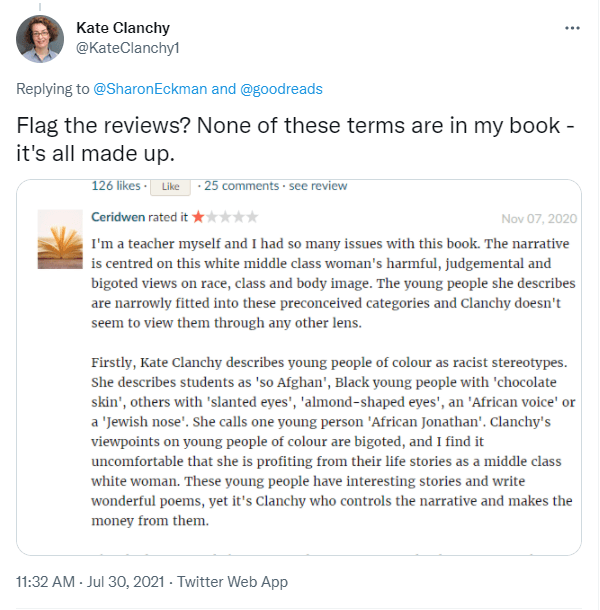
Then in 2021 on twitter Kate Clanchy alleged that Goodreads reviewer Ceridwen had made-up quotes from her book in their review.

Things went downhill rapidly from there!

Unfortunately, whenever people have received near universal acclaim & praise for their work they can react poorly when they encounter someone who says “whoa there is a problem here” and this is exactly what happened!

Instead of giving a blow by blow account what occurred, I will recommend that you read Beth Bhargava’s comprehensive write-up of what happened over at Bad Form Review here. I will just say that I was bitterly disappointed by a number of authors whose work I have previously enjoyed.

Like Public Libraries, Publishing is a majority white profession, both of which can be difficult to break in to, as many opening positions are notoriously low-paid. I could not help but compare what is happening with Kate Clanchy’s book with what happened with the CILIP Carnegie & Kate Greenaway Medals in 2017 where it took people of colour to start asking why no-one who was not white had won either of the awards in over 80 years and a big push from them and allies to start the process to effect change.

Kate Clanchy issued a statement on August 6th which caused more consternation and upset. Picador, KC’s publisher released three statements on the 6th, 9th and 11th, The Orwell Foundation issued a brief statement denying responsibility of what their external judges did, and Philip Pullman released an ‘apology’ on the 10th.

No mention was made by anyone at the centre about the vile language and threats directed against Professor Sunny Singh, Chimene Suleyman & Monisha Rajesh three of the highest profile people that stepped up to offer honest critiques of Clanchy’s work and challenge the racist rhetoric that was springing up in the discussion.

The end result of the storm of protest is that Kate Clanchy will rewrite portions of her work to remove the racist and ableist stereotypes contained in the original.

Systemic racism does not require that those working within the system to be racist; in publishing like libraries, is made up mostly of good, well-intentioned (white) people who do their best but miss many signs that what they are working on may be harmful to minority groups. Unfortunately, most white people lack the insights and cultural knowledge to identify problematic work and content. Even after an outcry those who ‘have learned’ from the criticism are often rewarded, while still excluding those that were harmed.

It should not fall to People of Colour to fight for systemic change on their own, no matter where it happens – in libraries, in publishing, or elsewhere if someone says that something is harming them and their community we need to stand with them and fight to make a meaningful change.

We (white people) have benefitted from systemic racism for hundreds of years, we are complicit even when we fight against it, and we should fight against it – we lose nothing if those that are disadvantaged gain the privileges that we currently enjoy.

It is often said that When you’re accustomed to privilege, equality feels like oppression, but this is something we need to stamp out of our psyches and instead embrace the need for true equality.

Mr Shaha’s Marvellous Machines

Transform and recycle household objects into your very own home-made toys and machines!

Learn about the centre of gravity by making a balancing bird, create a toroidal vortex with a smoke-ring machine, and turn a spoon into an electromagnet. Chances are you won’t need to buy the materials required for these machines because they’re all in your house right now. Every child can be an engineer with the help of Mr Shaha and his marvellous machines.

Written by a science teacher and dad, Mr Shaha’s Marvellous Machines is the highly anticipated sequel to Mr Shaha’s Recipes for Wonder. This book gives clear, step-by-step instructions for over 15 projects. Whether you’re a master engineer or a total beginner, it will spark inspiration for fun activities to engage young people in the marvels of machinery.

Scribe Publications
Mr Shaha’s Marvellous Machines, illustrated by Emily Robertson

I follow Alom Shaha on twitter and really appreciate how keen he is for families to play together to develop a passion for science and technology. Mr Shaha’s Recipes for Wonder is a great book so, when I saw that he had a new title coming, I asked him a few questions:

Do you have a favourite project in the book?

My favourite project in the book is probably the Rubber-band Racer. I think it was the first activity I knew I would include in the book because it just met all my criteria for a “marvellous machine” – it’s made of stuff most people will have lying around the house, is relatively straightforward to build, illustrates some sort of scientific principle, and, above all, elicits a sense of utter joy when you’ve successfully got it working.

This is your second published book, after Mr Shaha’s Recipes for Wonder. Why do you think it is so important that families engage with science and technology, learning at home?

This is actually the third book of mine to be published! My first was “The Young Atheist’s Handbook” which was published in the UK, Australia, and in a Turkish translation. There was even a successful campaign by Humanists UK to raise money to send it to every secondary school library in the UK. But to answer your question, I think it’s important for families to engage with STEM learning at home because I believe strongly that science can enrich our lives as much as literature, art, or music can, when we approach it in a way that is appropriate to our own needs and wants. There’s also research that suggests strongly that parental attitudes towards science plays a key role in children’s success, or lack of it, in science at school. I don’t think parents should leave their children’s first encounters with science education to schools – I want to encourage parents to become their children’s first science teachers. Parents are usually the ones who introduce their children to reading, numbers, painting and drawing, playing music and so on, and I wanted to give them the confidence and tools to do the same with science. 

As a science teacher, what is your favourite part of the curriculum?

Oh, that’s a tough one. I’d have to say that I love teaching all the ideas that generate a sense of awe and wonder in my students, from the counterintuitive nature of Newton’s First Law to the mindboggling fact that we can know, with a high degree of confidence, what stars are made of, and how they work.

In an ideal world, what kind of events would you want to do with children, and what age groups?

I love doing family workshops with primary aged children. I ran many when promoting “Recipes for Wonder”, and plan to do the same with “Marvellous Machines”. It’s really satisfying to watch parents and their children work together to do the activities in my books. 

Library staff will appreciate your desire to get the book into the hands of those who can’t afford to buy it. Other than libraries stocking it, what would you like to see people do to promote its use?

I’m going to release videos of the activities from the book on my YouTube Channel, “Mr Shaha’s Books” (https://www.youtube.com/channel/UCcv9_0EdBq0Xi4n_wJe4NCA), so that the message and ideas from the book are freely available. I’d love to see people sharing these videos, and perhaps their own videos of the activities, through their social media and other networks.

Alom sent me a picture of the introduction, which is a wonderful explanation for why the book exists, and shows some more of the wonderful illustrations by Emily Robertson that really bring it all to life:

The text can be read more clearly on his blog here

Mr Shaha’s Marvellous Machines is published on 8th July, it is aimed at 5-12year olds and their families, so Bea and I are looking forward to having a go at making some contraptions!

Alom Shaha, photo credit: Ed Prosser

The Lightning Catcher

Alfie has noticed a few things since his family moved to Folding Ford. He really misses life in the city. He and his sister don’t exactly fit in here. But the most interesting one is that the weather is BONKERS. One frost-covered branch on one tree in the middle of June? A tiny whirlwind in a bucket in the garden? Only in Folding Ford.

Armed with his bike, a notepad and his new best mate Sam, Alfie is going to investigate. His best clue is Nathaniel Clemm … the only thing in town weirder than the weather. When Alfie ‘investigates’ Mr Clemm’s garden, only SLIGHTLY illegally, he finds a strange box that freezes his trainers and makes his teeth tingle. And when he opens it, only SLIGHTLY deliberately, SOMETHING gets out. Something fast, fizzing and sparking with electricity and very, very much alive. But the creature from the box brings trouble of its own, and as barometers and tempers go haywire in Folding Ford, Alfie finds himself at the centre of a perfect storm.
Skellig meets Stranger Things in this funny, heartfelt adventure story perfect for fans of Ross Welford, Christopher Edge and Frank Cottrell Boyce.

Bloomsbury
Cover illustration by Paddy Donnelly

I loved THE LIGHNTING CATCHER! An absolutely brilliant debut, really imaginative sci-fi for MG+ with brilliant characters and some unexpected turns. I asked Clare Weze some questions and her answers are wonderfully insightful, so I’m not going to say anything else (except that: if you have the opportunity to invite an author in to do a creative writing session, I love her idea and want to come along)!

What gave you the idea of creating living weather (basically) for a story?

This is such a lovely question, because from an early age I’ve loved weather, so I was probably waiting for an opportunity to use inspiration arising from our own increasingly bizarre weather. But the idea came to me in stages rather than all at once. The isolation of the setting (based on aspects of the house I live in now) encouraged wild and unpredictable weather, but it wasn’t until I had the character that things started to gel. Because he was a curious, intrepid and somewhat contrary character, he went trespassing. The plot couldn’t have unfolded in my mind without that event, because it set off a unique chain. When he opened that box and let something loose, it gave me the perfect opportunity to have a creature that created its own weather systems. So rather than reverse-engineer a situation that would suit a creature like that, everything grew organically from playing around with a character in a setting.

Did you always intend to write for a middle grade audience, or did Alfie and the plot evolve that way?

The middle grade age has always been my favourite, not only to write for but to engage with in all ways. I particularly enjoyed being with my own children at that age. Pre-teens have such clever and original ideas, and their language use is funny and inspiring. And of all the ages I’ve been myself, that age felt the most magical in terms of the possibilities of the world, and even the universe. You get glimpses of what certain aspects of the natural world and the world of people might mean, but you don’t always get the full facts, so your mind joins the dots and comes up with something new and fun (even if it’s sometimes completely wrong!). That’s why that age felt, to me, like really living your best life. Perhaps when we’re that age, we carry that sense of ‘living in the moment’ into the worlds we inhabit when we read a book, and that’s why middle grade books feel so real and plausible to their readers.  

I find middle grade writing very freeing in terms of what can be explored. As long as you clarify things and don’t let the plot hang around, the sky’s the limit. Ordinary things can be explored afresh, and when they’re put next to extraordinary things, something new and exciting arrives.

Which is your favourite of Clemm’s menagerie?

I need two favourites, please! Lysander the hornbill is curious and cheeky, and he taps into Lily’s mood so perfectly, but I also have a big soft spot for Julia, the accidentally hairless cat. I also love the fact that Clemm has sacrificed almost everything for his conservation cause. His farm is falling down around his ears because instead of working hard to build up his finances, he’s been abroad looking for animals in distress.

Towards the end it takes quite a dark turn, with Alfie having been mistrusted by the “locals” in the small village the family have moved to, without overtly telling the reader that he was stereotyped because of his race. What led you to not be explicit about tension being caused by racism?

A lot of racism these days is covert and consists of gaslighting, so I thinks it’s fitting for the suspicions circling Alfie to follow this zeitgeist. I didn’t want to centre this particular book around race explicitly – to give it top billing – because Alfie’s exciting adventure is the main event.

It’s always nice to leave a few gaps between the lines so readers can insert their own meaning, their own interpretations, as that can be a richer experience. So with Mr Lombard in particular, his motivations can be however you choose to interpret them, because in real life, we only get to see what people show us.

The book set ups many questions about Mr Lombard’s motives. I suspect he wouldn’t view himself as racist. He might even be one of those people who thinks racism’s gone extinct, and he’s going after Alfie purely because of his audacity and rule-breaking. He’s certainly a busybody. Race might be a convenient peg for him to hang his prejudices on, but there’s always the alternative viewpoint. He could have mistrusted any incomer who’d been trespassing. The book might have worked with a white character who acted in the way Alfie did, but would Lombard have made it into such a vendetta with any other child? It’s interesting to go back and forth in this way. There’s quite a philosophical conundrum there. When someone from an ethnic minority does something slightly wrong, are they targeted because they stand out more, or is there less leeway given?

As for the other people in the village, the rumour mill is fascinating, and it doesn’t take much to get it going in small places. Racism is so complex, and it’s only getting more so as time goes on. I doubt even the most dyed-in-the-wool racist really has a firm grasp on why they’re acting that way.

I was interested in Alfie’s learning curve regarding all this, because coming from the particular area of the city he used to live in, he’d never really experienced being quite so conspicuous before. His detective cover is ruined; basically, he has no cover! His attempts at covert surveillance are therefore quite funny and touching.

Alfie and his family have moved because of his sister’s eating disorder, triggered by bullying at her old school, almost a whole storyline in itself and the main reason his parents are distracted. Did you find it harder to write these realistic scenes or the fantastical adventure side?

Both had their tricky aspects. The fantastical side probably wins the hardest label, because although it made sense in my head, there’s always the worry that it won’t transfer. I was dedicated while writing Lily, though, because I don’t think that particular kind of eating disorder gets much attention. You’re upset and traumatised, so your appetite disappears – without an appetite, there isn’t enough saliva being made, and you’re trying to chew dry food. It’s fairly common after a trauma. I thought it would be interesting to look at the consequences of bullying, the ‘next chapter’ of the part of Lily’s story that began in their former home.

In a perfect world, what kind of events would you like to do with young readers to get them interested in science and literature?

I would like to do an event where I give young readers some of my notes for The Lightning Catcher, which contain additional details for the science, and get them to formulate their own questions about everything involved. I’d also be interested in talking about where Alfie goes from here and whether he pursues science or detective work in his later teenage years. There are always more notes and ideas than a book has room for, so it would be nice to talk over some of the aspects that didn’t find space, which would be an interesting combination of science and literature for the event.

What are you reading at the moment and who would you recommend it to?

I’ve just started Voyage of the Sparrowhawk by Natasha Farrant. It appealed to me because the opening promised quirky characters and a fast-paced adventure, and the writing style is lovely and lyrical. There are orphans, and people helping each other, and others chasing them, and lots of animals, which sounds like my perfect read!

Have you plans for any more children’s books?

Yes, I’m writing my second children’s book for Bloomsbury right now! It’s about a London girl sent to live with her grandparents by the sea after her family are evicted from their home. She’s traumatised by the separation from her parents and school friends, but sees a boy in the sea who is never seen on land. An adventure begins, and the way she feels about home starts to change.

After that, I have outlines and notes for five more children’s books.

Thank you so much, Teen Librarian! These have been lovely, thought-provoking questions.

Thank you, Clare, for your brilliant, thoughtful answers! THE LIGHNTING CATCHER is out now in the UK and I’m really looking forward to what comes next! Huge thanks to Bloomsbury for sending a review copy and to Beatrice Cross for facilitating this interview.

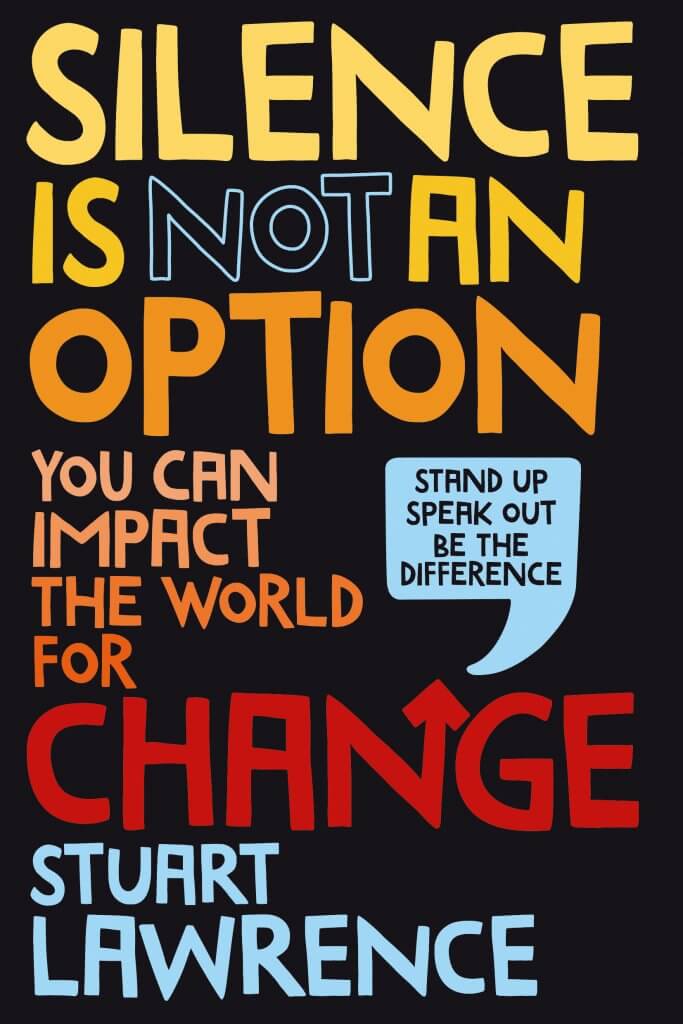
Silence is Not an Option

Silence is Not an Option is the first book by Stuart Lawrence – the younger brother of Stephen Lawrence who tragically died in an unprovoked attack on 22 April 1993. The book is interspersed with reflections on his brother Stephen’s life and murder as well as the tools that have helped him live positively and kept him moving forwards when times have been tough. An inspiring read directed at younger readers (aged 10 +) Stuart’s aim is to use his
own experience to help young people – to help all people – find their own voice, stand up for change, and contribute towards creating a more positive society.
Stuart is determined to ensure that children today understand the impact of their actions against others and the importance of inclusion through teaching tolerance and celebrating difference. He has a background in education – working as a teacher for over 15 years – and is now a motivational speaker and youth engagement specialist. Stuart is also a mentor for several young people in the South London area.
Since his brother’s death, Stuart and his family have had a huge impact on the change of attitude towards racism within British society. Their story is still as impactful and important today.

Scholastic

This is a great book to read slowly. It gives the reader practical activities in each chapter, to really think about themselves and how they can impact those around them, before moving onto the next chapter. It is for independent reading and reflection, but could also prompt some brilliant discussions between young people if shared with a group. Chapters range from the influence of role models (Stuart discusses meeting Nelson Mandela) to championing yourself and others. Stuart is incredibly busy, but I just asked him to quickly recommend some books for teenagers to help them understand their place in the world and how to contribute positively:

– Black and British by David Olusoga (I’ve read the abridged “short history” version for younger readers and it is brilliantly fascinating)

– This Book is Anti-Racist by Tiffany  Jewell (another full of practical advice)

– Everyone Versus Racism by Patrick Hutchinson

– No Win Race: A Story of Belonging, Britishness and Sport by Derek A Bardowell

Scholastic also allowed me to share this excerpt from chapter 3: YOU ARE IN CONTROL:

SELF-CONTROL

After losing my brother Stephen, I really had to learn self-control. Suddenly, my family and I were in the newspapers and on the TV. A lot of the time, the public were being misinformed about our story. I was so angry that my brother was being portrayed as a gang member and a drug dealer, when he was an A-level student aspiring to become an architect.

However, I had to control myself, because lashing out would only affect my family and my brother’s case negatively. It didn’t mean I didn’t speak out, but I had to exercise self-control in the way I handled the situation. I had to be calm and composed, even though I didn’t feel like it.

What is Self-control? Having self-control means being able to manage your decisions, emotions and behaviours so that you can achieve your goals. This skill is what separates humans from the rest of the animal kingdom!

Self-control is rooted in the front part of our brains, in an area called the prefrontal cortex. This is the planning, problem-solving and decision-making centre of the brain. Did you know that this part of the brain is much larger in humans than it is in other mammals? This area of our brain acts differently at different stages of our lives. For example, teenagers are more likely to act on impulse or to misunderstand their emotions than older people. As much as you might not want to believe us adults and feel like you are an exception to the rule, these are scientific facts!

You can only control yourself. For example, let’s say you are trying out to become the captain of the school netball team and, unfortunately, you aren’t picked for the role. Instead of sulking, getting angry or upset, you show good sportsmanship and shake the hand of your competitor. In doing this, you use your self-control. You are unable to control the situation but you are able to control your reaction and that is what is important. Don’t forget, it’s always useful to get feedback so that you can improve and win next time.

About the author: Stuart Lawrence is the younger brother of Stephen Lawrence, the young man who, on 22 April 1993, at the age of just 18, was murdered in an unprovoked racist attack. Stuart is an educator and motivational speaker, dedicated to helping to transform the life chances of young people.

Stephen Lawrence Day is held on 22 April each year to commemorate Stephen’s life.
Follow the journey: #SilenceIsNotAnOption Insta @hon_stuartlawrence Twitter @sal2nd

SILENCE IS NOT AN OPTION is published today by Scholastic.

With thanks for sending me a review copy

The Jericho Prize: Celebrating Black-British new writing for Children

The inaugural Jericho Prize for children’s writing, open to Black-British writers with great stories to inspire children aged 4 years plus and 7–9 has just been announced!

Find out more about it here: https://www.jerichoprize.com/

Forever Ends on Friday

What if you could bring your best friend back to life – but only for a short time?

Jamal’s best friend, Q, doesn’t know that he died, and that he’s about to die . . . again. He doesn’t know that Jamal tried to save him. And that the reason they haven’t been friends for two years is because Jamal blames Q for the accident that killed his parents.

But what if Jamal could have a second chance? A new technology allows Q to be reanimated for a few weeks before he dies . . . permanently. And Q’s mom is not about to let anyone ruin this miracle by telling Q about his impending death. So how can Jamal fix everything if he can’t tell Q the truth?

Forever Ends on Friday weaves together loss, grief, friendship, and love to form a wholly unique homage to the bonds that bring people together for life – and beyond.

Macmillan Kids

Published in the US as EARLY DEPARTURES, FOREVER ENDS ON FRIDAY is the second YA novel by Justin A. Reynolds. I interviewed him around the publication date of OPPOSITE OF ALWAYS and his answers were great, do have a look (and read that book if you haven’t yet)! The synopsis for FOREVER actually really reminded me of OPPOSITE, with the idea of doing things right the second time around, so I was a little worried that it might feel samey…thank goodness I was wrong! Although the idea of second chances is important in both books, it was a refreshingly different read. Family, again, is huge in the story, it is about the importance of family and relationships of all sorts. I loved the humour, brightening even the darkest moments but without spoiling them, and the warmth in the relationships. Jamal’s voice is just great. The premise is so interesting and plays out believably, leaving the reader with lots to ponder over: Do you think it is a good idea to have a second chance to say goodbye?

My last interview with Justin was one of my favourite for the blog, so when Amber at Macmillan asked if I’d like to be part of the blog tour for this second book I took the opportunity to ask just a few more questions…

What is it about the idea of second chances that sparks your imagination?

Great question! I think it probably has to do with my overanalyzing brain, ha. I tend to replay moments and episodes in a loop, turning over a situation on all sides, trying to grasp either what went right or wrong, what I could’ve done better or just differently. The idea of having the time and space to fix the things we stubbornly broke out of frustration, anxiety, or hurt feelings I think will forever remain intriguing to me. We’re so tragically flawed as people, all of us—and yet, most of us believe in redemption, myself included; and I believe it’s love that makes such healing possible.

Love, in its most honest form, is such a powerful experience; it’s like we’re being remade from the inside out—like remodeling for the soul. You are forever changed. And once you’ve had it, it’s crushing to be without it. For me, the reason we’re here on this planet is to form meaningful, interpersonal relationships, which only happens when we reciprocate vulnerability—but with such openness, we expose ourselves to pain, betrayal, and apathy. It’s not a question of if we’ll be hurt, but when, even at the hands of those who truly love us. I suppose all of my stories stem from this: I so desperately want to believe in humanity; I need to believe that, given the opportunity, we’ll do what’s right by each other. But I also appreciate that sometimes that requires a second chance.

I love the banter between the friends. Do you listen to a lot of teenagers chatting in real life for inspiration?

Thank you. I’m so happy you enjoy it because dialogue is probably the thing I enjoy most about writing—or maybe it’s the thing that I’ve always had the easiest time with, ha. I’m lucky that I get to visit schools all over the country and meet and listen to lots of young people talking about their experiences, the things that matter to them. I think listening is the most important part of writing, other than being a good reader. There’s a rhythm to language, to our conversations, whether those be internal or with our family and friends—and for me there are few greater writerly feelings than when you successfully tap into that sound. Another kinda weird thing I do is I watch movies and television with the subtitles (captions) on—which I know drives some people crazy, haha. But there’s something about seeing the words as they’re being spoken that I find both beautiful and instructive. The fact that there are so many ways to say the same thing to someone else, I love that.

Have you had much opportunity to engage with readers in these…interesting times?

I’m fortunate in that I’ve gotten to do quite a few virtual events, including book festivals and conferences and interviews. I’ve also done several virtual school visits, which are always fun. We also had our second annual Cleveland Reads (#CLEReads) Book Festival this year, also via a virtual platform, and that was such a thrilling experience, connecting with awesome readers, young and old, all over the world.

I will always ask: what are you reading at the moment and who would you recommend it to?

I always love this question because I love talking about other people’s books! So Bryan Washington’s MEMORIAL is amazing; any story highlighting “found family” is already going to be high on my list but then Bryan’s inventive language and his unique POV is absolutely electric. I should mention I believe this is formally categorized as an adult title.

Also, I’m reading and loving Danielle Evans’s new short story collection, THE OFFICE OF HISTORICAL CORRECTIONS. I don’t know if there’s a short story writer I enjoy and admire more; what she manages to convey in such small spaces detonates fireworks in my brain. Every Evans story makes me green with envy; she’s a master.

I also want to say thank you so much for having me; it’s always such a pleasure talking with you!

Thank you so much for your wonderful answers, it is my pleasure to read your books and have a chance to ask a few nosy questions!

Huge thanks to Macmillan Kids for sending me a review copy and inviting me to be part of the blog tour for another awesome Justin A. Reynolds!

The book is out now!

The Humiliations of Welton Blake

Welton Blake has done it – he’s asked out Carmella McKenzie, the best-looking girl in school, and she’s only gone and said yes!

But just as he thinks his luck, and life, is starting to change, Welton’s phone breaks, kickstarting a series of unfortunate and humiliating events. With bullies to avoid, girls ready to knock him out and all the drama with his mum and dad, life for Welton is about to go very, very wrong …

Barrington Stoke
The Humiliations of Welton Blake – Cover artwork by Ali Ardington

I really enjoyed this new Barrington Stoke novella by Alex Wheatle. For those of you who don’t know, they publish books with dyslexic readers in mind – short, engaging, and set out carefully to be as readable as possible – written by loads of the best authors of the moment. Alex already had one under his belt, Kerb Stain Boys, a YA story set on his Crongton Estate, but this is for a younger teen audience. Those just starting to think about asking a girl to go to the cinema with them, or worrying about having the latest phone and trainers. Welton, our protagonist, is a great voice, he’d be one of the students that is always in trouble at school but secretly a teacher’s favourite. I asked Alex Wheatle some questions before publication:

How different is the process, writing a book for Barrington Stoke versus a longer novel?

The writing process for a shorter novel remains the same but before I write the first paragraph, I spend more time in my head on the plot and in the writing I try to be more concise.

After writing for adults then young adults and older teens, this is your youngest protagonist. Did that change your approach?

Writing about a young protagonist didn’t really change my approach.  I still invested the same care and attention as I would do for any other character I have created.

What is special about Crongton Estate?

The North Crongton and South Crongton estates are really references to the many council estates I have visited throughout the UK and beyond. What’s special about Crongton is that it is a fictional place. I’m not tied to Brixton, South London or anywhere else so I can freely create my characters and geography how I see fit. I can also populate Crongton the way I want to.

Cane Warriors (which is spectacular btw) is very different to anything else you’ve published for children and teens, what prompted you to write it, and might you write something from that era for Barrington Stoke?

Cane Warriors was a labour of love. Since I read CLR James’ Black Jacobins in the early 1980s, I’ve always wanted to write Jamaican historical narratives. My mother, who grew up very close to the plantation sites where the 1760 slave revolt occurred, heard her elders occasionally mention Tacky’s War. I felt as I was really documenting my ancestors’ history.

Have you done many virtual events? How does it compare to in-person?

I always prefer to do in-person events and I struggled a bit at first to do virtual events. Hopefully, I’m improving but I yearn to get in front of audiences again and do my thing!

What are you reading and who would you recommend it to?

At the moment, I am enjoying A.M Dassu’s Boy, Everywhere and I recommend it to anyone at any age.

What was the most exciting thing for you to come out of 2020?

The most exciting thing for me to come out in 2020 was the Black Lives Matter marches around the world and the different shades who all walked together.

What’s next?

I really enjoyed myself writing my The Humiliations of Welton Blake, so I hope I can produce more of the same for middle-grade readers.

You can read the first chapter on the Barrington Stoke website, and if you want more: the book is out now!

Huge thanks to Barrington Stoke for a proof copy to review, and to Alex Wheatle for answering my questions.

4 Reasons Verse Novels are Awesome, by Lucy Cuthew

Blood Moon is an extraordinary YA novel in verse about the online shaming of a teenage girl. During astronomy-lover Frankie’s first sexual experience with the quiet and lovely Benjamin, she gets her period. It’s only blood, they agree. But soon a graphic meme goes viral, turning an innocent, intimate afternoon into something disgusting, mortifying and damaging. As the online shaming takes on a horrifying life of its own, Frankie begins to wonder: is her real life over? Blood Moon is a punchy, vivid and funny story of first-time love, hormone-fuelled sexuality and intense female friendships – whilst addressing, head-on, the ongoing exploitation of young girls online and the horror of going viral. Both shocking and uplifting, it cuts to the heart of what it is to be a teenager today and shows the power of friendship to find joy in even the darkest skies.

Walker Books

Blood Moon is a truly outstanding (and pretty unique) UKYA by Lucy Cuthew, her debut, and I recommend getting a few copies for every KS4/5 library! It is one of what feels like a recent flurry of amazing novels in verse, and Lucy has shared with us some of her favourites!

4 Reasons Verse Novels are Awesome

and 4 Awesome Verse Novels to Read

by Lucy Cuthew

Have you ever read a novel in verse? If so, did you like it? I love them, and wanted to share some of my favourites. If you’ve never read one, here are some reasons I love them:

* Big feels – I love a story that makes me laugh/cry/feel big feelings. Poetry can do that, just like music can.

* A fast read – I absolutely love sitting down and reading a book in one/two sittings. I love verse novels that are intense and immersive.

* Visually interesting – verse novels, because of the way they are set out, are visually very lovely things. There is much more white space than in a prose novel (prose just means normal writing, not broken up in any rhythmic way), and the way the text is set out on the page is playful and interesting. Each page looks different.

* Rhythm – when I read, I read out loud in my head (I know you know what I mean), and I love how reading a verse novel can be like hearing song or rap lyrics.

TOP YA VERSE NOVELS

The Poet X by Elizabeth Acevedo

This is a great one to start with. It takes you right up close to the main character and into her world. It’s a really moving and interesting story, and the writing is amazing. Acevedo is a spoken word poet and you can hear it when you read this book.

Gloves Off by Louisa Reid

I absolutely devoured this book. The main character becomes a boxer alongside her mother facing her agoraphobia. You get fast-moving punch verse from both characters and reading from both of their perspectives is so interesting. Reid’s other verse novel, Wrecked, is also absolutely amazing – the whole thing takes place in a court room as a young couple go on trial and the story of who was driving when someone was hit unravels.

Long Way Down by Jason Reynolds

This story is extremely short and follows a young boy as he takes a lift down his apartment block, joined by a ghost on each of the 6 floors, to decide whether he’s going to kill the guy that killed his brother. It’s an absolutely gripping moral dilemma full of moments outside the lift which expand our understanding of his world and how complicated the decision he has to make is.

The Black Flamingo by Dean Atta

This is the story of a boy finding himself in a world of strict gender rules. The edition I read (borrowed and really need to give back, sorry Wibke) is illustrated, set out in the most deliciously creative way and is just a perfect book. The writing is superb, it flows, it is really moving and it deals with some difficult subjects with tenderness, nuance and bravery.

Lucy Cuthew is the author of Blood Moon, a YA novel-in-verse about periods, sex and online shaming, published by Walker YA. Available at Waterstones, Barnes and Noble (US), and Amazon. 

A Thousand Questions blog tour

Set against the backdrop of Karachi, Pakistan, Saadia Faruqi’s tender and honest middle grade novel tells the story of two girls navigating a summer of change and family upheaval with kind hearts, big dreams, and all the right questions.

Mimi is not thrilled to be spending her summer in Karachi, Pakistan, with grandparents she’s never met. Secretly, she wishes to find her long-absent father, and plans to write to him in her beautiful new journal.

The cook’s daughter, Sakina, still hasn’t told her parents that she’ll be accepted to school only if she can improve her English test score—but then, how could her family possibly afford to lose the money she earns working with her Abba in a rich family’s kitchen?

Although the girls seem totally incompatible at first, as the summer goes on, Sakina and Mimi realize that they have plenty in common—and that they each need the other to get what they want most.

This relatable and empathetic story about two friends coming to understand each other will resonate with readers who loved Other Words for Home and Front Desk.

HarperCollins

A THOUSAND QUESTIONS is a brilliant new middle grade novel by Saadia Faruqi. I really enjoyed reading from the two perspectives, as they realise that the differences in their upbringings don’t change the things that are really important. Saadia’s love of Karachi shines through in her portrayal of the city and its landmarks, at the same time though, she doesn’t shy away from showing the disparities between rich and poor and it could lead to some really interesting conversations if you’re reading it as a class novel or with a reading group (or with your own child).

For the blog tour I was pleased to have the opportunity to ask Saadia a few questions!

I believe your writing began in a local newspaper, followed by the Yasmin books for beginning readers, and now longer middle grade like your new book A THOUSAND QUESTIONS. Which audience do you prefer writing for?

Wow those newspaper columns were such a long time ago, I hardly remember them! Yes, that’s right, and I also wrote a nonfiction academic-style book, plus a short story collection for adults. However, it was only when I started writing for children that I found my true passion. Children’s
books are so fun to write, and even when the message is serious, the act of writing them isn’t. I enjoy crafting stories that give hope and entertain my readers, showing them the world in a way that’s authentic but also full of positive aspects. Whether I’m writing early readers like Yasmin or middle grade novels like A Thousand Questions, I approach them the same way. I’d be hard- pressed to chose which I enjoy more.

Why do you think it is so important to have Muslim characters starring in children’s stories?

It’s very important to have stories that center Muslim characters, families and countries. The fact is that a growing number of our young readers are Muslim, and they deserve to see their stories reflected in the books they read. This means positive stories, ones that show realistic people and situations rather than caricatures and stereotypes. It also means everyday stories about experiences all children face at school, at home and in their neighborhoods. Finally, it means making Muslim children the heroes of our fantasy, sci-fi and mystery books, the ones who solve the crime or save the day. All this is important because storytelling is part of community, and
readers from Muslim backgrounds should know that they’re an essential part of our communities. Readers from other backgrounds should also realize that their friends and neighbors, their classmates in school, can be the heroes of the books they read.

Your author note says you were inspired by your children’s reactions to visiting Karachi, where you grew up. What do you think is the biggest difference between your childhood and theirs (aside from technology!)?

It’s a world of a difference, specifically for immigrant families like mine. I grew up in Pakistan with one type of culture, traditions, lifestyle, and everything else. My children are growing up in the U.S. with another type of culture. As a parent, I try very hard to keep Muslim and South Asian traditions alive in my house, but when they step outside it’s a very different world for my children. I believe that the physical differences aren’t as vast, but the emotional and mental differences are huge. My children feel “other” in a way that I never did. They feel the stress of living in a country that’s their own, but not their parents’. They experience life with each of their
feet on a different continent. I can’t even imagine what they go through every day, not completely fitting in because of their skin color or their background. I never had anyone ask me “where are you from?” growing up, and that’s probably the biggest, most insurmountable difference.

In A THOUSAND QUESTIONS, Mimi and Sakina do a lot of sightseeing. Which of the spots that the girls visit is your favourite?

Hmmm that’s an interesting question because I put all my favorite spots in the book! I really wanted to showcase all the best places to visit in Karachi, so that even if you never travel there physically you can understand what a beautiful, complicated, incredible place it is! If I had to choose a favourite, I’d say the beach. I’ve loved the ocean since I was a child, and still do. Clifton Beach, where Mimi and Sakina visit in the book, is also very fun because of the swarm of people, the camels, the food, and everything else.

The divide between wealthy and poor is highlighted brilliantly by the girls’ friendship. How hard was it to strike a balance between harsh reality and a fun story?

I love writing about juxtapositions. It’s what I do best, bringing to life characters who are diametrically opposed to each other, so my readers can understand that we can find something in common with everyone we meet, even if they’re very different. Imagine how peaceful the world would be if we all found something in common with each other and focused on that
commonality? In the book, Mimi seems well off, and Sakina seems poor. But when they get to know each other, they realize that they are both rich in some ways, and poor in others. Life in Pakistan (and other poor nations) is often reduced to poverty, like it’s something horrible and insurmountable. It was really important for me to change that narrative and write about complex, beautiful life for all people, including those that are poor. It wasn’t hard to do once I had those goals in mind.

Have you done virtual events with children about your books?

Absolutely! I do a ton of virtual events with schools and libraries around the world. Since the pandemic started, I’ve actually increased this aspect of my author-life significantly, because it’s the only way I can reach my readers and give them an encouraging word. I schedule 3-5 virtual visits every day, and most of them are free of charge because of the budget difficulties everyone is going through at the moment. I love meeting readers, answering their questions and inspiring them to be writers. Anyone who wants to schedule a short virtual visit can visit my website and
contact me there.

What are you reading at the moment and who would you recommend it to?

I’ve been reading the Planet Omar series by Zanib Mian with my daughter and really enjoying it. I think it’s great for children in elementary school, but can also be used as a read aloud for younger children. However, I enjoyed it as an adult, so my recommendation would be for everyone to read this series!

What are you working on at the moment?

I have several books in the pipeline, some of which are still secret. Ah, the joys of publishing! Four new Yasmin books are releasing in 2021, as well as a couple of picture books and a new middle grade novel featuring a boy main character, white supremacists, and a twenty-year old journal. I’m really excited about all my upcoming projects, but more than that I’m excited about the future of children’s books with all the fantastic BAME authors putting out great books for young readers. I’m proud to be a part of this new wave of books!

Saadia Faruqi (photo credit: QZB Photography)

A THOUSAND QUESTIONS is out now!

Thank you to HarperCollins UK for sending me a review pdf and involving me in the blog tour, and thank you to Saadia for answering my questions so thoughtfully (and I love the Planet Omar series too)!

Hijab and Red Lipstick – blog tour

Being a teenager isn’t easy. All Sara wants to do is experiment with make-up and hang out with friends. It doesn’t help when you have a super-strict Egyptian dad who tells you that everything is “haram” a.k.a. forbidden. But when her family move to the Arabian Gulf, it feels like every door is being closed on Sara’s future. Can Sara find her voice again? Will she ever be free? 

Hashtag Press

HIJAB AND RED LIPSTICK is not an easy read, in the author’s note to the reader she mentions that it covers some upsetting subjects (TW: including discussions of rape, coercive behaviour, self-harm, domestic abuse and sexual abuse), so it is definitely a Young Adult title. We join Sara as she begins talking to a journalist about her childhood experiences, her early years in the UK and then moving to the Gulf because of her father’s job. I can’t say I enjoyed reading it, as we were warned she doesn’t have a particuarly happy time, but it was a glimpse into a different (for me) culture that really made me think about things we take for granted in the UK.

I had the opportunity to ask the author, Yousra Imran, some questions about writing:

Your note to the reader said you drew on your own experiences as well as those of others, was it difficult to write or was it cathartic?

It was both difficult writing about such painful topics, even if it was a fictional piece of work, but also cathartic, as I felt by giving a voice to stories based on real life experiences that I was almost giving myself the talking therapy I never got to have.

How different was your approach to writing a full length novel compared to pieces for publications?

Writing an article for a publication is very different to writing a novel. At the moment I write current affairs articles which are of course much shorter (usually 800-1500 words) and they usually require me talking to lots of people to collect views, witness statements and facts. When it comes to writing a novel, even if I am basing it off things I have seen, heard or experienced, and even if I carry out research, I have that leeway to completely make up the characters and the story’s events. I don’t feel under pressure writing a novel as there is no deadline, whereas there is usually a tight deadline for an article. I don’t tend to map everything out when it comes to a novel – I have an idea of the storyline and I map out the characters, but the story evolves as I write it. With articles I have to completely map them out before I write them.

Did you always intend for this to be for young adults?

I think it was always going to naturally be for young adults if the main character is a teenager/young adult and is talking as a teen/young adult. However, the novel can be read by any adult too – that’s what I love about most YA books today – they can be read by adults too!

What advice would you give to a young woman in similar circumstances to Sara’s teen years?

Sadly this is a very tough question to answer, as it really depends on which country the young woman is living in. If she was living in Europe, the UK, America, Canada, Australia or New Zealand, I’d be able to say here’s a list of organisations that can help you and provide you with support. It’s a completely different ball game in other countries like those in the Middle East. Without sounding pessimistic, in Middle Eastern countries the legal system is patriarchal in the literal sense, meaning your father literally owns you. My advice to a teen or young woman in the Middle East would be to study hard, try to get a qualification and become financially independent, as financial independence gives you choices.

If you could write extensively about only one of the various topics you mention on your blog, which would you choose?

If I could only write about one topic it would definitely be about women’s rights in the Middle East, no hesitation!

Are you planning more YA?

My next novel is adult fiction, however, I do have an idea for a novel after that which would fall under YA!

Have you had an opportunity to talk to young people about the book?

The publishers and I had been talking about school visits before the pandemic and unfortunately lockdown meant we have been unable to, however, I am definitely planning to do virtual school and college “visits” where I can engage with young people and talk about the book.

What are you reading at the moment and who would you recommend it to?

I am reading The Seven Necessary Sins for Women and Girls, Mona El Tahawy’s feminist manifesto, which came out last year. It is hardcore feminism and I love it, and I would recommend it to everyone, regardless of gender. Reading it really puts the way world governments perceive and treat women, people of colour,  people with disabilities and the LGBTQ+ community into perspective. It’s also nice reading thoughts that I have had myself, thoughts which male family members said I was “weird” for having. I can’t be so weird if there are other women sharing the same exact thoughts!

HIJAB AND RED LIPSTICK is out now! Have a look at the rest of the blog tour (and thankyou to Hashtag Press and LitPR for including me):