Category Archives: Advocacy

The National Shelf Service

CILIP started the National Shelf Service on Monday 6th April, a daily recommendation of a book available to borrow electronically through local libraries, live at 11am. Hopefully you’ve been watching these great videos from YLG colleagues, but if you haven’t seen any yet then why not start with mine! I’m the only one (so far) that has talked about a book that isn’t aimed at teenagers or young adults, not really living up to the TeenLibrarian name, but as I say: this book can be read and loved by anyone of any age…

The illustrations on the banners are by Fiona Lumbers, from the book Luna Loves Library Day written by Joseph Coelho

Dear Simon Cowell finding books to read and enjoy with your children is easier than you think!

Dear Simon

Finding books to read and enjoy with your children is easier than you think!

I can still remember four years ago when you complained that children’s books were too boring for you and your then two-year old son and that you were going to give writing a children’s book as you thought you could do better.

At the time I am pretty sure I rolled my eyes as I hear many people declaring that they were going to write a book for children (usually followed by a “how hard could it be”). I then moved on with my life and did not give it another thought, until the news broke about your seven book deal with Hachette (congratulations by the way –  know how hard it can be for many new writers to get a foot in the door)

Your son is now six and I hope that in the past four years you both have discovered books that were not boring and instead sparked a love for reading in you both.

I know how difficult it can be to find something to enjoy – particularly if you have had a bad (or boring) experience with a book or books it can dent the enthusiasm that a reader may have for trying a new book. Now I know that you are thinking that I am going to throw a load of titles I think you should try, and I could but honestly how likely is it that you will be able to take time out of your busy schedule to try and find them, or even send a go-fer or lackey to do this task.

Rather I will recommend that you go to your local public library, I know you split your time between the Kensington in the UK and Beverley Hills in the US. Both locations have brilliant public libraries. Take your son with you, he is now six (or almost there if I have done my basic maths correctly), the best way for a library worker to match a reader with books they may enjoy is to take the time to speak to them. Heck I am happy to chat to you both about what you enjoy doing and then making some suggestions on what may appeal – I have over 20 years of experience as a Librarian for Children and Young People (and their families) under my belt – and many colleagues have even more.

Details and how to find the Beverley Hills Public library can be found here and the Central Library of the Royal Borough of Kensington & Chelsea can be found here.

Joining the library is free and you usually only need your ID with proof of address (the requirements of your local library may differ a bit so it is bet to check before going). Be sure to take your son too I am sure he would love a trip to the library with his dad – I know my daughter does!

Who knows they may even offer to host your book launch or even book you for a book talk or storytime.

I look forward to hearing back from you – but even if you do not respond I hope you do give your local library a try – I am sure they would love to help you both!

All the best

Matt Imrie

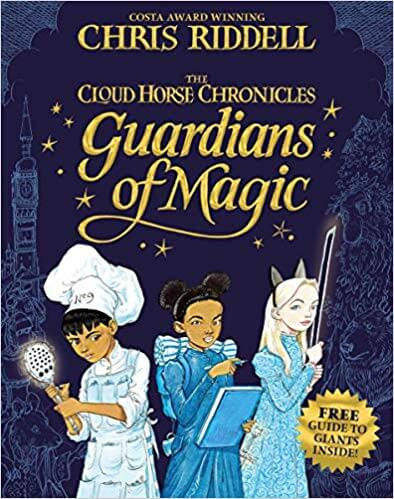
Chris Riddell: a Guardian of Magic

For as long as anyone can remember, children have looked up at billowing clouds in the sky and made a wish on a cloud horse. But no one has seen one.
Until now.

Macmillan Children’s
The Cloud Horse Chronicles

It is always a good day when a new Chris Riddell is published, and an even better day when it is the beginning of a new series! The Cloud Horse Chronicles: Guardians of Magic introduces us to three unsuspecting heroes as they receive magical gifts. The illustrations are perfectly placed and really bring the characters to life, but I particularly love the cross sections of where the children are living when we first meet them. PR for the book says it is reminiscent of Tolkein’s and Pullman’s worlds, but it mainly makes me want to re-read the Edge Chronicles (written by Paul Stewart and illustrated by Chris Riddell)! Readers will spot lots of nods to classic fairytales, tweaked in very pleasing ways.

I called this post “Guardian of Magic” because Chris Riddell really is one. Obviously, I am entirely biased in writing a Chris Riddell review, because we Librarians love him. He’s won the Kate Greenaway medal an unprecedented 3 times (not just because he’s Chris Riddell, honestly, he’s also not won it with lots of his books…) and he has long been an ardent supporter of libraries, often illustrating quotes (often from Neil Gaiman) about their importance. He’s been involved in talks with government in the Libraries All Party Parliamentary Group and as Children’s Laureate 2015-2017 he wrote an open letter to the then head of the Department for Education, Justine Greening, to make a plea on behalf of school libraries to ring-fence funding and set out standards for library provision that schools must follow. He’s been particularly vocal about their importance in schools and has been the President of the SLA (School Libraries Association) 2017-2020.

I could quite easily just copy and paste lots of his illustrations in this blog post, but I urge you to simply do an image search for “Chris Riddell library” to see the dozens of amazing and inspiring cartoons. This summer he tweeted a series of Owls he has created for the SLA and I couldn’t resist just sharing one here:

The Guardians of Magic is published on the 19th September 2019| Hardback, £12.99| Macmillan Children’s Books|ISBN 9781447277972

Huge thanks to Macmillan for sending a review copy!

We Need Diverse Books

You might be aware of the American charity We Need Diverse Books, set up in 2014 by a group of children’s book lovers (mainly writers initially, rallied by Ellen Oh) with the mission to put more books featuring diverse characters into the hands of all children.

We recognize all diverse experiences, including (but not limited to) LGBTQIA, Native, people of color, gender diversity, people with disabilities*, and ethnic, cultural, and religious minorities.
*We subscribe to a broad definition of disability, which includes but is not limited to physical, sensory, cognitive, intellectual, or developmental disabilities, chronic conditions, and mental illnesses (this may also include addiction). Furthermore, we subscribe to a social model of disability, which presents disability as created by barriers in the social environment, due to lack of equal access, stereotyping, and other forms of marginalization.

WNDB

Last night Knights Of, a newish and brilliant UK based publisher who are working so hard to improve inclusivity and diversity in publishing, invited Dhonielle Clayton, WNDB co-founder and Chief Operating Officer (an entirely voluntary position) to speak about the feasibility of starting something similar in the UK. The meeting was attended by aspiring and established authors, owners of small independent publishers, people who worked for larger publishers in all stages of book production and promotion, Inclusive Minds ambassadors, and of course some librarians!

We Need Diverse Books pin

The meeting was over in a blink of an eye with so much to talk about. The projects that WNDB manage are amazing:

  • Publishing internship programmes with stipends and mentoring to help break into the “Big 5” American publishers, mainly based in New York.
  • Speaking to marginalised students about publishing as a potential career.
  • Grants/mentoring/retreats for writers.
  • Making it easy for teachers and librarians to find diverse stock for their schools and libraries (and parents/teens themselves to find new titles) by creating the Our Story app, which highlights good books with diverse content from marginalised creators and even provides resources for many of the titles for educators to use.
  • Starting a book award for new books by and about diverse people, The Walter Dean Myers Award for Outstanding Children’s Literature, getting thousands of copies of these titles into the hands of children and young people across the country.
  • Fundraising to pay for all of this!

There was lots of discussion about the differences between the US and UK education system, book suppliers, nurturing homegrown talent, the problem of volunteer burnout, how to decide what to target first, what is already being done and by whom, funding, and including everyone. Dhonielle made it clear that their first priority in the US has been to get people from marginalised backgrounds into the publishing industry and actually producing the books, closely followed by getting those books into the hands of children that need to see themselves as heroes in what they’re reading. Afterwards I asked her whether, when talking to students about going into publishing, they discuss also becoming a “gatekeeper”, ie librarian/bookseller, and she said they do but (but) there’s no point having those conversations if these children don’t yet have a passion for books and reading.

A twitter account appeared after the meeting and already has over 500 followers:

So if you think you have something to contribute or want to know more then do get in touch with them, this will be a really exciting project to get involved in!

Library Island by Matt Finch

Library Island is an activity which simulates five years in the life of a nation’s library services. Participants become librarians, government officials, or community members on this island and face the challenges created by conflicting wants, needs, and limited resources. There is an Indigenous community and colonial history to be reckoned with, plus a range of political interests with their own agenda for the library.

It’s a simple game played with nothing more than office furniture, pens, and paper, but it swiftly leads to rich and complex scenarios. The fictional setting allows us to explore structural issues, political challenges, and even some of the disruptive behaviour that professionals may face from their users, within the relative safety of a “make-believe” context.

Source: What exactly is Library Island anyway? – matt finch / mechanical dolphin

Matt has provided a toolkit that can be downloaded with full instructions on how to run, adapt and play the game. It is available here:

https://booksadventures.files.wordpress.com/2019/01/library-island-toolkit.pdf

Children’s Rights to Read

To mark International Literacy Day an important campaign has been launched by the International Literacy Association. Learn more about ILA’s Children’s Rights to Read initiative on their website.

The 8th of September was proclaimed International Literacy Day by UNESCO at the 14th session of UNESCO’s General Conference on 26 October 1966 to remind the international community of the importance of literacy for individuals, communities and societies, and the need for intensified efforts towards more literate societies, and you will find lots of information about it on the UN website

The Home Office responds to my e-mail about the SCL Visa Deal… except they don’t

Well… 34 working days after I emailed the Home Office about their deal with the Society of Chief Librarians (now Libraries Connected) I have received a response.

My original email can be read here and that is not the email they are responding to – they are responding to an email from me asking why they have not responded to my original email.

Download (PDF, 66KB)

Anti Knife Crime Fiction and Resources Lists

Knife crime soared by almost a quarter last year in Britain amid warnings that the reduction in stop and search is fuelling violence on the streets…the police recorded just under 40,000 offences involving a knife in the year ending December 2017 – which was up 22 per cent on the previous year.
~https://www.telegraph.co.uk/news/2018/04/26/latest-crime-statistics-reveal-knife-crime-soaring-stop-search/

Violent crime in England and Wales is rising at an accelerating pace, according to police figures showing a 22% increase in knife crime 
~https://www.theguardian.com/uk-news/2018/apr/26/surge-in-knife-offences-fuels-rise-in-violent

The news about knife crime in the UK has been on my mind for a while now, Libraries (both school and public) are well-placed to offer links to information and resources for library uses of all ages. The lists I have compiled are a beginning so if anyone knows of other books or has links to resources not listed below, please leave a message in the comments.

Below is a list of YA fiction titles that about crime and violence involving bladed weapons.

When I Was Joe Keren David
When Ty witnesses a stabbing, his own life is in danger from the criminals he’s named, and he and his mum have to go into police protection. Ty has a new name, a new look and a cool new image – life as Joe is good, especially when he gets talent spotted as a potential athletics star, special training from an attractive local celebrity and a lot of female attention. But his mum can’t cope with her new life, and the gangsters will stop at nothing to flush them from hiding. Joe’s cracking under extreme pressure, and then he meets a girl with dark secrets of her own.

Hello Mum Bernardine Evaristo
“It’s a hot summer afternoon. Tension is in the air. A gang of youths on bikes gathers outside a chip shop. A teenage boy is stabbed and left bleeding on the street. The boy’s mother wonders how this could have happened to her son. She is full of questions, but when the answers lie so close to home, are they really what she wants to hear?”

The Deepest Cut Natalie Flynn
Adam blames himself for his best friend’s death. After attempting suicide, he is put in the care of a local mental health facility. There, too traumatized to speak, he begins to write notebooks detailing the events leading up to Jake’s murder, trying to understand who is really responsible and cope with how needless it was as a petty argument spiralled out of control and peer pressure took ho

The Knife that Killed Me Anthony McGowan
Paul Varderman could be at any normal school – bullies, girls and annoying teachers are just a part of life. Unfortunately ‘normal’ doesn’t apply when it comes to the school’s most evil bully, Roth, a twisted and threatening thug with an agenda quite unlike anyone else. When Paul ends up delivering a message from Roth to the leader of a gang at a nearby school, it fuels a rivalry with immediate consequences. Paul attempts to distance himself from the feud, but when Roth hands him a knife it both empowers him and scares him at the same time .

The Knife of Never Letting Go Patrick Ness
Imagine you’re the only boy in a town of men. And you can hear everything they think. And they can hear everything you think. Imagine you don’t fit in with their plans…
Todd Hewitt is just one month away from the birthday that will make him a man. But his town has been keeping secrets from him. Secrets that are going to force him to run…

Crossing the Line Gillian Phillip
Nick Geddes’s life is a mess. His sister’s boyfriend was killed in a school stabbing. His grandmother is descending into a world of her own, his mother has a ‘god-slot’ on local radio, and his father is drinking way too much. But that is nothing, because he is also crazy in love with Orla, the sister of the boy who has been killed.

Dead Boy Talking Linda Strachan
Josh has 25 minutes left to live.Lying alone in a pool of blood, Josh hasn’t much time to think.Yesterday he stabbed his best mate, and now it’s happened to him.But there are questions he can’t get out of his head. Like how did he get into this mess? Will anyone find him in time? Will his girlfriend forgive him, and what really happened to his older brother?As his life slips away, the events of the last 24 hours start to look very different…

The Passenger Dan Tunstall
Mikey’s trainers are box-fresh Nikes. They’re as white as new snow. White leather, white laces, white soles. But something on the right shoe catches my eye. It’s a tiny circle. The size of a five-pence piece. It’s bright, bright red. Blood.

Teacher’s Dead Benjamin Zephaniah
A teacher is dead, murdered by two of his students in front of the whole school. Right in front of Jackson Jones.
But Mr Joseph was a good man people liked him, respected him. How could those boys stab him and jog away like nothing had happened’
Unable to process what he has seen, Jackson begins his own investigation- everyone knows who did it, but as Jackson uncovers more about the boys, he becomes convinced that people need to understand why.

No More Knives or County Lines Christina Gabbitas & Evie Hurst

A comic strip style story about a group of friends groomed into county lines who suffer the consequences of carrying a knife.

Knife Crime Resource Links

Safety Box Knife Prevention

The Ben Kinsella Trust

Red Cross Knife Crime Teaching Resources

Teen Knife Crime booklet

Say No 2 Knives

No Knives Better Lives Resources

Knife Crimes Young People & Teachers’ Resources

First Aid

Red Cross: how do you help a stabbing victim?

How to help someone who has been stabbed or is seriously bleeding

#BookBuddy: an interview with Maz Evans

Over the weekend a discussion about donating books to School Libraries blew up on Twitter, led by author Maz Evans (Who Let the Gods Out?); she and other Children’s Authors in the course of visiting schools to speak to students had stumbled onto an open secret – that School Libraries in the UK are not statutory and many (if they exist at all) are not adequately funded.

Rather than writing an article about it I reached out to Maz with a request to interview her about the idea she had for a BookBuddy programme to introduce it to library folk and others that may have missed the initial discussion.

So without further ado, here is the BookBuddy interview with Maz Evans

What is BookBuddy?

It is essentially a scheme to pair those who have spare kids’ books with schools that can give them a great home. Anyone who has children’s books lying around – or wants to buy some new ones for a school – will be put in touch with a school for either a one-off donation or a longer partnership – entirely up to them.

What sparked the initial idea?

I travel extensively around the UK and visit at least one primary school a week. Most schools I visit don’t have a library, very few have a librarian and some have no books at all. I’ll say that again. There are schools in this country with no books in them. I don’t think people realise this. So many books are being funded by the educators themselves, which is insane. I have been badgering the government to address this issue, but I am a lone voice. I was trying to encourage the Education Secretary, Damian Hinds, to pass comment when one kind individual offered to donate all her reading books for a year to a school as their “book buddy” – I retweeted her offer and a school that follows me was ecstatic to take her up. More people came forward and schools started putting their hands up, so I drew up a “first-come” list and matched them to the offers. It was a total accident, but a happy one.

Has the response to your idea surprised you?

Yes and no. The number of schools desperate to join the scheme has, sadly, come as no surprise. The government should hang its head in shame to see schools in this parlous state when we have such wonderful people doing such a great job inside them. The generosity of people has been beyond uplifting. Authors, bloggers, reviewers, booksellers, schools and caring members of the public have come forward in their dozens, offering to donate used or buy new books for schools. What has been a very sad surprise has been the negativity the scheme has attracted in certain quarters, but more on that later…!

How many schools responded to your offer before you had to cap it?

On a Saturday afternoon, within an hour I had 100 schools on my list – I had to cap it to have a hope of finding those schools book buddies and didn’t want to create false hope. I currently have 28 schools left on my list – although many matches have been made ad hoc on Twitter for people who can only donate locally or have a particular type of donation. Over 100 schools are now receiving books from total strangers. It’s not enough, but it’s a start.

Will you be opening the school waiting list again if more buddies come forward?

Me sitting at the laptop copying and pasting Twitter handles is not the most efficient or sustainable way of running the scheme. But a very kind person has come forward and offered to build a website where schools can register and book buddies can find schools when they want to clear out or simply be lovely. I am absolutely behind the scheme and will do everything I can do to support it while I’m trying to pester the state to sort this mess out.

Does the non-statutory nature of school libraries shock you?

Horrifies me, actually. Something that came of the conversations prior to BookBuddy was that libraries are (rightly) statutory in prisons, but not in schools. So some children have a better chance of being exposed to books if they are convicted of a crime than during their primary school years. It’s a national disgrace.


What do you say to those that have criticised your endeavours by saying that:

  • it is the government’s responsibility
  • that it will spark an increased wave of schools approaching authors directly for donations or free visits
  • or that it will reduce an author’s pay
  • I’m not going to lie, I’ve been incredibly disappointed by the reaction of a certain (small) number of people, primarily because they haven’t bothered to research what I’m actually doing before sounding off on social media. To be explicit on this point, I am NOT putting the begging bowl out to the publishing industry. I receive hundreds of requests for free books and free visits and feel horrible that I can only fulfil a fraction of them. The last thing I want is to put further pressure on people. BookBuddy is firstly for people who have books they WANT to clear out. Yes, many of those are coming from the publishing industry because lots of us are fortunate enough to receive a lot of free books and not everyone wants to keep all of them.

    But as a parent, I know how easy it is to accumulate books that are never going to be read again and I have always donated them. I haven’t approached anyone to do anything – people are hearing about the scheme and coming to me. This whole thing was born out of me trying to get the government to see the damage they are doing to our future and the need to fund schools properly – how nice it would be if those who have the time to denounce this scheme on Twitter put their energies into lobbying their MP or Mr Hinds to demand action, as I am also doing.

    As for the financial argument, sorry, I just don’t buy it. These are books that are a) books for which royalties have already been paid 2) books for which royalties were never going to be paid (free copies to publishing people) or 3) new books that are being bought for the scheme, therefore are paying royalties! Also, put a book in a school and watch it breed like a randy rabbit. If anything, this will market books, not cost sales – and it gives schools a place to ask for donations, potentially easing the need to approach publishers/authors directly. If none of that convinces you, question your own humanity and privilege. At the end of the day, this is getting books to kids who wouldn’t otherwise have them. Should we have to do it? No – the government should. But as one author eloquently put it, we shouldn’t have to donate to food banks. But are we going to stand back and let people starve?

    If given the opportunity to speak to Damian Hinds the Education Minister what would you say to him?

    I want – no, demand – that the government enshrines funding for books in schools. One school I spoke to has £40K put aside for sports equipment, but can’t remember the last time they bought a new book. The government itself insists that reading for pleasure is at the heart of education – how the hell can educators do this without the books?! I see inside 100s of schools and while I see so much passion and inspiration from teachers and students, I also see an education system that is at breaking point. If we don’t invest in our future, we won’t have one.

    Do Librarians Hate Volunteers?

    I write this as I have been noticing an increase in accusations of hatred made against Librarians by Volunteer Library organisations recently, I have had this charge levelled against myself and several of my peers and friends have experienced this as well.

    so in answer to the question Do Librarians Hate Volunteers?

    The short answer: No!

    The longer answer:

    Volunteers have formed an essential part of the library ecosystem for years now, working alongside librarians and library workers, volunteers assist with programmes that would be difficult if not impossible to run without their involvement. Library staff appreciate the work done by volunteers in libraries and continue to do so.

    Where librarians and activists have a problem is local authorities off-loading library provision on community volunteers as this is cheating the people they work for, as public libraries are a statutory service and are paid for through taxes – basically volunteers are forced into running for a service they have already paid for and while some volunteer libraries still fall under the aegis of the local authority and are able to give the library users access to online information provision and catalogue use, many others do not -effectively robbing the people in the library catchment area of a service they already pay for.

    Volunteer libraries also create what amounts to a postcode lottery, depriving poorer communities of a library as many people are already making a choice between eating or the heating often cannot stretch themselves to volunteering.

    We do not want to close any libraries but once a public library has been cut off from the local authority and handed over to volunteer organisations it is lost, as once austerity is done there is little chance that councils will have the will to reopen libraries or take back ones they have already given away.

    It is important for areas that have community-groups that support libraries to resist governmental moves to close libraries as this sends the message that the amateurisation of the service is not a viable solution, a number of councils in the face of sustained campaigning have retained their libraries.

    There is also concern about the long-term sustainability of volunteer-run libraries, this is not a criticism but rather a serious question as to what will happen after five or 10 years of constant fund-raising and soliciting donations which may lead to giving fatigue this also dovetails with my previous point about communities being double-charged for a service they have already paid for.