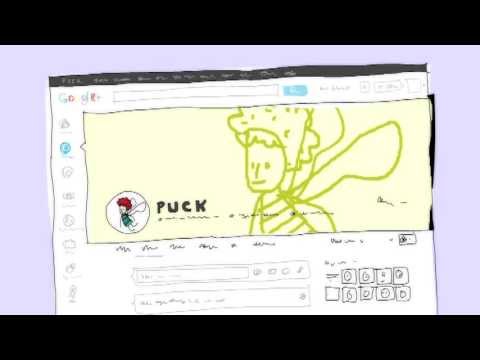
The Royal Shakespeare Company has worked with some brilliant bods at Google to bring to digital life Midsummer Night’s Dreaming, an interactive digital theatre project. This weekend, alongside a classic performance of Shakespeare’s A Midsummer Night’s Dream, a parallel play will be acted out online, with help from Internet thespians around the world.
The complete play will be performed from the 21st – the 23rd
There is no need to reread the play beforehand (although you can if you want to) as a video refresher is available here:
If you have time to spare you can hear the play read out in full (courtesy of Librivox)
Everything the RSC characters share and everything you share will be added to the wider event!
So if you share photos or video or words tagged #Dream40 (and it’s not naughty), they will show it there.
There are streams from +PUCK, from the public, and from all the new characters and blogs that have been created. You won’t miss a thing.
If you’re on the road and want to catch up then the stage works just as well on your phone or tablet. Or if you are a Google+ user you can also follow the cast via a shared circle.
If you miss it they will be sharing a curated timeline of events for 18 months after the show.
Until the 29th June there will be daily competitions to win reading group sets of books and author visits so keep checking the site for new competitions and information.
Short Story Day Africa brings together writers, readers, booksellers, publishers, teachers and school children from all over the globe to write, submit, read, workshop and discuss stories – and to foster the love of reading and writing African fiction.
When Nigerian novelist Chimamanda Ngozi Adichie addressed the TED Conference in 2009, she spoke of the danger of the single story, a distorted, one-dimensional view of Africa that sees the continent through a prism of war, disease, poverty, starvation and corruption. Short Story Day Africa has established a day – 21st June, the shortest day or night of the year – on which to celebrate the diversity of Africa’s voices and tell you who we really are; what we love; love to eat, read, write about. We want to bring you the scents on our street corners and the gossip from our neighbours, and to let you listen to strains of the music that get us dancing. Short Story Day Africa exists because we have something to tell the world. About us. In our own voices.
What’s New?
The project is in its third year and has grown substantially since 2011. We continue to have the support of the African writing community, and more writers are reaching out and holding workshops to share their knowledge. We’ve partnered with Worldreader and Paperight to bring out a Kids anthology comprising the best of their efforts, as well as an adult collection of fifteen stories harvested from the entries into our Feast, Famine and Potluck writing competition. Thus bringing us closer to one of our aims: to give writers – established and emerging, young and old – a platform for their work.
The Impact Literacy! By running competitions and workshops in schools and beyond, we foster a love of writing that leads to a love of reading. Perhaps we inspire the next Chimamanda. Also, we hope, the promotion of African fiction as we like to tell it.
Competitions
The support we’ve garnered from the writing community and beyond is evident in our prize sponsorships. 2013 prizes are sponsored by BooksLive, NB Publishers, All About Writing, Erotica sensation Helena S. Paige, Louis Greenberg, SL Grey, The Caine Prize, Modjaji Books, Botsotso and Heart & Soul Photography.
• Feast, Famine & Potluck (over 18) – Original unpublished stories, in any genre, inspired by our theme. 1st Prize R2000 + Writing course plus Word count: 3000 – 5000 words. Deadline 30th June 2013.
• Fairy tales, Myths & Legends Reimagined (17 and under) – Take any fairy tale, myth, fable or legend and reimagine it. Parents and teachers can download workshop packs from the website. Great fiction titles to be won in all categories. Age 9 and under, 900 words or less; Ages 10-13, 500-1200 words, Ages 14-17, 500-1200 words. Deadline 15th July 2013.
• Spine Stories (All ages) – Assemble a story from the titles on your book shelf. Snap a pic. Twitpic it @benrwms @shortstoryAFR with hashtags #shortstorydayafrica #spinestory .
Ends 30th June 2013.
Story Submissions
In the month of June we will publish short stories from some of Africa’s most talented writers. Stories will simultaneously be published across Worldreader Mobile to over half a million readers, giving writers the opportunity to grow their fanbase. See website for submission guidelines.
Who is behind Short Story Day Africa?
Rachel Zadok was raised in Johannesburg. In 2001, she escaped a career in advertising to become a writer, which she describes as being a little like running away to join the circus without the safety net. In 2005, she was a runner-up in the Richard & Judy How to Get Published Competition and her first novel, Gem Squash Tokoloshe, was published by Pan Macmillan later that year. Gem Squash Tokoloshe went on to be shortlisted for The Whitbread First Novel Award and The John Llewellyn Rhys Prize, and longlisted for the IMPAC award. She launched Short Story Day Africa in 2011, an initiative to highlight African fiction. Her writing has appeared in the Observer, The Jewish Chronicle, The Independent and, the 2012 Caine Prize Anthology. Rachel’s second novel, Sister-Sister (Kwela Books) was published in April 2013. She lives in Cape Town with her husband and daughter, and occasionally blogs. http://www.rachelzadok.com
Tiah Marie Beautement is the author of the novel Moons Don’t Go to Venus. Shorter works have appeared in various publications, including two anthologies: The Edge of Things and Wisdom Has a Voice. She lives on the Garden Route with her husband, two children, Orwell the dog and five chickens all named Eva.
Colleen Higgs is a writer and a publisher. She launched Modjaji Books (http://modjaji.book.co.za/), an independent press for southern African women writers, in 2007. She has two published collections of poems, Halfborn Woman (2004) and Lava Lamp Poems (2011). In 2012, her first collection of short stories, Looking for Trouble was published. She lives in Cape Town with her daughter.
Absolutely Normal Chaos – Sharon Creech The Adrian Mole Diaries – Sue Townsend Confessions of Georgia Nicolson – Louise Rennison Dear Dumb Diary – Jim Benton Diary of a Chav – Grace Dent Diary of a Wimpy Kid – Jef Kinney Diary of an (Un)Teenager – Pete Johnson Don’t You Dare Read This, Mrs. Dunphrey – Margaret Peterson Haddix Dork Diaries – Rachel Renee Russell Go Ask Malice: A Slayer’s Diary – Robert Joseph Levy Love Stargirl – Jerry Spinelli Mackenzie Blue – Tina Wells My Story series – various authors Spud – John van de Ruit The Absolutely True Diary of a Part-Time Indian – Sherman Alexie The Adventures of Jack Samsonite – Tom Clempson The Carbon Diaries – Saci Lloyd The Demigod Diaries – Rick Riordan The Donut Diaries of Dermot Mulligan – Anthony McGowan The Moth Diaries – Rachel Klein The Princess Diaries – Meg Cabot The Vampire Diaries – L.J. Smith Witch Child – Celia Rees Z for Zachriah – Robert C. O’Brien
Every four years two children are stolen away from Gavaldon, never to return. Most children fear being taken to the School for Good and Evil. But not Sophie…
She has dreamt all her life of being a princess and believes the school could be her chance.
Her friend Agatha has other ideas.
When the two girls are taken, things don’t quite go to Sophie’s plan.
Because sometimes, the princess and the witch don’t look like they do in fairytales.
This book…
Is BRILLIANT!
Sophie and Agatha are as different as night and day, Where Sophie is blonde and fair and does her best to look perfect, Agatha is dark of hair, lives in a cemetery and does her best to discourage everyone but they are best friends.
Good in pink. Evil in black. The School Master’s perfect pair.
Look, going by the blurb you just know what is going to happen are taken to the school, but what happens after – that is what makes this book fantastic!
The School for Good and Evil is dark, funny and entertaining. It asks the question how far will people go to achieve their dreams and forces the reader think about the nature of good and evil, prejudice, choice and predestination versus free will. It is quite a lot for a novel for young readers and what is more, it does it excellently!
Shining a light on to the characters that populate fairy tales is a brilliant idea, good may be good and evil may be evil but neither are very nice.
A wonderful tale, artfully told – I recommend it unreservedly!
The Embassy of Japan in the UK is once again launching their manga-writing competition, MANGA JIMAN 2013, with fantastic prizes up for grabs. Now in its 7th year, MANGA-JIMAN can be translated as ‘having pride in manga’ and the Embassy of Japan is proud to offer this opportunity to UK manga creators.
This competition is open to all UK residents aged fourteen (14)* years or over. All creations should be original and between six (6) to eight (8) A4-sized pages in length and drawn so that it reads from left to right. The manga should in some way make reference to ‘voyages of discovery’. We chose this theme because 2013 marks the 400th anniversary of the first British ship to arrive in Japan and 150 years since five samurai arrived in the UK, the first Japanese to study at university in Britain. NB Your manga does NOT specifically have to refer to these two events.
1st Prize: Two (2) return air tickets to Japan, courtesy of All Nippon Airways!**
2nd Prize: A fabulous laptop computer from Toshiba of Europe Ltd.
3rd Prize: A superb digital camera from RICOH UK Ltd
Runners-up will receive and a selection of manga publications, available in the UK from various UK manga publishers amongst others prizes.
The winners’ works will also be displayed in a special MANGA JIMAN EXHIBITION at the Embassy of Japan.
HI Sara, thank you so much for agreeing to be interviewed! For my first question would you be able to summarise Half Lives in 10 words? (if you can- more words can be used if necessary)
That’s a difficult challenge, but here goes…
Two stories of survival; separated by time but bound by a deadly secret.
Half Lives is two stories – one set at the end of our world as we know it and the second on the cusp of a new civilisation arising – how long did it take you to write the story?
The spark for the story came in November 2009 when my editor at Little, Brown sent me a link to an article on Slate.com’s Culture Gabfest. The article was titled “Atomic Priesthoods, Thorn Landscapes, and Munchian Pictograms: How to communicate the dangers of nuclear waste to future civilizations.” It discussed how a US Department of Energy panel planned to label the site of an underground nuclear waste repository.
The topic may sound dull, but the more I thought about it, the more it fascinated me. Some types of nuclear waste are deadly for more than 10,000 years – that’s longer than the world’s oldest civilization. Who knows what the world will be like even a thousand years from now? What language will we speak? What symbols will have meaning? The article sparked something in my brain and I couldn’t stop thinking about it.
I developed the novel on and off from the moment I read that article in 2009. The more I wrote and researched, the more I found that I wanted to explore.
(If you want to read more about the article that started it all and the issues behind the story, you can visit my web site at: http://www.sara-grant.com/half-lives/half-live-discussions/)
Was it difficult keeping the protagonists voices separate?
The voices, settings and time periods were so different that keeping the stories separate in my head wasn’t difficult. Also I initially wrote the two stories in Half Lives as separate novels. Once I was sure the stories were satisfying on their own then I knitted them together, endeavouring to show the reader the complete story by withholding and revealing information in each narrative.
The idea of a culture and religion based around modern day youth slang and culture is brilliant – what inspired you to come up with that concept?
It’s an idea I’ve been kicking around for a long time, maybe even since the 1995 Joan Osborne song One of Us with the chorus, “What if God was one of us. Just a slob like one of us. Just a stranger on the bus, trying to make his way home.”
Until Half Lives, I hadn’t found the story that would allow me to explore these ideas. What’s more fascinating than religion? Not only organized religion but also the systems of belief, faith and superstition that everyone creates to make it through the day.
Half Lives as a title works on a number of levels – the stories of Icie and Beckett, their lives being trapped by fate and circumstance and the time it takes radioactive materials to decay. Did the title come first or did you have the story planned and written before you named it?
Half Lives was the title from the very first proposal and outline. That happens sometimes; the title comes as part of the initial spark.
The covers of the British & American editions are very different – which one do you prefer?
I like both covers for different reasons. They both represent similar aspects of the novel. Both covers show the connected dark and light sides of the story. The US cover was designed to match the re-designed cover of my first teen novel Dark Parties. I must admit that my favourite detail appears on the UK cover; it’s a black cat sauntering across the ISBN bar code. (A black cat plays a significant role in the novel.) Details like this make me appreciate how much my publishers invest in and understand my work.
Did you have any involvement in the design?
I have two amazing publishers with fantastic art departments. They showed me initial designs, and I gave feedback, but they are responsible for the cover concept and design. I leave the visual art to the professionals.
The breakdown between Icie, Chaske, Tate and Marissa was as heart-breaking as it was inevitable – is it difficult to write scenes like this in your novels? I am aware that some authors have very public near breakdowns when talking about bad things happening to their characters.
Many scenes in Half Lives were difficult to write. If I’m heart broken when writing or upset or scared then that emotion often translates onto the page. Many scenes had to be written in layers. It’s easier to deepen difficult scenes over time rather than in one initial rush. I’m a planner so I know most of what will happen from the initial outline. But surprises happen along the way, and it can be devastating when you realize that something horrible must happen to one of your characters. Chaske surprised me the most in Half Lives. He was a mysterious character that revealed himself to me over the course of several drafts.
Was Half Lives written as a warning against the dangers of nuclear waste and weapons of mass destruction or was that just an added extra?
The novel sprang from an article about these issues so they were fundamental to the story from the very beginning. The more I researched about these topics the more unbelievable it became. Creating a substance that will be deadly for tens of thousands of years definitely seems like science fiction, something right out of a superhero comic book.
While reading the book I had no idea how you were going to bring the two strands of the story together separated as they were by time and culture. Did you start with the idea of how they would converge or did they converge together as you wrote?
I created a grid that outlined the plot points in the two novels and noted how and where they would intersect. The difficult aspect of this novel was that if I changed something in one story, I had to consider the ripple effect it would have in the other.
The Just Sayings that prefaced each chapter of Beckett’s story are brilliant – are there any plans to put them together and make them all available to the reading public?
That’s an interesting idea. I do have a bigger list of Just Sayings. I’m a bit obsessive about details like that so I have a grid that notes the origin of the Just Saying and where it appeared in the book. But my reference documents are sometimes only understandable to me. Maybe I’ll get that organized and post it on my web site. Thanks for the suggestion, Matt!
Finally – what are atomic priesthoods?
The phrase ‘atomic priesthoods’ comes from the article I mentioned that served as the spark for Half Lives. The article discussed how the US planned to mark the site of a nuclear waste repository and the conundrum of how you communicate with future generations that most likely won’t speak the same language we do nor understand the same symbols. Here’s the extract from the Slate.com article:
“In the early 1980s, the semiotician and linguist Thomas Sebeok wrote a paper for the U.S. Office of Nuclear Waste Management titled “Communication Measures To Bridge Ten Millennia,” which proposes a folkloric relay system to pass along information: “The legend-and-ritual, as now envisaged, would be tantamount to laying a ‘false trail,’ meaning that the uninitiated will be steered away from the hazardous site for reasons other than the scientific knowledge of the possibility of radiation and its implications; essentially, the reason would be accumulated superstition to shun a certain area permanently.” Sebeok further suggested a Dan Brown-like “atomic priesthood” of physicists, anthropologists, semioticians and the like who would preserve the “truth.”” (http://www.slate.com/articles/health_and_science/green_room/2009/11/atomic_priesthoods_thorn_landscapes_and_munchian_pictograms.html)
This was one idea for how to warn away future generations from these deadly burial grounds with only a select few – so called atomic priests – who know the truth. Thankfully this wasn’t the final recommendation. Atomic Priesthoods sounds like a great name for a rock band though.
Thank you so much for taking the time to be interviewed!
You are very welcome, Matt! Thanks for reading Half Lives and being my first official interview on the book.
Reading Groups For Everyone are excited to be running a fun photo competition with Curious Fox to celebrate the publication of their new horror book Soul Shadows by Alex Woolf. One lucky young people’s reading group will win 10 tickets to the cinema and a reading group set of Soul Shadows.
The competition:
To be in with a chance of winning 10 cinema tickets and 10 copies of Soul Shadows for your reading group, all you have to do is take a photograph of your shadow. Scare us or make us laugh, just be creative with your shadow snaps! The winning group will be chosen by the author Alex Woolf.