Author Archives: Matt Imrie

How to DeGoogle your Life

I was an early fan of Google, from managing to get an early invitation to Gmail, playing with Picasa and following it when it was purchased by Google and eventually became Google Photos, using and enjoying Google Docs and the other offerings in its Office Suite. My first smartphone ran Android (it was the HTC Desire), I ran library lessons on using Google products when I was a School Librarian and I enjoyed the ease of use and interconnectedness Google products offered.

Sadly over the years I have watched Google move from the days of “Don’t Be Evil” and fear that they are approaching their “I’m With Evil” phase, in fact they may already be there.

I have slowly been in the process of Degoogleing my life, and the other day I decided to share (via Bluesky) some replacements for Google products:

Instead of Google search try DuckDuckGo Instead of Chrome try FirefoxInstead of Gmail try ProtonMailInstead of Google Docs etc try LibreOfficeInstead of Google Photos try EnteFor every Google product there are multiple replacements you can try. The above suggestions are just examples to try

— Matt (@mattlibrarian.bsky.social) 2025-02-12T23:27:55.064Z

That skeet has proven to be extremely popular. So popular in fact, that I decided to create this post with more in-depth suggestions with regard to replacing Google products and services. I will caution at the outset that sometimes there are not like for like products that work in exactly the same way, but for each I will suggest at least one potential replacement you can try out.

Remember when looking to swap out apps and programs from companies that have taken a stance you disagree with, you should take the time to test out and research potential replacements- it is good to take heed of suggestions but find something that fits your particular needs and ethics.

I have limited this list to free to use products. Depending on your needs (& budget) there are a number of subscription services that may meet your needs that you can find with a quick search on your search engine of choice (see below for some examples).

Replacing Google Search:

https://duckduckgo.com

search.brave.com

www.dogpile.com

www.metacrawler.com

www.mojeek.com

Replacing the Chrome Browser:

https://brave.com

https://www.opera.com

https://vivaldi.com

DuckDuckGo Browser

Replacing Gmail:

https://tuta.com/secure-email

https://www.fastmail.com paid service

https://mailfence.com basic plan is free

Replacing Google Docs:

https://www.libreoffice.org

https://www.nuclino.com basic option is free

Replacing Google Photos:

https://ente.io 5GB free

Replacing Google Calendar:

https://www.any.do/calendar

Replacing Google Maps:

https://www.mapquest.com

https://maps.me

https://organicmaps.app

magicearth

https://osmand.net

Replacing YouTube:

https://www.dailymotion.com

https://odysee.com

Replacing your Android Phone:

https://lineageos.org

https://ubports.com/en

Replacing ChromeOS:

https://ubuntu.com/desktop

https://linuxmint.com

While not a Google product WhatsApp (owned by Meta) can also be swapped out:

https://signal.org/

A note about Proton

In my initial skeet I mentioned ProtonMail, I received several comments informing me that Proton CEO Andy Yen had made several disturbing statements

archive.ph/LlbSj

archive.ph/quYyb

https://www. reddit.com/r/ProtonMail/comments/1i2nz9v/on_politics_and_proton_a_message_from_andy/

The frustrating thing about this is that Proton offers email, a calendar, cloud storage, a password manager and a VPN all of which are free to use at the basic level. I have included links to these services if your need to deGoogle your life trumps (no pun intended) your dislike of the current US administration.

The Pod(y) in the Library: Bad Librarians

I have started a new series on my long-dormant podcast. I have called the series Bad Librarians, in it I am casting a critical eye at librarians who have harmed both the profession as well as the communities they were supposed to serve.

I was going to start with the so-called “father of modern librarianship” Melvil Dewey but due to what is currently happening in the US and elsewhere I decided to jump right in with Nazi Librarians. You can take a listen below.

Carnegies Long-lists Announced

The 2025 Carnegie Medal for Writing longlist is (alphabetical by author surname):


  • On Silver Tides by Sylvia Bishop (Andersen Press)
  • You Could Be So Pretty by Holly Bourne (Usborne)
  • I Am Wolf by Alastair Chisholm (Nosy Crow)
  • Treacle Town by Brian Conaghan (Andersen Press)
  • Sisters of the Moon by Marie-Louise Fitzpatrick (Faber & Faber)
  • The Things We Leave Behind by Clare Furniss (Simon & Schuster)
  • The Final Year by Matt Goodfellow, illustrated by Joe Todd-Stanton (Otter-Barry Books)
  • Island of Whispers by Frances Hardinge, illustrated by Emily Gravett (Macmillan Children’s)
  • If My Words Had Wings by Danielle Jawando (Simon & Schuster)
  • King of Nothing by Nathanael Lessore (Bonnier Books UK)
  • Little Bang by Kelly McCaughrain (Walker)
  • Glasgow Boys by Margaret McDonald (Faber & Faber)
  • Trigger by C.G. Moore (Little Island Books)
  • All That It Ever Meant by Blessing Musariri (Head of Zeus)
  • Play by Luke Palmer (Firefly Press)
  • Fallout by Lesley Parr (Bloomsbury Publishing)
  • The Wrong Shoes by Tom Percival (Simon & Schuster)
  • Louder Than Hunger by John Schu (Walker)
  • Us in the Before and After by Jenny Valentine (Simon & Schuster)

The 2025 Carnegie Medal for Illustration longlist is (alphabetical by illustrator surname):


  • The Last Zookeeper by Aaron Becker (Walker)
  • The Invisible Story by Wen Hsu Chen, written by Jaime Gamboa, translated by Daniel Hahn (Lantana)
  • Grey by Lauren Child, written by Laura Dockrill (Walker)
  • Flower Block by Hoang Giang, written by Lanisha Butterfield (Puffin)
  • I Love Books by Mariajo Ilustrajo (Quarto)
  • The Dictionary Story by Oliver Jeffers and Sam Winston (Walker)
  • Clever Crow by Olivia Lomenech Gill, written by Chris Butterworth (Walker)
  • Dive, Dive into the Night Sea by Thea Lu (Walker)
  • Letters in Charcoal by Juan Palomino, written by Irene Vasco, translated by Lawrence Schimel (Lantana)
  • Homebody by Theo Parish (Macmillan Children’s Books)
  • The Bridges by Tom Percival (Simon & Schuster)
  • Wolf and Bear by Kate Rolfe (Macmillan Children’s Books)
  • Flying High by Yu Rong, written by Cao Wenxuan, translated by Simone Monnelly (UCLan Publishing)
  • Do You Remember? by Sydney Smith (Walker)
  • Grandad’s Star by Rhian Stone, written by Frances Tosdevin (Harper Collins Publishers)
  • The Wild by Yuval Zommer (Oxford University Press)


The Carnegies celebrate outstanding achievement in children’s writing and illustration and are unique in being judged by children’s librarians, with the Shadowers’ Choice Medals voted for by children and young people. The awards aim to spark a lifelong passion for reading by connecting more children with books that will change lives. The longlists were chosen from 119 nominations by the judging panel which includes 14 children’s and youth librarians from CILIP’s Youth Libraries Group.

Regular Show: the Complete Series

The Regular Show follows the lives of best friends Mordecai and Rigby, whose lazy afternoon adventures always seem to be interrupted by zombies and misadventures with their gang of friends Benson, Pops, Muscle Man, Hi-Five Ghost, Skips, Thomas, Margaret and Eileen or sometimes even dealing with Death himself.​

Ok, I am going to preface this review with the caveat that I am extremely tired today! The reason for this will be explained in my review, so I ask for your forbearance while you read and I will say upfront that you need this cartoon series in your life! It came out while I lived in the UK at a time when I did not own a television so when it was originally showing it bypassed me completely, but now that it is in my life I am rejoicing as it is that good! Now on to the review!

 Is The Regular Show the greatest cartoon series ever made?

No! But it is up there!

Can you explain?

Sure! Pull up a chair and I’ll get started.

I received a review box set of this delightfully odd cartoon yesterday (Monday, Feb 3rd) so I have not been able to make too great a dent into the 245 episodes (and a movie), but what I have seen I have enjoyed.

Strike that! I have loved the episodes I have viewed so far!

The Regular Show is fucking weird! No, no this is a good thing, well for me anyway – I grew up watching cartoons in the 80’s and I enjoy weird! But weird and compelling stories – that is something I do not always find!

It also has, from what I have seen, an internal consistency and loose arc development and AND it has what is possibly the best homage to one of the greatest ever 70’s New York gang movies – Warriors, a movie that I first watched when I was way too young but it burned itself into my long term memory.

I spat out my tea onto my computer at 3:30 this morning. Ok why was I up at 3:30am? Well, my daughter has been ill and I was sitting up with her while she slept because she asked me to – and I can’t say no to a tearful request from my sickly child.

While she dozed I plugged an external DVD player into my laptop and bounced through the box set at random, until I landed upon episode 22 of series 4. It is called Picking Up Margaret – I watched it three times giggling like a loon all the while and admiring the storytelling chops of the writers and cartoonists. This episode draws on the plot of the afore-mentioned Warriors and it caught me completely by surprise! I only twigged when one of the Wickets called out: Moredcai put your phone away! That was the line that caused me to spit my tea – and it has been running through my head all day!

The Regular Show box set is out on general release today, you can find out more about it and where to get your hands on it here.

I am a fan of physical media and love owning things, if you are the same then look for The Regular Show wherever films and TV shows are sold. If you are running out of space then check with your local library, and if they don’t have it in stock yo can request that they purchase it (it is one of the things that most public libraries are happy to do!

.

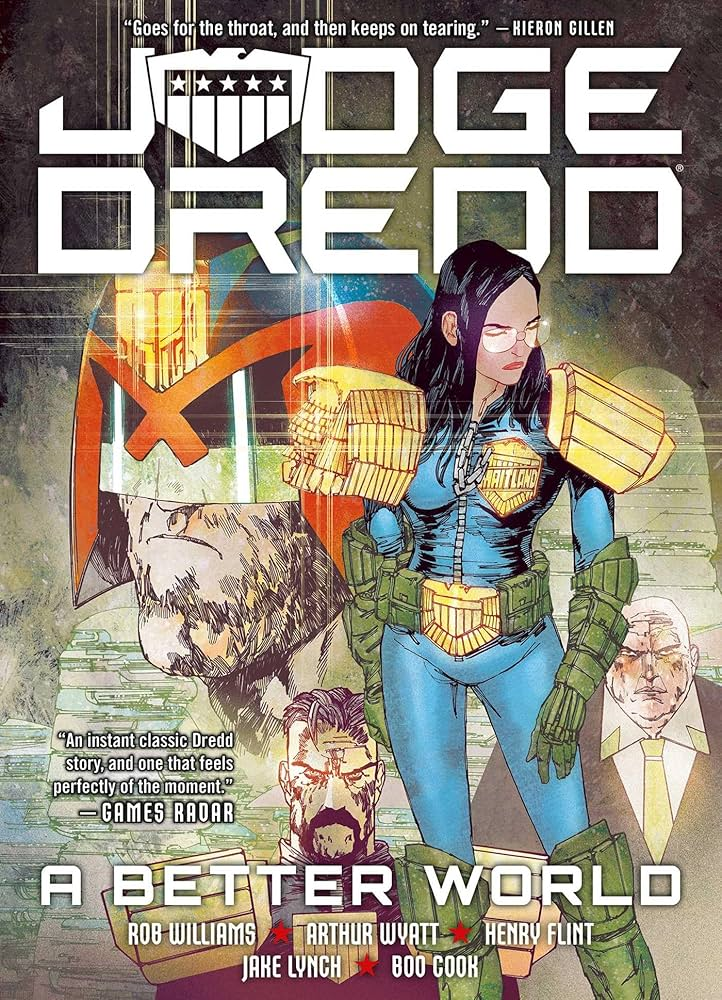
Judge Dredd: a Better World

Judge Maitland has a plan to lower the crime rate of Mega City One: divesting funds from Justice Department into education and services that would benefit the average citizen. She is given one year to improve one sector of Mega-City One; one year to succeed, and create a better world.

But when her plan begins to work, and Justice Department decides to roll it out over ten more sectors, citizens like vid-news mogul Robert Glenn and Judge Hernandez – who have a vested interest in keeping the status quo – step in to spoil the experiment using whatever means are at their disposal.

Judge Dredd started out as a satire of British and American culture, with a focus on authoritarianism and police brutality. As I have grown older and slightly more jaded I have looked at the ramping up of militarized policing around the world and begun to wonder if some people have looked at these comics and thought “Hey this is a good idea!” instead of “Gosh this is a bit much – maybe we should not go down this road!”

Dredd has never been the good guy, in his words he is The Law. Judgement and punishment doled out without fear or favor to the deserving and often to those who commit crimes like eating sugar, or taking their teacher a fresh apple. It was ever a warning, given with a nudge and a wink but the joke has never been funny (except for the stories that were written to elicit a laugh).

A Better World is a Judge Dredd story that is as near to perfect as you will read, Rob Williams has become one of my favorite Dredd writers and, though it may be heresy to say, his take on the lawman of the future often builds upon and surpasses the works of John Wagner. This story is a timely take on the defund the police movement that has been rolling around the United States in recent years, except in this case, that call comes from within the Justice Department. Judge Maitland is a young Judge that earned the trust of Judge Dredd in one of his earlier cases and provides insights and thoughts that Dredd himself, due to his nature cannot envision or express.

Mega City One has been through a lot over the decades and the Judges and what citizens are left after Apocalypse Wars, Zombies, Dark Judges and more eventually something will have to give. So when Maitland approaches Dredd after her research shows that ploughing money, education and services into deprived areas will change the lives of the citizens of MC1 and make them less liable to become perps she has to take it before the ruling council (of five) of the City.

Hope is dangerous, if you are not careful it will get you killed!

I have been a fan of 2000AD for most of my life, and loved the Dredd stories in particular, but living i a country where firearms are fetishized to the nth degree and the police are lauded as incorruptible paragons of virtue while given billions in funding at the expense of other services it taints my enjoyment somewhat as the line between satire and reality is so indistinct as to be invisible! Oh I love this story, I want to push it into the hands of everyone (and particularly those who hold financial control over towns and cities).

A Better World *is* possible, not just in the pages of Judge Dredd but in our world too. I would like to thank Rob and Arthur for creating a story that elicited a bone-deep feeling of despair and hope within me that I feel every time I read this work.

Get yourself a copy! In its pages you may just find your favorite graphic story of the year.

Judge Dredd: a Better World is published by 2000AD and is available wherever fine comics can be found!

Artificial Intelligence some questions and answers from a Librarian’s perspective

What is Artificial Intelligence (AI)?

Broadly speaking, AI is intelligence shown by machines, particularly computer programs. It is a field of research in computer science dedicated to developing and studying software and methods that allow machines to perceive their environment and use their intelligence, bolstered by learning to take actions that will allow them to increase its chances of achieving defined goals.

Are any machines or computer programs actually intelligent?

To put it bluntly no, currently all publicly available “AI” programs are basically a type of machine learning programs known as “large language models” (LLMs) that have been trained on massive amounts of text and images, and with set parameters can generate text and images. True machine intelligence has been hypothesized in science fiction but until the AI singularity occurs true Artificial Intelligence will remain in the realm of science fiction.

What is the AI Singularity?

This is the hypothetical point at which AI systems will achieve the ability to surpass human ingenuity and be able to improve itself and soon after this achieve true intelligence and then (possibly) attempt to destroy humanity.

So how are ‘Large Language Models” trained?

The people programming them load vast quantities of text and images into the program to allow the program to analyze these and learn how to write similar works.

Where did they get these vast quantities of text?

They scraped the entirety of the world wide web and downloaded everything they could find to feed the digital beasts they were creating.

And did they pay for all the works not in the public domain that they downloaded?

They did not!

Why not?

To legally acquire all the material still under copyright would have bankrupted them all! To quote (Generative AI) company Anthropic: today’s general-purpose AI tools simply could not exist if AI companies had to pay licences for the material

Why did they not just use materials that are in the public domain?

To quote a spokesman from OpenAI (creator of the LLM program ChatGPT): “copyright today covers virtually every sort of human expression – including blog posts, photographs, forum posts, scraps of software code, and government documents – it would be impossible to train today’s leading AI models without using copyrighted materials. Limiting training data to public domain books and drawings created more than a century ago might yield an interesting experiment, but would not provide AI systems that meet the needs of today’s citizens.”

So they didn’t want to pay to access all copyrighted material to train their programs because it would have been too expensive?

Basically yes!

Is that even legal?

Writers, musicians, artists, other creators and a bunch of publishers and more claim that it isn’t! There is a statement that has been released that has amassed over 40 thousand signatures protesting the use of copyright materials in LLM training: The unlicensed use of creative works for training generative AI is a major, unjust threat to the livelihoods of the people behind those works, and must not be permitted.

The creators of LLM AI programs claim that it is fair use to use copyrighted materials to train their programs: we believe that legally copyright law does not forbid training.

So a legal grey area that will have to be fought out in the courts?

mmmmm

OK but is it ethical?

Is it ethical to use a program that has been created using pirated materials in libraries? To quote article 4 of the American Library Association’s Code of Ethics: We respect intellectual property rights and advocate balance between the interests of information users and rights holders. I think as Library Workers we should not be using tools that have been created using methods that may be considered legally, ethically or morally suspect. Most, if not all of us are aware that a majority of authors, musicians and artists struggle to survive on the money they make from what they have created, so to give tacit approval to companies owned by billionaires stealing what they have labored over for years by using Generative AI products so we can push a button to create a generic library lesson plan or library poster that may have one too many fingers or other weird digital glitch is not worth it.

What if I really want to use Generative AI programs at work?

Well I can’t stop you, but I will encourage you to read up on the ethics of using such programs as well as the impact they have on the environment and author incomes. I will put some links to articles below if you would like to start here.

Links:

OpenAI warns copyright crackdown could doom ChatGPT – archived Telegraph article

Explained: Generative AI’s environmental impact – MIT news

Generative AI requires massive amounts of power and water, and the aging U.S. grid can’t handle the load – CNBC

Does the Use of Copyrighted Works to Train AI Qualify as a Fair Use? – Copyright Alliance

Meta Secretly Trained Its AI on a Notorious Piracy Database, Newly Unredacted Court Docs Reveal – Wired article

Authors file a lawsuit against OpenAI for unlawfully ‘ingesting’ their books – The Guardian

UC student explores AI art ethics – University of Cincinnati News

Training Generative AI Models on Copyrighted Works Is Fair Use – Association of Research Librarians

Fair Use Defenses in Disruptive Technology Cases – UCLA Law Review

le chat GPT

Bluesky

Bluesky is the latest (& arguably greatest) pretender to the vacant throne once held held by Twitter; it appears to be achieving critical mass with close to 17 million accounts signed up as I am writing this. By the time you read this it may well have passed that number! I have been kicking the tyres for the past year and it has rapidly become my favourite of the newer short form social media sites.

Less niche than Mastodon and more usable than Threads, if I were a betting man I would put money on Bluesky becoming the preeminent social site among social sites. Bluesky is rapidly achieving feature parity with Twitter, from sharing short videos, images and links to direct messages, hashtags, lists and more. Possibly the thing that makes it greater that Twitter ever was are the baked in anti-toxicity features, developed to help prevent bullying, piling on and worse.

You can find me here most days: mattlibrarian.bsky.social

Rather than rehashing what has gone before, I would recommend anyone interested in using Bluesky to check out author & illustrator Debbi Ridpath Oni‘s Unofficial Guide to Using Bluesky, it is one of the best of (many) the user guides out there, and one that I dipped into a number of times in my early days on Bluesky.

Library Bluesky has been growing at an exponential rate and many of my friends, colleagues and library collaborators have already signed up and I am discovering new (to me) library related folk every day, as well as authors, illustrators, publishers and book bloggers as well. There are a number of feeds, starter packs and lists that created specifically for library folk and those interested in the library world.

Feeds:

Starter Packs:

Lists:

News articles about Bluesky:

Protecting Yourself From Government Surveillance

The WIRED Guide to Protecting Yourself From Government Surveillance

Donald Trump has vowed to deport millions and jail his enemies. To carry out that agenda, his administration will exploit America’s digital surveillance machine. Here are some steps you can take to evade it:

https://www.wired.com/story/the-wired-guide-to-protecting-yourself-from-government-surveillance/

Open Source Digital Security:

https://opensauce.simonxix.com/open-source-digital-security/

Mental Health Assistance

The Trevor Project The Trevor Project is an American nonprofit organization founded in 1998. Focused on suicide prevention efforts among lesbian, gay, bisexual, transgender, queer, and questioning youth, they offer a toll-free telephone number where confidential assistance is provided by trained counselors.

988 Suicide & Crisis Lifeline “988” is the three-digit, nationwide phone number to connect directly to the
988 Suicide and Crisis Lifeline.

Disaster Distress Helpline The DDH is the first national hotline dedicated to providing year-round disaster crisis counseling. This toll-free, multilingual, crisis support service is available 24/7 to all residents in the U.S. and its territories who are experiencing emotional distress related to natural or human-caused disasters.

Public Library Regional and State Specific Resources

Denver Library Community Assistance Resources