Beautiful video courtesy of Bloomsbury Publishing…

Make it: Technobabble
The BBC has created a games site to allow children & teens to create their own games. It ties in with the CBBC show Technobabble.
It’s a starter kit. It requires no technical knowledge, no download and works just as well on mobile and tablets as desktop.
The only requirements are access to the web, a willingness to experiment and an idea. In minutes a child can create a game.
– Martin Wilson BBC head of digital creativity for future media

Citing Times: Creating a Bibliography in the Library
Bibliographies are important, they show what sources have been used to put an assignment together!
This is what I tell my students when they come in to the library for lessons when I introduce them to The Harvard Method of Bibliographic citation, you know the one:
[Author Surname], [Initial]. [Year of publication]. [Title of book]. [City]: [Publisher], pp.[Pages used]
The World Wide Web has made research easier and harder, easier because you can access so much more information (through school site subscriptions or everything that you can get through your public library service).
I had no idea how many sources could be referenced until I started researching what i needed to know to impart to my students.
Fortunately there are a plethora of online tools that one can use. My current personal favourite is www.citethisforme.com a website that you can use on any computer that has an internet connection.
The list of sources it will help you to cite for you is huge:
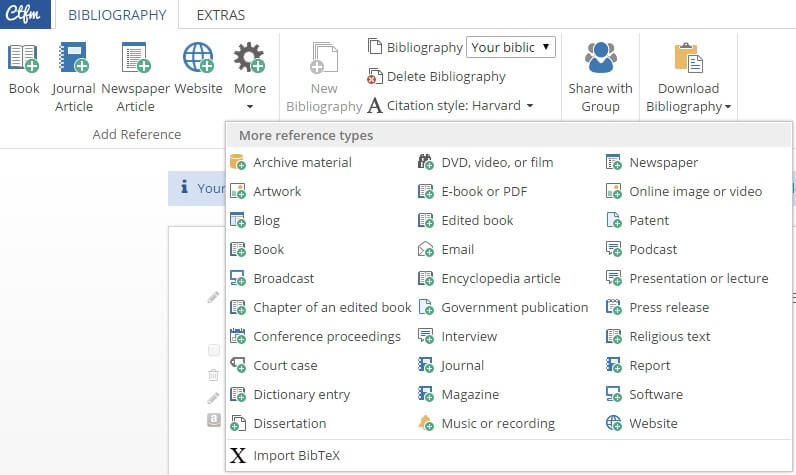
The site allows you to scan a books ISBN, and using WorldCat will find and create a bibliography for you in the style that you prefer. You can create a free account to store your bibliographies online or you can use it casually which allows you to keep your bibliography for up to seven days.
A second tool that I discovered today is called RefMe,

it has a web-based component as well as a smartphone app that connects to a free online account. You can scan an ISBN with your smartphone and it will store the record and you can access it through your account. It is not as powerful as Cite This For Me and could not locate the information for several books that I tried scanning but it allows you to add the information manually and does have potential for further development. As with Cite this for Me it also offers bibliography creation for a variety of sources.
Library A to Z

The launch of the Library A to Z will happen during the week 17th – 22nd November. Packs including copies of books and other materials will be sent to local, national and international politicians.
The aim of this action is to highlight the continued importance and value of library services, to encourage continued investment.
What is the Library A to Z you may ask… well it is a campaign created by librarian Gary Green, researcher Andrew Walsh and artist Jose Filhol to highlight the breadth of services, resources and facilities available, and celebrate the importance, value and relevance of well-funded and professionally-run public libraries.
It is this A to Z that has turned into the illustrations and promotional and advocacy material that is freely available for use on this site. The services, along with the words that have been turned into the illustrated letters, aren’t comprehensive, but are just a representative sample.
From

is for access; advice; answers; archives; art (view public art and sometimes borrow it too!); astronomy (some libraries loan out telescopes for stargazing); audio books; author events.

to


is for ‘zines (magazines); zzzzz (child sleeping after being read bedtime story).
Find out all about the project here:
Dyslexia, Dictionaries, Fonts & Learning
There is a new dictionary coming out at some point in 2015, many people may not think that this news is particularly earth-shattering as dictionaries are printed and published all over the world. The thing that makes this one special is that it is aimed squarely at people with dyslexia.
Known as the Maple Mayes Dictionary after the school where the idea has been in development for quite some time.
Now, after almost 25 years analysing the way dyslexics learn, the Browns have decided to rewrite the dictionary after identifying that its layout, which is biased towards phonetic language, proves to be a huge stumbling block for youngsters with dyslexia. The traditional dictionary – as its name indicates – was originally a tool primarily to promote the correct pronunciation of words.
This is fantastic news; I work with a number of dyslexic students and am excited at the thought of being able to offer a new resource to help them learn.
I found out about the dictionary while reading an article on the NPR website about dyslexic fonts and their development.
The Dyslexie font has been around for quite some time, but reading about it and how it works has given me a new appreciation for the amount of work that has gone into its development, I was also not properly aware of how it worked, apart from the font being weighted – but that is only a part of how it makes words easier to read.
How the font works:

Further information:
Lichfield father and son re-write dictionary to help dyslexic children
Christian Boer Designs Typeface for Students with Dyslexia
Specialist Dyslexia School Rewrites the Dictionary
Spotting Dyslexia May Be Possible Even Before Kids Learn To Read
Project ReMix
The competition is open to UK residents age 13-19: to enter, teenagers are asked to make their own creative work in response to a selection of books, stories, poems and graphic novels from some of the best-selling contemporary and classic authors, including: John Green, Suzanne Collins, Philip Pullman, Benjamin Zephaniah, Jane Austen, Arthur Conan Doyle and Bram Stoker.
Entries can be submitted in five categories:
Music
Book cover design
Book trailer
Creative writing
Comic strip
The aim of Project Remix is to engage young people with literature, using it as a creative springboard into other storytelling mediums, and to open doors to the arts and the creative industries. The competition was inspired by the growth of online fandom, including fan-fiction and fan art and the surge in related digital communities.
Find out more about the competition, including how to enter, at www.projectremix.co.uk
Red House Children’s Book Award blog tour: Stuart Hill


I actually based part of Redrought’s character on every awkward, stumbling and shy teenage boy I’ve ever known – including me! As a grown-up he was a like a cross between a friendly Viking and a grizzly bear; the type of bear that would deliberately break wind loudly in quiet exam rooms or tell vicars dirty jokes and then roar with laughter, not noticing the silence that had settled around him. But as a boy he was very different. He’d blush if a girl so much as looked at him, and he’d definitely fall over his own feet if he had to do something terrifying like actually go for a walk with one of the strange creatures that he found so fascinating.


I think there are more stories to be told involving the young King Redrought, his fighting, farting cat Cadwalader, and his future wife Athena, the warrior princess of the mighty Hypolitan. Perhaps one day, I’ll tell them.


The Power of Reading: A YLG London training day
YLG London are delighted to announce that the booking period is open for this years One Day School entitled ‘The Power of Reading’. We have a great line up of authors, practitioners, librarians and speakers from across a range of organisations coming together to deliver this course. The Course aims, objectives, programme and booking form are included in the body of this email. If you would like further information, please don’t hesitate to contact Simon.
Friday 14th November 2014
CILIP
7 Ridgmount Street
London WC1E 7AE
COURSE AIMS AND OBJECTIVES
This course is aimed at frontline library staff working with the public and Librarians with an interest in promoting stock and engaging readers. The course will provide;
· Practical advice for engaging with young people
· Ideas for reading promotion
· Raised stock awareness
· Raised awareness of the wider literary network
BOOKING INSTRUCTIONS
Course Fee
£50 + VAT CILIP Personal members
£55 + VAT Non members
£40 + VAT Unwaged
Places are limited to 40 and will be confirmed in writing or by e-mail on a first come first served basis. To book a place, please complete the enclosed booking form including your CILIP membership number if applicable and return to:
Simon Smith
YLG London
62 Belmont Road
Reading
RG30 2UU
simonsmith78@btinternet.com
COURSE OUTLINE
08:45 Registration
09:30 Welcome and Introductions
09:35 Power of Reading
Keynote speaker: Julia Eccleshare MBE
10:15 Power of Awards
Panel discussion
Fen Coles – Letterbox Library
Emily Drabble – Guardian
Clare Shanahan – Booktrust
11:10 Break
11:30 Power of Poetry – bringing poetry to life
Performance poet Joe Coelho
12:00 Power of Performance
Group discussions – using examples of books – what can you draw out of books to inspire and motivate – activities/success stories
12:55 Summary of morning
13:00 Lunch
14:00 Power of Summer
Getting the best from the Summer Reading Challenge – Sarah Mears
14:30 Group discussions – what works/doesn’t/ideas
15:00 Power of Authors
Panel discussion with:
Rob Lloyd Jones
Katie May Green
Rob Biddulph
Piers Torday
15:55 Summary of afternoon
16:00 Refreshments and Book Signing. Books on Sale Big Green Bookshop
The CILIP Carnegie & Kate Greenaway (CKG) Awards process
Titles must have been first published in the UK between 1 September 2013 and 31 August 2014
Books first published in another country must have been co-published in the UK within three months of the original publication date
The CILIP Carnegie Medal is awarded annually for an outstanding book for children and young people
The Carnegie Award is a gold medal and comes with £500 worth of books that the author can donate to the library of their choice.
The CILIP Kate Greenaway Medal is awarded annually for an outstanding book in terms of illustration for children and young people
The Kate Greenaway Award is also a gold medal and comes with £500 worth of books but also the Colin Mears Award which is a £5000 bequest left to the winner of the Kate Greenaway Award by Colin Mears, this has been awarded annually since the year 2000.