Author Archives: Matt Imrie

HOW DO YOU LIVE? by Genzaburo Yoshino

First published in 1937, Genzaburō Yoshino’s How Do You Live? has long been acknowledged in Japan as a crossover classic for young readers. Academy Award–winning animator Hayao Miyazaki has called it his favorite childhood book and announced plans to emerge from retirement to make it the basis of a final film. 
 
How Do You Live? is narrated in two voices. The first belongs to Copper, fifteen, who after the death of his father must confront inevitable and enormous change, including his own betrayal of his best friend. In between episodes of Copper’s emerging story, his uncle writes to him in a journal, sharing knowledge and offering advice on life’s big questions as Copper begins to encounter them. Over the course of the story, Copper, like his namesake Copernicus, looks to the stars, and uses his discoveries about the heavens, earth, and human nature to answer the question of how he will live.

There are a lot of books that get given the title ‘classic’, not all of them deserve that, but for How Do You Live? that title is richly deserved! Re-edited and published in Japan many times over 80 years

For people who can only read books in English this is a rare treat! As more and more books from outside the English canon are translated we see more into the cultural milieu of other nations. The story questions militarism and the rise of martial society, which in the time it was originally written and published is really quite amazing!

Read this work before Miyazaki’s movie is released (it will give you instant street cred in the eyes of all the fans of Studio Ghibli’s works)

Power Born of Dreams: My Story is Palestine

What does freedom look like from inside an Israeli prison?

A bird perches on the cell window and offers a deal: “You bring the pencil, and I will bring the stories,” stories of family, of community, of Gaza, of the West Bank, of Jerusalem, of Palestine. The two collect threads of memory and intergenerational trauma from ongoing settler-colonialism. Helping us to see that the prison is much larger than a building, far wider than a cell; it stretches through towns and villages, past military check points and borders. But hope and solidarity can stretch farther, deeper, once strength is drawn of stories and power is born of dreams. Translating headlines into authentic lived experiences, these stories come to life in the striking linocut artwork of Mohammad Sabaaneh, helping us to see Palestinians not as political symbols, but as people.

How can something so beautiful be so heart-breaking?

I ask myself that each time I pick up Power Born of Dreams… three time snow I have read this book each time I have spent ages poring over the pages admiring the stark beauty emanating from the pages of this work of art that Mohammad Sabaahneh has created. I learned the art of linocut when I was in school, but Mohammad has elevated the simple act of slicing shapes out of linoleum he cut into the history of his time as a political prisoner and the stories of Palestinians, living their lives under a brutal occupation, fenced in with electronic eyes watching them every day and night. These are stories of heartache and loss and of hope. These are some of the stories of Palestine.

It may be the fact that I grew up in South Africa during apartheid that makes me sympathetic to the plight of the Palestinian people. Having heard the stories from my friends and fellow South Africans of colour of what they experienced the dehumanising and degrading treatment at the hands of the white minority government has made me resolute in my opposition to oppression wherever it may occur.

In time I can see Mohammad Sabaahneh joining Joe Sacco, Art Spiegelman and other cartoonists in the lists of those who have used their art to open the eyes of the world to the iniquities suffered by so many.

Power Born of Dreams: My Story is Palestine was created by Mohammad Sabaahneh and will be published in November by Street Noise Books.

Overlooking Problematic Content is a Feature, not a Bug

Kate Clanchy’s memoir Some Kids I Taught and What They Taught Me is an award-winning book that has received rave reviews, New Statesman called it refreshing, The Guardian thought that people like Clanchy are needed to keep liberal ideals alive, The Times called it inspiring and uplifting, The Sunday Times deemed it inspiring, moving and funny.

Philip Pullman said that it is: The best book on teachers and children and writing that I’ve ever read. No-one has said better so much of what so badly needs saying. I want to see this book become a bestseller, I want to see it in every staffroom, I want to see it read by every student teacher. This is a wonderful achievement.

In 2020 Some Kids I Taught and What They Taught Me won the 2020 Orwell Prize for Political Writing

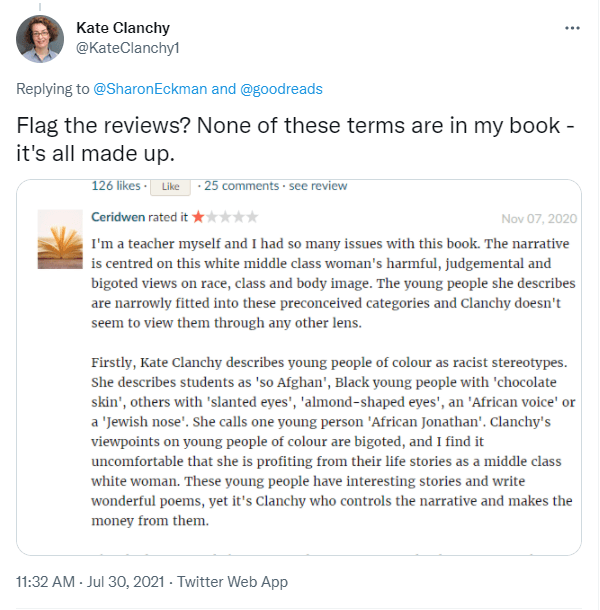
Then in 2021 on twitter Kate Clanchy alleged that Goodreads reviewer Ceridwen had made-up quotes from her book in their review.

Things went downhill rapidly from there!

Unfortunately, whenever people have received near universal acclaim & praise for their work they can react poorly when they encounter someone who says “whoa there is a problem here” and this is exactly what happened!

Instead of giving a blow by blow account what occurred, I will recommend that you read Beth Bhargava’s comprehensive write-up of what happened over at Bad Form Review here. I will just say that I was bitterly disappointed by a number of authors whose work I have previously enjoyed.

Like Public Libraries, Publishing is a majority white profession, both of which can be difficult to break in to, as many opening positions are notoriously low-paid. I could not help but compare what is happening with Kate Clanchy’s book with what happened with the CILIP Carnegie & Kate Greenaway Medals in 2017 where it took people of colour to start asking why no-one who was not white had won either of the awards in over 80 years and a big push from them and allies to start the process to effect change.

Kate Clanchy issued a statement on August 6th which caused more consternation and upset. Picador, KC’s publisher released three statements on the 6th, 9th and 11th, The Orwell Foundation issued a brief statement denying responsibility of what their external judges did, and Philip Pullman released an ‘apology’ on the 10th.

No mention was made by anyone at the centre about the vile language and threats directed against Professor Sunny Singh, Chimene Suleyman & Monisha Rajesh three of the highest profile people that stepped up to offer honest critiques of Clanchy’s work and challenge the racist rhetoric that was springing up in the discussion.

The end result of the storm of protest is that Kate Clanchy will rewrite portions of her work to remove the racist and ableist stereotypes contained in the original.

Systemic racism does not require that those working within the system to be racist; in publishing like libraries, is made up mostly of good, well-intentioned (white) people who do their best but miss many signs that what they are working on may be harmful to minority groups. Unfortunately, most white people lack the insights and cultural knowledge to identify problematic work and content. Even after an outcry those who ‘have learned’ from the criticism are often rewarded, while still excluding those that were harmed.

It should not fall to People of Colour to fight for systemic change on their own, no matter where it happens – in libraries, in publishing, or elsewhere if someone says that something is harming them and their community we need to stand with them and fight to make a meaningful change.

We (white people) have benefitted from systemic racism for hundreds of years, we are complicit even when we fight against it, and we should fight against it – we lose nothing if those that are disadvantaged gain the privileges that we currently enjoy.

It is often said that When you’re accustomed to privilege, equality feels like oppression, but this is something we need to stamp out of our psyches and instead embrace the need for true equality.

Games Workshop swings the Ban(War)hammer

Over the past weekend I was dismayed to read that GW is once again running roughshod over fans, followers and just about everyone that is invested in their creation.

It is no secret that they have always been very trigger-happy when it comes to litigating against those perceived to have overstepped the exceedingly narrow boundaries of their intellectual property; even when it came to terms that existed long before Games Workshop was even an idea (I am of course referring to the infamous Space Marines lawsuit saga).

The updates to their terms & conditions now forbid any and all fan created animations:

individuals must not create fan films or animations based on our settings and characters. These are only to be created under licence from Games Workshop.

Fan-made games, fan art, fiction and websites are permitted so long as they’re not-for-profit and make it clear they’re not official works.

The incredibly popular Oculus Imperia will be staying online for as long as possible:

Sadly the If the Emperor had Text to Speech Device by Bruva Alfabusa has officially thrown in the towel:

Other amateur animator fans (apart from those hired by GW) will no doubt start falling over the coming days and weeks.

Culture blog BoingBoing has been covering the GW shenanigans here, as has PCGamer and Vice.

The Reddit  Warhammer 40k meme subreddit /r/Grimdank has been flooded by people furious about Games Workshop’s new policy.

I have been a long-time fan of Warhammer 40K although I have not played since I left my job as a school librarian a few years ago, I still borrow and read the novelizations.

GWs moves while legal still leave a bad taste in the mouth, for decades it has been fans that have created a richer tapestry of the universe created by GW, and now on the eve of the release of Warhammer+ they are trying to stamp out any potential threats to their being able to wring out as much money from fans as possible.

It is very poor form!

Online Story Times, Copyright and Fair Use/Fair Dealing

Story-times are one of the greatest selling points of libraries all over the world. When the coronavirus quarantine started in 2020 story-times were among the first programs shifted to an online format.

It is a long-held view that live readings of story-time books in libraries are legal, thanks largely to the Fair Use doctrine in US copyright law, and Fair Dealing in UK law.

Fair Use (USA)

Fair Use describes uses of copywritten works by entities other than the copyright holder in quantities, means or purposes that do not infringe on the rights of the copyright holder.

Under section 107 0f the Copyright Act (Limitations on exclusive rights: Fair use) in order to perform, utilize, or reproduce a copyrighted work and be covered by the “Fair Use” exemption, the use must meet four (4) criteria:

The purpose and character of the use, including whether such use is of a commercial nature or is for nonprofit educational purposes;

~Public Library story-times are always non-profit & educational,

The nature of the copyrighted work

~The work used is (generally) a picture story book – which is meant to be used by or for certain age groups, and (generally) are meant to be read aloud

The amount and substantiality of the portion used in relation to the copyrighted work as a whole

~The nature and purpose of the work is meant to be read from start to finish. In most cases the entirety of the work is used in a story-time.

The effect of the use upon the potential market for or value of the copyrighted work.

~Story-time does not have a detrimental effect on the marketability of the work. In most cases, story-time books highlight those works and increase marketability.

Fair Dealing (UK)

A statutory definition for fair dealing does not exist; it will always be a matter of fact, degree and interpretation in every fair use case. The Intellectual Property Office lists the key factors used to determine the validity of whether a particular dealing with a work is fair as follows:

Has the use of the work impacted negatively on the market for the original work? If the creator or owner has lost potential revenue through the re-use of their work, it is not likely to be fair.

~Story-time does not have a detrimental effect on the marketability of the work. In most cases, story-time books highlight those works and increase marketability.

In the UK authors & illustrators are compensated through the Public Lending Right scheme. Each time a book is borrowed by a library worker for story-time it contributes towards the amount that registered authors & illustrators receive each year through PLR.

Was it reasonable and necessary to use the amount of work that was taken?

~The nature and purpose of the work is meant to be read from start to finish. In most cases the entirety of the work is used in a story-time.

—

The rights to making a video or audio recording of a story are set out explicitly in law as belonging to the copyright holder.

—

The current theory is that like in-person story-times, live (unrecorded) online story-times are ephemeral and also covered by fair use.

To date there has been no official legal precedent that supports this theory.

At present most publishers in the US, UK and elsewhere have temporarily relaxed copyright restrictions (with a number of caveats) to allow libraries and educational institutions to offer pre-recorded and live online story-times.

Once the threat of Covid has receded, many libraries may look at keeping a reduced virtual story-time offer in conjunction with their in-person ones for patrons who are unable to visit a physical branch; when this starts happening a wide-ranging discussion about this and copyright will begin in earnest.

Resources:

Section 107 of the Copyright Act (USA): https://www.copyright.gov/title17/92chap1.html#107

Fair Use Copyright Explained: https://www.bl.uk/business-and-ip-centre/articles/fair-use-copyright-explained

Public Lending Right: https://www.bl.uk/plr/about-us

Diverse Book Awards Longlist Officially Announced

Introducing the ultimate must-read list of diverse & inclusive children’s, YA and adult fiction books in the UK

London, United Kingdom, 27th July 2021: More than 100 submissions were received for the second year of The Diverse Book Awards, created by writing community The Author School (www.theauthorschool.com). Today, the longlist is officially unveiled, revealing the outstanding diverse and inclusive books published by British/UK-based authors/publishers in the hugely challenging year of 2020. The shortlist will be revealed on 20th September and the winners in each category announced on October 21st 2021.

Abiola Bello, co-founder of The Author School and award-winning author: Through The Diverse Book Awards I have discovered new diverse books and authors that I hadn’t previously been aware of. I hope that the longlist inspires others to discover new talent too. The conversation around diversity in publishing has stepped up a level over recent months, at a time when we were shouting out for submissions to The Diverse Book Awards. The longlist represents the work that has been done already within publishing and showcases that it is truly is possible for diverse and inclusive books to be the ‘norm’ rather than ‘exception’. We hope that encouraging publishers and authors to write more diverse and inclusive books – and enter them into next year’s awards – will be a positive step forward for the publishing industry in this country. Massive thank you to the judges!

The three winners from each category will receive a bundle of prizes including a trophy, a six-month PR and marketing membership of Literally PR’s ‘100 Club’, a feature and virtual event with Back To Books, editorial content in Bad Form and Pen&Inc, the opportunity to be part of two author panel events – hosted by The Author School and the other with Simon & Schuster.

The Children’s winner will have their book featured as part of World Book Day Book Club and a school visit organised by World of Diversity.

The YA winner will be part of Wigtown YA Literary Festival and a school visit organised by World of Diversity.

The Children’s and YA winner will be featured on Tiny Revolution’s website and included in their catalogue of books.

Our YA headline sponsor is Book Clubs In Schools and the YA winner will be part of the National Teen Book Club, a UK wide virtual book club for teens.

​

The Diverse Book Awards Longlist 2021

Adult Longlist 2021

The First Woman by Jennifer Nansubuga Makumbi (Oneworld)

If I Don’t Have You by Sareeta Domingo (Jacaranda)

A More Perfect Union by Tammye Huf (Myriad Editions)

Broadwater by Jac Shreeves-Lee (Fairlight Books)

Ugly Dogs Don’t Cry by DD Armstrong (Jacaranda)

Love After Love by Ingrid Persaud (Faber)

The Street Hawker’s Apprentice by Kabir Kareem-Bello (Jacaranda)

The Cat and the City by Nick Bradley (Atlantic Books)

The Family Tree by Sairish Hussain (HQ)

Truth Be Told by Kia Abdullah (HQ)

Young Adult Longlist 2021

Eight Pieces of Silva by Patrice Lawrence (Hodder Children’s Books (Hachette)

Run, Rebel by Manjeet Mann (Penguin Random House Children’s)

Cane Warriors by Alex Wheatle (Andersen Press)

And The Stars Were Shining Brightly by Danielle Jawando (Simon & Schuster Children’s Books)

Boy, Everywhere by A. M. Dassu (Old Barn Books)

Wonderland by Juno Dawson (Quercus Children’s Books (Hachette)

Hideous Beauty by William Hussey (Usborne)

Hijab and Red Lipstick by Yousra Imran (Hashtag Press)

Crown of Crowns by Clara Loveman (Clara Loveman)

Love Frankie by Jacqueline Wilson (Penguin Random House Children’s)

Children’s Longlist 2021

Windrush Child by Benjamin Zephaniah (Scholastic Children’s Books)

Too Small Tola by Atinuke, Onyinye Iwu (Walker Books)

Do You Know Me? by Rebecca Westcott, Libby Scott (Scholastic Children’s Books)

Nothing Ever Happens Here by Sarah Hagger-Holt (Usborne)

Baller Boys by Venessa Taylor, Kenneth Ghann (Hashtag Press)

Zombierella: Fairy Tales Gone Bad by Joseph Coelho, Freya Hartas (Walker Books)

Dragon Mountain by Katie & Kevin Tsang (Simon & Schuster Children’s Books)

Clean Up by Nathan Bryon and Dapo Adeola, Nathan Bryon (Penguin Random House Children’s)

A Secret of Birds & Bone by Kiran Millwood Hargrave (Chicken House)

Little Badman and the Time-Travelling Teacher of Doom by Humza Arshad and Henry White, Aleksei Bitskoff (Penguin Random House Children’s)

The Curie Society

From the amazing nerds at MIT (well MIT Press actually) comes a phenomenal graphic novel celebrating Science, Technology, Engineering, and Math, teamwork and foiling the plots of evildoers with science!!

In 1903, Marie Curie founded a clandestine society where brilliant women could pursue the furthest reaches of their intellect. The Curie Society still covertly exists today in secret chapters at dozens of universities worldwide!

When Simone, Maya, and Taj arrive at Edmonds University, they think they’re simply starting their coursework, but after a strange night of puzzles and coded communications, they are introduced to The Curie Society. Almost immediately, they are deployed on their first urgent mission! A mysterious criminal network has stolen research data from a top-secret Curie de-extinction lab, and if no one intervenes, it will soon be sold to some of the world’s worst elements.

These new recruits will have to use all their specialized scientific skills to protect the Curie Society and save the world – or their first mission may be their last!

The Curie Society takes the adventure tropes of a group of brilliant individuals that seem not to like each other much at the beginning and then get molded together into a kick-ass team under the guidance of a jaded mentor that has suffered betrayal and loss! This may be a work of fiction but the history and science wrapped up in the story is all too real! Honestly I spent hours reading up on everything referenced in the story (and I am not even half way done learning!) This is my favourite type of story, one that you can read again and again and discover something new each time you pick it up!

My enjoyment of this story was heightened by the short biographies of several scientists at the end as well as the glossary explaining the facts and scientific concepts behind many important parts of the story.

Created by: Heather Einhorn & Adam Staffaroni; written by Janet Harvey; with art by Sonia Liao & edited by Joan Hilty The Curie Society was published by MIT Press and is available now!

You can discover amazing scientific facts and more at thecuriesociety.com and use the STEM guides to create science experiments at home!

Library Books for Palestine

“مطلوب” or “Wanted” is an initiative of the Librarians and Archivists with Palestine (LAP), in partnership with the Tamer Institute.

When you donate the cost of a book and its shipping, they coordinate delivery of the book to the requesting library. Please note that book titles will be purchased as prioritized by the participating libraries.

Palestinian libraries, in addition to limited funding, face unique barriers to access caused by Israeli policies. With this campaign, we hope to raise awareness about these access issues and the context in which Palestinian libraries operate, while at the same time offering material support for the libraries’ collections.

You might notice that the cost of some books on this site is significantly higher than the list price for the title. This is because Palestinian libraries in the West Bank and Gaza cannot simply order a book and expect it to arrive quickly and reliably. Israel’s “enemy state” designation prevents literature from being sent directly to Palestinian libraries and booksellers if it has originated in Lebanon, Syria, Iran, and sometimes other countries. This is a particular problem with Lebanon, a major hub of Arabic-language publishing. As a result, Palestinian libraries often contain more books originally written in English, Swedish, and other languages, than in Arabic.

To find out more information about this initiative or to purchase a book for a Palestinian Library please visit:

https://matloub.librarianswithpalestine.org/

Visit Librarians and Archivists with Palestine to find out about past projects they have run as well as current initiatives (like Matloub) that may be of interest.

Legendary Comics Forms New Young Adult Imprint

Launching with a slate of five original graphic novels created for the young adult space, Legendary Comics announced a new imprint, Legendary Comics YA, dedicated to telling original and character-driven stories across a wide array of genres. With a commitment to amplify new voices, spotlight diverse perspectives, and seek out passionate talent telling authentic stories, the imprint gives emerging and veteran artists a platform to share stories never told before and retell classics from a new point of view, in hopes to transport readers to other worlds that span a range of genres, from fantasy to historical fiction, and beyond.

“We’ve identified the young adult genre as an opportunity to expand and invest in our audience growth. Legendary Comics YA is the beginning of our long term commitment to this category and the diverse stories we want to tell,” said Robert Napton, Senior Vice President of Legendary Comics.

“The YA genre is known for telling groundbreaking, innovative, and unique stories. By working with exciting new talent and comic book veterans in the YA space, we have been able to acquire books where emotional and personal journeys are at the forefront. Legendary Comics YA is our chance to focus on fresh character-driven stories that reflect the diverse voices of young adults all over the world,” said Nikita Kannekanti, Senior Editor at Legendary Comics.

The Legendary Comics YA slate includes:

  • Championess (in stores now) – based on the true story of Elizabeth Wilkinson, a female bare-knuckle boxer in 18th century London. Elizabeth, reimagined as half-Indian, and her sister Tess struggle to make ends meet and cover Tess’s debts. While Elizabeth works odd jobs at the local newspaper, the only way she knows how to make enough money to help them survive is her true passion, bareknuckle boxing. With Tess’s support, Elizabeth trains at the boxing facility of one of the most famous retired boxers and the only real fight promoter of any notoriety, James Figg. As Elizabeth trains with Figg and James Stokes, she confronts her personal demons of what destroyed her family and comes to terms with being the first half-Indian female boxer in a white male world. Writers: Tarun Shanker and Kelly Zekas. Arist: Amanda Perez Puentes.
  • The Heart Hunter (August 3, 2021) – set on the cursed island of Envecor, where everyone is doomed to wear their heart outside their body and are immortal—unable to die, to change, to have children — until they find their soul mate. Paired soul mates are then turned mortal, freed from the curse, and able to leave. But all fairy tales have a dark side: those who don’t want to lose their immortality pay “Heart Hunters” to find their soul mates and kill them so they may remain immortal. Psyche, a Heart Hunter, is hired by the king to kill his soulmate. As she sets out on her quest, she begins her own journey of mending her broken heart and learning to trust again. Writer: Mickey George. Artist: V. Gagnon.
  • Lupina (September 9, 2021) – a six-part captivating saga about a young girl on a journey of revenge with her wolf companion. In the coastal town of Kote, recently brought under the yoke of the Addalian Empire, four-year-old Lupa spends her days getting bullied by her older sister and hiding behind her mother’s skirts. But when tragedy strikes, Lupa finds herself alone in a new world… alone until she’s found by the she-wolf, Coras, and sets off on a journey of discovery… and revenge. Writer: Eisner Award-nominated writer James F. Wright. Arist: Li Buszka.
  • The Witches of Silverlake (October 1, 2022) – the story of Elliot Green, who moves across country to start high school in one of Los Angeles’ most prestigious private schools. He’s quickly taken in by the school’s outcasts: the scholarship kids; the queer kids; and the ones who just don’t really fit in with the glossy trust fund babies of SJTBA. They quickly let him in on their little secret…they are witches. Elliot joins them in their world among the crystal stores and occult shops of Silverlake and ends up joining his new friends’ coven. During one of their magical experiments, they accidentally release a bloodthirsty demon that starts murdering their classmates and teachers. Elliot and his coven realize that the fun and games of playing with crystals and candles is over, that magic is powerful, real, and that it might be more dangerous than they’d ever imagined. Writer: Simon Curtis. Arist: Stephanie Son.
  • Tragic (April 18, 2022) – a retelling of Shakespeare’s Hamlet from a queer lens and told through the eyes of 17-year-old Harper Hayes. After her father Hamilton dies a mysterious and tragic death, Harper is convinced that he was murdered, and her first suspect is her uncle, who has been sleeping with her mother. With the help of her ex-girlfriend Talia and her best friend (sometimes with benefits) Holden, Harper is determined to find her father’s killer. But when Caius, Talia’s father and Hamilton’s business partner, is also found dead, Harper realizes the answer to Hamilton’s murder is more complicated than she had initially realized. As Harper begins to see her father’s ghost in the form of a teenage Hamlet everywhere and starts slipping into hallucinations of his murder that end with blood on her hands, one thing becomes clear—in order to uncover the truth about what happened to her father, Harper has to confront her own demons and ones that haunt the Hayes family. Writer: Dana Mele. Artist: Valentina Pinti. Colorist: Chiara Di Francia.

15 Years of TeenLibrarian

The release of the latest issue of the TeenLibrarian Newsletter marks the 15th anniversary of both newsletter and blog.

You can read the newsletter here: https://mailchi.mp/b0566afe1947/teenlibrarian-newsletter-may-2021

I launched this blog 15 years ago (I feel old) to try and provide the library workers in the UK that had a focus on working with teens in libraries a dedicated site to share information, experience and ideas. It turned into a personal blog where I shared ideas, resources, reviews and other things I was working on as well as posts and articles from friends and colleagues I coaxed into writing up things that they had designed, created or worked on with regard to teens in libraries.

I would like to thank everyone that has read the newsletter, browsed through the blog, made use of the resources and provided feedback on improving them THANK YOU!

Also a massive thank you goes out to my co-editor (UK) Caroline Fielding for helping keep the good ship TeenLibrarian afloat over the years; as well as my other friends, colleagues, authors and illustrators who have contributed articles, interviews and ideas. In no particular order they are:

anonymous
Steve Gravener
Paul Fisher
Gail Wright
E.E. Richardson
Lisa Clark
Garth Nix
Emma Vieceli
Sonia Leong
Janet Atkinson
Jerry Hurst
Tabitha Suzuma
Sue Prior
Eileen Brock
Sherry Ashworth
Lucy Kitchener
Peter Hautman
Cathy Hopkins
Ferelith Hordon
Cathy Myers
Elaine Simpson
Mary Byrne
Donna Taylor
Jane McCarthy
Joe Craig
Gabrielle Koenig
Sarah McNicol
J.M. Warwick
Clare Argar
Anthony McGowan
Emma Sherriff
Angela Robinson
John Vincent
Cherry Whytock
Nancy Lockett
Matthew Bernstein
Tim Lott
Liz Rose
Jen Trevisan
Derek Lawrence
Mel Gibson
Amanda Lees
Gemma Malley
Maria Snyder
Jon Hayward
Greg Neri
Cathy Forde
Jonathan Zemsky
Rachel Wright
Phil Bradley
Amanda Deaville
Karen Wenbourn
Celia Rees
Margot Lanagan
Susie Cornfield
Archie Black
Carl Cross
Emily Barwell
James Swallow
Alina Pete
Julie Musslewhite
Craig Simpson
Nicola Cameron
Dawn Stanley Donaghy
Pamela McKee
Sam Enthoven
Pauline Fisk
Gemma Panayi
Graham Marks
Jen Bakewell
Lili Wilkinson
Judy Ottaway
M.G. Harris
Clover Anyon
Rachel Ward
Liz de Jager
N.M. Browne
Ana Grilo
Thea James
Tim Bowler
Josh Lacey
Damian Kelleher
Luisa Plaja
Becca Fitzpatrick
Judith Way
Emily Milroy
Mary Naylus
Bev Humphrey
Marcus Chown
Tamsyn Murray
Darren Hartwell
Alyxandra Harvey
Clare Thompson
Keris Stainton
Jill Keeling
Jim Carrington
Angela Shoosmith
Fiona Hukins
Liz Rose
Jandy Nelson
Nina Simon
Emily Dezurick Badran
P.C. Cast
Nicola Cameron
Rebecca Lee
Jon Mayhew
Paul Stringer
Shaun Kennedy
Karen Horsfield
Colette Townend
Caroline Fielding
Miriam Halahmy
Mal Peet
Sara Grant
Nicky Adkins
Jane Prowse
Savita Kalhan
Paula Rawsthorne
Dave Cousins
Bryony Pearce
Keren David
Katie Dale
Matt Whyman
Zac Harding
Barry Hutchison
Anne Harding
S.A. Partridge
James Kearney
Chris Ould
Dr Matthew Finch
Jeff Norton
Lesley Hurworth
Anna James
Edyth Bulbring
Joanne Macgregor
Ian Johnstone
Andy Robb
Sophie Castle
Sandra Greaves
Andrew Givan
Gill Ward
Marcus Alexander
Helen Robinson
Lucy Powrie
Natasha Desborough
Tracey Hager
Non Pratt
Jenny Hawke
Melanie Chadwick
Amy McKay
Neena Shukla
Valerie Dewhurst
A.J. Steiger
Jaime Dowling
Peter Kalu
Anne Booth
Sam Usher
Lucas Maxwell
Dr Dominic Walliman
Ben Newman
Paul Register
Helen Swinyard
Sarah Alexander
Laura Bennett
Barbara Band