Author Archives: Caroline Fielding

Chartered School Librarian, CILIP YLG London Chair, Bea-keeper

We Need Diverse Books

You might be aware of the American charity We Need Diverse Books, set up in 2014 by a group of children’s book lovers (mainly writers initially, rallied by Ellen Oh) with the mission to put more books featuring diverse characters into the hands of all children.

We recognize all diverse experiences, including (but not limited to) LGBTQIA, Native, people of color, gender diversity, people with disabilities*, and ethnic, cultural, and religious minorities.
*We subscribe to a broad definition of disability, which includes but is not limited to physical, sensory, cognitive, intellectual, or developmental disabilities, chronic conditions, and mental illnesses (this may also include addiction). Furthermore, we subscribe to a social model of disability, which presents disability as created by barriers in the social environment, due to lack of equal access, stereotyping, and other forms of marginalization.

WNDB

Last night Knights Of, a newish and brilliant UK based publisher who are working so hard to improve inclusivity and diversity in publishing, invited Dhonielle Clayton, WNDB co-founder and Chief Operating Officer (an entirely voluntary position) to speak about the feasibility of starting something similar in the UK. The meeting was attended by aspiring and established authors, owners of small independent publishers, people who worked for larger publishers in all stages of book production and promotion, Inclusive Minds ambassadors, and of course some librarians!

We Need Diverse Books pin

The meeting was over in a blink of an eye with so much to talk about. The projects that WNDB manage are amazing:

  • Publishing internship programmes with stipends and mentoring to help break into the “Big 5” American publishers, mainly based in New York.
  • Speaking to marginalised students about publishing as a potential career.
  • Grants/mentoring/retreats for writers.
  • Making it easy for teachers and librarians to find diverse stock for their schools and libraries (and parents/teens themselves to find new titles) by creating the Our Story app, which highlights good books with diverse content from marginalised creators and even provides resources for many of the titles for educators to use.
  • Starting a book award for new books by and about diverse people, The Walter Dean Myers Award for Outstanding Children’s Literature, getting thousands of copies of these titles into the hands of children and young people across the country.
  • Fundraising to pay for all of this!

There was lots of discussion about the differences between the US and UK education system, book suppliers, nurturing homegrown talent, the problem of volunteer burnout, how to decide what to target first, what is already being done and by whom, funding, and including everyone. Dhonielle made it clear that their first priority in the US has been to get people from marginalised backgrounds into the publishing industry and actually producing the books, closely followed by getting those books into the hands of children that need to see themselves as heroes in what they’re reading. Afterwards I asked her whether, when talking to students about going into publishing, they discuss also becoming a “gatekeeper”, ie librarian/bookseller, and she said they do but (but) there’s no point having those conversations if these children don’t yet have a passion for books and reading.

A twitter account appeared after the meeting and already has over 500 followers:

So if you think you have something to contribute or want to know more then do get in touch with them, this will be a really exciting project to get involved in!

The Deepest Breath

Stevie is eleven and loves reading and sea-creatures. She lives with her mum, and she’s been best friends with Andrew since forever. Stevie’s mum teases her that someday they’ll get married, but Stevie knows that won’t ever happen. There’s a girl at school that she likes more. A lot more. Actually, she’s a bit confused about how much she likes her. It’s nothing like the way she likes Andrew. It makes her fizz inside. That’s a new feeling, one she doesn’t understand. Stevie needs to find out if girls can like girls – love them, even – but it’s hard to get any information, and she’s too shy to ask out loud about it. But maybe she can find an answer in a book. With the help of a librarian, Stevie finds stories of girls loving girls, and builds up her courage to share the truth with her mum.

Little Island
The Deepest Breath

I adored this book. I made a note of pages with favourite quotes and cannot find my copy (thanks for sending it to me Nina) anywhere…I must have lent it to someone, I hope I get it back! Obviously my favourite quotes were about just how special the library and librarian are! But the whole book is just beautiful and lyrical and perfectly pitched for a middle grade audience.

Meg Grehan kindly wrote a piece for the blog:

On writing THE DEEPEST BREATH, and on queer representation in books and the media

About a year ago I wrote an article about how queer characters so often get stuck with sad endings. I tried my best to be inclusive in the language I used, I wrote at least five drafts and I spent hours researching the history of this trend to learn and share why it’s so pervasive. Within a couple hours of the article being posted it had over a hundred comments, almost all of them
negative. I tried my best to stay away, to convince myself not to read them, to just close the tab and walk away. But like a moth to a flame I just kept going back, refreshing and refreshing. I watched them flood in, most of them seemed like their writers hadn’t even read the article but just wanted to spread vitriol about the subject or the inclusive language I’d used in the title. But some of them, a surprisingly large number of them, said something along the lines of this: “I’m straight and I’ve never used a character in a book as instructions on how to behave.”

I hated these comments, I couldn’t help it, no matter how hard I tried to let them roll of my back they climbed up and latched on. The point of the article was to discuss the importance of happy endings, of positivity, and all it seemed to have accomplished was to give angry people another place to leave hateful words.

Queer representation in the media is something I’m passionate about, especially when it comes to books. I’m all about kindness and acceptance, with my books all I strive to do is to make a little space safe, to try to make life even the tiniest bit softer and easier for anyone who might find themselves between the pages. Seeing so many people disregard the importance of representation made me feel deflated. Seeing yourself in the books you read makes you feel validated, it helps you understand and accept yourself. It affirms your existence. So many of us need to see aspects of ourselves, especially those that make us different, to know that we aren’t
alone. It doesn’t mean we need instructions on to behave, on how to be gay or bi or however we identify. It means we need to feel less alone. To disregard this need because you don’t share it is cruel.

It is a privilege to never have to look for yourself, to have it be so entirely normalised that you needn’t notice or pay it any attention. To be the default.

A year on I still think about those comments sometimes, about what a strange overwhelming experience it all was. If I was to respond to those comments, which for the sake of my sanity I didn’t, I would ask their writers to have a little empathy. I would tell them that opening a book
and finding a character who identifies how I do was an experience I waited such a long time for, one that fundamentally changed how I viewed myself, how I treated myself. I would tell them that it made me stop thinking of myself as a weird, as someone who might always feel lonely. I would ask them to understand that just because they don’t need it doesn’t mean no one does.

Meg Grehan’s THE DEEPEST BREATH, a beautifully written, poetic, lyrical and insightful story of one girl’s coming into full awareness of who she is, and who she might want to love (Little Island), is out now.

Why You Should Read Children’s Books, Even Though You Are So Old and Wise

In this delightful and persuasive essay for adult readers Katherine Rundell explores how children’s books ignite, and can re-ignite, the imagination; how children’s fiction, with its unabashed emotion and playfulness, can awaken old hungers and create new perspectives on the world.

Bloomsbury
Why You Should Read Children’s Books, Even Though You Are So Old and Wise

Katherine Rundell has written some amazing adventures for children that are destined to be classics, her latest The Good Thieves could well be my favourite, but she is also an academic, and this summer Bloomsbury published her essay “Why You Should Read Children’s Books, Even Though You Are So Old and Wise”. They gave me the opportunity to ask her some questions about this lovely little tome!

Why You Should Read Children’s Books, Even Though You Are So Old and Wise puts into words a lot of my thoughts about children’s books, as well as providing a brief but fascinating history, what prompted you to write such an essay for publication?

I felt that there was such a treasure trove of brilliant books, that adults were overlooking, books which could offer a defibrillation for the imagination – and imagination feels to me something which we need urgently at this point in history. And it’s also a bit of a love letter, after more than ten years of writing children’s fiction; a sort of thank you note, to all the books I’ve loved.

The research on fairy tales is particularly interesting, the development of the Cinderella story is fascinating & I like the thought of your retelling. Might you publish one, one day?

I’d love to, one day! I find the story of Cinderella, and her many strange and sharp-edged incarnations, so fascinating: so, absolutely, it might be on the cards, some time down the road…

How does your approach differ when writing fiction versus writing an essay? Do you favour one style of writing over the other?

I think, in both cases, I’m interested in structure and rhythm, and in making a sentence sound as right as I can make it – I think something well or vividly put sticks better in the mind; but they feel quite different beasts, to me, fiction and non-fiction. I love both, but fiction has my heart.

All of your stories are set in very different environments and have very different plots, the only thing guaranteed is adventure, have you considered revisiting any of your characters or writing a series?

Yes! I’m not allowed to say very much, but one day I would love to write a series. I love the idea of continuity, and being able to dig deeper into a world: that sort of ongoing excavation looks very tempting.

If you go into schools, do you prefer writing workshops or author talks?

I like to do a sort of amalgam of both: 25 minutes of talking, about where ideas come from, and story-hunting, and then I enjoy getting the group to write a story together, which I write down. Some of the stories the kids come up with are truly superb: the only consistent feature between schools is that the kids tend to want disastrous, riotous endings: everyone dead on the floor: a pleasingly apocalyptic tone.

What are you currently reading and who would you recommend it to?

I’ve recently finished Lanny, by Max Porter; a book so brilliant it’s like being kicked in the lung. A children’s book I adored recently was Poet X, by Elizabeth Acevedo; it’s so spare and funny and painful and clever, the kind of book to blow your hair back.

What books do you find yourself revisiting most often?

My copies of Philip Pullman’s His Dark Materials trilogy, and the Diana Wynne Jones Chrestomanci books, are so heavily read the pages keep falling out. And I love Jane Austen’s Emma so wildly – for its wit and sharpness and generosity and wisdom – that I’ve read it more than a dozen times; if you read me one line, I can usually recite the next. This is not a party trick, I have to admit, that many people find exciting and/or sexy.

What can we expect from you next?

I’m working on turning my PhD into a book, about John Donne and his obsessions – and, alongside that, I have a new story brewing. I can’t give much away, except: it will be quite different from anything that’s come before, and I am very excited to see how it turns out. 

Katherine Rundell

Huge thanks to Bloomsbury for sending me a copy of the book and passing on my questions!

Little Rebels Prize

The Alliance of Radical Booksellers (ARB) is delighted to announce that the winner of this year’s Little Rebels Children’s Book Award for Radical Fiction is Catherine Johnson for her book, Freedom (Scholastic 2018).

A short historical novel, Freedom tells the story of Nat, a young boy enslaved on a Jamaican plantation, brought over to England in the late eighteenth century. Hopeful that, once on UK soil, he will finally be free from bondage, Nat instead witnesses the pivotal role Britain played in building the slavery industry. Praising the winning title, the award judges commented:

“Freedom is radical in a number of ways. It tells a story of a young enslaved man in Britain. It explores the humanity of those whose humanity was denied through chattel slavery. It subtly examines the similarities and the differences between class oppression and a system of slavery rooted in racism. It tells a story of Britain that continues to be neglected. Johnson’s writing is a masterclass in the maxim ‘show don’t tell’ – through the point of view of her protagonist we are brought into his world and yet we are afforded space to emotionally engage with the story she offers us.”

Darren Chetty, Teaching Fellow at UCL and contributor to The Good Immigrant.

“Catherine Johnson brings the horrific history of slavery to life in this important piece of historical fiction for a middle grade audience. A brilliant adventure story that shines a much-needed spotlight on the UK’s role [and which also introduces us to] real life people who should be more famous than they are, including former slave turned author and abolitionist Olaudah Equiano and Shadrack Furman, the first black army Pensioner. A well deserved win from one of the UK’s most fabulous storytellers.”

Emily Drabble, head of children’s books promotion and prizes at BookTrust
2018 winner Zanib Mian congratulates Catherine Johnson after the announcement

The winner of the Little Rebels Children’s Book Award 2019 was announced at an event held in the CLPE (Centre for Literacy in Primary Education) Literacy Library on Wednesday July 10th by Zanib Mian, the 2018 winner for The Muslims (now Planet Omar). This followed on from a panel discussion with the other shortlisted authors (all except Sarah MacIntyre) and a chance to have a look around the beautiful CLPE library.

The Little Rebels Children’s Book Award is now in its 7th year. The Award recognises fiction for ages 0-12 which promotes or celebrates social justice and equality. It is run by booksellers Housmans Bookshop and Letterbox Library and is awarded by the Alliance of Radical Booksellers (ARB).

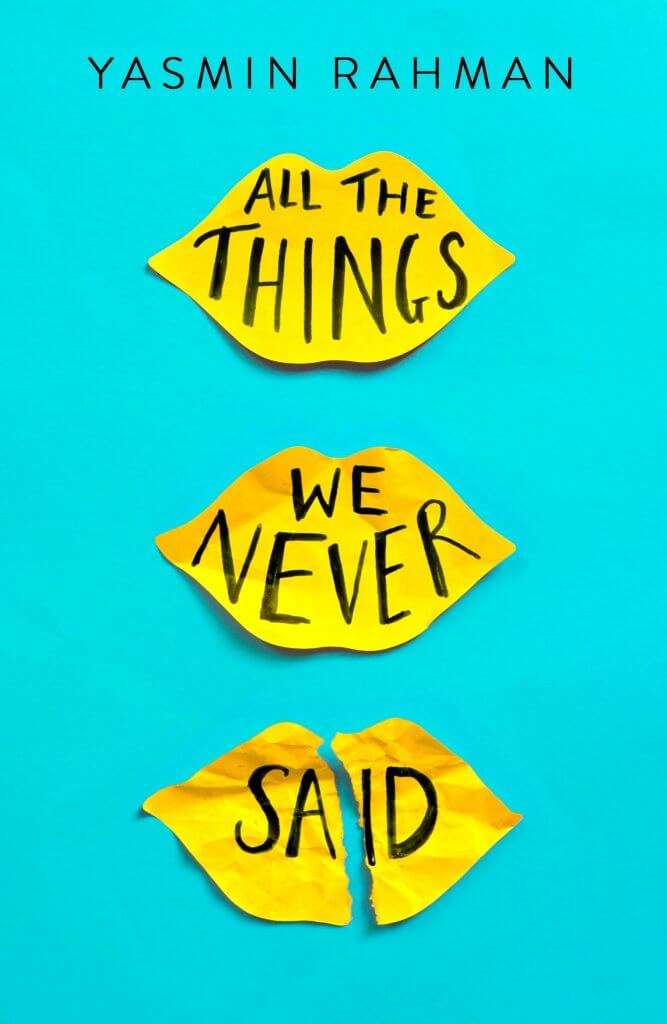
All the Things We Never Said

16-year-old Mehreen Miah’s anxiety and depression, or ‘Chaos’, as she calls it, has taken over her life, to the point where she can’t bear it any more. So she joins MementoMori, a website that matches people with partners and allocates them a date and method of death, ‘the pact’. Mehreen is paired with Cara Saunders and Olivia Castleton, two strangers dealing with their own serious issues.
As they secretly meet over the coming days, Mehreen develops a strong bond with Cara and Olivia, the only people who seem to understand what she’s going through. But ironically, the thing that brought them together to commit suicide has also created a mutually supportive friendship that makes them realise that, with the right help, life is worth living. It’s not long before all three want out of the pact. But in a terrifying twist of fate, the website won’t let them stop, and an increasingly sinister game begins, with MementoMori playing the girls off against each other.
A pact is a pact, after all.
In this powerful debut written in three points of view, Yasmin Rahman has created a moving, poignant novel celebrating life. ALL THE THINGS WE NEVER SAID is about friendship, strength and survival.

Hot Key Books

I read this book in one big gulp all the way back in April when the proof was sent to me, and it has stayed with me because of the strength of the voices, the originality of the plot, and the honesty of the writing. One of my favourite things about it is that one of the three protagonists is a devout Muslim that isn’t doubting her faith, and in fact her depression and anxiety just is, for no “reason” (not abused, not grieving, no family drama), it just exists. The other two have more obvious issues, but again their POVs are so nuanced and not simply “I’m sad because of what happened to me”.

It treads some very dark ground, definitely for a YA+ audience, but (slight spoiler) it is ultimately hopeful. Helpful resources for support regarding the issues included are listed in the back of the book.

I was fortunate enough to have the opportunity to ask Yasmin some questions…

Hi Yasmin, welcome to TeenLibrarian and thank you for giving up your time to undergo the third degree!

Thank you so much for having me!

Your debut published work was a short story in the Stripes ‘A Change is Gonna Come’ anthology, had you already started writing ‘All the Things We Never Said’ at that point, or was it still just a simmering idea?

‘Fortune Favours the Bold’, my short story in ‘A Change is Gonna Come’ was actually a ridiculously early version of what eventually became ‘All The Things We Never Said’. I was trying to write a book about mental health with a Muslim protagonist, but was finding my way into HOW to tell the story at the time. I’d written about 5000 words of this original idea when I realised it wasn’t working and moved on. When I saw the call out for Changebook, I realised that beginning fit so well that I just turned it into a short story.

What has been the best thing so far about being published?

There have been so so many amazing things that have happened during this journey – from seeing an 8ft poster of my cover at London Book Fair to being able to record the author note for the audiobook. The best thing for me though is how it’s touching readers, particularly teenagers. I’ve had some lovely reviews where people have connected with my characters so much and that’s always lovely. I remember this one encounter I had with two young Muslim girls who said to me “you’re an inspiration”…and then I burst into tears of course. When I was a teen, there weren’t many people who were so visibly Muslim writing books, or on TV or whatever, so to be able to provide that to young people in a tiny way now is truly the best thing.

You’ve been so honest, in the publicity for the book, about your own mental health in your teen years. How has that been?

It was something I was really scared of at the beginning, baring myself to strangers. But it seems to be somehow a lot easier to talk about it to strangers than people you know! I think being open about it is important to me personally as it echoes the mentality of the book. Also, the fact that so many people can relate makes it a lot more manageable. It wasn’t too long ago that I felt scared of telling people “I struggle with anxiety and depression”, but now I feel less wary of talking about it as I’ve met so many people who have had the same or similar experiences, and if me talking about it openly can maybe help someone else understand their own mental health, then I feel it’s completely worth it.

Of the three girls, which story was hardest to write?

I had trouble at some point or another with each girl, but I think Olivia and Mehreen nudged ahead of Cara in terms of difficulty. I was drawing on a lot of my own emotions when writing Mehreen, which is always tough, and Olivia’s story just had some really really hard scenes to write. Her voice also took a long time to figure out.

Have you talked to many teenagers about the book? What kind of reaction have you had?

I haven’t yet had many readers of the book, since it’s not officially out as I’m writing this, but the brief conversations I’ve had with teens where I’ve spoken about it in vague terms have been very positive! I spoke to a few teenagers when doing research for the book, and received such lovely feedback about how exciting the story sounded, and what an important topic it was – I got very emotional!

What kind of event would you like to do if invited into schools?

There’s so many things covered in the book that would be great for discussion with students – mental health and the benefits of talking about it/seeking help, internet danger, grief, etc. But I think what I’d personally love to do is to talk about craft. When I was young I could never imagine that being an author was attainable, so would love to let teenagers know that it’s a viable career! Having studied two Masters degrees on Creative Writing, it would be great to be able to put those skills into a workshop format and teach students how to go about writing a novel.

What are you reading at the moment and who would you recommend it to?

I am in such a reading slump! And have been for a REALLY long time! The last thing I remember reading was an extract of Sarah Juckes’ WIP. Sarah wrote the YA novel ‘Outside’ which was published by Penguin in January 2019, and I just know her next book is going to be just as amazing. We have very similar brains, and a love for dark YA, so I think anyone who enjoys All The Things We Never Said would probably like her writing!

Any hints of what we can expect from you next?

I don’t want to mention anything specific about book 2, because anything can change at this point! But one thing I’m sure about is that there will be a Muslim protagonist – that’s something I’d like to carry on in everything I write.

Yasmin Rahman, author of All the Things We Never Said

All the Things We Never Said is OUT NOW! Thanks to Hot Key Books for sending me a proof copy all those months ago.

The Starlight Watchmaker

I feel like I should have a tag just for Barrington Stoke reviews, because they are some of my very favourite books. The Starlight Watchmaker by Lauren James is no exception (so huge thanks for sending me a proof)!

Wealthy students from across the galaxy come to learn at the prestigious academy where Hugo toils as a watchmaker. But he is one of the lucky ones. Many androids like him are jobless and homeless. Someone like Dorian could never understand their struggle – or so Hugo thinks when the pompous duke comes banging at his door. But when Dorian’s broken time-travel watch leads them to discover a sinister scheme, the pair must reconcile their differences if they are to find the culprit in time. A wildly imaginative sci-fi adventure from YA star Lauren James, particularly suitable for struggling, reluctant or dyslexic readers aged 13+

I love sci-fi that makes you think without taking itself too seriously, and this fit the bill perfectly. The characters and their backgrounds are so imaginative and well rounded considering the length of the book, fitting such world building into such a short novella takes real craft! I was very excited to be given the opportunity to ask Lauren some questions, about the book and more…

Hi Lauren, welcome to Teen Librarian!

This is your first book for Barrington Stoke, was writing a novella a very different process to writing a longer novel?

It was a lot faster and more fun, and it gave me the freedom to experiment in ways I wouldn’t for a full-length novel.

Was it a longer editing process to fit the “readability” criteria of a Barrington Stoke book?

It was the most intensive editing process I’ve ever undertaken. There are usually several rounds of edits for a book – the first focussing on wide-ranging plot points, then focussing in scene-by-scene, then line to line, then finally looking at each word. With a readable novella, that process is then continued again for several more rounds of edits that make sure that every single word fits with the words around it, that everything is explained, and that the words only have one possible interpretation. They work to make sure that sentence structure is chronological and easy to understand, there are plenty of dialogue markers to make the speaker obvious, and there isn’t any complicated formatting. It was like watching masters at work.

My favourite character was Ada, how did you get the idea for (basically) a living volcano?

I really love Calcifer in Howl’s Moving Castle, who is a fire demon/burning ember. He expresses emotions through burning fire, which I always thought was excellent. I wanted to do something similar.

Might you revisit the characters in another story?

Yes! I want to write a sequel set on Dorian’s underwater planet – I have a plot already planned out, so fingers crossed I get chance to write it! Hugo and Dorian’s relationship still has a lot more story to tell.

What books/films/TV shows are your main source of inspiration?

I wanted to write a more readable story that still uses all of my favourite sci-fi elements – there are hints of Binti, Jeeves & Wooster, Starfleet Academy from Star Trek, Saga, Howl’s Moving Castle and The Watchmaker of Filigree Street.

This novella is designed to be a jumping-off point to help readers explore the whole canon of sci-fi, hopefully while feeling like there might be a place for them in the genre, after all.

If you go into schools, do you prefer writing workshops or author talks?

Great question! I love both, but I think workshops are a lot more fun because I can talk to individual students rather than speaking to a whole hall. Plus, students always have such great writing imaginations. They come up with ideas that I would never dream up.

What are you currently reading and who would you recommend it to?

Daisy Jones & The Six by Taylor Jenkins Reid – A fictional take on a spoke history of a seventies rock band feud. A great look at unreliable narrators and biased storytelling.

The True Queen by Zen Cho – This series is a Malaysian take on Regency romances, with magic and dragons and fairies. So wonderfully unique.

What are you working on now?

My next book hasn’t been announced yet, but I can tell you it’s about ghosts and murder and university life.

Lauren James (photo credit Pete Bedwell)

Lauren James is the author of Young Adult science fiction, including The Quiet at the End of the World, The Loneliest Girl in the Universe, The Starlight Watchmaker and The Next Together series. She teaches creative writing for the University of Cambridge, Coventry University and Writing West Midlands, and has written articles for numerous publications, including the Guardian, Buzzfeed, The Toast, and the Children’s Writers and Artist’s Yearbook. You can find her on Twitter at @Lauren_E_James or her website http://www.laurenejames.co.uk, where you can subscribe to her newsletter to be kept up to date with her new releases and receive bonus content.

The Starlight Watchmaker is published in July!

Quill Soup

Noko, the porcupine, is very hungry. On arriving at a village, he asks the other animals for some food and shelter. But, despite their full bellies, all the animals say they have nothing to spare. Never mind: he’ll just have to make do and cook a pot of soup from the quills off his back – a soup so tasty even the king likes it. Once the villagers hear of his plan they offer just enough ingredients to make a soup worthy of them all…
This African version of Stone Soup celebrates generosity and kindness – and the message that we can all benefit if we share our resources. It’s part of our One Story, Many Voices series, which explores well-known tales told from different cultural perspectives.

Tiny Owl blurb
Quill Soup, written by Alan Durant and illustrated by Dale Blankenaar

I’m sure many readers of this blog are aware of the tale Stone Soup, and there will be well thumbed versions of it in most libraries. This is an African version, with the same message : that we can all benefit if we share resources, and an exhortation to open our arms to strangers (something that desperately needs encouraging in these times).

Quill Soup was retold by British author Alan Durant and illustrated by Dale Blankenaar, a full time illustrator from South Africa. The illustrations are wonderfully detailed, there is so much going on in each spread while the animals (such a range of animals) try to put off the newcomer, the colours are bold and captivating, and the text is great to read aloud.

Tiny Owl are a new(ish), small independent publisher of books for children with one aim: to promote under-represented voices and cultures in beautiful picture books. Quill Soup is part of a series they have called One Story, Many Voices, exploring “well-known stories told from different cultural perspectives from all over the world, pairing authors and illustrators from different countries and different backgrounds.”. Also already published, and also wonderful and different, are Cinderella of the Nile and The Phoenix of Persia.

Thankyou Tiny Owl for sending me a copy of Quill Soup to review, it is available to buy now!

Comic Scene

Tony from Comic Scene kindly sent me copies of the first six months of this new magazine to have a look at, and I asked if he’d like to do an introductory post for the blog. Not only has he written a blurb about the fascinating range of articles, as well as reviews and original comic strips, he has also very generously included a special offer and prize draw for librarians who would like to encourage wider reading of comics and graphic novels, see below!

ComicScene Magazine is a new magazine which guides librarians, adults and children to what classic and contemporary comics to try, and what graphic novels from U.K., US and European publishers people should be reading.  It also introduces you to the exciting and eclectic work of independent and small press comics.  For those who love superhero movies and TV shows they go back to the original comic source of the films and TV.  Many of the original comics inspiring films, such as the Avengers, are over 30 to 40 years old, so a rich source of material to explore.  Did you also know publishers like Rebellion are publishing new Roy of the Rovers comics and bringing back girls comics like Tammy, Jinty & Misty? Comic Fans love the magazine – but the main aim of the title is to help those parents/carers who casually read boys and girls comics when they were younger to revist old friends or recommend comics to their children and grandchildren.   From the current issue they have also introduced some of the best comic strips being produced today with plans for a dedicated pull out comic section for adults to give to their children to encourage reading and improve literacy.  It’s the only monthly magazine dedicated to comics and comic culture being published today in the U.K. and Ireland and we’d recommend it as your guide. The magazine is available to buy in selected WHSmiths, McColls and Easons in Ireland, and it can be ordered in any newsagent or comic shop.  Just pop your postcode into the shop finder to check what local stores stock the magazine. Libraries can also subscribe monthly to the magazine or subscribe in print or digital from £2.50 a copy digital or £5.50 in print (with free digital copy).

On the ComicScene shop they have just added the first six months of the magazine in a £30 pack and if a library purchases a pack and/or subscribes before the end of July they will be put in a draw to get their subscription back for the year PLUS £100 of free Graphic Novels (email comicsceneuk@gmail.com when you have made your order).

With sales of graphic novels for children on the rise and University courses now available to study producing comics and comic history who knows – you could be inspiring the next comic writer or artist by introducing the magazine to your library!

gal-dem manifesto

This is the manifesto that the gal-dem contributors created when putting together their powerful book of essays “I will not be erased”, a collection of stories based on diaries and letters from their teen years, full of understanding and advice they wish they could share with their younger selves. Rules to live your life by!

I shared “I will not be erased” on the blog last week, after being sent a review copy

The Third Degree with Louie Stowell

Brilliant illustrations by Davide Ortu, including this fab cover!
Matt pipped me to the post and wrote this glowing review of The Dragon in the Library a couple of weeks ago! But I got to ask Louie some questions…

Hi Louie, welcome to TeenLibrarian and thank you for giving up your time to undergo the third degree!

You’ve written/worked on a lot of non-fiction, have you had a story bubbling up for a long time or did it come to you suddenly?

This particular story came very suddenly, but I’ve been writing fiction in the background for a long time. My first novel (in a drawer) was about a half-vampire, half-fairy who gave you a wish in return for blood.

A lot of research is needed for both types of writing, but was it a very different approach? Do you prefer one over the other?

I never see it as stories OR non-fiction. It’s both. Facts are magic too. I still work on non-fiction at work so it’s great to keep doing that. Fiction obviously gives you more scope to take things in any direction you want, unconstrained by reality, although writing stories that feel real is very important to me. I love fantasy that happens in the midst of everyday life, just out of sight.

This is quite a love letter to libraries & library staff, why are they so important to you?

As a child, going to the library was a ritual – and having an (apparently) infinite supply of books was incredible. The thing I remember most is the book smell. It smelled like possibility. As an adult, I want new generations to have that sense of infinity.

What made you decide to make the main character a reluctant reader instead of a bookish child?

I felt like I’d read a lot of books where the main character was into books, but a lot of children I meet in real life aren’t so… I suppose I wanted to give them a go in the driving seat. Also, because it’s fun to put characters in uncomfortable positions, so the idea of forcing an unbookish person to do something that requires lots of reading felt enjoyably mean. [C: I really enjoyed listening to Louie explain this to a room of book lovers at the YLG London AGM, but she didn’t need to worry, we love the challenge of reluctant readers!]

Who is your favourite Dragon in fiction?

Smaug. It’s always Smaug. What a class act.

Have you done any school visits? If so, what’s the best bit?

I’ve done loads of non-fiction ones but I’ve just started doing ones for the Dragon in the Library and what I’m really enjoying is the suspension of reality – creating a fictional world in the real world, and pretending that magic is 100% real. (Or am I pretending…?)

What are you reading at the moment and who would you recommend it to?

I’m currently reading A Pocketful of Stars by Aisha Bushby. I was lucky enough to get an early copy and it is beautiful and magical. One for anyone who’s in touch with their emotional side… but also people like me who aren’t at all, but books like this help me learn more about how feelings work.

What’s next for Kit & co.?

I’m trying to work out how to say this in unspoilery terms… their next adventure involves a journey and a new wizard… and a new monster. 

Huge thanks to Louie for answering my questions on top of her actual blog tour, and to Nosy Crow for sending me (and Matt all the way in America!) proofs, and to both Louie and Nosy Crow for the brilliant talk and signed books at the YLG London 2019 AGM last week! I loved what Louie said about the importance of just having books around (in lots of formats) and you might just “slip into one”, quite literally in this story.

The Dragon in the Library is out now!