Drawing on and expanding their long-running column for Books for Keeps, Dr Darren Chetty and Professor Karen Sands O’Connor trace how Black and racially minoritised characters have been represented in ‘the secret garden’ of British children’s literature from its earliest stages. Examining how children’s literature has both been shaped by, and shaped, prevailing attitudes towards people of colour, they take a thematic approach that offers teachers and parents contextual knowledge that will enrich how books are discussed with children.
English Media Centre

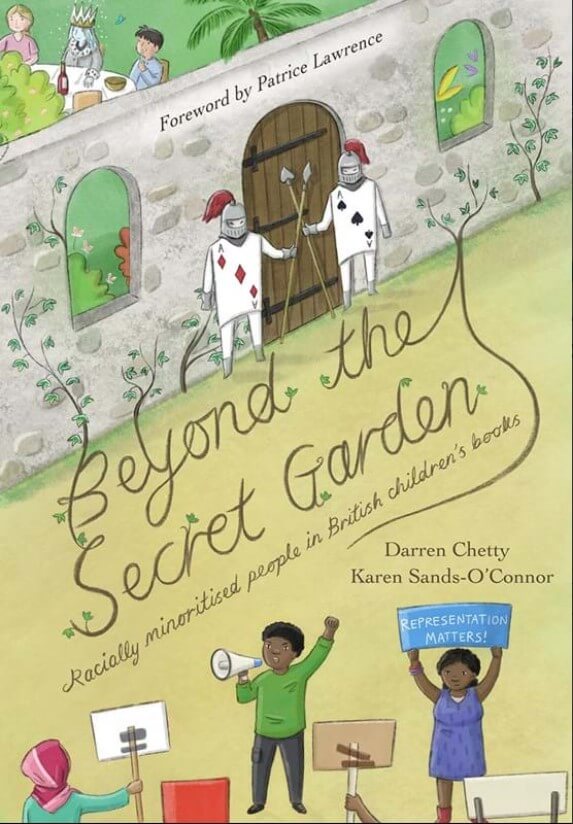
Beyond the Secret Garden has long been my favourite article in the (entirely brilliant) Books for Keeps virtual magazine, exploring the representation of Black and racially minoritised characters in British children’s literature, so when Darren and Karen were supported to expand that into a book by the English Media Centre I was thrilled. It is essential reading for anyone involved in children’s books in any capacity. I’ve heard Darren speak a number of times about the importance not only of representation, but of *positive* representation, in the books children consume. The duo have written us a piece about how teens specifically are engaged.
Teen Readers and YA Books Beyond the Secret Garden
When we conceived of our column, Beyond the Secret Garden, we were mostly thinking about British children’s books and the way that they created a safe haven—adventure without risk, and with a nice hot something waiting to eat or drink at the end of it—but only for certain readers and certain characters. White British characters in books like Frances Hodgson Burnett’s The Secret Garden (1911) or C. S. Lewis in the Narnia chronicles get to have the adventure, while Mary Lennox’s servants are ‘not people’ and the Pevensie children fight the dark-skinned Calormenes in The Last Battle (1956). But children’s books traditionally follow a home-away-home pattern, so their main characters are always going to have the keys to the secret garden, and people who are not like them are barred out. Teenagers, on the other hand, more typically are on a quest away from home, away from safety. They are, in some sense, leaving the secret gardens behind to find new continents and new worlds, or new ways to be themselves. So, does that make YA literature inherently beyond the secret garden already?
Historically, the answer is no. Before YA literature had a label, books for teen boys and teen girls published in Britain had very separate functions. Books for teen boys, written by the likes of G.A. Henty or Captain Marryat for example, were about conquering and maintaining the Empire, which often involved recreating Britain in far off locations such as India and an often generic version of Africa. Books for teen girls, such as Julia Horatio Ewing’s Six to Sixteen, were about becoming good future wives and mothers when the adventuring boys returned home. But Henty’s heroes, like the Pevensie children, had ‘savages’ to tame and Margery in Six to Sixteen (1872) exchanges an Ayah’s education for the freedom of the Yorkshire countryside—much as Mary Lennox would do a few decades later. Black and Brown ‘savages’ and servants alike disappear from the narratives the closer the teenaged British character comes to achieving their proper adult role.
Many modern British YA novels begin with the secret garden of childhood already destroyed. Clare Furniss’s The Things We Leave Behind (2024) opens with a picture of the main character, Clem’s, last perfect day, a birthday picnic with nostalgic childhood food and best friends she’d known most of her life. Yet despite the perfection, cracks are already appearing—Britain (minus Scotland which has seceded) is run by an authoritarian leader who wants to expel or imprison all foreigners and refugees. This includes Clem’s stepmother, Claudia, who is Jamaican by birth and who is forcibly removed from their home and detained. Following a mass protest in London, Clem and her younger half-sister Billie (Claudia’s and Clem’s father’s daughter) are separated from their father, and ultimately must escape from London to Edinburgh in order to survive. Clem’s thoughts are constantly on her stepsister, but Billie remains carefree throughout. The ending of the book contains a reunion, but it is a broken reunion, and the perfection of the picnic birthday is gone forever, as is any semblance of childhood innocence.
Like Clem, Patrice Lawrence’s character Charlene in Needle (2022) is concerned for her younger half-sister Candy. However, unlike Clem, Charlene is Black British, living in present-day Britain rather than a dystopia, and the concern she has for Candy is portrayed differently from the concern Clem has for Billie. Clem’s sense of responsibility for her sister leads to a mental breakdown, which is treated by the adults around her with kindness and compassion. Charlene, on the other hand, is constantly under surveillance and is always presumed to be leading her sister astray rather than looking out for her. Charlene does not become mentally ill over her concern for her sister, she becomes angry, and this anger leads to her eventual arrest and a journey through the juvenile justice system. She, unlike Clem, is not granted a reunion, even a broken one, because she remains angry at those who would separate her from her half-sister, including a foster brother who, despite inciting Charlene’s anger, is free to carry on at university without punishment. While both books examine teenage experiences outside of the secret garden of childhood, only Clem is allowed to keep sacrosanct the idea of innocent childhood that the secret garden protects, at least in her memories. Black youths like Charlene, and even Billie, do not get to remain safe in Britain’s secret garden; instead, their well-being is viewed by society as less important than that of the white youths who retain innocence – this is seen starkly in real-life cases of ‘adultification’ where Black children are treated as adults by authority figures.. While all young adult characters may be outside the secret garden, their access to it was never equal to begin with.


Professor Karen Sands O’Connor is Visiting Professor at the University of Sheffield and a former British Academy Global Professor specialising in the history of Black, Asian and Minority Ethnic children’s literature and publishing, and the author of three books on children’s literature. Dr Darren Chetty taught in primary schools for over twenty years. His essay in the best-selling The Good Immigrant has been used in schools, and universities and shared widely in children’s and young adult publishing. In addition to their Books for Keeps column, Darren and Karen advise on CLPE’s Reflecting Realities research and contributed to the CILIP Carnegie Awards Diversity Review.

